Year: 2019

24 Jul 2019

Peer-to-peer parking marketplace Rover tests monthly subscriptions

In today’s instalment of ‘the future is 100% subscription-based,’ Toronto-based startup Rover is testing out subscriptions for its parking marketplace. Rover lets users list their unused parking spots for on-demand rental by others on the service, giving them a passive way to earn some income while hopefully increasing the utilization rate of parking spaces at the same time.

Rover has offered the spots on their platform on a per use, on-demand basis before now, but it’s going to pilot a monthly subscription starting this summer, with a planned test phase extending into early fall. The company says it’s going to try out a few different versions of a monthly sub, including potential perks like a percentage discount vs. individual on-demand parking charges, advanced booking and premium customer service.

Pricing should be in the ballpark of between $5 and $15 Canadian depending on the features you’re willing to pay for, and this should inform eventual subscription price points for the startup’s services should they move beyond this pilot phase. Rover currently offers spots in Toronto, Montreal and Ottawa, with plans to expand to Canada’s west coast and then eventually California in future.

Uber recently debuted a subscription pilot that rolls in its ride-hailing, Eats, bikes and scooter rental services, and Rover cites this move as an example of the move to subscriptions generally in the on-demand space in its own announcement. Subscriptions are a great way for consumers to easily take car of known recurring costs, but the rise of this business model across a range of industries will definitely test the limits of consumer willingness to trade cost for convenience.

24 Jul 2019

Dataplor raises $2M to digitize small businesses in Latin America

There’s a gap forming in Latin America between the growing digital food delivery market and the number of businesses in the region that are actually online. 

Food delivery startups continue to replicate and expand throughout the region, and VCs are channeling mega rounds into them with the hope of capitalizing on consumer online buying trends within growing digital populations.

VCs from all over the world have collectively invested billions into food delivery in the Latin American region. One of the largest rounds to date in Latin American startup history is Movile’s $400 million raise for Brazilian delivery business iFood. SoftBank recently confirmed a $1 billion investment into Colombia’s Rappi in March. 

As big checks, new business models and consolidation mold a new on-demand landscape in Latin America, smaller players are coming in to supplement existing marketplaces like Rappi and iFood.

Dataplor founder and CEO Geoffrey Michener saw an opportunity to bring more vendors online. That’s why he invented Dataplor, a platform that indexes micro businesses in emerging markets. Now, Dataplor has raised a third round of seed capital, bringing the company’s total raised to $2 million. Quest Venture Partners led the company’s most recent funding, along with participation from ffVC, Magma Partners, Sidekick Fund, and the Blue Startups accelerator. 

What does Dataplor actually do? The 13-person company created platform that recruits, trains, and manages what has grown to more than 100,000 independent contractors – or what Dataplor calls Explorers.

Explorers are tasked with feet-on-the-street visits to businesses to capture information like latitude and longitude points, photos, hours of operation, owners names and contact info, and whether or not a business accepts credit cards. Dataplor then licenses that data to companies like American Express, iZettle and PayPal. Dataplor also works within a joint partnership to digitize Mexico with Google and Virket. 

GettyImages 1091916996

Michener says that 20% of Mexican businesses don’t have any digital footprint, and less than 5% of businesses have a website. This impacts the reach of what Google can index, as well as where companies like iFood subsidiaries or Rappi can deliver from.

Dataplor, founded in 2016, says it’s responsible for getting 150,000 businesses onto Google in its three years of operation. Michener says Dataplor pays Explorers above-market wages, and is careful about “not using the Uber model to drive down the cost of paying contractors.”

Michener likes to think of his business model as a trifecta of helping small businesses get onto Google for free, creating part time opportunities for a growing workforce in LatAm, and using its tech to help Google and Uber become better populated with accurate info in geos that might be more difficult for a foreign company to access.

Take Mexico for example. Michener says that 20% of Mexican businesses don’t have any digital footprint, and less than 5% of businesses have a website. This impacts the reach of what Google can index, as well as where companies like iFood or Rappi can deliver from. Basically, offline businesses are missing out on new digital distribution opportunities and therefore, big cash.

In the United States and Europe, companies like Google and Uber scrape data from online directories in order to power their platforms. But this process works differently in Latin America. A small business’ chance of showing up in Google’s index is a lot slimmer, because most businesses are still offline in growing economies. Dataplor first launched in Mexico and bootstrapped its way into Brazil – an aggressive move for a young company due to Brazil’s competitive startup scene and Spanish-Portuguese language barriers. Dataplor says it will expand to Chile, Peru, and Colombia in 2019.

Michener tested the minimum viable product by literally going on Craigslist Mexico City and sending willing people money over PayPal to go out and gather data about small businesses. Turns out there was some traction.

What happens when all the businesses in Latin America are online? Dataplor plans to make money by licensing its data, but there’s another component to the equation. Dataplor is building a relationship with these businesses. Google will pay to know when a menu changes, hours of operation shift or a restaurant goes out of business. 

Dataplor’s tech stack could pique interest for any company that wants a hand in the digitization of growing markets. Now that they’ve built a playbook for Explorer logistics, that operational piece of their business may be interesting to companies like Google, Apple and Uber too.




24 Jul 2019

Daily Crunch: Facebook will pay $5B fine

The Daily Crunch is TechCrunch’s roundup of our biggest and most important stories. If you’d like to get this delivered to your inbox every day at around 9am Pacific, you can subscribe here.

1. Facebook settles with FTC: $5 billion and new privacy guarantees

Although in line with what was reported before the official announcement, the FTC notes this is the largest fine for any company violating consumer privacy.

In addition to the payment, Facebook has agreed to new oversight, with a board committee on privacy covering WhatsApp and Instagram, as well as Facebook itself.

2. Netflix launches Rs 199 ($2.80) mobile-only monthly plan in India

Netflix has a new plan to win users in India: make the entry point to its service incredibly cheap. The new tier restricts the usage to one mobile device, with standard definition viewing.

3. DOJ announces investigation into big tech

More regulatory fun! In a statement, the DOJ said that it will consider “widespread concerns that consumers, businesses, and entrepreneurs have expressed about search, social media and some retail services online.”

Camping site with a caravan and a four wheel drive parked under a tree by the Darling River in Australia.

4. Andreessen Horowitz values camping business Hipcamp at $127M

The San Francisco-based startup provides a “people-powered platform” that unlocks access to private land for camping, glamping or just a beautiful spot to park your RV.

5. Google intros Gallery Go offline photo editor

The new product joins a suite of Google apps created specifically for users in development markets, where solid online connections aren’t always a given.

6. Tile finds another $45M to expand its item-tracking devices and platform

Tile makes popular square-shaped tags to help people keep track of physical belongings like keys and bags. Recently, it’s been linking up with chipmakers to expand into wireless headsets and other electronics.

7. Digging into the Roblox growth strategy

After 15 years, the company has accumulated 90 million users and a new $150 million venture funding war chest. (Extra Crunch membership required.)

24 Jul 2019

DoorDash will change controversial tipping model

DoorDash CEO Tony Xu announced via Twitter that the company will be changing its model for compensating Dashers (a.k.a. DoorDash drivers and other delivery people).

The company faced criticism this year its payment policies. Under the current system, a Dasher’s payment consists of a $1 base from DoorDash, the customer’s tip and — when the first two items fall below the guaranteed minimum — an additional payment boost from DoorDash.

In other words, although DoorDash insists that Dashers get to keep 100% of their tips, it starts to look like those tips are being used to subsidize payments that would otherwise come from DoorDash. (Instacart has been criticized and sued for similar practices, leading to a CEO apology and policy changes.)

Xu has defended this approach in the past. For example, when the company announced raising a $400 million round shortly after the controversy broke, he said the system was tested “not in a quarter, not in a month, but tested for months” before being implemented in 2017.

However, the issue didn’t go away. Last month, DoorDash tried to address it — not by changing the system, but by offering more transparency.

In his recent tweets, Xu insisted that the company designed the system to “to prioritize transparency, consistency of earnings, and to ensure all customers get their food as fast as possible.” However, he acknowledged that DoorDash “didn’t strike the right balance.”

“We thought we were doing the right thing by making Dashers whole when a customer left no tip,” he said. “What we missed was that some customers who did tip would feel like their tip did not matter.”

So Xu said DoorDash will be changing that model. The company isn’t releasing all the details yet, but the key change is that “Dashers’ earnings will increase by the exact amount a customer tips on every order.”

24 Jul 2019

Revolut tweaks business accounts with new pricing structure

Fintech startup Revolut announced changes to its business accounts this week. The good news is that if you were thinking about trying Revolut for your business needs, it’s now cheaper to get started. But there are some limits.

While Revolut is better known for its regular consumer accounts that let you receive, send and spend money all around the world, the company has been offering launched business accounts for a couple of years.

The main advantage of Revolut for Business is that you can hold multiple currencies. If you work with clients or suppliers in other countries, you can exchange money and send it to your partners directly from Revolut’s interface.

The company also lets you issue prepaid corporate cards and track expenses. Revolut for Business also has an API so that you can automate payments and connect with third-party services, such as Xero, Slack and Zapier.

None of this is changing today. Revolut is mostly tweaking the pricing structure.

Previously, you had to pay £25 per month to access the service with a £100,000 topup limit per month. Bigger companies had to pay more to raise that ceiling.

Now, Revolut is moving a bit more toward a software-as-a-service approach. Instead of making you pay more to receive and hold more money, you pay more as your team gets bigger and you use Revolut for Business more intensively.

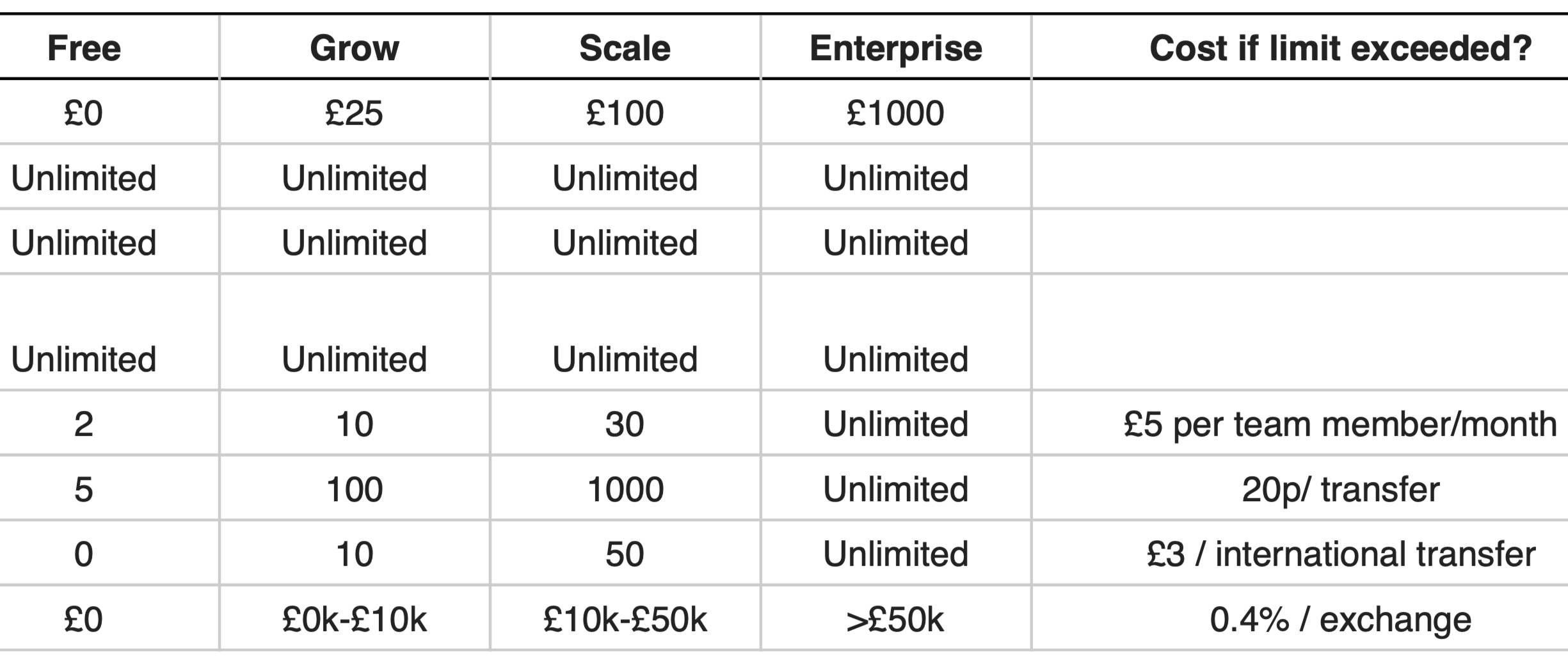
The basic plan is free with 2 team members, 5 free local transfers per month and 0.4% in foreign exchange fees. If you want to add more team members or initiate more transfers, you pay some small fees.

If you were paying £25 before, you can now top up as much money as you want in your Revolut account, but there are some limits when it comes to team members (10), local transfers (100 per month) and international transfers (10 per month, interbank exchange rate up to £10,000).

Once again, going over the limits doesn’t necessarily mean that you need to change to a new plan. You’ll pay £0.20 per extra local transfer, £3 per extra international transfer, etc.

Here’s a full breakdown of the new plans:

Screen Shot 2019 07 24 at 7.35.45 PM

If you’re a freelancer, there’s now a free plan. You’ll pay 0.4% on foreign exchange and £3 per international transfer, but there’s no topup limit anymore.

Similarly, the old £7 plan for freelancers has been replaced by a new £7 plan that removes the limit on inbound transfers but adds some limits on transfers.

It’s good news if you’re a small customer. But if you vastly exceed the transfer limit in one of the categories, you might pay more than before. With this change, the company wanted to make Revolut for Business more accessible instead of making small customers subsidize bigger customers with high entry pricing.

Existing customers can switch to a new plan starting today. And Revolut plans to switch everyone to the new plans on October 1st, 2019.

Revolut for Business 2

24 Jul 2019

Occipital’s Structure Sensor Mark II is a smaller and much improved 3D scanner for your iPad


Back in 2013, Occipital (a company then best known for making the RedLaser barcode scanning app) released the Structure Sensor, a device that turned any iPad you strapped it to into a portable 3D scanner.

Five years later, they’re back with the next one: Structure Sensor Mark II. It’s about half the size, but considerably more capable.

After releasing the original Structure Sensor, Occipital found that it was particularly popular in two different use cases: making 3d scans of people (like, say, scanning someone’s foot to make orthotics), and making 3d scans of rooms. Mark II’s specs and design have been tuned with these use cases in mind.

To improve accuracy when scanning a person, they’ve bumped up the resolution (from 640×480 on the original sensor to 1280×960 on Mark II), and increased the distance between the Structure’s cameras — thereby allowing it to capture finer details up close.

higher res

To help with room scanning, they’ve introduced a fish eye lens; this widens the Structure’s view, which should help it perform better in smaller rooms.

Scanning range has been increased from 4m to 10m, they’ve added built-in gyroscopes/accelerometers, moved from a rolling shutter to a global shutter, and a pair of new IR depth cameras let it scan outdoors (whereas v1 was stuck inside)

If you’ve been watching this space closely, you might remember that Occipital released a device called the Structure Core late last year. Whereas the original Structure is primarily meant to be strapped to an iPad (and is built with iOS compatibility in mind), the Structure Core was built to work with everything else — it’ll play friendly with Linux, MacOS, Windows, and Android, acting as the eyes for whatever project you might have in mind. Beyond the wider compatibility, the Structure Core also saw a pretty significant spec bump over the original Structure.

Occipital co-founder Jeff Powers tells me that Structure Mark II shares a lot of its guts with that recently released Structure Core. The main differences, I’m told, are that it uses a different connector (USB 2.0/Lightning versus USB 3.0 on Core), has a built-in battery (because they need more power than they can pull from the iPad, currently), and runs “significantly modified” firmware to make it play friendly with iOS.

Occipital tells me that Structure Sensor Mark II will sell for $399. They’re also planning to open up a trade-in program, allowing anyone who has the original Structure to turn it back in and get $100 off a Mark II.

24 Jul 2019

What lower Netflix pricing tells us about competing in India

At a conference in New Delhi early last year, Netflix CEO Reed Hastings was confronted with a question that his company has been asked many times over the years. Would he consider lowering the subscription cost in India?

It’s a tactic that most Silicon Valley companies have adapted to in the country over the years. Uber rides aren’t as costly in India as they are elsewhere. Spotify and Apple Music cost less than $2 per month to users in the country. YouTube Premium, LinkedIn Premium and many of Microsoft’s services, as well as subscriptions to U.S. news outlets such as WSJ and New York Times are also priced significantly lower compared to the prices they charge in their home turf.

Hastings had also come prepared: He acknowledged that the entertainment viewing industry in India is very different from other parts of the world. To be sure, much of the pay-TV in India is supported by ads and the access fee remains too low ($5). But that was not going to change how Netflix likes to roll, he said.

“We want to be sensitive to great stories and to fund those great stories by investing in local content,” he said. “So yes, our strategy is to build up the local content — and of course we have got the global content — and try to uplevel the industry,” he said, identifying movie-goers who spend about Rs 500 ($7.25) or more on tickets each month as Netflix’s potential customers.

GettyImages 992527026 1

Indian commuters walking below a poster of “Sacred Games”, an original show produced by Netflix (Image: INDRANIL MUKHERJEE/AFP/Getty Images)

Less than a year and a half later, Netflix has had a change of heart. The company today rolled out a lower-priced subscription plan in India, a first for the company. The monthly plan, which restricts usage of the service to mobile devices only, is priced at Rs 199 ($2.8) — a third of the least expensive plan in the U.S.

At a press conference in New Delhi today, Netflix executives said that the lower-priced subscription tier is aimed at expanding the reach of its service in the country. “We want to really broaden the audience for Netflix, want to make it more accessible, and we knew just how mobile-centric India has been,” said Ajay Arora, Director of Product Innovation at Netflix.

The move comes at a time when Netflix has raised its subscription prices in the U.S. by up to 18% and in the UK by up to 20%.

Netflix’s strategy shift in India illustrates a bigger challenge that Silicon Valley companies have been facing in the country for years. If you want to succeed in the country, either make most of your revenue from ads, or heavily subsidize your costs.

But whether finding users in India is a success is also debatable.

24 Jul 2019

Benchling’s software for managing biotech research nabs $34.5 million

In a field where the laboratory notebook is still considered the state of the art, it’s no wonder a company like Benchling, which provides software for managing life sciences research was able to nab $34.5 million.

Considering how much detailed technical work goes into the research that produces all of our great leaps forward in biotechnology, it’s a wonder that the practice wasn’t digitized sooner.

Financiers certainly see the benefit in Benchling’s technology — a new twist on what’s now a standard verticalized software as a service for a niche industry. Y Combinator Continuity, Thrive Capital, Benchmark Lead Edge Capital joined lead investor, Menlo Ventures in financing the company.

The company said it would use the money to grow internationally and develop new products and services.

“Life science R&D has become incredibly complex across molecules, processes, and data structures. And until Benchling, there had been no end to end purpose-built SaaS application to enhance, streamline, and drive collaboration across R&D processes,” said Matt Murphy, Partner at Menlo Ventures, in a statement. “Biologics are the future of life sciences and the faster that innovation gets to market, the more society benefits. Benchling‘s software replaces pen and paper workflows and becomes the system of record for a wide range of biotech and pharma R&D projects from medicine and cancer treatment to plant-based meat and sustainable materials.”

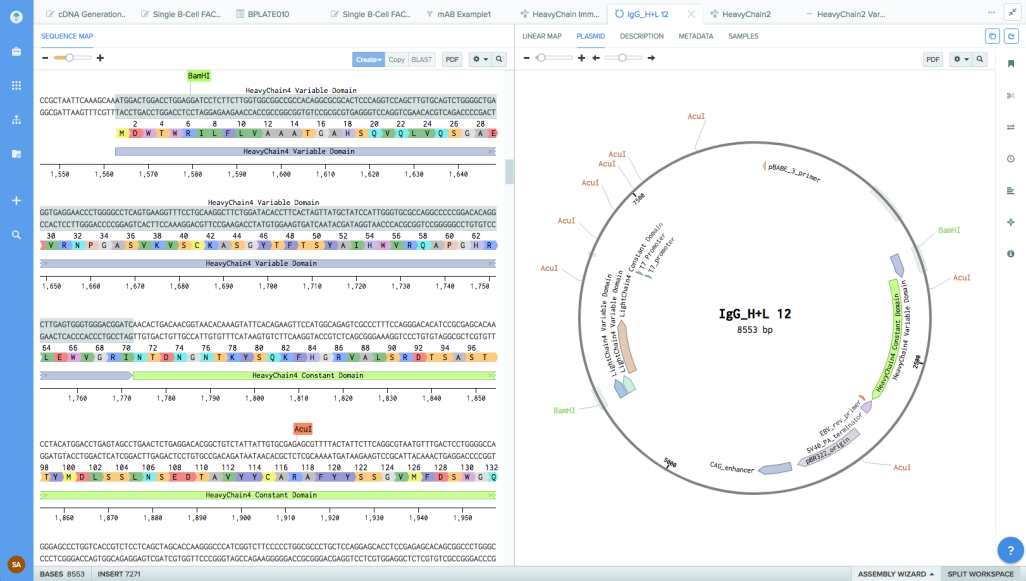
benchling screenshot Mol Bio

Screenshot of Benchling’s molecular modeling tool.

Benchling’s software is used by over 170,000 scientists around the world in academic labs at Harvard, Stanford, MIT, and Berkeley, according to the company. Its paying customers include Beam Therapeutics, Regneron Pharmaceuticals, Zoetis, and Zymergen .

Benchling started out with free software for researchers to replace notebooks with an electronic records management system and a digital model of molecules that could be collaboratively updated by a team of researchers.

Since those initial products the company added project management, cross-project visibility, and real-time views of development progress for business customers, according Menlo’s Murphy.

Benchling was created for today’s researchers who are working on cutting-edge science, allowing them to focus on achieving the next breakthrough outcomes,” said Sajith Wickramasekara, co-founder and CEO at Benchling, in a statement. “The next generation of scientists is already on Benchling and at the forefront of establishing the future of the life science and biotech industries. We’ll use this investment to support deeper engagements with large commercial customers and bring the power of the cloud to tackle the complexity of biotech.”

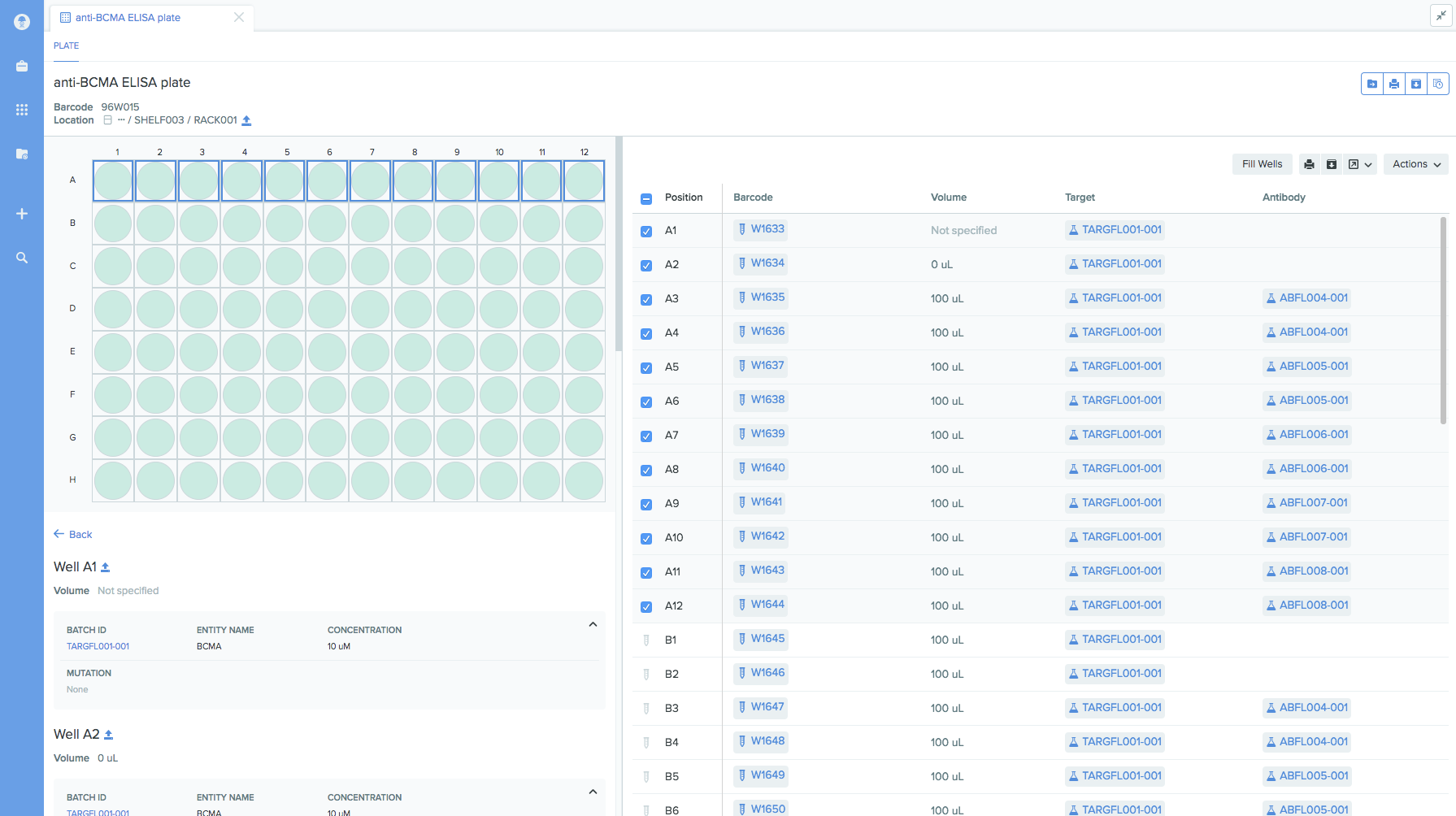
benchling screenshot Samples

Screenshot of Benchling’s batch management software


24 Jul 2019

Duo’s Wendy Nather to talk security at TC Sessions: Enterprise

When it comes to enterprise security, how do you move fast without breaking things?

Enter Duo’s Wendy Nather, who will join us at TC Sessions: Enterprise in San Francisco on September 5, where we will get the inside track on how to keep enterprise networks secure without slowing growth.

Nather is head of advisory CISOs at Duo Security, a Cisco company, and one of the most respected and trusted voices in the cybersecurity community as a regular speaker on a range of topics, from threat intelligence to risk analysis, incident response, data security and privacy issues.

Prior to her role at Duo, she was the research director at the Retail ISAC, and served as the research director of the Information Security Practice at independent analyst firm 451 Research.

She also led IT security for the EMEA region of the investment banking division of Swiss Bank Corporation — now UBS.

Nather also co-authored “The Cloud Security Rules,” and was listed as one of SC Magazine’s Women in IT Security “Power Players” in 2014.

We’re excited to have Nather discuss some of the challenges startups and enterprises face in security — threats from both inside and outside the firewall. Companies large and small face similar challenges, from keeping data in to keeping hackers out. How do companies navigate the litany of issues and threats without hampering growth?

Who else will we have onstage, you ask? Good question! We’ll be joined by some of the biggest names and the smartest and most prescient people in the industry, including Bill McDermott at SAP, Scott Farquhar at Atlassian, Julie Larson-Green at Qualtrics, Aaron Levie at Box and Andrew Ng at Landing AI and many, many more. See the whole agenda right here.

Early-bird tickets are on sale right now! For just $249 you can see Nather and these other awesome speakers live at TC Sessions: Enterprise. But hurry, early-bird sales end on August 9; after that, prices jump up by $100. Book here.

If you’re a student on a budget, don’t worry, we’ve got a super-reduced ticket for just $75 when you apply for a student ticket right here.

Enterprise-focused startups can bring the whole crew when you book a Startup Demo table for just $2,000. Each table gives you a primo location to be seen by attendees, investors and other sponsors, in addition to four tickets to enjoy the show. We only have a limited amount of demo tables and we will sell out. Book yours here.

24 Jul 2019

Hear Hans Vestberg talk about the 5G opportunity at Disrupt SF 2019

The promise of 5G is staggering. With its ultra-high bandwidth and low latency, it has the potential to alter how consumers interact with technology. However, questions remain around its deployment, use cases, and marketing.

We’re excited to have Verizon CEO Hans Vestberg sit down for a fireside chat at Disrupt SF to talk about the telecom’s 5G efforts. Vestberg took over Verizon on the eve of 5G.

Here’s the thing: Hans Vestberg is my boss. (Technically, he’s my boss’s boss’s boss’s boss.) TechCrunch is owned by Verizon, operating under the Verizon Media Group, yet we remain editorially independent. Verizon doesn’t tell us what to write or not to write. Likewise, nothing is off-limits for this interview.

Verizon and other telecoms began rolling out the next-generation network to their subscribers this year. And the company has announced plans to launch 5G in at least 30 U.S. cities by the end of this year even though there are limited hardware options and few marketable use cases.

How will consumers use 5G? When should startups begin building for 5G? How will Verizon educate consumers about real 5G versus fake 5G? We have questions, and we hope Vestberg has answers.

Vestberg became CEO of Verizon in August 2018, succeeding Lowell McAdam. Vestberg joined Verizon in 2017 as its CTO and VP of Network and Technology. Previously, he worked at Ericsson for 25 years, six of which he spent as CEO until he was ousted in 2016 following poor financial results.

Under McAdam, Verizon looked to media companies for additional channels for growth, notably acquiring Aol and Yahoo and merging the two into an ad-serving giant called Oath. Earlier this year Oath was renamed Verizon Media. Its future remains in question as rumors persist about Verizon wanting to spin out the division en masse or by dumping various brands like Huffpo or even TechCrunch.

Vestberg is joining Disrupt SF’s long list of speakers that includes other chief executives, such as Sebastian Thrun, Evan Spiegel, Rachel Haurwitz and many more. The three-day conference is shaping up to feature a fantastic speaker lineup covering all aspects of the startup world.

Tickets to the show, which runs October 2 to October 4 in SF, are available now.