Year: 2019

24 Jul 2019

Tinder’s new personal security feature can protect LGBTQ+ users in hostile nations

A new security feature rolling out on Tinder will help to protect LBGTQ+ users who travel to dozens of nations, which still criminalize same-sex acts or relationships.

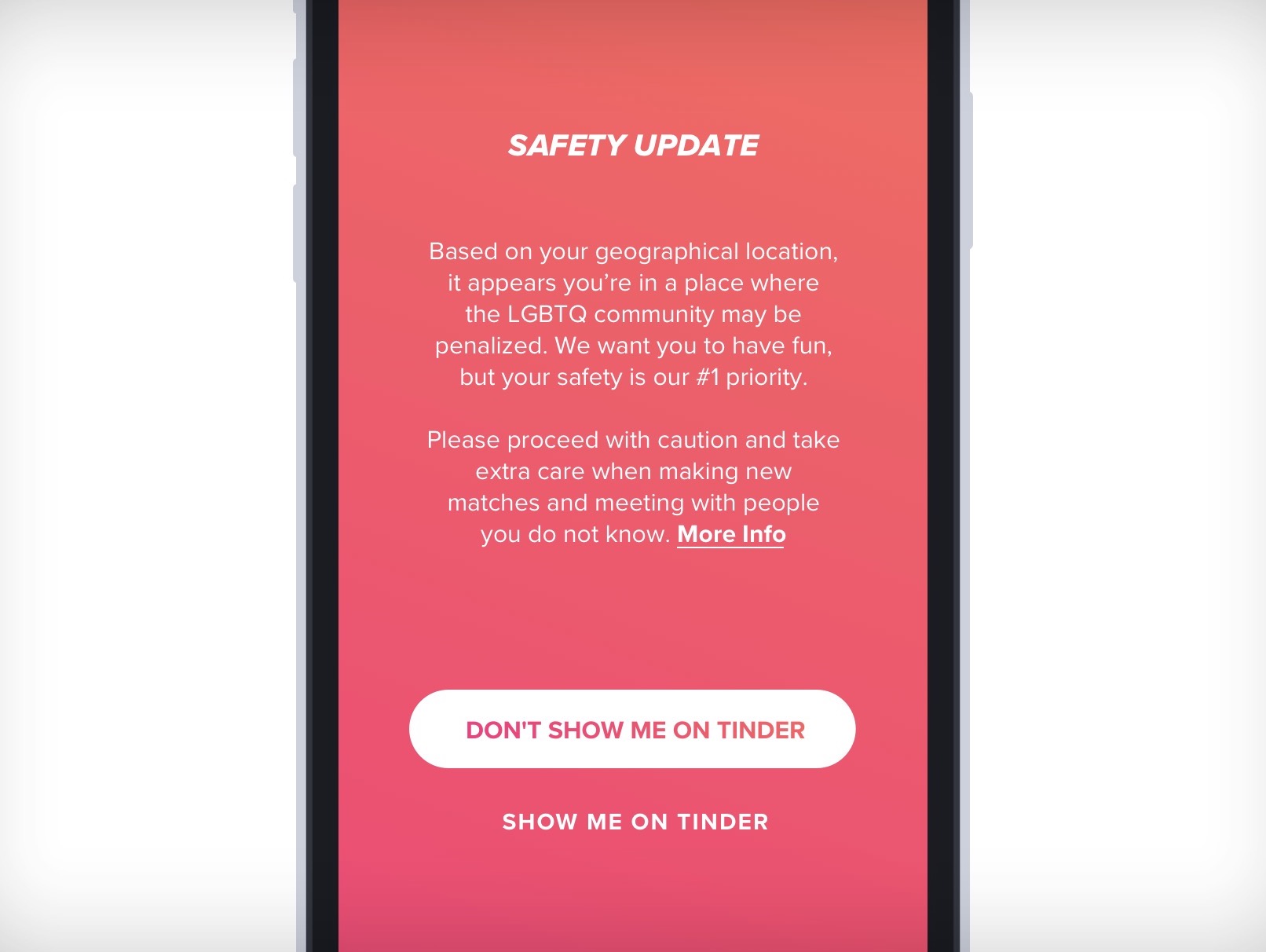
As part of the update, users who identify as lesbian, gay, bisexual, transgender or queer on the app will no longer automatically appear on Tinder when they arrive in an oppressive state. This feature, which Tinder dubs the Traveler Alert, relies on your phone’s network connection to determine its location. From there it will give users the choice to keep their location private. If users opt-in to make their profile public again, Tinder will hide their sexual orientation or gender identity from their profile to safeguard the information from law enforcement and others who may target them, the company said.

Once a user leaves the country or changes their location, their profile will become visible again.

“The purpose of this is to protect users who could be persecuted for their identity in these countries,” a spokesperson said.

The dating app maker, which has tens of millions of users in 190 countries, said the update will warn users when they travel to a country where same-sex relationships are punished under law help to keep “all its users safe.”

“It is unthinkable that, in 2019, there are still countries with legislation in place that deprives people of this basic right,” said Elie Seidman, Tinder’s chief executive.

Seidman said it was part of the company’s belief that “everyone should be able to love who they want to love.”

tinder alert

Tinder’s new Traveler Alert feature. (Image: supplied)

When traveling internationally, foreign nationals have to abide by the laws of their host country — no matter how different or abhorrent the rules may be. Although LGBTQ+ rights have come a long way in recent years in many Western countries, dozens of less-progressive countries consider same-sex acts or relationships illegal.

In March, the International Lesbian, Gay, Bisexual, Trans and Intersex Association (ILGA) found 69 countries considered same-sex acts illegal — the number of countries included in the Traveler Alert — sans Botswana, which recently decriminalized same-sex relationships.

Nine of the countries, including Iran, Sudan, and Saudi Arabia — a major U.S. ally in the Middle Easy — allow for prosecutors to pursue the death penalty against same-sex acts and relationships.

Despite a slow but promising push for equal rights, several countries have reversed course and doubled down on their laws, despite international condemnation. One such nation — Brunei, a small south Asian absolute monarchy — was forced to back down from its plans to sentence those who had gay sex to be stoned to death amid outcry from several major companies and celebrities who threatened to boycott the country.

ILGA’s executive director André du Plessis praised Tinder’s effort to warn its users.

“We work hard to change practices, laws and attitudes that put LGBTQ people at risk — including the use of dating apps to target our community — but in the meantime, the safety of our communities also depends on supporting their digital safety,” he said.

Read more:

24 Jul 2019

Why do media companies struggle to produce anything of value?

It’s the absolute best economy the United States has seen in decades, and yet, you wouldn’t know it from looking at the employee rolls at major news and media outlets. Thousands of journalists have lost their jobs this year through restructurings and layoffs while cities like Youngstown, Ohio have lost their one and only daily local newspaper.

That’s led to much hand-wringing: can media be saved? And even more specifically, can media companies ever build the kinds of scalable product businesses that we’ve seen in the software world? In short, why does media struggle to create value?

One trigger for this conversation was Maxwell Strachan’s in-depth HuffPost retrospective analysis of the rise and demise of Mic, which had garnered tens of millions of venture capital in its heyday before fire-selling to Bustle Digital Group. That piece led venture capitalist and former media company founder Om Malik to opine with a great post yesterday assigning blame for the (many) plights facing the media industry squarely on the shoulders of, let’s just call them dumb media executives:

When you have sales guys (they are mostly guys) in charge, decisions will reflect their usual approach, which is to maximize their personal gains as quickly as possible, cash in their bonus checks, and then move on to another outfit desperate enough to let them do it all again. This won’t work in an industry in need of the focus, foresight, and boldness that brings about transformational change. Sadly, the media establishment’s attitude appears to track more with our politicians’ thinking on climate change. They tell themselves, “I’ll be dead before the bad stuff happens.”

Malik’s answer is direct but only partially correct. Yes, media executives share plenty of the blame for what’s happened to the industry the past two decades. But part of the reason they failed to produce value is that they believed in this widespread notion that software “product” and media “product” are somehow similar and can borrow each others’ mental models and frameworks.

It’s just not true though, and the alchemical fusion of digital and media into our modern “digital media” hellscape is still predicated on a fundamental mistake: that somehow media can be made to look like software, and all we need is “foresight” and “innovation” to bridge the divide.

Let’s start with just the pure economics of these businesses. Venture capitalists and founders love software businesses because there is both leveraged scale and high rates of return on effort. Once you write code, you can deploy it today at global scale to as many customers as you want. It’s the old Java slogan of “Write once, run everywhere” and it is perhaps the single greatest profit driver in the past century if market caps are anything to judge by.

Once written, software produces revenues without additional labor. Yes, you need bug fixes and devops and analytics and monitoring to keep everything running smoothly, for sure. But like the building manager of a real estate investment, the entire engineering team can take a vacation for spates at a time — and yet the underlying asset continues to throw off cash.

Compare that to the media world. If the entire editorial team of TechCrunch or the New York Times takes a vacation … well, then, there is no site (or paper, as it were). Unlike code, which reproduces value, content has an incredibly short half-life in nearly all media segments. It doesn’t matter if a site’s business model is traffic or premium subscription — one way or another, you need to stoke that content boiler on a very regular basis lest your readers shift their time (and wallets) to some other diversion.

Wealth in media comes from only a handful of places: a database that is reusable by a wide number of customers (think Crunchbase), evergreen articles that are good for repeated referencing (think WebMD), and brands that bring traffic, attention, and customer dollars without additional labor (think Disney’s extended animated movie catalog).

In software, you are valued by the total effort expended on building your product. In media, you are valued by the marginal effort expended on producing your product, with the margin determined by your content’s half-life. Adding a new feature to an app is a capital expense. Adding a new vertical to a site is a recurring operational expense.

Other than glib summaries of “product” as “do what users need,” those differential economics prevent media PMs from just following software PM playbooks. Resources are different, staffing is different, metrics are different, brand is different, users and their willingness to pay are different.

Media companies struggle to create value since they borrow too much, but they also have too much of an obsession with finding something new over the horizon. Malik also wrote in his piece that:

To put it bluntly, media execs are good at aping, not at innovating. Most wait for others to try new things, and then adopt those things once they have proven successful. As a smart media insider quipped to me, “The smartest people in media get out.” It is a forest fire of an industry.

Counterintuitively, media has actually been too responsive to new avenues for growth and fresh products. That whole pivot to video a few years ago was pretty blazing stupid in retrospect — but a whole flotilla of smart PMs at major media companies sure got those products out the door. We might be headed the same way in podcasts given the extreme increase in audio hours being produced these days. Everyone in media is searching for the next frontier, that next disruptive innovation that is going to be magic formula for growth and profit.

Instead, we need to throw out pretty much everything we have learned the past decade to create value and double down on what makes media, media — which is consistent quality, engaging editorial voice, and a true purpose that fulfills the needs of users.

It’s that last part that so many media companies continue to get wrong. Asking your users to pay is the first step to building a deeper relationship with them and ensuring they enjoy what they are consuming (hence why we launched Extra Crunch).

And I will tell you — and here the media industry does have a similarity with software and with all businesses — many of our readers are not interested in paying. Who can blame them when so much of media is so badly produced and targeted? Media brands ask their users, “Do we create value?” and a huge chunk of readers go, “Nah.”

That’s Malik’s forest fire in a nutshell. But like real forest fires and even metaphorical ones like the 2008 financial crisis, these conflagrations have a real purpose: to burn away the deadwood and replenish the soil with nutrients for future growth. These are tough times, but everyone in media — from executives to editors and writers and producers — needs to start focusing on how they are creating value to users who will pay.

All the jobs lost today can come back — if only people produced what users demand and will pay for.


24 Jul 2019

Fintech mega rounds, Gogoro scooters, Waymo, Shift, Microsoft, and employee engagement

Final Reminder: Extra Crunch Event Discount for Tomorrow’s Summer Party

TechCrunch’s annual Summer Party is tomorrow — come meet all the staff at the Park Chalet beer garden on the Pacific Coast in San Francisco. If you want to join us, be sure to use your event discount (part of the annual EC subscription offering) by emailing your member customer service representative at extracrunch@techcrunch.com.

Embedded finance, or why fintech mega VC rounds have become so common

Every day there seems to be another multi-hundred million dollar venture round for a fintech startup. Why? I’ve been chatting with a bunch of leading fintech VCs and CEOs, and my analysis is a first sketch of why fintech is the hot darling of the growth equity markets these days. In short: fintech is finally embedding itself where customers already are.

24 Jul 2019

Raena raises $1.82 million to help influencers in Southeast Asia launch their own consumer brands

Raena, an Indonesian startup that helps social media influencers launch their own e-commerce brands, announced today that it has raised $1.82 million in seed funding. The round was led by Beenext, with participation from Beenos, Strive and the personal offices of Shailesh Rao, a partner with TPG Growth, and Sanjay Nath, managing partner of Blume Ventures. Like Revolve Group in the United States and Ruhnn Holding in China, which both recently went public, Raena partners with influencers, providing them with the resources to create products under their own branding.

The company launched two months ago and is currently focused on Southeast Asia, where it has partnered with seven influencers so far, who have a total following of 12 million. Founded by CEO Sreejita Deb, who previously held roles at Amazon, InMobi and Google, Raena started by selling Japanese and Korean beauty brands to Indonesian customers. Deb says the company decided to start working with influencers after the products sold well, despite their premium prices and having little brand recognition in Indonesia.

She adds that Southeast Asian countries like Indonesia, Vietnam, Malaysia and Thailand, have some of the highest rates of social media penetration in the world, especially on Instagram, but influencers still have few ways to make money no matter how large their follower base is.

“The internet ad market is not as robust as in the U.S. or China, so influencers have a ready-made audience, but their opportunity to monetize their audience is very low,” says Deb. “That’s the premise on which I started the company. If influencers want to monetize their audiences, one way is to become their own e-commerce unit.”

Raena’s team includes people who previously worked at Google, Amazon, Alibaba, Zalora, beauty brand Foreo, Indonesian education startup Ruangguru and Benscrub, an online skincare store. The company draws on their connections to product development teams, suppliers and distribution networks in India, China, Japan and Korea. In order to figure out who to work with and what products to launch, Raena takes a data-driven approach, Deb says.

The company looks for influencers that have at least 500,000 subscribers on YouTube or Instagram and has had discussions with people who have as many as 6.6 million followers. Its most important metric, however, is audience engagement, and to gauge that Raena has developed internal tools that crawl the last 50 posts made by an influencer on Instagram to see how many of their followers liked or commented on it (in the case of videos, it checks the percentage of people who watched the whole thing). Deb says a good engagement rate is anywhere about two percent, with 10 percent being “amazing.”

Since Raena is currently focused on women’s beauty products, its internal tools then hone in on how many of their posts are about beauty-related products and checks if engagement on those posts is higher or lower than the average aggregated engagement for their other posts.

“If someone has a million followers and has 10 percent engagement on average, but when you check branded content or a promo she’s done and see the engagement dips to .5 percent, that indicates her audience doesn’t want to hear her talking about brands or beauty,” Deb says. “Those nuances become very important for us. We look for influencers who have a certain threshold of engagement and influence in different categories.”

RaenaFor influencers who meet their metrics, Raena provides product development and logistical resources. The first brand it launched was Moonella and Family, created with babymoonella, a family with a total audience of more than two million. Deb says its debut offering, the Calm and Rescue Balm, took five weeks to create from conception to launch and was chosen because the company saw demand among milliennial parents for childcare products that are paraben- and sulphate-free. They also saw that many young women, even those without children, like to buy all-purpose balms to use on their lips or dry skin.

Raena’s team first discusses consumer research with its influencer partners, who are usually presented with about five product concepts. Then they go back to suppliers with feedback and the influencer’s criteria. After that, products are refined over several iterations. During that process, the influencer polls followers about what they want in the final product, before it goes into production. Deb says Raena plans to keep a very standardized product development process in order to ensure quality as the company scales up. Raena isn’t disclosing how much revenue it shares with influencers, but Deb says they get a cut of sales, without flat fees or minimum guarantees so the company and its partners share risk more evenly.

One key difference between Southeast Asia and many other markets is the importance of marketplaces versus individual online stores. For example, the Calm and Rescue Balm is sold on Shopee and Lalabee.co. Deb says that presents unique distribution challenges, but on the other hand, it also leaves a lot of room for new products and direct-to-consumer brands.

“One of the biggest things in our favor is that in the U.S., the U.K. or Europe, when companies like Unilever or Procter and Gamble plan out a pipeline, those come to the top in more mature, developed markets like that. Essentially there is still very little product innovation for audiences in markets like Indonesia or India and a lot of direct-to-consumer brands have rushed to fill that void,” she says.

“We are launching in new markets and there are key differences,” she adds. “The approach to distribution needs to be more thoughtful and tailored to the market. You can’t copy and paste distribution models from the U.S., but on the plus side, video and social media have much higher penetration and because consumer companies are not moving at a fast enough pace for these markets, it leaves them ripe for direct-to-consumer innovation.”

24 Jul 2019

Cryptocurrency loan site YouHodler exposed unencrypted user credit cards and transactions

A cryptocurrency loan startup exposed reams of customer credit cards and user transactions for almost a month — because it forgot to protect the server with a password.

Security researchers Noam Rotem and Ran Locar found the database belonging to YouHodler, a lending platform designed for cryptocurrency, which claims to have processed $10 million in loans to more than 3,500 customers. The researchers shared their findings exclusively with TechCrunch, and to verify the authenticity of the data. The researchers also wrote up their findings.

Once the researchers reported the leaking data, the company pulled the database offline.

The database contained 86 million lines of daily updating records of the lending platform, containing streams of logs and computer commands based on users’ interactions on the front-end website. That also included sensitive information such as every time a transaction or a loan went through.

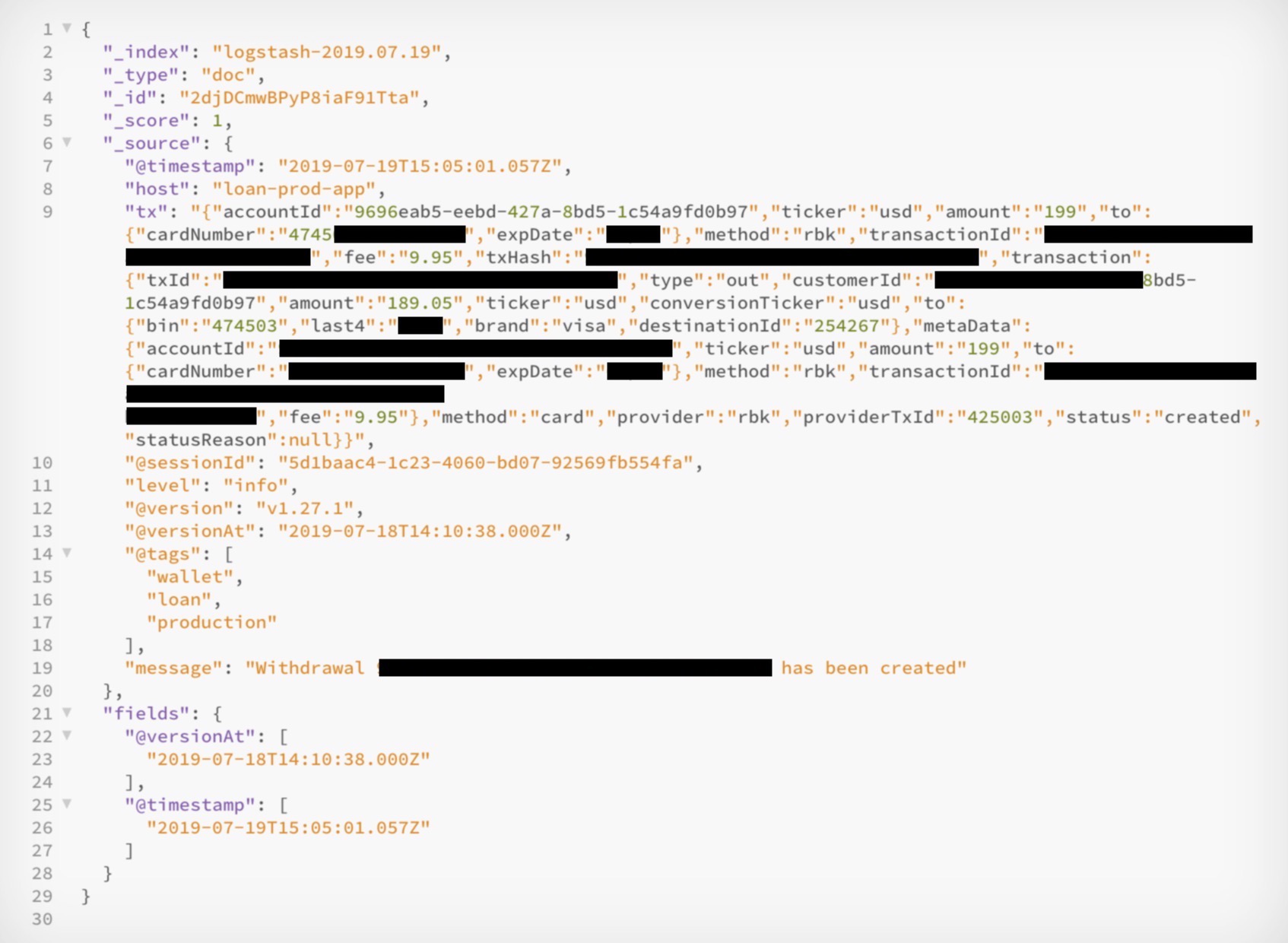
Among the records we reviewed, we found records with enough information to make fraudulent card purchases — such as names, transaction amounts, and credit card numbers, including card verification numbers (CVV) and expiry dates.

None of the data was encrypted.

1 kibana data

One of the transaction records exposing unencrypted credit card data. (Image: TechCrunch)

Several other records seen by TechCrunch contained banking information, including names, addresses, bank account and routing numbers, SWIFT codes, and the transaction amount.

The database also contained customer phone numbers and in some cases passport numbers, according to the researchers.

“The amount of information included in the database makes stealing a users identity a simple task,” said Rotem and Locar.

Once the data had been secured, we reached out to YouHodler’s chief executive Ilya Volkov prior to publication but did not hear back.

It’s the latest exposed database in a stream of recent findings by the researchers in recent months.

The researchers have previously found data leaking on Fortune 500 firm Tech Data, exposed user records and private messages of Jewish dating app JCrush and leaking data from Canadian cell network Freedom Mobile, and online retailer Gearbest. Earlier in July, the researchers found an unprotected database belonging to Aavgo, which exposed user hotel bookings.

Read more:

24 Jul 2019

RED is working on a Hydrogen Two smartphone

In a post on RED’s message board, founder Jim Jannard reasserted the company’s commitment to the disappointing Hydrogen One handset. It’s a distant memory now, but the pricey niche device was teased and delayed for months, only to be generally run through the ringer in reviews.

The camera module was one of various complaints with the device, and now RED’s placing the blame firmly at the feet of its ODM partner. In the post, Jannard notes that, while Foxconn has been a solid manufacturer, the design partner essentially blew it,

Our ODM, which was responsible for the mechanical packaging of our design including new technologies along with all software integration with the Qualcomm processor, has significantly under-performed. Getting our ODM in China to finish the committed features and fix known issues on the Hydrogen One has proven to be beyond challenging. Impossible actually. This has been irritating me to death and flooding our reactor.

Given the generally rough reviews for the $1,300 device, a lesser company would have no doubt abandoned the ship. Jannard and RED, however, are using the opportunity to double down. A new camera module (named “Komodo”), he notes, will be coming not only to the Hydrogen One, but a future Hydrogen Two.

“To that end,” he writes, “every Hydrogen One owner will get significant preferential treatment for the Hydrogen Two and/or new Cinema Camera model, both in delivery allocations and pricing.”

Given the time it took for the first gen to launch, it’s probably not worth holding one’s breath for the sequel. That said, the first handset is often the hardest, and creating a phone certainly presented a new paradigm for the high-end camera manufacturer, which is more accustom to building devices in house.

24 Jul 2019

SpaceX’s CRS-18 mission delivers a new automated docking adapter to the ISS – here’s why that matters

SpaceX is set to fly its CRS-18 resupply mission for the International Space Station later today (or tomorrow depending on weather). One big, important part of its cargo is the new International Docking Adapter built by Boeing, otherwise known as IDA-3. This new docking station will offer new types of standard ports that are designed to work with Boeing’s CST-100 Starliner and the SpaceX Crew Dragon, and any other ISS-destined spacecraft to follow.

Thanks to these new standard ports and sensor arrays found on the IDA-3, the new docking station will be able to dock with these new spacecraft autonomously, without any assistance required by astronauts on board the ISS. That’s a big upgrade from today, when the final docking procedure for spacecraft like the Dragon cargo capsule making the trip today typically involve astronauts making use of the space station’s Canadarm2 robotic arm to capture the capsule and bring it in for the final connection.

This is actually the second brand new docking adapter with this automated docking capability to be delivered to the International Space Station – the first, IDA-2, was installed in 2016 and was actually already used by SpaceX during its list uncrewed Dragon crew capsule test flight. That mission, Crew Dragon Demo-1, flew in March, with a successful docking procedure taking place with IDA-2 on March 3.

Canadarm2 actually gets a chance to shine with this delivery, however, since it’ll be used to unload IDA-3 and set it in place on the ISS’s Harmony module in preparation for its permanent installation, to be performed by astronauts via spacewalk later this year.

Once installed, IDA-3 will provide twice the automated docking capability for the ISS for future crewed mission, allowing for a lot more opportunities for future ISS missions  of all stripes.

In case you’re curious about the numbering, there was indeed an IDA-1 – this was the supposed to be the first docking port of its kind attached to the ISS, but it was destroyed when the Falcon 9 rocket for SpaceX’s CRS-7 resupply mission exploded due to a second-stage failure post-launch in 2015.

24 Jul 2019

FTC also sues Cambridge Analytica, settles with former CEO and app developer

As part of the investigation against Facebook’s privacy lapses, the FTC announced today that it is suing Cambridge Analytica. The agency has already agreed to settlement with former Cambridge Analytica CEO Alexander Nix as well as app developer Aleksandr Kogan.

The Federal Trade Commission described the administrative complaint in a press release. It alleged that Cambridge Analytica and the app developer that worked with the company “employed deceptive tactics to harvest personal information from tens of millions of Facebook users for voter profiling and targeting.”

In particular, an app called GSRApp or “thisisyourdigitallife” took advantage of Facebook’s API to collect personal information without proper consent. The app collected profile data from 250,000 to 270,000 users located in the U.S. In addition to the answers to personality questions, the app collected page likes of those users.

But the app went one step further by collecting likes and personal information from the Facebook friends of those users. It represents 50 million to 65 million people, including at least 30 million people in the U.S.

While Cambridge Analytica, Nix and Kogan took advantage of Facebook’s generous API, they misled users of the app. And that’s what the FTC didn’t like.

“Almost half of the app users, however, originally refused to provide their Facebook profile information. To address this issue, the GSRApp began telling app users that it would not ‘download your name or any other identifiable information—we are interested in your demographics and likes.’

The FTC alleges, however, that this was false, and that the GSRApp in fact collected users’ Facebook User ID, which connects individuals to their Facebook profiles, as well as other personal information such as their gender, birthdate, location, and their Facebook friends list.”

Cambridge Analytica then allegedly used this data to generate personality scores and launch targeted advertising campaigns according to voter profiling.

Finally, according to the FTC, Cambridge Analytica complied with the EU-U.S. Privacy Shield framework, but the certification lapsed in May 2018. The FTC alleges that Cambridge Analytica failed to protect personal information from EU users after Cambridge Analytica stopped complying to the Privacy Shield.

Cambridge Analytica has filed for bankruptcy and couldn’t settle the FTC’s allegations. But its former CEO as well as the person who developed the malicious app have settled.

Going forward, they can’t make “false or deceptive statements regarding the extent to which they collect, use, share, or sell personal information, as well as the purposes for which they collect, use, share, or sell such information.”

And, of course, they have to delete all personal information they have collected through the GSRApp and projects related to that data set. The commission vote against Cambridge Analytica and for the settlement was 5-0.

If you want to learn more about Cambridge Analytica, Netflix released a documentary today about the Cambridge Analytica scandal.

24 Jul 2019

Google intros Gallery Go offline photo editor

At an event this week in Nigeria, Google introduced Gallery Go, a photo management and editing tool designed for offline use. The new offering joins a suite of Google apps created specifically for users in development markets, where solid online connections aren’t always a given.

Gallery Go works with devices running Android 8.1 (Oreo) and newer, taking up just 10 MB of storage space on a mobile device. The app uses similar machine learning tools as Google Photos to organize and mange images, but does so without requiring a constant connection. User can create folders and access images directly from an SD card with the app.

There’s a handful of simple editing tools on board as well here, including filters, auto enhance for quick fixes, rotate and crop. The app joins similar offerings from companies like Facebook, designed to open services to users in areas where handsets are prevalent computing devices, but mobile connections tend to be a bit more spotty.

It’s available now through the Play Store and will be available as the default gallery app on select devices starting next month.

24 Jul 2019

Adam Nelson joins FirstMark Capital

Adam Nelson, an early Dropbox employee and partner at Social Capital, has today announced that he’s joined New York-based FirstMark Capital as a partner.

Nelson was actually born and raised here in New York City on the Upper East Side and moved out to the West Coast when he attended Stanford for his MBA. It was there that he felt the first spark of Silicon Valley inspiration, which ultimately led him to join Dropbox as an early employee.

There, Nelson led their partner network, helping mom-and-pop IT shops serving SMBs sell Dropbox products to their clients. He also worked on the revenue partnerships team, which was mostly focused on strategic business development with large flagship partners, such as Vodafone and Softbank, in international markets.

Nelson then moved on to Social Capital where he spent a few years investing in startups, with a portfolio that includes Slack, Clearbanc, WeeCare, and FareHarbor.

After some turmoil at the firm, Social Capital founder Chamath Palihapitiya changed the structure of the firm to become more of a holding company than a traditional VC firm.

Now, Nelson has landed at FirstMark Capital.

FirstMark is one of the most vital VC firms in New York city, with a portfolio that includes Shopify, Airbnb, Discord, DraftKings, Brooklinen, and Upwork. The firm has $1.6 billion under its management, and is known across the NYC ecosystem for its many events that bring startup founders and tech communities together.

The team at FirstMark includes Rick Heitzmann, Matt Turck, Amish Jani, and Beth Ferreira. Nelson said that, predominantly, the team was a big part of what attracted him to FirstMark.

Their reputation speaks for itself, not only as early investors in some of the most transformational companies of the last decade and the returns that come with it, but most notably as true partners to the entrepreneurs leading those companies. That sentiment was overwhelming in my conversations across their portfolio and was also reinforced as I’ve gotten to know the team over these last few months. Ultimately, the venture business all comes down people, and the team at FirstMark is the group I want to come to work with everyday to help advance the meaningful companies of the next decade.

So what is Nelson looking for?

Coming from private equity, Nelson has a particular curiosity when it comes to the disruption of more traditional industries such as logistics, education, and construction.

“I still think we’re in early innings,” said Nelson. “We’re seeing a lot of investment in finance, real estate, logistics, construction, and the labor markets that support those huge multi-trillion dollar revenue markets. But we’re still in the early stages of that.”

At his core, however, Nelson is still a software investor and has experience in building out an operational playbook and a go-to-market playbook that can be applied to larger industries.