Year: 2019

17 Jul 2019

Snyk brings in new CEO to help lead future expansion

Startup founders typically face a management challenge. They often began their careers in technical engineering jobs, and are thrust into the CEO role when starting a company. Sometimes it makes sense to bring in a more experienced executive to guide a fast-growing startup, and that is what Snyk announced it’s doing today, shifting founder/CEO Guy Podjarny to president and chairman of the board, while bringing in board member and investor Peter McKay as CEO.

Over the past 18 months the company has grown significantly moving from just 18 employees to 150 as its open source software development approach to security has taken hold in the marketplace. McKay is someone who makes sense for the job given he has been involved with the company as an investor since its early days, and has known Podjarny in various roles for 15 years. The two talked about having a good working relationship, something that Podjarny said was essential to this transition.

“I think I would be going through many sleepless nights if I was bringing just somebody we interviewed into the company for a role like this at a time like this,” he said. He added that having known and worked with McKay for so long has helped ease the role changes.

As important as the working relationship between the two is going to be, McKay brings an executive pedigree that includes stints as co-CEO at Veeam and general manager of Americas at VMware, where he managed an operation with $4 billion in annual revenue.

McKay says that he and Podjarny have had many conversations about how they will handle their new roles moving forward. “Guy and I have spent a great deal of time talking through a lot of [issues] before we ever said that we were going to move forward with this change,” he said. He added, “We wanted to make sure we’re aligned on how we would handle decisions. We want to be aligned on how we handle things like diversity, how we handle things like empowering and core company values,” he said.

As for Podjarny, he says this move allows him to return to a more technical function, and the two will take advantage of each other’s strengths as they move into these new roles. “Peter brings in extensive large-scale management experience, experience with markets. This is experience that I don’t have, but which naturally complements my product vision and community leadership skills,” he explained.

As a startup grows, picking the right leader to guide the company into the future is a tricky decision, and one that Podjarny and McKay did not take lightly. In spite of their long relationship, they recognize there will be challenges ahead as company founder and board member/investor take on new roles, but they believe that this is the best decision for the company to develop and grow moving forward. Time will tell if they are right.

17 Jul 2019

Another 2.2 million patients affected by AMCA data breach

Another clinical lab ensnared in the AMCA data breach has come forward.

Clinical Pathology Laboratories (CPL) says 2.2 million patients may have had their names, addresses, phone numbers, dates of birth, dates of service, balance information and treatment provider information stolen in the previously-reported breach.

Another 34,500 patients had their credit card or banking information compromised.

The breach was limited to U.S. residents, the company said.

CPL blamed the AMCA, which it and other labs used to process payments for their patients, for not providing more details on the breach when it was disclosed in June.

“At the time of AMCA’s initial notification, AMCA did not provide CPL with enough information for CPL to identify potentially affected patients or confirm the nature of patient information potentially involved in the incident, and CPL’s investigation is on-going,” said the company in a statement.

LabCorp was first hit with 7.7 million patients affected, then 11.9 million Quest Diagnostics patients were next. BioReference Laboratories pushed the breach over the 20 million mark.

Then, AMCA filed for bankruptcy protection amid several class action suits.

Several lawmakers have since contacted both Quest and LabCorp, two of the biggest laboratories in the U.S. to demand answers about the breach and why it went undetected for close to a year.

Read more:

17 Jul 2019

Nintendo introduces a Switch model refresh with better battery life

Nintendo already announced an entirely new Switch console this month, the Switch Lite, and now it’s bumping some of the specs on the existing Switch with a slightly updated version, spotted by The Verge. This update improves the hardware right where it counts when it comes to Switch portable playing power.

The new model will provide between 4.5 and 9 hours of battery life, depending on use, which is a big bump from the 2.5 to 6.5 hour rating on the original hardware that’s been offered to date. This is likely an improvement derived from a change in the processor used in the console, as well as more power-efficient memory, both of which were detailed in an FCC filing from last week.

Nintendo’s official Switch comparison page lists the models with improved battery life as model number ‘HAC-001(-01), with the bracketed addition distinguishing it from the original. You can check the version based on the serial number, with XKW preceding the newer hardware, and XAW starting off serials for the older, less power efficient version. No word on a specific street date, but if you’re in the market it’s worth taking a ‘wait and see’ approach to ensure this battery boosted hardware is the one you get.

In all other respects the two Switch models appear to be similar, if not identical, so it’s probably not enough of a change to get anyone considering an upgrade, unless the battery life on your current version really seems to fall about two hours short of your ideal play session length on average.

17 Jul 2019

Nexar’s Live Map is like Street View with pictures from 5 minutes ago

We all rely on maps to get where we’re going or investigate a neighborhood for potential brunch places, but the data we’re looking at is often old, vague, or both. Nexar, maker of dashcam apps and cameras, aims to put fresh and specific data on your map with images from the street taken only minutes before.

If you’re familiar with dash cams, and you’re familiar with Google’s Street View, then you can probably already picture what Live Map essentially is. It’s not quite as easy to picture how it works or why it’s useful.

Nexar sells dash cams and offers an app that turns your phone into one temporarily, and the business has been doing well, with thousands of active users on the streets of major cities at any given time. Each node of this network of gadgets shares information with the other nodes — warning of traffic snarls, potholes, construction, and so on.

The team saw the community they’d enabled trading videos and sharing data derived by automatic analysis of their imagery, and, according to co-founder and CTO Bruno Fernandez-Ruiz, asked themselves: Why shouldn’t this data shouldn’t be available to the public as well?

Actually there are a few reasons — privacy chief among them. Google has shown that properly handled, this kind of imagery can be useful and only minimally invasive. But knowing where someone or some car was a year or two ago is one thing; knowing where they were five minutes ago is another entirely.

Fortunately, from what I’ve heard, this issue was front of mind for the team from the start. But it helps to see what the product looks like in action before addressing that.
nexar zoom

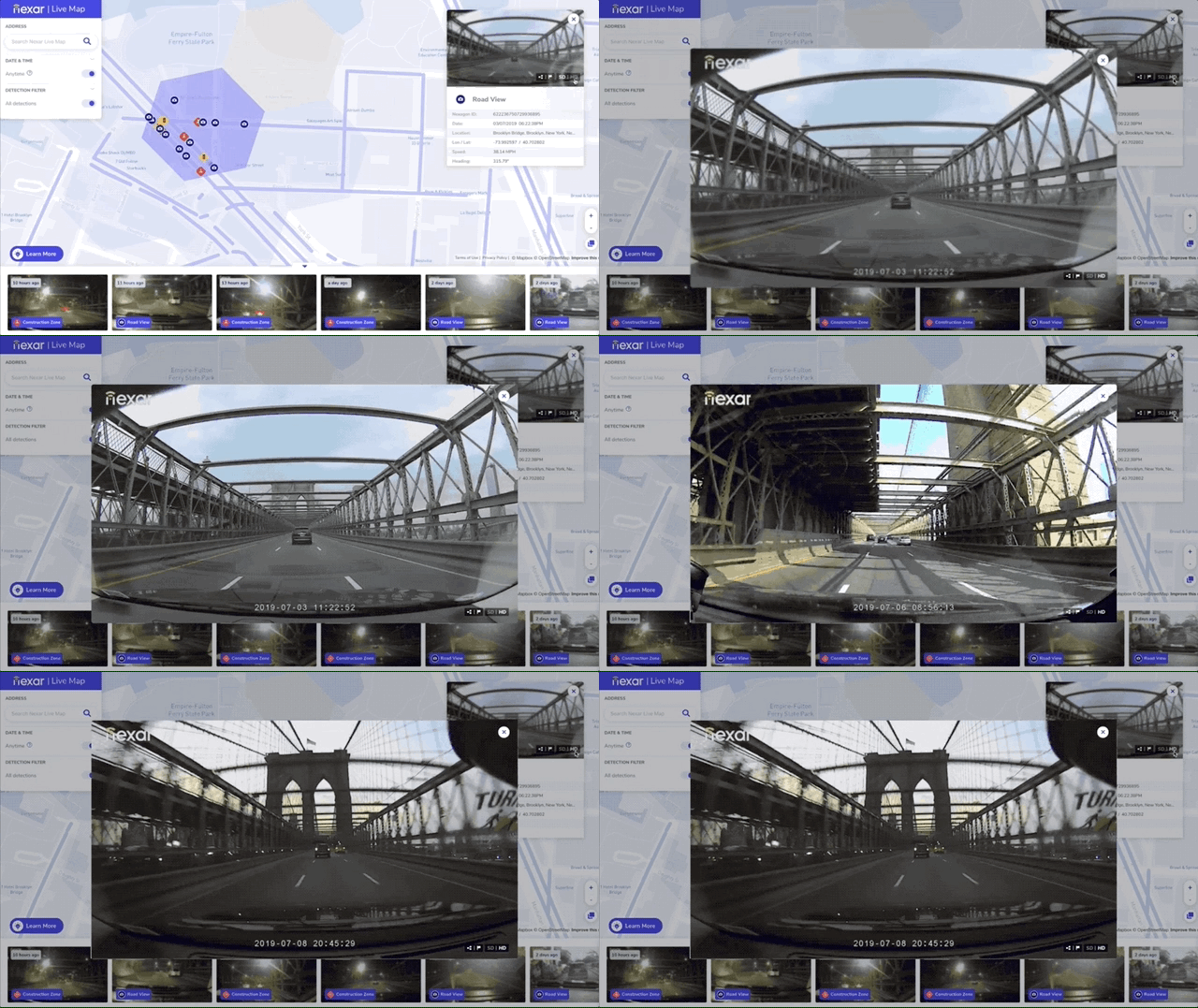
Zooming in on a hexagonal map section, which the company has dubbed “nexagons,” polls the service to find everything the service knows about that area. And the nature of the data makes for extremely granular information. Where something like Google Maps or Waze may say that there’s an accident at this intersection, or construction causing traffic, Nexar’s map will show the locations of the orange cones to within a few feet, or how far into the lanes that fender-bender protrudes.

You can also select the time of day, letting you rewind a few minutes or a few days — what was it like during that parade? Or after the game? Are there a lot of people there late at night? And so on.

Right now it’s limited to a web interface, and to New York City — the company has enough data to launch in several other areas in the U.S. but wants to do a slower roll-out to identify issues and opportunities. An API is on the way as well. (Europe, unfortunately, may be waiting a while, though the company says it’s GDPR-compliant.)

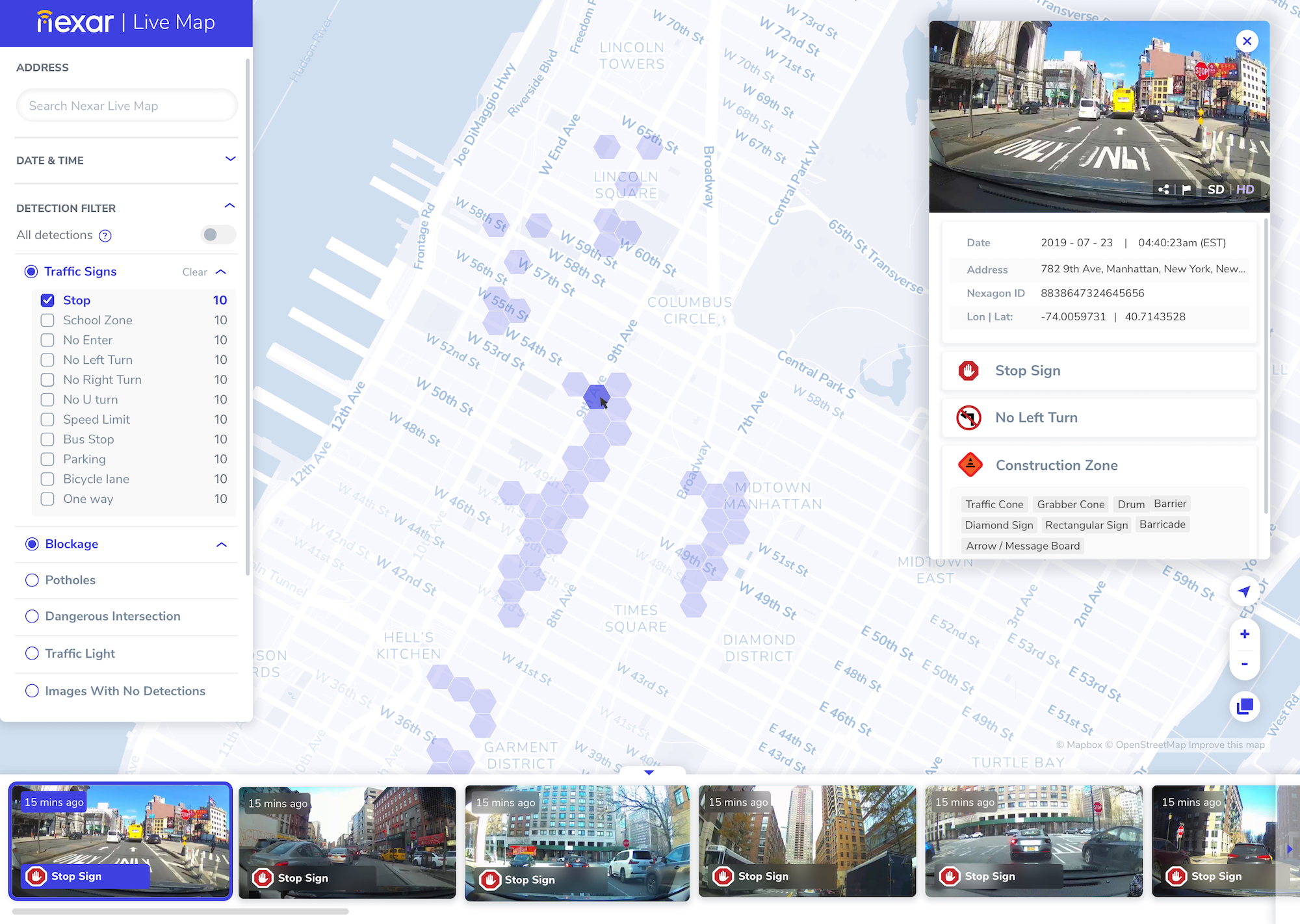
The service uses computer vision algorithms to identify a number of features, including signs (permanent and temporary), obstructions, even the status of traffic lights. This all goes into the database, which gets updated any time a car with a Nexar node goes by. Naturally it’s not in 360 and high definition — these are forward-facing cameras with decent but not impressive resolution. It’s for telling what’s in the road, not for zooming in to spot a street address.
Detection Filtering

Of course, construction signs and traffic jams aren’t the only things on the road. As mentioned before it’s a serious question of privacy to have constantly updating, public-facing imagery of every major street of a major city. Setting aside the greater argument of the right to privacy in public places and attendant philosophical problems, it’s simply the ethical thing to do to minimize how much you expose people who don’t know they’re being photographed.

To that end Nexar’s systems carefully detect and blur out faces before any images are exposed to public view. License plates are likewise obscured so that neither cars nor people can be easily tracked from image to image. Of course one may say that here is a small red car that was on 4th, and is on 5th a minute later — probably the same. But systematic surveillance rather than incidental is far easier with an identifier like a license plate.

In addition to protecting bystanders, Nexar has to think of the fact that an image from a car by definition places that car in a location at a given time, allowing them to be tracked. And while the community essentially opts into this kind of location and data sharing when they sign up for an account, it would be awkward if the public website let a stranger track a user all the way to their home or watch their movements all day.

“The frames are carefully random to begin with so people can’t be soloed out,” said Fernandez-Ruiz. “We eliminate any frames near your house and your destination.” As far as the blurring, he said that “We have a pretty robust model, on par with anything you can see in the industry. We probably are something north of 97-98 percent accurate for private data.”

So what would you do with this kind of service? There is, of course, something fundamentally compelling about being able to browse your city in something like real time.

On Google, there’s a red line. We show you an actual frame – a car blocking the right lane right there. It gives you a human connection,” said Fernandez-Ruiz. “There’s an element of curiosity about what the world looks like, maybe not something you do every day, but maybe once a week, or when something happens.”

No doubt we are many of us guilty of watching dash-cam footage or even Street View pictures of various events, pranks, and other occurrences. But basic curiosity doesn’t pay the bills. Fortunately there are more compelling use cases.

“One that’s interesting is construction zones. You can see individual elements like cones and barriers – you can see where exactly they are, when they’re started etc. We want to work with municiapl authorities, department of transportation, etc on this — it gives them a lot of information on what their contractors are doing on the road. That’s one use case that we know about and understand.”

In fact there are already some pilot programs in Nevada. And although it’s rather a prosaic application of a 24/7 surveillance apparatus, it seems likely to do some good.

But the government angle brings in an unsavory linen of thinking — what if the police want to get unblurred dash cam footage of a crime that just happened, or one of many such situations where tech’s role has historically been a mixed blessing?

“We’ve given a lot of thought to this, and it this concerns our investors highly,” Fernandez-Ruiz admitted. “There are two things we’ve done. One is we’ve differentiated what data the user owns and what we have. The data they send is theirs – like Dropbox. What we get is these anonymized blurred images. Obviously we will comply with the law, but as far as ethical applications of big data and AI, we’ve said we’re not going to be a tool of an authoritarian government. So we’re putting processes in place — even if we get a subpoena, we can say: This is encrypted data, please ask the user.”

That’s some consolation, but it seems clear that tools like this one are more a question than an answer. It’s an experiment by a successful company and may morph into something ubiquitous and useful or a niche product used by professional drivers and municipal governments. But in tech, if you have the data, you use it. Because if you don’t, someone else will.

You can test out Nexar’s Live Map here.

17 Jul 2019

Ebix to acquire Indian travel company Yatra for $337.8M

Atlanta-based software firm Ebix said today it is acquiring online travel booking company Yatra through a merger deal at an enterprise value of $337.8 million as they look to strengthen their position in India and footprints worldwide. Once the acquisition has completed, Yatra will become part of Ebix’s EbixCash travel portfolio — which also includes Via and Mercury — and will continue to serve customers under the Yatra brand, the two companies said.

Yatra, which went public in 2016 following a reverse-merger with a listed company, Terrapin 3 Acquisition Corporation, counts Reliance Industries-owned Network18 and Reliance Capital, Macquarie Group and Rotation Capital among its shareholders. Yatra posted a revenue of $31.7 million in Q4 2018. It had about 800 corporate clients as of earlier this year.

The combined entity will leverage Yatra’s large and loyal existing customer base, comprehensive service offering and multi-channel platform to take advantage of the dynamic and growing multibillion-dollar opportunity in India, the companies said in a joint statement.

Ebix, which develops software solutions for insurance, financial, and healthcare industries, said it is targeting an EbixCash IPO in the second quarter of next year. “The synergies and the cross-selling opportunities can create tremendous economic value for the shareholders, once the IPO is done,” the companies said.

In a statement, Dhruv Shringi, cofounder and CEO of Yatra, said, “Becoming a part of Ebix’s EbixCash travel portfolio will enable us to continue on that path. As part of a larger diversified organization with the necessary scale and resources to be a leader in today’s dynamic travel marketplace, we will provide more options and an enhanced experience for our joint customers and will be an even stronger partner to the airline, hotel, car rental and other businesses we work with.”

“We are confident that combining Yatra’s loyal customer base, comprehensive service offering and multi-channel platform with Ebix’s complementary Via and Mercury businesses, will create a leading online travel platform and India’s largest corporate travel platform that will capture growth opportunities and deliver enhanced value to shareholders.”

More to follow…

17 Jul 2019

India’s 30-year-old MyMoneyMantra raises $15M to scale its financial services marketplace

MyMoneyMantra, a 30-year-old New Delhi-based firm that operates a marketplace of financial services, has raised $15 million in its maiden funding round from an external source to expand its offerings and reach in the nation.

Dutch investment firm IFSD BV and private equity firm Vaalon Capital funded the $15 million round in MyMoneyMantra, the Indian firm said on Wednesday. A person familiar with the matter said the round valued MyMoneyMantra at about $50 million.

The company’s founder Raj Khosla said MyMoneyMantra, which employs about 2,500 employees and serves over 4 million customers across 50 cities, will use the capital to explore ways to capture a larger share of the market.

Khosla said the firm would work closely with Vaalon Capital’s team to expand its offerings and deepen its ties with banks and insurance companies. In the financial year that ended in March, MyMoneyMantra generated a revenue of $19.6 million.

MyMoneyMantra works with over 90 banks, non-bank lenders, and insurance companies to help customers get deals on loans and credit cards. The firm, which competes with BankBazaar and Andromeda in India, has done business of over $5.5 billion to date.

Today’s announcement underscores investors’ growing interest in India’s fintech market that saw tens of millions of users try out digital payment services for the first time after the Indian government banned some paper bills. Cash still dominates most of the transactions in the country.

India’s fintech startups raised $285.6 million in the quarter that ended in March this year, thereby surpassing China to become Asia’s top fundraising hub for financial technology, according to CBInsights.

And that momentum continues. In recent months, a score of startups that are trying to help India’s next hundreds of millions of users access financial services have secured significant capital from major investors. While some startups such as Open and Niyo are operating “neo banks” to help blue-collar workers access financial services, many big names like Paytm and Ola have launched their own credit cards.

17 Jul 2019

Atomico founding partner Mattias Ljungman is leaving to start his own seed fund

Changes are afoot at European VC Atomico, with news breaking that founding partner Mattias Ljungman is leaving to raise his own seed fund.

TechCrunch understands that staff at the London-headquartered firm, which he co-founded in 2006 with Skype founder Niklas Zennström, were informed of his decision to part ways earlier today, although he won’t be leaving immediately. Instead, I’m told Ljungman will be transitioning out over the next six months to ensure as little disruption as possible.

Atomico is also thought to be on the verge of closing a new fund, so arguably the timing is well-aligned, too. ‘In between’ funds is the best time for a founding partner to leave a VC firm, if there ever is one.

In the meantime, Ljungman will be carrying on with existing portfolio responsibilities and gradually handing over his board seats to other Atomico team members. He currently sits on the boards of Peakon, Teatime Games, Bossa Studios, and Lendinvest, to name a few.

Ljungman’s seed firm is to be called Moonfire Ventures and my understanding is that Atomico will invest in the new venture and become one of its first LPs (the ‘Series A and beyond’ VC is an LP in a sprawling number of seed funds, something that it tends to keep quite quiet).

Meanwhile, Ljungman’s thinking is that while European seed stage investing has blossomed recently, the European early-stage ecosystem remains “too fragmented, immature and definitely underfunded”. He believes that there are some excellent seed funds in Europe, but more are needed and especially ones that can think on a pan-European basis and have global ambition.

“My hope is to assemble a team of investors who can light a fire within seed stage investing in Europe to help entrepreneurs grow their boundless ambition and burning creativity,” Ljungman writes in a blog post to be published shortly.

“Given Europe’s diversity and fragmentation issues, I believe it’s time to reimagine how venture capital adds value by embracing technology to help with discovery, evaluation and more efficient provision of support for the most promising ventures”.

17 Jul 2019

Stonly lets you create interactive step-by-step guides to improve support

French startup Stonly wants to empower users so that they can solve their issues by themselves. Instead of relying on customer support agents, Stonly wants to surface relevant content so that you can understand and solve issues.

“I’m trying to take the opposite stance of chatbots," founder and CEO Alexis Fogel told me. “The issue [with chatbots] is that technology is not good enough and you often end up searching through the help center.”

If you’re in charge of support for a big enough service, chances are your customers often face the same issues. Many companies have built help centers with lengthy articles. But most customers won’t scroll through those pages when they face an issue.

That’s why Stonly thinks you need to make this experience more interactive. The service lets you create scripted guides with multiple questions to make this process less intimidating. Some big companies have built question-based help centers, but Stonly wants to give tools to small companies so that they can build their own scenarios.

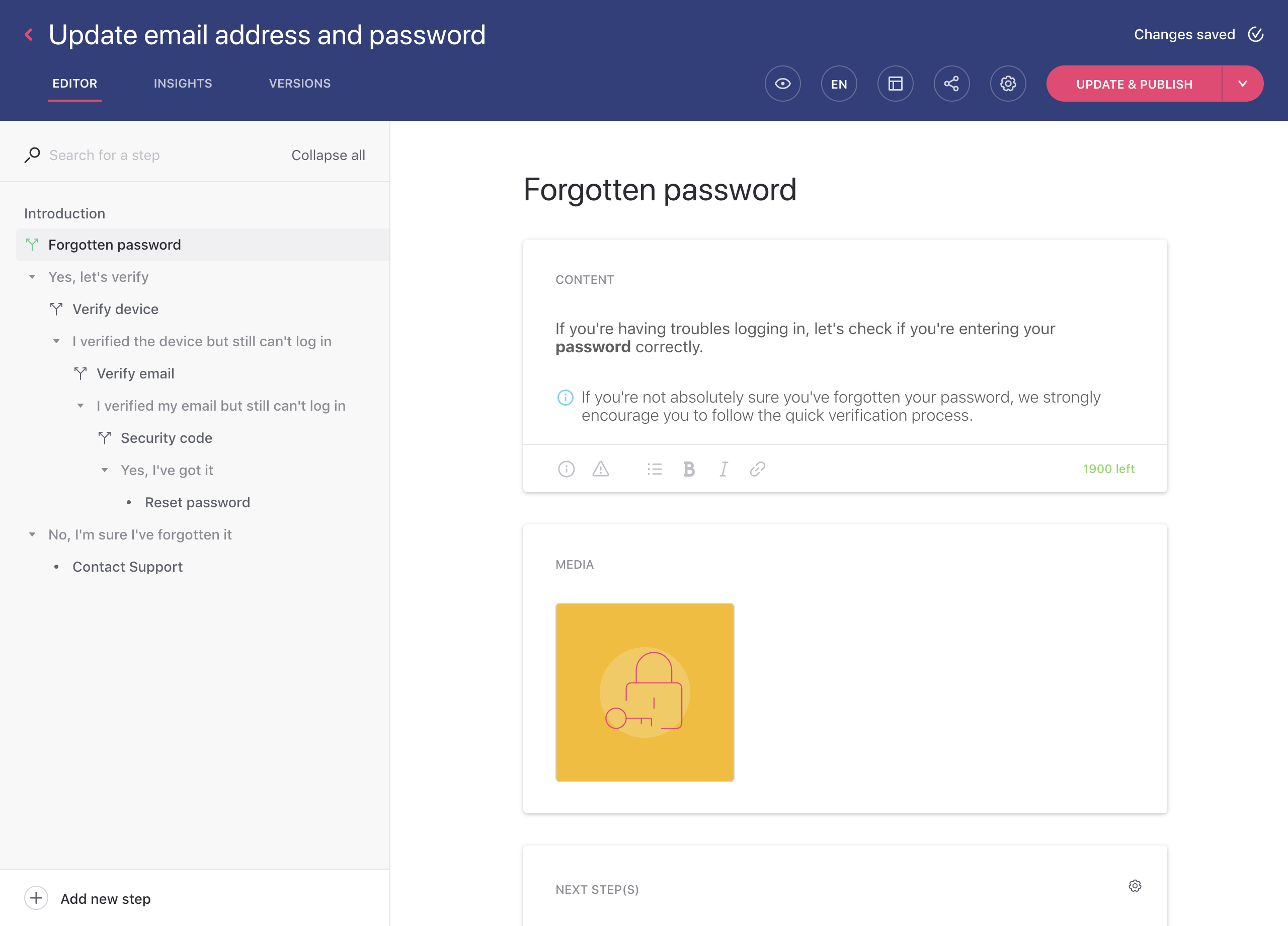
A Stonly module is basically a widget that you can embed on any page or blog. It works like a deck of slides with buttons to jump to the relevant slide. Companies can create guides in the back end without writing a single line of code. You can add an image, a video and some code to each slide.

At any time, you can see a flowchart of your guide to check that everything works as expected. You can translate your guides in multiple languages as well.

Once you’re done and the module is live, you can look back at your guides and see how you can improve them. Stonly lets you see if users spend more time on a step, close the tab and drop in the middle of the guide, test multiple versions of the same guide, etc.

But the startup goes one step further by integrating directly with popular support services, such as Zendesk and Intercom. For instance, if a user contacts customer support after checking a Stonly guide, you can see in Zendesk what they were looking at. Or you can integrate Stonly in your Intercom chat module.

Editor 01

As expected, a service like Stonly can help you save on customer support. If users can solve their own issues, you need a smaller customer support team. But that’s not all.

“It’s not just about saving money, it’s also about improving engagement and support,” Fogel said.

Password manager company Dashlane is a good example of that. Fogel previously co-founded Dashlane before starting Stonly. And it’s one of Stonly’s first clients.

“Dashlane is a very addictive product, but the main issue is that you want to help people get started,” he said. It’s true that it can be hard to grasp how you’re supposed to use a password manager if you’ve never used one in the past. So the onboarding experience is key with this kind of products.

Stonly is free if you want to play with the product and build public guides. But if you want to create private guides and access advanced features, the company has a Pro plan ($30 per month) and a Team plan (starting at $100 per month with bigger bills as you add more people to your team and use the product more extensively).

The company has tested its product with a handful of clients, such as Dashlane, Devialet, Happn and Malt. The startup has raised an undisclosed seed round from Eduardo Ronzano, Thibaud Elzière, Nicolas Steegmann, Renaud Visage and PeopleDoc co-founders. And Stonly is currently part of the Zendesk incubator at Station F.

17 Jul 2019

Europe is now formally investigating Amazon’s use of merchant data

European regulators have announced a formal antitrust investigation of Amazon’s use of data from third parties selling on its ecommerce platform.

Commenting in a statement, competition commissioner, Margrethe Vestager said: European consumers are increasingly shopping online. Ecommerce has boosted retail competition and brought more choice and better prices. We need to ensure that large online platforms don’t eliminate these benefits through anti-competitive behaviour. I have therefore decided to take a very close look at Amazon’s business practices and its dual role as marketplace and retailer, to assess its compliance with EU competition rules.

The move is not a surprise as Amazon was already on the radar of Vestager’s department.

Last fall it emerged the regulator was making preliminary enquiries about Amazon’s use of third party sellers’ data — to try to determine whether or not merchants selling on its platform are being placed at a competitive disadvantage vs the products Amazon also sells as a consequence of its access to their data.

Dual sided platforms — that both host sellers on a marketplace and sell stuff themselves — raise competition-related questions about what is done with third parties’ data, she said then.

Based on its preliminary fact-finding the Commission said today that Amazon “appears to use competitively sensitive information — about marketplace sellers, their products and transactions on the marketplace”. Although it’s worth emphasizing that this is a preliminary finding and does not prejudice the outcome of the formal probe.

The Commission said its in-depth investigation of Amazon’s practices will focus on:

  • the standard agreements between Amazon and marketplace sellers which allow its retail business to analyse and use third party seller data — saying that, in particular, it will focus on “whether and how the use of accumulated marketplace seller data by Amazon as a retailer affects competition”
  • the role of data in the selection of the winners of the ‘Buy Box’ and “the impact of Amazon’s potential use of competitively sensitive marketplace seller information on that selection”. The Commission notes that the ‘Buy Box’ is “displayed prominently” on Amazon and “seems key for marketplace sellers as a vast majority of transactions are done through it”

The Buy Box — an example of which can be seen in the below screengrab — refers to a coveted section of the Amazon website where consumers who are viewing a product can click to add it to their shopping cart.

Seller/s who win placement in the box likely gain an advantage over competing sellers of the product.


Screenshot 2019 07 17 at 12.25.32

Responding to the Commission’s announcement of a formal probe, an Amazon spokesperson sent us this statement: “We will cooperate fully with the European Commission and continue working hard to support businesses of all sizes and help them grow.”

Yesterday the ecommerce behemoth was among a number of tech giants being questioned by US lawmakers about antitrust concerns.

On both sides of the Atlantic regulators are fast dialling up their scrutiny of the tech sector. Although Europe has led the charge — with Vestager spearheading a number of investigations into tech giants during her tenure as competition chief, including probes of Google, Apple and now Amazon.

Earlier this year EU institutions also reached agreement over new regulations designed to boost transparency around online platform businesses and curb unfair practices to support traders and other businesses that rely on digital intermediaries for discovery and sales.

The new fairness and transparency rules online platforms are likely to come into force in the EU next year.

17 Jul 2019

Ford unveils its latest pickup truck built for a smartphone

Ford’s F-Series line of pickup trucks has been the best-selling vehicle in the U.S. for decades, which should make the automaker an expert of sorts in the truck-building business.

Ford unveiled Wednesday the latest addition to its pickup truck portfolio. This particular one, isn’t meant for driving. The automaker created a pickup truck emoji, which is debuted to celebrate World Emoji Day.

There currently is not a pickup truck emoji available. Although there are emojis for nearly every other kind of transport including airplanes, boats, cars and scooters.

Ford submitted a proposal in 2018 for a truck emoji to the Unicode Consortium, the organization that reviews
and approves proposals for new emojis. The truck emoji has been short-listed as a candidate for inclusion in a future version of Unicode. The final list of approved emoji won’t be revealed until early 2020.


Ford staff sifted through message boards, investigated texting influencers and watched social media feeds
to understand customers’ needs, according to Craig Metros, Ford North America design
director.

“People want a truck emoji that’s fresh, stylish, carries their ideas, and ‘tows’ the line on
what a truck means,” Metros said. “The end result is a modern icon that should give all truck fans a smiley face
emoji.”