Year: 2020

25 Aug 2020

Eden intros SaaS tools in a bid to become a more comprehensive office management platform

Eden, the office management platform founded by Joe du Bey, is today announcing the launch of several new enterprise software features. The company, which offers a marketplace for office managers to procure services like office cleaning, repairs, etc., is looking to offer a more comprehensive platform.

The software features include a COVID team safety tool that tracks who is coming into the office, and lets them reserve a specific desk to help ensure social distancing precautions are being taken.

“For us, the pandemic really accelerated our plans around enterprise tools,” said Joe du Bey. “We realized by talking to our clients that what they need right now isn’t services. Services are important, but what they really want in this moment is to have software so they can get back into the office.”

Eden is also introducing a service desk ticketing tool to allow workers to make requests or file a ticket for a broken piece of equipment from their own desktop, as well as a visitor management tool and a room booking tool.

[gallery ids="2035754,2035755,2035756"]

The company’s acquisition of Managed By Q, its biggest competitor in the services space, also greatly accelerated its ability to deliver software. Managed By Q, which was acquired by WeWork in 2019 for $220 million, was already on the trajectory of building out software well before its acquisition by Eden, and had itself acquired companies like Hivy to offer SaaS-based tools to customers.

As Eden grows its product portfolio, competition still abounds. Envoy (with just under $60 million in funding) has been in the visitor management space since its inception and is looking to broaden its product portfolio beyond office visitors. UpKeep is charging into the service ticket space with a mobile app to make it easier for service workers within an office to do their job and move seamlessly from task to task. Meanwhile, Robin is in the mix with its own room booking platform.

The point? There is clearly a rush to build out a platform that helps folks manage the physical space of an office and the people within it. Eden, with $40 million in total funding, is well positioned to duke it out for the top spot among a variety of competitors who are angling to ‘do it all.’

“This is a board meeting question: are we fighting too many battles or is comprehensiveness our most important asset?” said du Bey. “We have a completeness to our vision. A lot of our customers are saying they want a few tools from one place versus the very fragmented experience they have today. But there are trade offs in comprehensiveness. It means that someone can can spend all day building a hundred integrations for their app that for us might not be possible. So, there are some really interesting trade offs.”

That’s not without hardship, however. Eden had to layoff about 40 percent of its workforce amid the coronavirus pandemic. And though COVID has slowed growth, du Bey says that revenue in April 2020 was still higher than it was the year prior.

Alongside trying to support marketplace partners and customers through the pandemic, Eden has also introduced new ways to search for service providers, including a way to solicit a bid from black-owned businesses in the wake of the Black Lives Matter movement.

The Eden team is 52 percent female. Black employees represent 12 percent of the workforce, and Latinx employees represent 8 percent of the workforce.


25 Aug 2020

Google Chrome update brings better tab management, QR codes, plus performance improvements

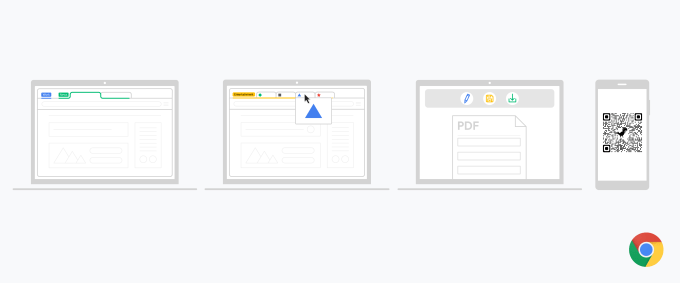
Google today will begin rolling out several updates to its Chrome web browser, with the goal of increasing user productivity and making the browsing experience faster. Specifically, Google is making Chrome’s tabs and its newer tab groups easier and quicker to use. Under-the-hood, it promises improvements that will deliver up to 10% faster page loads and those that will reduce the impact of having idle background tabs.

Together, the full set of new features address concerns of Chrome power users who tend to have many tabs open at once and work in their browser on a regular basis.

Google this May introduced tab groups, initially in beta. The feature allows users to add their open tabs to a group that they can then name and label, to keep their various projects, tasks, applications, and other online research organized. In this release, tab groups will roll out to all users.

Based on beta user feedback, Google is tweaking how tab groups work, as well.

Chrome will now users to collapse and expand their tab groups, so you can focus on the ones you need to access right now. Google says this was the most popular request it heard from those who were using tab groups, during tests. Also, Google is introducing a new touchscreen interface for tabs designed for laptops being used in tablet mode, coming to Chromebooks first. This will make it easier for users to flip through tabs.

On Android’s version of Chrome, if you start typing a page in the address bar, you’ll see a suggestion to switch to that tab if it’s already open. Android users will also gain simplified URL sharing to make it easier to copy links and share to other devices or send links through other apps.

In addition, they’ll be able to print the page or even generate a QR code to scan or download.

The new QR code feature will make its way to Chrome on the desktop, too, and will be accessible from a new QR code icon in the Chrome address bar.

Google will also begin to roll out what will likely be a very popular new feature in this latest release — the ability to fill out and save PDF forms directly from Chrome. You’ll even be able to re-open these files again and pick up where you left off. This feature, however, will slowly roll out over the next few weeks, Google says.

Meanwhile, the Beta version of the Chrome browser will introduce a feature that lets you hover over a tab to see a thumbnail preview of the page. This could be useful particularly for those times when you have many open tabs from the same domain, like Google Docs. 

To improve the overall experience of using many tabs in Chrome, this release (version M85) will deliver two improvements. The first is Profile Guided Optimization, which is a compiler optimization technique where the most performance-critical parts of the code can run faster, Google explains. It says this will bring up to 10% faster page loads by prioritizing the most common tasks. The improvement will roll out across Mac and Windows with Chrome M85. (The technique was actually first introduced in M53 using Microsoft Visual C++ [MSVC], Chrome’s previous build environment. Now it uses Clang and will reach both Mac and Windows).

In the Chrome Beta channel, Google is also introducing tab throttling which gives more resources to the tabs you’re currently using by taking the resources back from tabs that have been in the background for a long time. This change should bring improvements across loading speed, battery and memory saving.

Chrome has often been criticized for being slow and a resource hog on Mac. While user complaints can be attributed to a variety of problems, ultimately users will blame the software, not the OS it runs upon. That means Google has to make an effort to address the areas it’s able to fix by rolling out optimizations such as these. To what extent the improvements deliver the results Google promises, however, will have to be confirmed by third-party testing after they arrive.

25 Aug 2020

YC’s most anticipated startup raised $16M from A16z before Demo Day

Trove, a startup that sells a suite of internal compensation tools to other startups, has quietly graduated from this summer’s Y Combinator batch with millions in venture capital and a whopping valuation.

A16z and Trove did not immediately respond to a request for comment.

The deal likely closed weeks after the company joined the famed accelerator cohort, which went virtual due to the coronavirus pandemic. The startup deferred presenting on Demo Day, Y Combinator’s biannual showcase of all startups within the batch, probably because it raised.

The business, less than a year old, is raising a $16 million round with a $75 million post-money valuation, according to individuals familiar with the deal. Andreessen Horowitz is leading the round. WorkLife Ventures confirmed that it also participated in the competitive round.

Simply put, Trove helps employers compensate their employees. In startups, stock options are a thorny but big part of compensation packages. Trove is a platform that helps managers visualize earnings amid different valuation scenarios, and then communicate those numbers to employees.

The startup is also breaking into the market during a time where startup employees are indefinitely working from home. Compensation gets trickier as perks disappear. What do you pay your San Francisco employee who now lives in Denver and acquires far less costs of living? If the perks disappear, does that turn into cash for an employee? Companies need new benchmarks, and a suite of startups is popping up to help bring clarity.

The company is founded by Matthew Schulman, a former software engineer at Facebook and graduate of University of Pennsylvania Engineering and Wharton school. The company raised a $850,000 pre-seed round in March.

Since Trove did not present on Demo Day, we don’t have a clear understanding of the company’s growth. Trove is one of many startups in the space that are trying to make it easier to understand how to pay employees through cash and equity within a startup. Just last week, Welcome raised $1.4 million with the goal of providing a clear picture of how total compensation works to job candidates. It describes itself as a “first offer management and closing platform.”

Across startupland, the size of seed rounds has been growing. In 2018, the average seed round was $5.6 million. Yet Y Combinator serves as sort of an anecdote for how big the rounds could actually get. Over time, the incubator graduates startups with competitively priced rounds on high valuations.

It hasn’t always been this way. For a sense of how things changed, consider that Trove raised at a $75 million post-money valuation, while Airbnb, which was once a Y combinator company, raised its first check at around a $2.5 million valuation in 2009.

So while high valuations are somewhat expected of Y Combinator graduates, Trove’s raise comes with a pandemic-sized footnote. Startups are closing big rounds even in a remote investment world, showing that the fundraising scene for seed stage startups definitely isn’t as bleak as we thought it would be in early March.

According to California filings, Trove is selling 8 million shares as of August 20th. Given that due diligence takes 30 days, it’s reasonable to believe that the startup was only part of Y Combinator’s cohort for a few weeks before it raised a Series A round.

It’s clear that A16z isn’t shy about placing big valuations on months old companies.

Last summer, the firm landed a lead investor spot with Tandem, another breakout star from the Y Combinator cohort. This year, A16z beat out other investors to lead a financing in Clubhouse, a buzzy app loved by VC and Silicon Valley elite, at a $100 million valuation.

Other investors in Trove include the Graduate Fund, Backend Capital, and Village Global, according to Trove’s website.

25 Aug 2020

YC’s most anticipated startup raised $16M from A16z before Demo Day

Trove, a startup that sells a suite of internal compensation tools to other startups, has quietly graduated from this summer’s Y Combinator batch with millions in venture capital and a whopping valuation.

A16z and Trove did not immediately respond to a request for comment.

The deal likely closed weeks after the company joined the famed accelerator cohort, which went virtual due to the coronavirus pandemic. The startup deferred presenting on Demo Day, Y Combinator’s biannual showcase of all startups within the batch, probably because it raised.

The business, less than a year old, is raising a $16 million round with a $75 million post-money valuation, according to individuals familiar with the deal. Andreessen Horowitz is leading the round. WorkLife Ventures confirmed that it also participated in the competitive round.

Simply put, Trove helps employers compensate their employees. In startups, stock options are a thorny but big part of compensation packages. Trove is a platform that helps managers visualize earnings amid different valuation scenarios, and then communicate those numbers to employees.

The startup is also breaking into the market during a time where startup employees are indefinitely working from home. Compensation gets trickier as perks disappear. What do you pay your San Francisco employee who now lives in Denver and acquires far less costs of living? If the perks disappear, does that turn into cash for an employee? Companies need new benchmarks, and a suite of startups is popping up to help bring clarity.

The company is founded by Matthew Schulman, a former software engineer at Facebook and graduate of University of Pennsylvania Engineering and Wharton school. The company raised a $850,000 pre-seed round in March.

Since Trove did not present on Demo Day, we don’t have a clear understanding of the company’s growth. Trove is one of many startups in the space that are trying to make it easier to understand how to pay employees through cash and equity within a startup. Just last week, Welcome raised $1.4 million with the goal of providing a clear picture of how total compensation works to job candidates. It describes itself as a “first offer management and closing platform.”

Across startupland, the size of seed rounds has been growing. In 2018, the average seed round was $5.6 million. Yet Y Combinator serves as sort of an anecdote for how big the rounds could actually get. Over time, the incubator graduates startups with competitively priced rounds on high valuations.

It hasn’t always been this way. For a sense of how things changed, consider that Trove raised at a $75 million post-money valuation, while Airbnb, which was once a Y combinator company, raised its first check at around a $2.5 million valuation in 2009.

So while high valuations are somewhat expected of Y Combinator graduates, Trove’s raise comes with a pandemic-sized footnote. Startups are closing big rounds even in a remote investment world, showing that the fundraising scene for seed stage startups definitely isn’t as bleak as we thought it would be in early March.

According to California filings, Trove is selling 8 million shares as of August 20th. Given that due diligence takes 30 days, it’s reasonable to believe that the startup was only part of Y Combinator’s cohort for a few weeks before it raised a Series A round.

It’s clear that A16z isn’t shy about placing big valuations on months old companies.

Last summer, the firm landed a lead investor spot with Tandem, another breakout star from the Y Combinator cohort. This year, A16z beat out other investors to lead a financing in Clubhouse, a buzzy app loved by VC and Silicon Valley elite, at a $100 million valuation.

Other investors in Trove include the Graduate Fund, Backend Capital, and Village Global, according to Trove’s website.

25 Aug 2020

Carbon Health’s Eren Bali and Color’s Othman Laraki will join us at Disrupt 2020

The COVID-19 pandemic has left no industry untouched, but the healthcare industry is arguably the one that stands to be transformed the most by the ongoing pandemic. At TechCrunch Disrupt 2020, get the perspectives of two founders who’ve created entirely new healthcare modals with their respective startups on how their companies have adapted to a world transformed by a global health crisis.

Eren Bali, co-founder CEO of Carbon Health, and Othman Laraki, founder and CEO of Color, will join us on our virtual stage during Disrupt, which runs September 14-18 this year. Bali’s Carbon Health is a startup focused on creating a new standard for primary and urgent care, using modern clinics equipped with smart technology, as well as remote healthcare devices to enable a high standard of distanced clinical practice. Laraki’s Color, meanwhile, has adapted its population genomics platform and added COVID-19 testing as a core capability, with an eye to establishing and sharing best practices for high-volume diagnostics.

We’ll talk about how healthcare has changed since the advent of the pandemic, and what it means for people looking to ensure that their primary care continues to be offered at a high level – without other problems falling through the cracks. We’ll also discuss Color’s experience working with the city of San Francisco to roll out its in-person testing capabilities, including providing crucial testing resources for primary care workers. We’ll also look ahead to what kind of challenges we’re still likely to face before the pandemic is over, and how it will change how we approach community and individual care for decades to come.

Both Carbon Health and Color are at the frontlines of COVID-19 testing during an unparalleled national and global emergency, and their insight will be invaluable for getting a sense of what’s going right and what’s going wrong with testing in the U.S., and where we go from here. You won’t want to miss the perspectives that these two can offer.

Disrupt 2020 runs from September 14 through September 18 and will be 100% virtual this year. Get your front row seat to see Bali and Laraki live with a Disrupt Digital Pro Pass or a Digital Startup Alley Exhibitor Package. We’re excited to see you there.

25 Aug 2020

Facebook is bringing a Shop section to its app, while Instagram expands Live Shopping

Facebook is announcing a number of new e-commerce features both within the main Facebook app and on Instagram.

The pandemic has forced many businesses to shift online, and Facebook made a big announcement in May around the ability of merchants to create Facebook Shops that are viewable on both Facebook and Instagram. More recently, Instagram launched a redesigned Shop section, where users can browse products from their favorite brands and creators.

Now the company is bringing a similar experience to the main Facebook app. The company said that in the United States, it’s started testing a new section called Facebook Shop — like Instagram Shop, it’s basically a shopping destination where you can find products from a variety of different businesses. (This is distinct from Facebook Marketplace, which is designed for peer-to-peer sales.)

Director of Product Management George Lee told me the goal is to create something that’s “unique to the Facebook app and the Facebook community.”

Facebook Shop

Image Credits: Facebook

“That’s not to say that there aren’t learnings across the board,” he said. “[Instagram Shop and Facebook Shop] probably look like slightly different on day one, and the goal is not to have them be cookie cutters of the same experience.”

In addition, the company is announcing new tools for businesses running Facebook Shops, including new design layouts, the ability to see a real-time preview of collections, the ability to automatically create Shops if you’re a new seller and new data in Commerce Manager. Shops will also feature a new messaging option for customers to send sellers a message through Messenger, WhatsApp or Instagram Direct.

On the Instagram side, the company said all sellers in the United States will be able to use the Instagram checkout feature “in the coming weeks,” managed either through Facebook’s Commerce Manager or through partners platforms BigCommerce and Shopify (with more integrations planned). Instagram will waive its selling fee for checkout through the rest of the year.

The company has also been testing a live shopping experience, where businesses can show off products in a live video, while consumers can browse the highlighted products and make purchases. Instagram Live Shopping should now be available to all sellers using Instagram Live Shopping in the United States.

Instagram Live Shopping

Image Credits: Facebook

“We’ve seen live shopping take off in other parts of the world,” said Instagram’s vice president of product Vishal Shah. “The pandemic has really changed behavior from a consumer perspective, so we’re moving as fast as we can to bring out these tools to help [businesses respond].”

25 Aug 2020

Azure’s Immersive Reader is now generally available

Microsoft today announced that Immersive Reader, its service for developers who want to add text-to-speech and reading comprehension tools to their applications, is now generally available.

Immersive Reader, which is part of the Azure Cognitive Services suite of AI products, developers get access to a text-to-speech engine, but just as importantly, the service offers tools that help readers improve their reading comprehension, be that through displaying pictures over commonly used words or separating out syllables and parts of speech of a given sentence.

It also offers a distraction-free reading view, similar to what you will find in modern browsers. Indeed, if you use Microsoft’s Edge browser, Immersive Reader is already included there as part of the distraction-free article view, together with its other accessibility features. Microsoft also bundled its translation service with Immersive Reader.

Image Credits: Microsoft

With today’s launch, Microsoft is adding support for fifteen of its neural text-to-speech voices to the service, as well as five new languages (Odia, Kurdish (Northern), Kurdish (Central), Pashto and Dari) from its translation service. In total, Immersive Reader now supports 70 languages.

As Microsoft also announced today, the company has partnered with Code.org and SAFARI Montage to bring Immersive Reader to their learning solutions.

“We’re thrilled to partner with Microsoft to bring Immersive Reader to the Code.org community,” said Hadi Partovi, Founder and CEO of Code.org. “The inclusive capabilities of Immersive Reader to improve reading fluency and comprehension in learners of varied backgrounds, abilities, and learning styles directly aligns with our mission to ensure every student in every school has the opportunity to learn computer science.”

Microsoft says it saw a 560% increase in use of Immersive Reader from February to May, likely because a lot of people were starting to look for new online education tools as the COVID-19 pandemic started. Today, more than 23 million people use it every month and Microsoft expects that number to go up once again in the fall, as the new school year starts.

25 Aug 2020

Vue’s $179 Lite smart glasses have built-in speakers for music and calls

Perhaps some day in the not-so-distant future, we’ll all be wearing smart glasses. Stranger things have happened. And hey, most people were fairly skeptical in the early days of smartwatches. And while I’m not saying that it will definitely take Apple launching its own pair to accelerate mainstream acceptance à la the Apple Watch, I would be short sighted to rule out the possibility.

The category is a strange holding pattern, as Vue announces the launch of its $179 Lite glasses. The original Google Glass are far enough in the rearview to make references feel outdated, but the arrival of a truly revolutionary model still feels a long ways off. Intel abandoned its Vaunt project and North killed its second-generation Focals before getting scooped up by Google. Bose’s own project appears in jeopardy after it shuttered its AR division this June.

When I first had some hands-on time with Vue’s original glasses back in October 2016 (a very different time to be sure), I was intrigued. The company was, notably, plagued by delays — certainly not an anomaly in the world of crowdfunding. “We apologize for the delays and wish we could be more timely. We don’t enjoy being late, but it can happen when developing a new product,” the company wrote in a recent post.

Image Credits: Brian Heater

At the very least, it’s worth noting that the first project is almost always the most difficult for hardware startups, for obvious reasons. I can also tell you now that I’ve had a pair of the Vue Lite for about a week now, which I’ve been using off and on. So on that front, at least, they’re a real thing. They’re also simpler than their predecessors, which could help on that front.

It’s worth tempering your exceptions a bit, in terms of what to expect from a pair of smart glasses. The main features are music playback, through a pair of low-power speakers that fire directly at the air. Those replace the Vue Pro’s more advanced bone-conduction system. They are, be warned, pretty quiet, but the design does go a ways toward keeping you in tune with your environment, as they don’t cover the ear.

Each side features a simple touch control, used to control music playback, pick up phone calls and trigger voice assistant. Like the speaker, the microphone’s…not the best, but it gets the job done. I definitely wouldn’t use the Vue Lite as my primary music device, and probably not for too many important calls, either. But it’s nice enough when you’re on the move.

Image Credits: Brian Heater

The company’s swapped out the cool charging glasses case for simple conduction pads on either arm — each with their own battery that needs to be charged independently. You should be able to get around three-and-a-half hours of playback on a charge — an hour less than the Pros. They also drop some key features, including fitness tracking and Find My Glasses.

As for their look, they’re a bit boxy for my taste (though there are three styles available), though reasonably lightweight. You also can get them to ship with your prescription.

25 Aug 2020

Microsoft brings transcriptions to Word

Microsoft today launched Transcribe in Word, its new transcription service for Microsoft 365 subscribers, into general availability. It’s now available in the online version of Word, with other platforms launching later. In addition, Word is also getting new dictation features, which now allow you to use your voice to format and edit your text, for example.

As the name implies, this new feature lets you transcribe conversations, both live and pre-recorded, and then edit those transcripts right inside of Word. With this, the company goes head-to-head with startups like Otter and Google’s Recorder app, though they all have their own pros and cons.

Image Credits: Microsoft

To get started with Transcribe in Word, you simply head for the dictate button in the menu bar and click on ‘transcribe.’ From there, you can record a conversation as it happens — by recording it directly through a speakerphone and your laptop’s microphone, for example — or by recording it in some other way and then uploading that file. The service accepts .mp3, .wav, .m4a and .mp4 files.

As Microsoft Principal Group PM Manager for Natural User Interface & Incubation, Dan Parish, noted in a press briefing ahead of today’s announcement, when you record a call live, the transcription actually runs in the background while you conduct your interview, for example. The team purposely decided not to show you the live transcript, though, because its user research showed that it was distracting. I admit that I like to see the live transcript in Otter and Recorder, but maybe I’m alone in that.

Like with other services, Transcribe in Word lets you click on individual paragraphs in the transcript and then listen to that at a variety of speeds. Since the automated transcript will inevitably have errors in it, that’s a must-have feature. Sadly, though, Transcribe doesn’t let you click on individual words.

One major limitation of the service right now is that if you like to record offline and then upload your files, you’ll be limited to 300 minutes, without the ability to extend this for an extra fee, for example. I know I often transcribe far more than 5 hours of interviews in any given month, so that limit seems low, especially given that Otter provides me with 6,000 minutes on its cheapest paid plan. The max length for a transcript on Otter is 4 hours while Microsoft’s only limit for is a 200MB file upload limit, with no limits on live recordings.

Another issue I noticed here is that if you mistakenly exit the tab with Word in it, the transcription process will stop and there doesn’t seem to be a way to restart it.

It also takes quite a while for the uploaded files to be transcribed. It takes roughly as long as the conversations I’ve tried to transcribe), but the results are very good — and often better than those of competing services. Transcribe for Word also does a nice job separating out the different speakers in a conversation. For privacy reasons, you must assign your own names to those — even when you regularly record the same people.

It’d be nice to get the same feature in something like OneNote, for example, and my guess is Microsoft may expand this to its note-taking app over time. To me, that’s the more natural place for it.

Image Credits: Microsoft

The new dictation features in Word now let you give commands like “bold the last sentence,” for example, and say “percentage sign” or “ampersand” if you need to add those symbols to a text (or “smiley face,” if those are the kinds of texts you write in Word).

Even if you don’t often need to transcribe text, this new feature shows how Microsoft is now using its subscription service to launch new premium features to convert free users to paying ones. I’d be surprised if tools like the Microsoft Editor (which offers more features for paying users), this transcription service, as well as some of the new AI features in the likes of Excel and PowerPoint, didn’t help to convert some users into paying ones, especially now that the company has combined Office 365 and Microsoft 365 for consumers into a single bundle. After all, just a subscription to something like Grammarly and Otter would be significantly more expensive than a Microsoft 365 subscription.


25 Aug 2020

Leaked S-1 says Palantir would fight an order demanding its encryption keys

Palantir, the secretive data analytics startup founded by billionaire investor Peter Thiel, would challenge a government order seeking the company’s encryption keys, according to a leaked document.

TechCrunch has obtained a leaked copy of Palantir’s S-1, filed with U.S. regulators to take the company public. We’ve covered some ground already, including looking at Palantir’s financials, its customers, and some of the company’s self-identified risk factors.

But despite close relationships with law enforcement and government customers — including the U.S. government — Palantir indicated where it would draw the line if it was served a legal demand for its data.

From the leaked S-1 filing:

From time to time, government entities may seek our assistance with obtaining information about our customers or could request that we modify our platforms in a manner to permit access or monitoring. In light of our confidentiality and privacy commitments, we may legally challenge law enforcement or other government requests to provide information, to obtain encryption keys, or to modify or weaken encryption.

The S-1 touches on a particularly thorny issue in the U.S., given repeated efforts by the Trump administration to undermine and weaken encryption at the request of law enforcement, who say that encryption used by U.S. tech and internet giants makes it harder to investigate crimes.

But despite the close ties between Palantir co-founder Peter Thiel and the administration, Palantir’s position on encryption aligns closer with that of other Silicon Valley tech companies, which say strong encryption protects their users and customers from hackers and data theft.

In June, the government doubled down on its anti-encryption position with the introduction of two bills which, if passed, would force tech giants to build encryption backdoors into their systems.

Tech companies — including Apple, Facebook, Google, Microsoft, and Twitter — strongly opposed the bills, arguing that backdoors “would leave all Americans, businesses, and government agencies dangerously exposed to cyber threats from criminals and foreign adversaries.” (Verizon Media, which owns TechCrunch, is also a member of the coalition.)

Orders demanding a company’s encryption keys are rare but not unheard of.

In 2013 the government ordered Lavabit, an encrypted email provider, to turn over the site’s encryption keys. It was later confirmed, though long suspected, that the government wanted access to the Lavabit account belonging to NSA whistleblower Edward Snowden.

More recently, the FBI launched legal action in 2016 to compel Apple to build a custom backdoor that would have allowed federal agents access to an encrypted iPhone belonging to one of the San Bernardino shooters, Syed Rizwan Farook, who with his wife Tashfeen Malik, killed 14 people and injured 22 others. The FBI dropped the case after hiring hackers to break into the shooter’s iPhone, without Apple’s help.

Palantir did not say in the S-1 if it had received a legal order to date. But the S-1 filing said that the company risks “adverse political, business, and reputational consequences” regardless of whether or not the company challenged a legal order in court.

A Palantir spokesperson did not return a request for comment.