Year: 2020

05 Aug 2020

What Q2 fundraising data tells us about the rest of 2020

It’s safe to say that no one could have predicted how this year’s fundraising marketplace was going to shape up. The beginning of the year saw us trending toward a blockbuster start, similar to 2018, rather than the steady burn of 2019. But after March there was no clear road map for how VCs and founders were going to react.

We’ve been tracking three key data metrics from the 2020 DocSend Startup Index to show us real-time trends in the fundraising marketplace. Using aggregate and anonymous data pulled from thousands of pitch deck interactions across the DocSend platform, we’re able to track the supply and demand in the marketplace, as well as the quality of pitch deck interactions.

The main two metrics are Pitch Deck Interest and Founder Links Created. These are leading indicators for how the fundraising marketplace is shaping up as it measures the activity happening around the pitch deck. As that interest peaks, we expect the amount of funds deployed to increase in the months after. Pitch Deck Interest is measured by the average number of pitch deck interactions for each founder happening on our platform per week, and is a great proxy for demand.

Founder Links Created is how many unique links a founder is creating to their deck each week; because each person you send a document to in DocSend gets a unique link, we can use this as a proxy for supply by looking at how many investors a founder is sharing their deck with per week.

Here’s what we saw in Q2 and how that will affect the rest of the year.

VCs are shopping

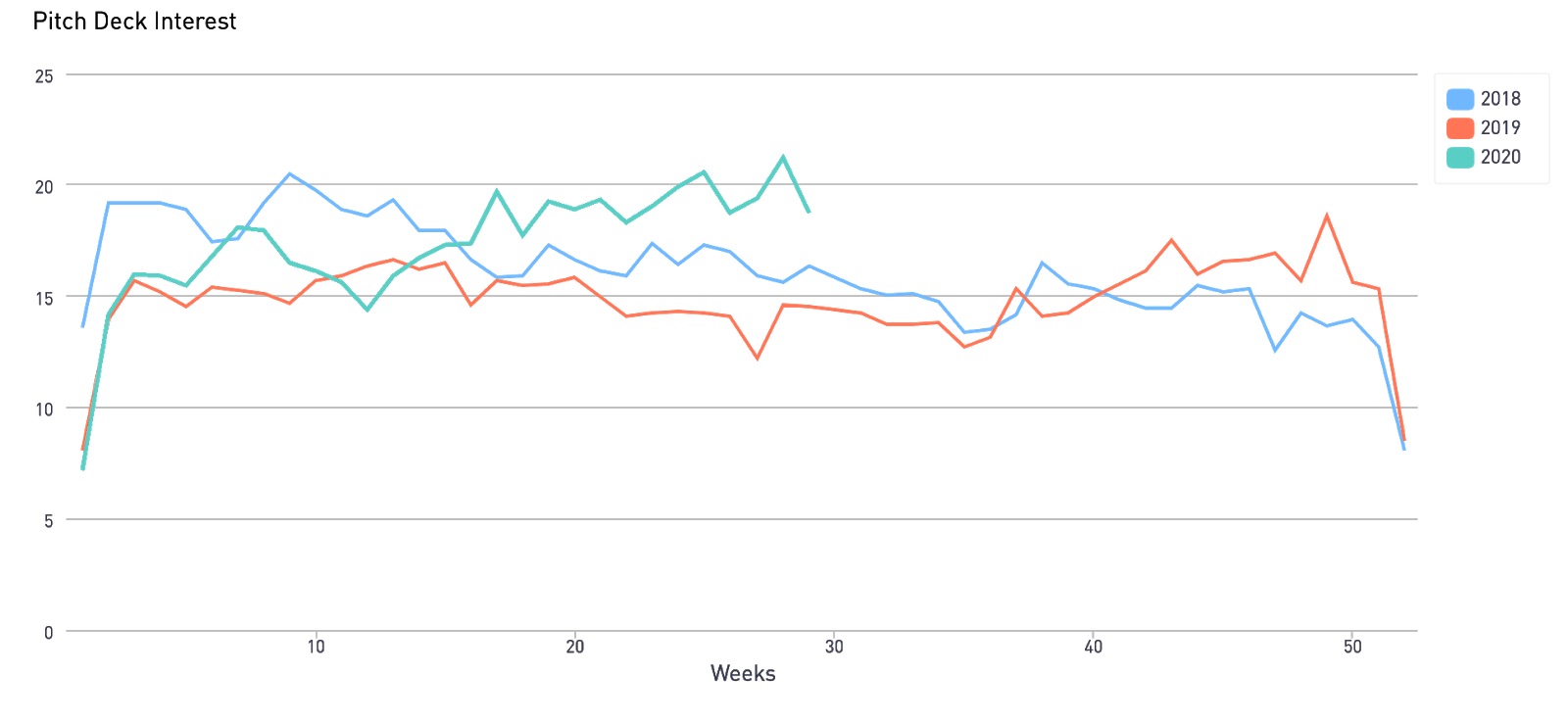
VC interest has been at an all-time high over the last quarter. Interest rebounded over the course of a few weeks after the pandemic was declared and shelter-in-place orders were given. But once interest rebounded to pre-pandemic levels it did something surprising. It kept climbing. In fact, the top 10 weeks for VC interest this year were all in Q2. Overall, interest was up 21.6% QoQ and 26% YoY. This means we’re looking at VCs viewing more pitch decks than they have any time in the last two years.

This is in spite of VC interest traditionally declining from late spring into summer, before bottoming out during the last two weeks of August. After the initial peak in the spring, VC interest typically doesn’t rebound until October.
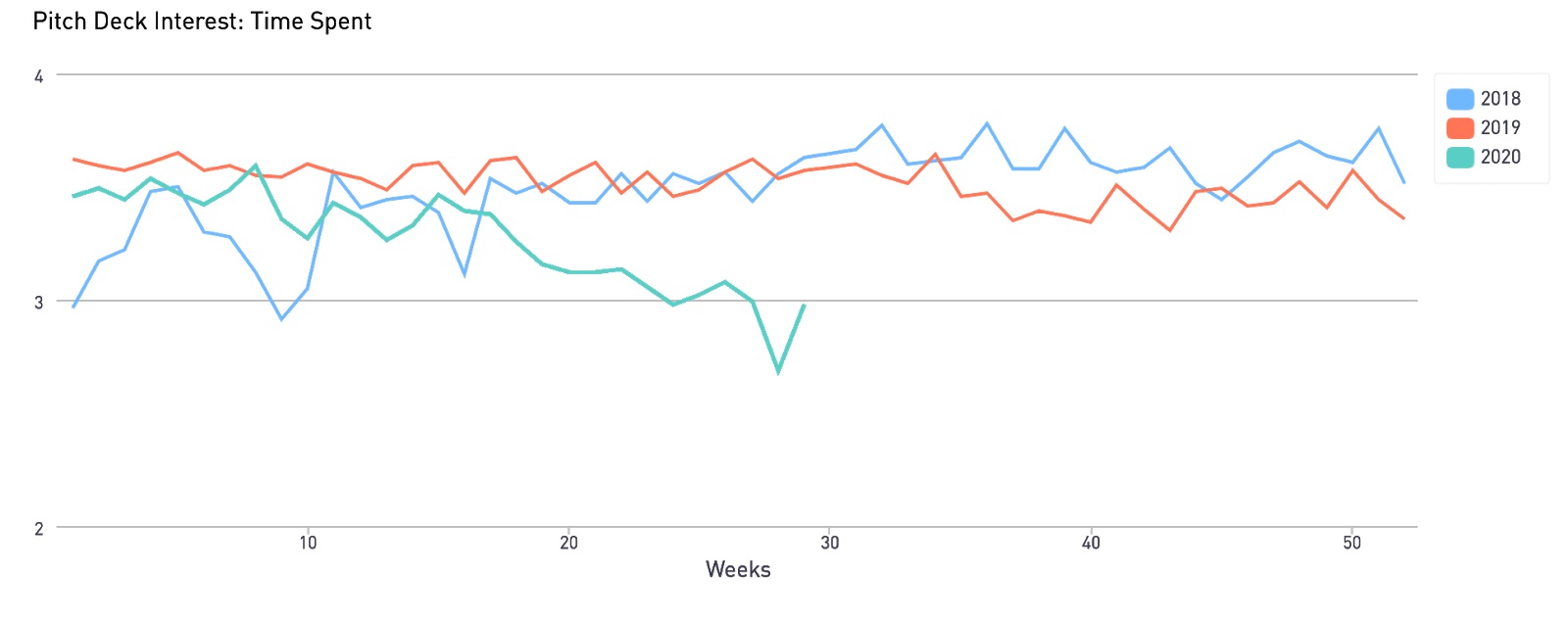
But not only can we see that VCs are interacting with a lot of decks, we also can determine the quality of those interactions. We measure how long a VC spends reading each deck. From our previous research we know that the average pitch deck interaction is less than 3.5 minutes. But the amount of time VCs spent reading each deck in Q2 steadily declined, going below two minutes toward the end of the quarter. This tells us VCs are speeding through decks. That means they either know what they’re looking for and aren’t wasting time, or they’re scrutinizing decks less, opting for a Zoom call to hear more from a founder.
For founders, this means having a tight deck is even more important than before. Don’t have more than 20 slides, don’t send your appendix in your send-ahead deck and keep your slides concise and thoughtful (read our guide on how to put together a send-ahead deck here).

If you’re still not able to get a meeting with a VC during this intense shopping season, you may want to consider changing your fundraising strategy.

Founder timelines have changed

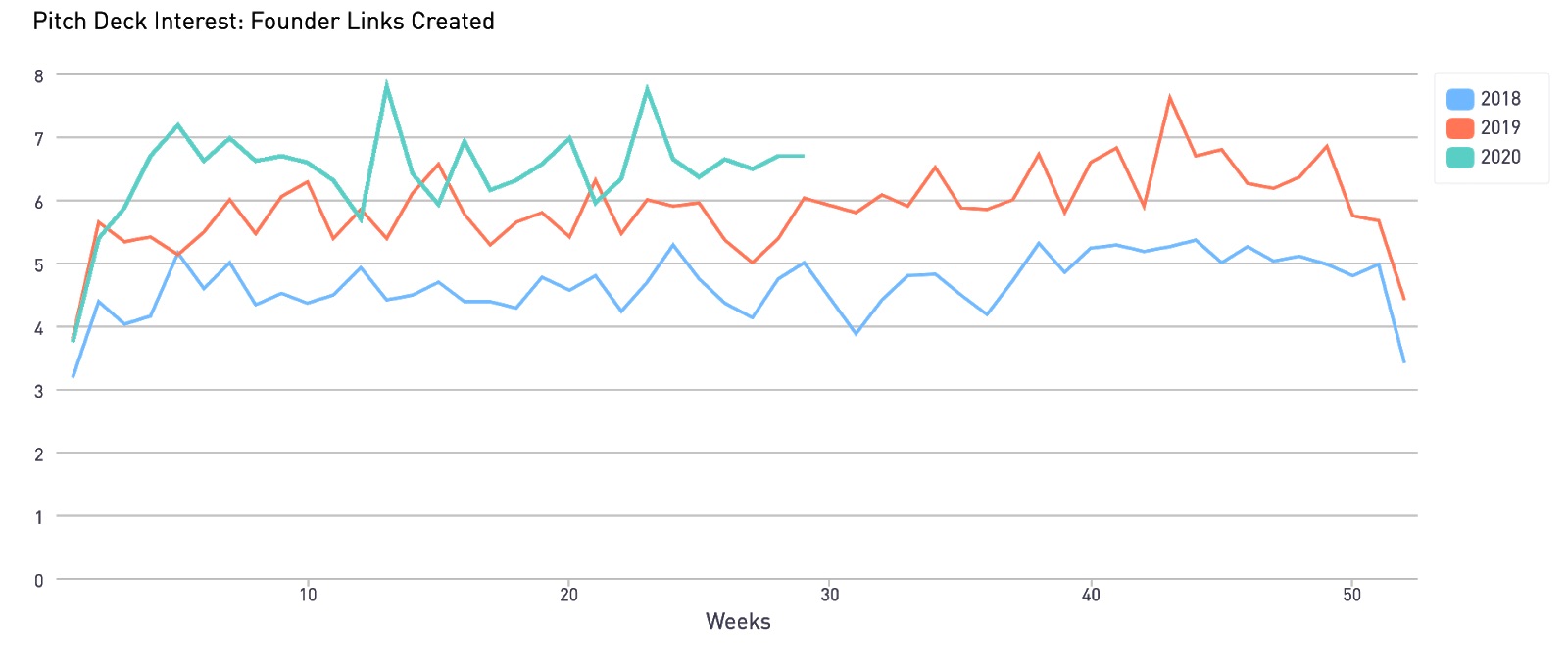
We can see over the last quarter that there have been clear spikes in the amount of links founders are sending out. Founders sent out 11% more deck links in Q2 than they did in Q1, but what’s interesting is that the number of links created actually dropped below 2019 levels on three separate occasions. So while founders might have been rushing to send their deck out during unstable times, there were plenty of weeks where founders were hanging back.

This conflicting story can tell us several things. First, founders have most likely condensed their fundraising efforts. According to our research earlier this year, the average pre-seed round takes longer than three months to complete. For those fundraising during a pandemic, three months can seem like a lifetime. This is not only due to the logistics of setting meetings with VCs who have packed calendars, but also the iteration process of receiving feedback from a potential investor, working on your deck, then sending it out to new targets. With global uncertainty, many founders likely decided to shorten their time away from their business by reducing their fundraising efforts to just a few weeks.

Second, due to aggressive cost cutting at the beginning of the pandemic, many founders found themselves with more runway than they expected. In fact, according to a recent survey we did, nearly 50% of founders changed their fundraising timeline by either moving it forward or delaying it. Founders that could afford to decided to avoid the volatile fundraising marketplace in an effort to preserve their valuations.
We’re looking at more than displaced interest from March

While it was easy during April and early May to think the fundraising marketplace was experiencing delayed activity due to the crash in March, the sustained interest makes it hard to believe that’s still the case, especially taking into account seasonality. The last week of the quarter saw a 37% increase in interest over 2019 and an 18% increase over 2018. With that level of activity, we’ve clearly entered a new normal for fundraising.

While valuations might be fluctuating, it’s quite clear VCs are shopping. To figure out why, you don’t have to look any further than the 2008 financial crisis. The businesses born out of crises tend to address real, systemic problems that require big, bold fixes. And the pandemic has certainly laid bare many societal issues that are worth addressing.

What Q3 and Q4 could look like based on current trends

If it’s clear that VCs are shopping, and it’s clear that this isn’t displaced interest from earlier this year, what does that mean for the future? We would normally see an increase in founder activity starting in late summer, leading to peak VC interest in the fall. Founder activity has been up and down, and VC interest has been steadily rising, which tells us there’s still pent-up demand to deploy capital. We should also see many founders who delayed their fundraising efforts enter the marketplace in the next few months. If pandemic conditions worsen, we might also see founders who had decided to push their fundraising efforts to next year moving their timelines forward.

If the current level of interest represents the new normal for VCs, we expect it to only increase as we enter the fall. And with more founders coming online in early to late fall, that pent-up demand should result in an increasingly active market. If you’re a founder, I would recommend kicking off your fundraise now in order to capitalize on the increased interest from investors and decreased competition for at least the first pitch meeting.

05 Aug 2020

Q3 2020 is primed to be an intense shopping season for VCs

With the high possibility of an extremely active fundraising marketplace for the rest of the year, founders need to know how to take advantage of it. As you can see from the DocSend Pitch Deck Interest Metrics, spikes in the marketplace previously have resulted in some pretty specific behaviors by VCs.

Here are some tips on how to use the increasing levels of VC interest to your advantage.

VCs are spending less time on your deck, so get to the point

We’re seeing record low time spent per pitch deck. We know from previous research that VCs spend on average 3.5 minutes per pitch deck. But over the last quarter that time has dipped below three minutes. That can actually be a good and a bad thing. It implies that VCs are streamlining their process of looking at decks, which means they most likely know what they want. The downside of this is if you break a few cardinal rules right now your deck could end up in the reject pile.

From our research, VCs expect a deck to be around 20 pages. They expect a straightforward narrative that starts with your problem, leading to the solution, and then your product and business model. Our data found that VCs respond best to 35-50 words per slide (too few words per slide is also an issue; you want to offer enough context for your deck to make sense without you presenting it). The only place you can increase your word count is on your Team page. Our data shows the average number of words on a successful Team slide is 80. This gives you room to highlight the founding team’s relevant experience and show how you’re uniquely suited to build your business.

You have to include a “why now” slide and it should mention COVID-19

We already know that investors respond well to a Why Now slide. Our research shows that 54% of successful pitch decks included a Why Now slide, where only 38% of failed decks included it. That slide now has to work twice as hard. We’re hearing from investors that they expect to see information in your pitch deck about how your business has been affected by COVID-19 and how you plan to manage that impact moving forward. Even if the pandemic has had no material effect on your business, the investor will still have the question. Get out in front of it with a well-formed response near the beginning of your deck.

05 Aug 2020

Samsung’s Galaxy Note 20 ships August 21, starting at $1,000

Samsung promised a lot of gadgets for today’s big Unpacked event — five in all, as a matter of fact. As expected, the big headliners — both figuratively and literally — are the latest additions to the popular Note line.

Also unsurprising is the company’s positioning the Note 20 — along with the rest of today’s new hardware — as  “devices […] that seamlessly integrate to empower consumers navigating a rapidly changing world.” It’s mostly a bit of hyperbole as the company looks to position a pair of pricey flagship phones in the midst of an extraordinarily unprecedented year.

Like the Galaxy S20 before it, Samsung’s skipping 10 full numbers here for the sake of consistency. On a whole, nothing here jumps out as a huge leap in progress, a fact due in no small part to the company’s six-month flagship cycle. There are, however, a number of notable upgrades on-board here, as the company works to retain its position among the bleeding edge of smartphone advances.

Image Credits: Samsung

Samsung was, of course, one of the first company’s to embrace 5G, employing the next-gen technology well before achieving any sort of saturation point. The company has also embraced the budget side of the spectrum with the Galaxy A71 5G. It follows then, the Note line is the company’s “first fully 5G-capable Note,” meaning that the technology is no longer just the realm of the more premium model — and that it utilizes both the Sub-6 and mmWave versions of 5G technology.

Once again, the Note line is divided into two distinct models: this time out, the Note 20 and Note 20 Ultra, starting at $1,000 and $1,300, respectively. Much has been made of Samsung’s attempts to move the devices at a — less than opportune time. The fact of the matter is people aren’t really buying handsets these days. For one thing, lots of people just don’t have the sort of disposable income they did just a year ago. And what money is going to technology is generally being spent on things like PCs, as remote becomes the new norm for office workers.

Image Credits: Samsung

Handsets costing $1,000+ had already become a tough sell in recent years, with an overall market slow down — and recent figures from third-party analysts show that the COVID-19 pandemic hasn’t been kind to Samsung’s sales bottom line.

All of that said, the Note is still very much the standard by which all other phablets are judged. Plenty of other companies have tried and failed to launch competitive pocket productivity devices, and for its nearly decade-long existence, no one has been able to come close to the Galaxy Note.

As is its custom, Samsung continues to press the bounds of screen size on the line. The Note 20 and Note 20 Ultra sport 6.7 and 6.9-inch displays, respectively. Both are up from the 10, which sported a 6.3 and 6.8-inch screen. The Ultra also sports a 120Hz refresh rate.

For the first Samsung launch in recent memory, I can’t tell you what kind of job the company has done keeping the footprint down in spite of an ever-enlarging screen — for reasons that are probably obvious, I haven’t seen or touched the device in person yet. Soon, I’m told.

Image Credits: Samsung

What I can say is that the dimensions have increased, but only by a millimeter or so. And both models have added somewhere between 10-30 grams apiece. The device retains the familiar three-camera array, albeit with a redesigned enclosure. The Note Ultra borrows some key cues from the S20 Ultra. The biggest additions are the 108-megapixel wide-angle and the Space Zoom technology, which brings up to 50x super zoom (only 5x optical) on the Ultra and 30x (3x hybrid optical) on the 20. The Ultra also sports laser auto focus for quicker shots, while the 20 sports a 64-megapixel telephoto. Both models can now shoot video in 8K, as well.

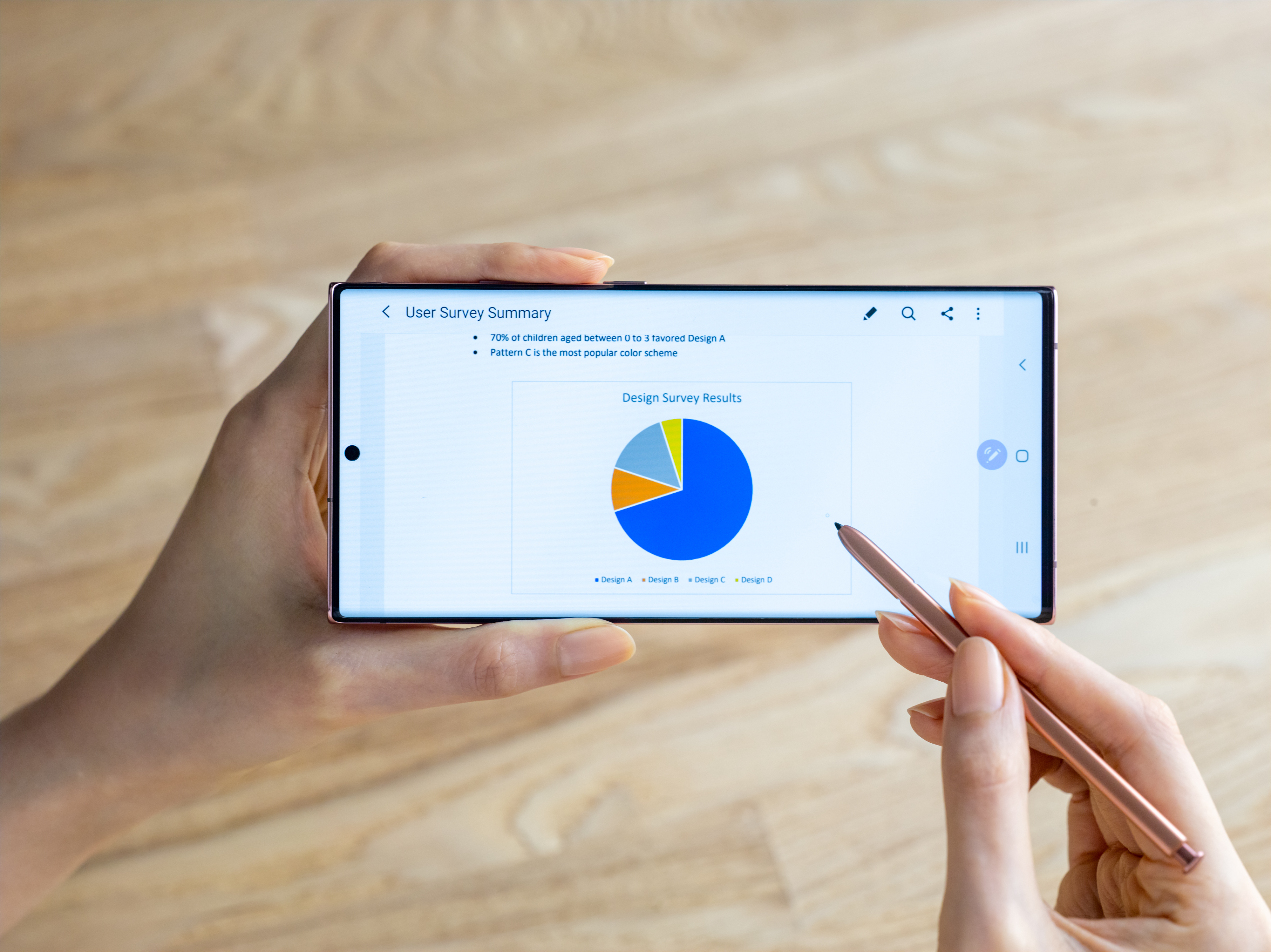
The fan favorite S Pen gets a bunch of updates, including increased precision and responsiveness, along with gesture controls that do things like shoot screenshots or return to the home screen. The stylus can be used as a remote control as well, up to 30 feet, courtesy of Bluetooth Low Energy. The associated Notes app features better cloud syncing and a new recording feature, which associates time stamps with written notes (there’s no live transcription à la Google Recorder, however).

[gallery ids="2026979,2027015,2027014,2027013,2027012,2027011,2027010,2027009,2027008,2027007,2027006,2027005,2027004,2027003,2027002,2027001,2027000,2026999,2026998,2026997,2026996,2026995,2026993,2026992,2026991,2026990,2026989,2026988,2026987,2026986,2026985,2026982,2026981,2026980"]

Samsung and Microsoft have broadened their partnership here. That includes the ability to access Samsung notes and mirror the mobile device on a Windows 10 PC. And mid-next month, the Note 20 will be getting Xbox Game Pass access, with 100+ games, as Samsung looks to position its high-end handsets as more serious mobile gaming devices.

There is, as ever, DeX support, letting users mirror the system to a connected smart TV. In spite of rumors around Samsung’s waning interest with Bixby, the company tells me that the smart assistant “remains consistent” with what has been offered on previous devices. A fun addition also worth pointing out is the ability to pair the new Galaxy Buds Live as microphones for when you’re shooting a subject talking. UWB (ultra-wideband) is another new addition that lets users share files when in close proximity and will double as a digital key at some point down the road.

Image Credits: Samsung

The models are powered by the new Snapdragon 865+. The Ultra ships with 12GB of RAM and either 128GB or 512GB of storage. The Note 20 has 8GB of RAM and 128GB of storage. Their batteries are 4,500mAh and 4,300mAh, respectively. Pre-orders open tomorrow, and they’ll start shipping August 21.

05 Aug 2020

Samsung’s new Galaxy Buds Live bring active noise cancelation for $170

Samsung’s made quality earbuds for a number of years now. They’re never particularly exciting or innovative, but they’re always a solid choice in an overcrowded market. Today’s big Unpacked event adds yet another model to the growing list of options.

Already sporting the Galaxy Bean nickname based on early leaks, and for reasons that should be painfully obvious, the most notable thing here is the addition of Active Noise Canceling. That’s a feature that has most often been reserved for higher-priced models.

Image Credits: Samsung

For $170, these are certainly worth considering, even if they’re not quite as premium as the Sony WF-1000XM3 or AirPods Pro. But honestly, not everyone is looking to shell out more than $200 for a pair of wireless earbuds.

The Galaxy Buds Live sport a 12mm speaker (larger than what’s found on the Buds+), coupled with a bass duct for increased low-end sound. There are three mics on board, which can double for the phone microphone while shooting video with a connected Note 20. They’re IPX2 water resistant and feature removable tips with two different sizes for a better fit.

[gallery ids="2026955,2026971,2026970,2026969,2026968,2026967,2026966,2026965,2026964,2026963,2026962,2026961,2026960,2026959,2026958,2026957,2026956"]

The battery should give you eight hours on a charge (down to six with active noise canceling on), plus another 21 hours via the carrying case. Five minutes of charging, meanwhile, should get you an hour of playback. The Buds Live are available now through Samsung’s site.

05 Aug 2020

The bezel is back for Samsung’s Galaxy Watch 3

The rotating bezel has always felt like Samsung’s secret weapon in the smartwatch battle. It is, without question, the best input device. No one, not even Apple’s crown, comes close. For that reason, it was a bit baffling when the company opted to drop it for its Active line of watches. Samsung attempted to convince us all that the “digital bezel” was just as good. It definitely, definitely wasn’t.

Thankfully, the newly announced Watch 3 brings back the bezel. The company is quick to note that it’s a “slimmed down” version, which, fair enough. The company’s smartwatches — like its smartphones — can tend toward the bulky. And it’s definitely possible to have too much hardware on one’s wrist.

Overall, the timepiece is 14% thinner and 15% lighter than its predecessor, in both the 41mm and 45mm versions, which offer a larger screen in spite of the smaller frame. The company is also promising two full days of battery life on a charge — a necessary feature with the introduction of National Sleep Foundation-approved sleep tracking, which measures breathing, movement and REM cycles to give you a better picture of your nocturnal activities.

There are a number of other health features on board, as well, including VO2 max blood oxygen tracking, fall detection, a running coach and activity tracking for 40 exercises (seven of which can be autodetected). The watch also features an EKG reader and blood pressure detection, both of which will be available in Korea at launch (U.S. users will have to wait for FDA approval to get in on that action).

The Watch 3 goes on sale tomorrow, priced at $400 and $430 for the 41mm and 45mm versions, respectively. There’s also an LTE-enabled version of each, priced at $450 and $480.

05 Aug 2020

The Galaxy Tab S7 will bring 5G to Samsung’s tablet line

Samsung’s going all in on 5G. The company was an early adopter for the next-gen wireless technology and has just offered it across the newly announce Galaxy Note 20. Turns out its new tablets will be getting the connectivity as an upgrade option.

The Galaxy Tab S7 and S7+ were among the five devices launched at today’s unpacked event, arriving as “the first tablets that support 5G available in the United States,” according to the associated press material. And certainly they’re ahead of the curve here, though I’d expect to see the option become more common in the coming year, as carriers push toward a saturation point.

The two models sport 11- and 12.4-inch screens, respectively, coupled with four speakers featuring Dolby Atmos and Samsung’s own AKG tuning. The insides look fairly uniform, with either 6GB or 8GB of RAM and 128GB or 256GB of storage, augmentable up to 1TB by way of a microSD card. The on-board batteries are pretty nicely sized at 8,000mAh and 10,900mAh on the S7 and S7+, respectively. Definitely curious to see how much of an impact 5G will have on life.

The tablets are arriving at some point this fall, starting at $650 for the S7 and $850 for the S7+. No word yet on pricing for timing or the 5G models, however, but Samsung promises they’ll be hitting the States at some point.

05 Aug 2020

Stix, offering D2C pregnancy and ovulation tests, raises $1.3 million in seed funding

Stix, a direct-to-consumer women’s health brand, today announced the close of a $1.3 million seed round. Investors such as BDMI, Rogue Women’s Fund, Vamos Ventures, Founders Factory New York, as well as angels like Heidi Zak (ThirdLove) Laurence Franklin (Coach) and Steve Gutentag and Demetri Karagas (30 Madison) participated in the round.

There is no shortage of men’s health startups out there to ease the awkwardness and stress of getting products for hair loss or erectile disfunction. But when it comes to something as common and straightforward as purchasing a pregnancy test, women must still make a run to the drug store.

Until Stix.

Stix offers competitively priced pregnancy tests and ovulation tests that customers can purchase online. As a diagnostics product, Stix is FDA-approved and everything from the instructions to the promotional language has to go through the approval process, according to Plotch. The cofounder and CEO says that both the pregnancy tests and ovulation tests are more than 99 percent accurate.

The Stix pregnancy test costs $13, and includes two tests, free shipping and instructional materials. The ovulation test, which includes seven tests, costs $17.

The company has also taken measures to ensure that the delivery of these products is discreet for customers who don’t want their roommates, whether it’s a live-in partner or parent or just a regular roommate, to know they’re purchasing a pregnancy test.

Stix uses PayPal to stay discreet on the credit card bill, and doesn’t include ‘Stix’ on the return address of the shipped products.

“The entire experience is really based on learning and education,” said Plotch. “We believe that all women deserve access to these products and peace of mind throughout the experience. So, unlike other brands, we don’t focus on the outcome of the test. We don’t care whether or not you’re trying to get pregnant. We just want to make sure that you have accurate results and the information that you need to understand them.”

Beyond the physical products, Stix also offers the Stix Library, an educational resource online that includes content around Stix products (of course), pregnancy, ovulation, birth control, and more general health information.

“What we’ve found is that there is a huge problem around the lack of proper sex education in this country,” said Plotch, adding that it provides an opportunity for Stix to fill in the gaps.

When asked if Stix would ever get into the birth control space, Plotch said that Stix has “high goals” and that “nothing is out of the question in the near future.”

Stix is currently a team of three women, and plans to use the funding to continue growing the team, which is currently 100 percent white. Plotch added that the company has a commitment to diversity and that the team will “definitely look different” on the heels of this round.

05 Aug 2020

Mozper launches digital banking service for Latin American parents and kids

Mozper, a new service launching from Y Combinator’s latest cohort to provide digital banking services, takes its name from the English words for money, prosperity, and generation Z, according to co-founder Yael Israeli.

A former banker at Lehman Brothers and Barclays Capital, Israeli worked as a consultant for Copa Airlines and then as an independent advisor from her home in Panama.

It was during conversations with her husband’s roommate from Israel, Gabriel Roizner, a serial entrepreneur who built consumer startups in Latin America (like Disca, the online fashion community), that Mozper was born.

Roizner had spent years wandering from Uruguay to France to Brazil to Israel to Mexico and now, settled in Miami, Roizner was ready to start another business.

So the two began planning a service for Latin American consumers that would mirror the kinds of options parents and children have in the US and Europe through startups like Greenlight and GoHenry. Last year, in a sign of how well the business resonates with investors, Greenlight Card raised $54 million in funding to roll out its banking business for parents to teach kids about money.

The team added longtime tech developer Pablo Klestorny as chief technology officer and co-founder and set out to raise capital for their business.

Mozper co-founders Gabriel Roizner, Pablo Klestorny, and Yael Israeli. Image Credit: Mozper

Investors know a good thing when they’ve seen it before, so Mozper has already managed to raise roughly $1.5 million on the back of the company’s founders’ personal connections and a business plan that’s proven successful.

What’s different in Latin America is the massive disparity in financial education. Only thirty percent of Latin Americans have received financial education, according to Israeli. So a service like Mozper’s is far more necessary, she says. 

Like the incumbents in the US and Europe, Mozper intends to charge a fee for access to the card and will provide a debit card and an app that both parents and their children can access.

Mozper’s initial market is Mexico, where it launched in late July. The company uses Toka as its sponsor bank and is working on getting its fintech license from the Mexican government. Mozper has also partnered with Visa on card processing services, according to Israeli.

05 Aug 2020

Direct-to-consumer cat food startup Smalls raises $9M

While dog owners have plenty of direct-to-consumer options if they want to order pet food online, we haven’t seen a similar wave of startups for cats. But that may be starting to change.

Earlier this year, I wrote about Cat Person, a startup backed by Harry’s Labs offering a variety of cat care products, including food. And Smalls, a cat food startup that launched in 2018, is announcing today that it has raised $9 million in Series A funding.

Co-founders Matt Michaelson (CEO) and Calvin Bohn (COO) said that it’s not simply a matter of taking the D2C dog food model and applying it to cats.

“The traditional sort of MO for companies in the pet care space is to do everything for dogs first,” and then expand into cat products, Bohn said.

Michaelson argued that this means companies “often overlooked the nutritional needs of cat.” In particular, he said, “We found that we needed a much broader range of products to really succeed. Cats are picky because they’re apex predators.”

So Smalls offers a variety of food options, including what it says is fresh, human-grade chicken and beef; freeze-dried chicken, turkey and duck; plus other treats (and non-food products like litter and toys).

Smalls

Image Credits: Smalls

Michaelson and Bohn started out by cooking the food in the kitchen of their New York City apartments, then moved into what was then known as Brooklyn Foodworks. Smalls now manufactures its cat food in a facility in Chicago.

They acknowledged that the cost can be a bit higher than what cat owners are used to paying — the exact comparison will depend on the brand and quality you currently buy, but after taking a quick quiz on the Smalls website, I was offered subscription plans that cost around $3 or $4 per cat per day. Michaelson noted that “retention is not correlated to income” (so Smalls customers aren’t just wealthy cat owners), and he argued that investing healthy food for your cat could save money down the road

“We don’t have studies to say that yet, but at the same time, you would naturally assume eating better food is going to be a good investment in yourself,” he said.

Bohn added that when cat owners switch to Smalls, they quickly notice the difference: “Within weeks, their cats were sleeping better at night, their coats were more lustrous, their stool smelled better.” (Journalists who tried it out seem to agree.)

The Series A brings Smalls’ total funding to $12 million. It was led by Left Lane Capital (whose partner Jason Fiedler previously invested in The Farmer’s Dog), with participation from Founder Collective and Companion Fund.

“While we’ve seen a proliferation of highly successful healthy dog food brands, the cat food market has remained completely ignored,” Fiedler said in a statement. “Smalls has successfully developed a brand, product mix, supply chain and customer experience that is specifically optimized for cats that no one else has.”

Michaelson said Smalls currently has “several thousand” active subscribers, up 4x year-over-year. And while the pandemic has created some supply chain challenges, it also led to “a huge rise in pet adoption,” as well as convincing some owners that they should look for alternatives to their local pet store.

“Because we’re seeing this big movement towards the direct-to-consumer side of things with COVID, it’s really an opportunity to lean into that and grow faster,” he said.

05 Aug 2020

Kubermatic launches open source service hub to enable complex service management

As Kubernetes and cloud native technologies proliferate, developers and IT have found a growing set of technical challenges they need to address, and new concepts and projects have popped up to deal with them. For instance, operators provide a way to package, deploy and manage your cloud native application in an automated way. Kubermatic wants to take that concept a step further, and today the German startup announced KubeCarrier, a new open source, cloud native service management hub.

Kubermatic co-founder Sebastian Scheele says three or four years ago, the cloud native community needed to solve a bunch of technical problems around deploying Kubernetes clusters such as overlay networking, service meshes and authentication. He sees a similar set of problems arising today where developers need more tools to manage the growing complexity of running Kubernetes clusters at scale.

Kubermatic has developed KubeCarrier to help solve one aspect of this. “What we’re currently focusing on is how to provision and manage workloads across multiple clusters, and how IT organizations can have a service hub where they can provide those services to their organizations in a centralized way,” Scheele explained.

Scheele says that KubeCarrier provides a way to manage and implement all of this, giving organizations much greater flexibility beyond purely managing Kubernetes. While he sees organizations with lots of Kubernetes operators, he says that as he sees it, it doesn’t stop there. “We have lots of Kubernetes operators now, but how do we manage them, especially when there are multiple operators, [along with] the services they are provisioning,” he asked.

This could involve provisioning something like Database as a Service inside the organization or for external customers, while combining or provisioning multiple services, which are working on multiple levels and a need a way to communicate with each other.

“That is where Kubecarrier comes in. Now, we can help our customers to build this kind of automation around provisioning, and service capability so that different teams can provide different services inside the organization or to external customers,” he said.

As the company explains it, “KubeCarrier addresses these complexities by harnessing the Kubernetes API and Operators into a central framework allowing enterprises and service providers to deliver cloud native service management from one multi-cloud, multi-cluster hub.”

KubeCarrier is available  on GitHub, and Scheele says the company is hoping to get feedback from the community about how to improve it. In parallel, the company is looking for ways to incorporate this technology into its commercial offerings and that should be available in the next 3-6 months, he said.