Year: 2021

15 Jul 2021

Researchers match DeepMind’s AlphaFold2 protein folding power with faster, freely available model

DeepMind stunned the biology world late last year when its AlphaFold2 AI model predicted the structure of proteins (a common and very difficult problem) so accurately that many declared the decades-old problem “solved.” Now researchers claim to have leapfrogged DeepMind the way DeepMind leapfrogged the rest of the world, with RoseTTAFold, a system that does nearly the same thing at a fraction of the computational cost. (Oh, and it’s free to use.)

AlphaFold2 has been the talk of the industry since November, when it blew away the competition at CASP14, a virtual competition between algorithms built to predict the physical structure of a protein given the sequence of amino acids that makes it up. The model from DeepMind was so far ahead of the others, so highly and reliably accurate, that many in the field have talked (half-seriously and in good humor) about moving on to a new field.

But one aspect that seemed to satisfy no one was DeepMind’s plans for the system. It was not exhaustively and openly described, and some worried that the company (which is owned by Alphabet/Google) was planning on more or less keeping the secret sauce to themselves — which would be their prerogative but also somewhat against the ethos of mutual aid in the scientific world.

That concern seems to have been at least partly mooted by work from University of Washington researchers led by David Baker and Minkyung Baek, published in the latest issue of the journal Science. Baker, you may remember, recently won a Breakthrough Prize for his team’s work combating COVID-19 with engineered proteins.

The team’s new model, RoseTTAFold, makes predictions at similar accuracy levels using methods that Baker, responding to questions via email, candidly admitted were inspired by those used by AlphaFold2.

“The AlphaFold2 group presented several new high level concepts at the CASP14 meeting. Starting from these ideas, and with a lot of collective brainstorming with colleagues in the group, Minkyung has been able to make amazing progress in very little time,” he said. (“She is amazing!” he added.)
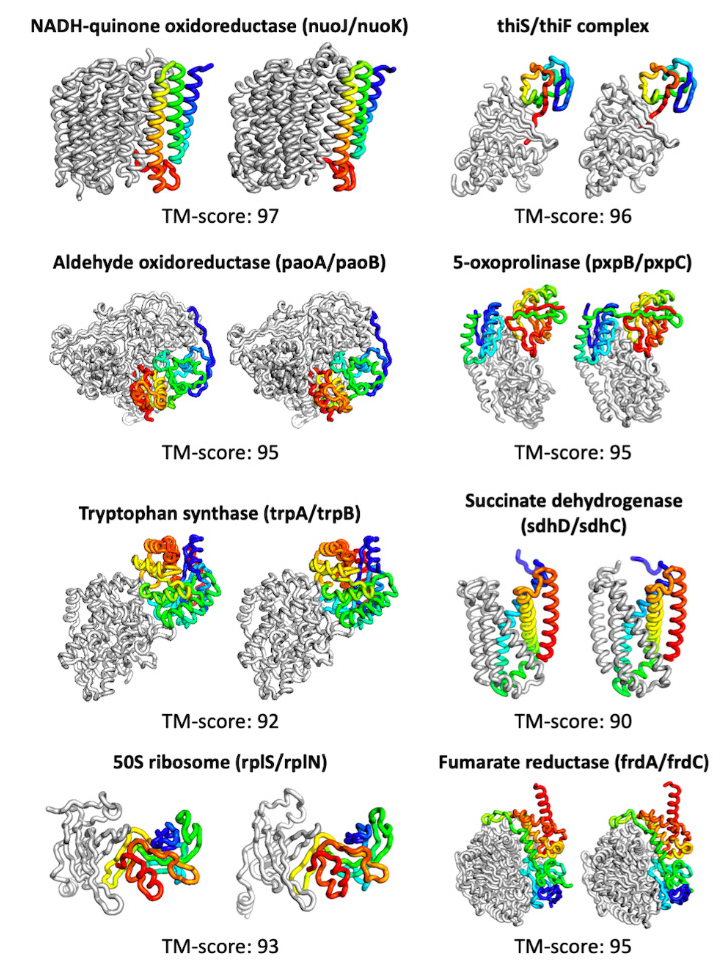
Examples of predicted protein structures and their ground truths. A score above 90 is considered extremely good.

Baker’s group more or less placed second at CASP14, no mean feat, but hearing DeepMind’s methods described even generally set them on a collision course. They developed a “three-track” neural network that simultaneously considered the amino acid sequence (one dimension), distances between residues (two dimensions), and coordinates in space (three dimensions). The implementation is beyond complex and far outside the scope of this article, but the result is a model that achieves almost the same accuracy levels — levels, it bears repeating, that were completely unprecedented less than a year ago.

What’s more, RoseTTAFold accomplishes this level of accuracy far more quickly — that is, using less computation power. As the paper puts it:

DeepMind reported using several GPUs for days to make individual predictions, whereas our predictions are made in a single pass through the network in the same manner that would be used for a server…the end-to-end version of RoseTTAFold requires ~10 min on an RTX2080 GPU to generate backbone coordinates for proteins with less than 400 residues.

Hear that? It’s the sound of thousands of microbiologists sighing in relief and discarding drafts of emails asking for supercomputer time. It may not be easy to lay one’s hands on a 2080 these days, but the point is any high-end desktop GPU can perform this task in minutes, instead of requiring a high-end cluster running for days.

The modest requirements make RoseTTAFold suitable for public hosting and distribution as well, something that might never have been in the cards for AlphaFold2.

“We have a public server that anyone can submit protein sequences to and have the structures predicted,” Baker said. “There have been over 4500 submissions since we put the server up a few weeks ago. We have also made the source code freely available.”

This may seem very niche, and it is, but protein folding has historically been one of the toughest problems in biology and one towards which countless hours of high-performance computing have been dedicated. You may recall Folding@Home, the popular distributed computing app that let people donate their computing cycles to attempting to predict protein structures. The kind of problem that might have taken a thousand computers days or weeks to do — essentially by brute-forcing solutions and checking for fit — now can be done in minutes on a single desktop.

The physical structure of proteins is of utmost importance in biology, as it is proteins that do the vast majority of tasks in our bodies, and proteins that must be modified, suppressed, enhanced, and so on for therapeutic reasons; first, however, they need to be understood, and until November that understanding could not be reliably achieved computationally. At CASP14 it was proven to be possible, and now it has been made widely available.

It is not, by a long shot, a “solution” to the problem of protein folding, though the sentiment has been expressed. Most proteins at rest in neutral conditions can now have their structure predicted, and that has huge repercussions in multiple domains, but proteins are seldom found “at rest in neutral conditions.” They twist and contort to grab or release other molecules, to block or slip through gates and other proteins, and generally to do everything they do. These interactions are far more numerous, complex, and difficult to predict, and neither AlphaFold2 nor RoseTTAFold can do so.

“There are many exciting chapters ahead… the story is just beginning,” said Baker.

If you’re curious about the science and the potential repercussions, consider reading this much more detailed and technical account of the methods and possible next steps written in the wake of AlphaFold2’s CASP14 performance.

15 Jul 2021

The latest distraction-free Freewrite features an Ernest Hemingway monogrammed attaché case

In our review last year, we called the Freewrite Traveler “outstanding, but expensive.” The latest version of Astrohaus’ distraction-free word processing hardware tool does little to address the latter concern. In fact, the Ernest Hemingway Freewrite Signature Edition comes in at a full $300 more than its predecessor.

But the latest edition of the hardware strives to be something more than just a utilitarian writing tool. In fact, Astrohaus secured the blessing from the Ernest Hemingway estate for the new version of a product that began life as the “Hemingwrite” for its 2014 Kickstarter campaign.

The product strives to live up to some of the ethos and/or aesthetics of “The Sun Also Rises” author. “Even though we changed the name to Freewrite in 2015, the original Hemingwrite concept is what captured the world’s attention,” co-founder and CEO Adam Leeb said in a release tied to the news. This time out, however, the company secured the family’s blessing.

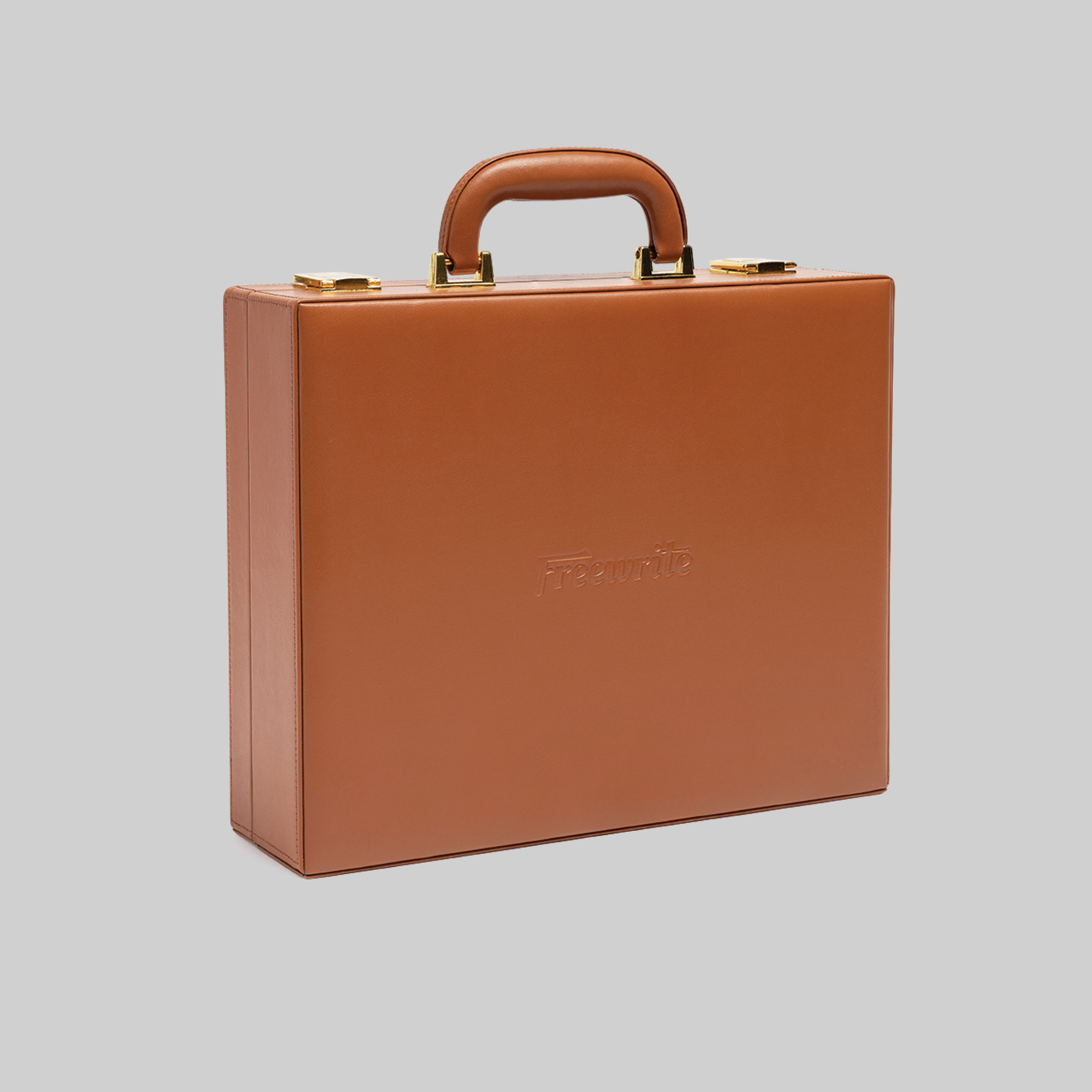
The new version trades portability for aesthetic, with the inclusion of an attaché case that brings to mind both writers’ tools of yore and, more recently, retro turntables from companies like Crosley. There were, of course, travel typewriters that came with their own carrying case, but the Freewrite’s significantly slimmer profile makes the setup far more compact.

Here’s Astrohaus’ write-up of the hardware [best read in a Ron Burgundy voice]:

The Hemingwrite features an exclusive design with green keycaps and a hand-polished aluminum chassis that is uncoated and will develop a unique patina over time. Each unit is finished by hand – no two are exactly alike. Every Hemingwrite comes with a Hemingway monogramed cleaning cloth and an exclusive attaché case to safely store the device and elegantly transport it anywhere inspiration is found. The hard-sided Hemingwrite Attaché Case is crafted from rich cognac leather and a cream-colored velvet lining. A deep pocket is located inside to store books, pens, notebooks, or other pieces of writing inspiration.

If you’re looking for something to reduce the distractions that come from writing on a laptop, while ramping up the aesthetic homage to days of yore, the Ernest Hemingway Freewrite Signature Edition is available now for $899.


15 Jul 2021

American Express taps startup BodesWell for expansion into financial planning

American Express is branching out into financial planning, with a little help from a seven-person startup called BodesWell.

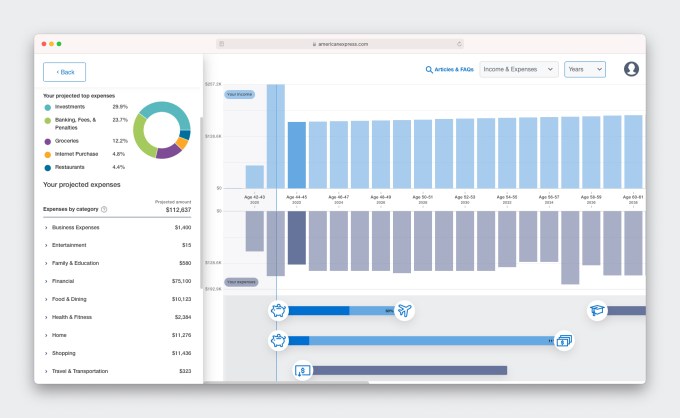
This week, the credit card giant launched a pilot of its first self-service digital financial planning tool, dubbed “My Financial Plan (MFP).” The six-month pilot kicked off on July 11 with about 25,000 select Amex cardmembers.

American Express quietly invested in BodesWell in late 2020 via its venture arm, Amex Ventures. Since then, the financial services behemoth teamed up with the tiny startup to develop the financial planning tool for its users. The new product is designed to give users a complete picture of their financial health and help them make and achieve major life goals, such as buying a house or retirement.

TechCrunch talked with Amex Ventures’ Julia Huang, who led the investment and strategy around the new product, and BodesWell co-founder and CEO Matthew Bellows to learn more details.

The pair actually met while serving on a panel together in 2019. 

“I was drawn to the fact that it was not a round-up savings tool, but rather a holistic tool to understand your full financial picture that could be used to plan for the financial impact of your life decisions,” Huang told TechCrunch.

Before deciding to invest in BodesWell, Huang says Amex Ventures — which over time has backed more than 70 startups — had “evaluated the space quite extensively.”

Huang introduced Bellows and his staff to Amex’s Digital Lab team and they embarked on jointly developing a specialized offering for Amex customers. (While Bellow is based in Boston, he says the startup is “globally distributed.”)

“Our goal is to democratize financial planning with our cardmembers by providing detailed insights and forecasts to help them with their holistic planning,” she told TechCrunch.

Image Credits: Amex Ventures

Bellows started BodesWell in early 2019 with the goal of empowering clients and customers to build their own financial plan.

“So much of financial planning software is aimed at financial advisors, and requires them to run it,” he said. “So, most people can’t get the benefits of financial planning…Our hope is to expand benefits to a lot more people.”

BodesWell will guide users in setting up a financial plan and will work even better if they sync with their other financial information via Plaid so it can “update in real time,” Huang said.

The tool “takes into account income, assets, expenses and liabilities — what cash flow looks like holistically so that users can drag & drop to plan life events,” Bellow said. 

An estimated 85 million American households don’t have a financial, planner for a variety of reasons — including mistrust of a planner’s intentions or just feeling overwhelmed by the process.

The product is free during the pilot phase and American Express hasn’t yet determined if it will charge for it afterwards.

“We’re gauging first for engagement and the power of the product for our customers,” Huang told TechCrunch. “We want to make sure the product resonates and that we iterate on the product to make sure it’s good for the broader population. Our primary goal is that our customers use it and find it valuable.”

Amex Ventures has formed “some level of partnership” with more than two-thirds of its portfolio companies, she added.

“We try to engage with our portfolio in that way, to provide value with our startup ecosystem,” Huang said.

For its part, BodesWell had previously raised about $1.5 million from investors such as Cleo Capital, Ex Ventures, Riot.vc, GritCapital and Argon Capital and angels like HubSpot CEO Brian Halligan and Kintent CEO Sravish Sridhar.

15 Jul 2021

GSA blocks senator from reviewing documents used to approve Zoom for government use

The General Services Administration has denied a senator’s request to review documents Zoom submitted to have its software approved for use in the federal government.

The denial was in response to a letter sent by Democratic senator Ron Wyden to the GSA in May, expressing concern that the agency cleared Zoom for use by federal agencies just weeks before a major security vulnerability was discovered in the app.

Wyden said the discovery of the bug raises “serious questions about the quality of FedRAMP’s audits.”

Zoom was approved to operate in government in April 2019 after receiving its FedRAMP authorization, a program operated by the GSA that ensures cloud services comply with a standardized set of security requirements designed to toughen the service from some of the most common threats. Without this authorization, federal agencies cannot use cloud products or technologies that are not cleared.

Months later, Zoom was forced to patch its Mac app after a security researcher found a flaw that could be abused to remotely switch on a user’s webcam without their permission. Apple was forced to intervene since users were still affected by the vulnerabilities even after uninstalling Zoom. As the pandemic spread and lockdowns were enforced, Zoom’s popularity skyrocketed — as did the scrutiny — including a technical analysis by reporters that found Zoom was not truly end-to-end encrypted as the company long claimed.

Wyden wrote to the GSA to say he found it “extremely concerning” that the security bugs were discovered after Zoom’s clearance. In the letter, the senator requested the documents known as the “security package,” which Zoom submitted as part of the FedRAMP authorization process, to understand how and why the app was cleared by GSA.

The GSA declined Wyden’s first request in July 2020 on the grounds that he was not a committee chair. In the new Biden administration, Wyden was named chair of the Senate Finance Committee and requested Zoom’s security package again.

But in a new letter sent to Wyden’s office late last month, GSA declined the request for the second time, citing security concerns.

“GSA’s refusal to share the Zoom audit with Congress calls into question the security of the other software products that GSA has approved for federal use.” Sen. Ron Wyden (D-OR)

“The security package you have requested contains highly sensitive proprietary and other confidential information relating to the security associated with the Zoom for Government product. Safeguarding this information is critical to maintaining the integrity of the offering and any government data it hosts,” said the GSA letter. “Based on our review, GSA believes that disclosure of the Zoom security package would create significant security risks.”

In response to the GSA’s letter, Wyden told TechCrunch that he was concerned that other flawed software may have been approved for use across the government.

“The intent of GSA’s FedRAMP program is good — to eliminate red tape so that multiple federal agencies don’t have to review the security of the same software. But it’s vitally important that whichever agency conducts the review do so thoroughly,” said Wyden. “I’m concerned that the government’s audit of Zoom missed serious cybersecurity flaws that were subsequently uncovered and exposed by security researchers. GSA’s refusal to share the Zoom audit with Congress calls into question the security of the other software products that GSA has approved for federal use.”

Of the people we spoke with who have first-hand knowledge of the FedRAMP process, either as a government employee or as a company going through the certification, FedRAMP was described as a comprehensive but by no means an exhaustive list of checks that companies have to meet in order to meet the security requirements of the federal government.

Others said that the process had its limits and would benefit from reform. One person with knowledge of how FedRAMP works said the process was not a complete audit of a product’s source code but akin to a checklist of best practices and meeting compliance requirements. Much of it relies on trusting the vendor, said the person, describing it like ” an honor system.” Another person said the FedRAMP process cannot catch every bug, as evidenced by executive action taken by President Biden this week aimed at modernizing and improving the FedRAMP process.

Most of the people we spoke to weren’t surprised that Wyden’s office was denied the request, citing the sensitivity of a company’s FedRAMP security package.

The people said that companies going through the certification process have to provide highly technical details about the security of their product, which if exposed would almost certainly be damaging to the company. Knowing where security weaknesses might be could tip off cyber-criminals, one of the people said. Companies often spend millions on improving their security ahead of a FedRAMP audit but companies wouldn’t risk going through the certification if they thought their trade secrets would get leaked, they added.

When asked by GSA why it objected to Wyden’s request, Zoom’s head of U.S. government relations Lauren Belive argued that handing over the security package “would set a dangerous precedent that would undermine the special trust and confidence” that companies place in the FedRAMP process.

GSA puts strict controls on who can access a FedRAMP security package. You need a federal government or military email address, which the senator’s office has. But the reason for GSA denying Wyden’s request still isn’t clear, and when reached a GSA spokesperson would not explain how a member of Congress would obtain a company’s FedRAMP security package

“GSA values its relationship with Congress and will continue to work with Senator Wyden and our committees of jurisdiction to provide appropriate information regarding our programs and operations,” said GSA spokesperson Christina Wilkes, adding:

“GSA works closely with private sector partners to provide a standardized approach to security authorizations for cloud services through the [FedRAMP]. Zoom’s FedRAMP security package and related documents provide detailed information regarding the security measures associated with the Zoom for Government product. GSA’s consistent practice with regard to sensitive security and trade secret information is to withhold the material absent an official written request of a congressional committee with jurisdiction, and pursuant to controls on further dissemination or publication of the information.”

GSA wouldn’t say which congressional committee had jurisdiction or whether Wyden’s role as chair of the Senate Finance Committee suffices, nor would the agency answer questions about the efficacy of the FedRAMP process raised by Wyden.

Zoom spokesperson Kelsey Knight said that cloud companies like Zoom “provide proprietary and confidential information to GSA as part of the FedRAMP authorization process with the understanding that it will be used only for their use in making authorization decisions. While we do not believe Zoom’s FedRAMP security package should be disclosed outside of this narrow purpose, we welcome conversations with lawmakers and other stakeholders about the security of Zoom for Government.”

Zoom said it has “engaged in security enhancements to continually improve its products,” and received FedRAMP reauthorization in 2020 and 2021 as part of its annual renewal. The company declined to say to what extent the Zoom app was audited as part of the FedRAMP process.

Over two dozen federal agencies use Zoom, including the Defense Department, Homeland Security, U.S. Customs and Border Protection, and the Executive Office of the President.

15 Jul 2021

Thales Alenia Space to develop pressurized modules for Axiom’s private space station

More details are beginning to emerge on Houston-based Axiom Space’s ambitious project to build and operate the world’s first commercial space station.

Thales Alenia Space, a European aerospace manufacturer, will develop the two pressurized modules of the Axiom Space Station. The two elements, which are scheduled to launch in 2024 and 2025, will dock to the International Space Station before eventually detaching and operating as fully independent, commercial station.

The two companies announced the signing of the final contract, valued at €110 million ($130 million), on Thursday. Each module will be able to accommodate four people. Thales will also be designing the micrometeoroid and debris protection system for each module.

The modules are still in their design phase, Thales Alenia said. The company recently completed development of the first module’s four radial bulkheads at its facility in Turin, Italy. The bulkheads, once connected, will form a cylinder. That structure will attach to the common berth mechanisms, parts of the module that will can connect to the ISS, and hatches.

The two modules have a long road ahead of them. Thales Alenia, a joint venture between French company Thales Group and Italian conglomerate Leonardo, will begin welding on the first module this September through to next year. That module will be sent to Axiom’s Texas facilities in July 2023, where Axiom will then integrate the core systems and prepare it for launch in 2024.

NASA tapped Axiom to build the first commercial living quarters for the ISS in January 2020. Once the ISS is decommissioned, Axiom’s station will detach and function as a commercial center for future missions and scientific experiments. It’s a major part of NASA’s plans to encourage the growth of the burgeoning low Earth orbit economy and the buildout of other private orbital labs and commercial facilities.

Axiom will also operate the first fully private mission to the ISS, scheduled for January 2022. Axiom Mission 1 will send four private astronauts to space onboard a SpaceX Crew Dragon, for an eight-day mission.

15 Jul 2021

GM to launch fleet charging service to power commercial EVs, even at home

GM and its new EV business unit BrightDrop are launching a fleet charging service as the automaker aims to ramp up its bet on connected and electric commercial vehicles.

The service, branded Ultium Charge 360 fleet charging service in a nod to GM’s new electric architecture and batteries that will be the foundation of its future EV plans, offers many of the tools that a commercial delivery, sales or motor pool business might need. It also includes an effort to add home charging for drivers.

The charging service is the latest addition to BrightDrop, which was launched in January. The business unit offers commercial customers — starting with FedEx — an ecosystem of electric and connected products. BrightDrop has said it will begin with two main products: an electric van called the EV600 with an estimate range of 250 miles and a pod-like electric pallet dubbed EP1. BrightDrop is part of GM’s aim to reach 1 million EV sales globally by 2025.

GM and BrightDrop are launching the charging service with Duke Energy company eTransEnergy, EVgo, In-Charge Energy and Schneider Electric, four companies that can provide the infrastructure needed to keep the commercial vans properly powered.

On the home-charging front, GM said it will expand an existing agreement with Qmerit.

The service is meant to provide tools for fleet operators, which Alex Keros, GM’s  lead architect of EV Infrastructure noted in a call with reporters Thursday are important market growth segment and a critical piece of the electrification puzzle. The company looked at “how to put the right customer experiences together … you know, when you think about fleets these are cars that come home with employees for example, and we’ll have to help those companies and employees figure out charging in their home.”

15 Jul 2021

Revolut’s 2020 financial performance explains its big new $33B valuation

News broke this morning that Revolut, a U.K.-based consumer fintech player, raised a Series E round of funding worth $800 million at a valuation of $33 billion. Those figures are breathtaking not only due to their sheer scale, but also thanks to their radical divergence from Revolut’s preceding funding event.

At times, The Exchange, TechCrunch’s markets-and-startups column, runs into two topics worth exploring in a single day. Today is such a day. You can check out our earlier notes on the buy now, pay later startup market and Apple’s entrance into the BNPL space here. Now, let’s talk about neobanks.

As TechCrunch’s Ingrid Lunden wrote earlier today concerning the news:

This latest Series E is being co-led by Softbank Vision Fund 2 and Tiger Global, who appear to be the only backers in this round. It comes on the heels of rumors earlier this month Revolut was raising big. Revolut last raised about a year ago, when it closed out a Series D at $580 million, but what is stunning is how much its valuation has changed since then, growing 6x (it was $5.5 billion last year).

Stunning indeed.

Lunden also went on to report on the company’s changing financial picture based on Revolut’s recently released 2020 results. In this entry, we’re digging more deeply into those financial results and usage metrics detailed by the fintech megacorn.


The Exchange explores startups, markets and money. Read it every morning on Extra Crunch or get The Exchange newsletter every Saturday.


The picture that emerges is one of a company with a rapidly improving financial image, albeit with some blank spaces regarding recent customer growth.

15 Jul 2021

Announcing Sight Tech Global 2021

Shortly after the first  Sight Tech Global event, in December last year, Apple and Microsoft announced remarkable new features for mobile phones. Anyone could point the phone camera at a scene and request a “scene description.” In a flash, a cloud-based, computer vision AI determined what was in the scene and a machine-voice read the information. Learning that “a room contains three chairs and a table” might not seem like a big advance for the sighted, but for blind or visually impaired people, the new feature was a notable milestone for accessibility technology: An affordable, portable and nearly universal device could now “see” on behalf of just about anyone.

Technologies like scene description will be on the agenda at the second annual Sight Tech Global event, December 1-2, 2021. The free, sponsor-supported, virtual and global event will convene many of the world’s top technologists, researchers, advocates and founders to discuss how rapid advances in technology, many centered on AI, are altering — both improving and complicating — accessibility for people with sight loss.

Register today — it’s free.

At the heart of Sight Tech Global is the hard question: How do highly advanced, AI-based technologies actually become compelling, affordable products that folks who are blind or visually impaired readily adopt? It took 40 years, for example, for the $50,000 “Kurzweil reading machine,” a boxy desktop device, to evolve into what blind people take for granted today, a free app available on any mobile phone that can “read” just about any text. As anyone working in the field will tell you, shaping technologies into truly useful, everyday, affordable tools for people with vision loss is no less demanding than it was 40 years ago.

The agenda for last year’s Sight Tech Global convened many of the best minds across the spectrum of accessibility-related technologies, including Microsoft’s Saqib Shaikh, Amazon’s Josh Miele, Apple’s Chris Fleizach, Orcam’s Amnon Shashua, civil rights lawyer Haben Girma, author and professor Sara Hendren and researcher and professor Danna Gurari. In addition to those speakers were a dozen well attended breakout sessions led by Perkins Access, Salesforce, APH, Humanware and others.

Because the event was free, virtual and highly accessible, more than 4,000 people from 70 countries attended the event last December. All the sessions (video and transcript) are still available on demand via the agenda or on YouTube. Attendees gave the event a generous thumbs up: 4.7 out of 5  for programming and 4.6 out of 5 for accessibility.

Now is the time to register so that our all-volunteer team can keep you posted on agenda updates and ensure you have a chance to sign up for limited-attendance breakout sessions. You can register here.

Got programming ideas? We are happy to hear from you — especially founders, inventors and researchers who have working technology products! The programming committee includes Jim Fruchterman (Benetech / TechMatters), Larry Goldberg (Verizon Media), Matt King (Facebook), Professor Roberto Manduchi (UC Santa Cruz) and Will Butler (Be My Eyes). Contact us Info@sighttechglobal.com.

Calling all sponsors! We’re delighted that Google, TechCrunch and Verizon Media have already signed on for 2021, and nearly all last year’s sponsors have signaled that they plan to renew their support for this significant event. Private donors are also welcome! To learn more, read here or contact us a sponsor@sighttechglobal.com.

Sight Tech Global is a production of the Vista Center for the Blind and Visually Impaired, a 501(c)(3), that has been serving the Silicon Valley area for 75 years. Vista’s executive director, Karae Lisle, is the event’s chair. Vista is the beneficiary of all sponsorships and donations to Sight Tech Global. In 2020, 92% of the proceeds from Sight Tech Global went to support the Vista Center’s work to help thousands of people with vision loss in the Bay Area lead their best life.

Please join us at Sight Tech Global in December!


15 Jul 2021

Norwest’s Lisa Wu explains how to think like a VC when fundraising

At the TechCrunch Early Stage: Marketing and Fundraising event last week, Norwest Venture PartnersLisa Wu took the stage to discuss how founders can think like venture capitalists in all facets of their business. The overlapping in job roles is uncanny: The best investors and founders have to find focus through the noise, understand the weight of due diligence and pitch others with conviction. Wu, who has investments in Plaid, Calm and Ritual, used anecdotes and exercises — such as the eyebrow test — in the tactical, engaging chat.

Pitch deck or pitch blurb?

Startup founders often turn to pitch decks when fundraising as a visual representation of their story — from the origins to total addressable market to those juicy metrics. While the format definitely works, the influx of pitch decks in a hot deal environment makes it harder to stand out.

Wu gave some pointers on how she reacts to cold pitch decks, and why founders may want to take some unconventional advice.

I love it because I can quickly flip through the deck and generally form an opinion on it. And I think I’ve read some stat recently, which is that investors really spend 2 minutes and 47 seconds per deck. It’s an easy way for me to, in that short amount of time, just get a calibration of the business to decide whether to move forward.

But, as the founder, I’ll probably tell you don’t do [the cold pitch deck]. Because if you’re sending me the pitch deck, I’m quickly screening and then I’m making a decision of whether it makes sense to meet, but your goal is really just to try to get the meeting with me to tell the story and let that unfold. And so, give us enough of it — like a blurb to tease us to want to continue to engage is great. But if it is possible, I would suggest a late pullback of the pitch deck, even though I love to receive it in advance. (Timestamp: 21:50)

In other words, she loves founders sliding into the DMs with pitch decks, but doesn’t think that strategy always gives the founder storytelling power.

This answer triggered a series of questions from attendees on whether pitch decks are even necessary in the first place. Here, Wu explains how the competitive venture market has impacted her preferences — and her interest in what I’d describe it as a private beta, except for fundraising rounds.

So, everything is shifting these days. Because there’s so much capital [and competition] out there, sometimes if I’m chasing a really hot company, I actually prefer that they don’t have a deck, or they haven’t created one yet. Because once you have a deck, that means you can go and take it out to a bunch of other investors, too. And so it’s helpful to structure the conversation and to storytell around it. I think I like a deck more so than not, unless it’s in a competitive situation. If I’m trying to close the deal, I actually prefer just an open dialogue. (Timestamp: 23:30)

We just have them come in and we just prepare our team internally to let them know that there’s no deck here. And so, it’s just up to the founders to really just tell the story to us. And, it’s worked. (Timestamp: 24:20)

Help TechCrunch find the best growth marketers for startups.

Provide a recommendation in this quick survey and we’ll share the results with everybody.


How to implement conflicting feedback?

15 Jul 2021

Abodu raises $20M to build prefabricated backyard homes

The need for more affordable housing has never been more urgent as a shortage in the U.S. housing market persists.

Startups attempting to help address the shortage in a variety of ways abound. One such startup, Abodu, has raised $20 million in a Series A funding round led by Norwest Venture Partners. Previous backer Initialized Capital also participated in the financing, along with Redfin CEO Glenn Kelman, former Stockton, California Mayor Michael Tubbs, GGV investor Hans Tung and Paradox Capital’s Kyle Tibbitts.

The California legislature changed laws in 2017 to make it easier to build Accessory Dwelling Units (ADUs). Then on January 1, 2020, the state of California made it dramatically easier to add extra housing units to single-family home sites. Cities and local agencies have to quickly approve or deny ADU projects within 60 days of receiving a permit application. The state also now prevents cities from imposing minimum lot size requirements, maximum ADU dimensions or off-street parking requirements. 

Redwood City, California-based Abodu, which builds prefabricated ADUs, was founded in 2018 to serve as a “one-stop shop” for building an ADU, or as some describe it, a home in a backyard.

Image Credits: Co-founders John Geary and Eric McInerney / Abodu

What sets the company apart from others in the space, its execs claim, is that it not only builds and installs the units, it helps homeowners with the painful process of getting permits. Abodu says it pre-approves its structural engineering with California state-level agencies to ensure its units can be built statewide and works with local agencies to pre-approve its foundation systems to ensure projects can proceed on predictable timelines.

It also claims to offer a cheaper and faster process than if one were to build an ADU from start to finish. Specifically, the startup claims that one of its backyard homes can be installed in just 10% of the time it would take for a traditional ADU to be built. 

Abodu has been active in the market, selling and building its ADUs since the fall of 2019. Since then, it has put “dozens and dozens” of units in the ground, and has multiple dozen units in production on top of that, according to CEO and co-founder John Geary. So far, it’s operating in the Bay Area, Los Angeles and Seattle. The company claims it can deliver an ADU in as little as 30 days in San Jose and Los Angeles thanks to the cities’ pre-approval process. In other cities in California and Washington, turnaround is “as little as 12 weeks.” But a standard bespoke project takes 4-5 months from start to finish, according to Geary.

The startup’s three products include a 340-square foot studio; a 500-square foot one bedroom, one bath, and a 610-square foot two bedroom unit. All have kitchens and living space.

Pricing starts at $190,000, but the average project cost across all sizes is around $230,000, Geary said, inclusive of permits and site work.

There are a variety of use cases for ADUs, the most popular of which is to house family and for rental income. 

“During the pandemic, multigenerational living has been at an all-time high. There are acute family needs that people are trying to solve for,” Geary said. “In addition, folks are earning extra money by renting them out to members of the community such as teachers or fireman, a single person or younger couple.”

Next, Abodu is eyeing the San Diego market.

Earlier this week, we covered the recent raise of Mighty Buildings, another Bay Area-based startup building ADUs and other housing. The biggest difference between the two companies, according to Geary, is that Mighty Buildings is focused on innovation in construction with its 3D-printed method. 

“We decided early on that we didn’t want to reinvent the wheel from the construction standpoint,” Geary said. “Instead, we looked at ‘how can we solve for speed and ease?’ ”

Abodu operates with an asset-light model, and doesn’t own any factories. Instead, it has built a network of factory “partners” across the Western U.S. that builds its units depending on how their capacities look at any given time.

Naturally, the company’s investors are bullish on the company’s business model.

Jeff Crowe, managing partner of Norwest Venture Partners, believes that Abodu’s “beautifully crafted units” are just one of the company’s selling points.

“John, Eric, and their team manage the end-to-end process of permitting, building, and installing on behalf of their customers,” he told TechCrunch. “And with the expedited permitting that Abodu has been granted in over two dozen cities, it has faster time-to-installation than other ADU market participants.  The result has been very high levels of customer satisfaction and rapid growth.”

Former Stockton Mayor Tubbs said Abodu is tackling two of California’s most consequential issues: the statewide housing shortage and its impacts on racial and economic segregation in our neighborhoods.

“By making it fast and accessible for normal homeowners to build high-quality backyard housing units, Abodu’s success will mean integrating options for both renters and homeowners in the same neighborhoods, while supporting small landlords and property owners in building equity in their homes,” he wrote via email.

Abodu’s success would be a win-win that strengthens communities.

He went on to describe the speed that Abodu can deliver housing units to customers in certain parts of California “astounding.” 
“Abodu’s team has done some of the most difficult legwork for property owners by building local contractor relationships with reliable, vetted, high-quality partners,” he said. “As a homeowner myself, I know the challenges of permitting and finding contractors during construction. It’s this thoughtful attention to detail and customer trust that sets Abodu apart from other similar offerings.”