
Year: 2021

29 Jun 2021

Revel unveils electric vehicle fast charging superhub with 25 chargers in Brooklyn

On a muggy Tuesday morning in Brooklyn, electrified mobility company Revel unveiled its first electric vehicle fast charging superhub. U.S. Secretary of Energy Jennifer Granholm joined the New York-based startup, alongside Revel’s founder and CEO Frank Reig in a ribbon cutting ceremony. 

“Thank you, ⁦Revel, for being an example of what we need in this country[…] Thank you for showing the county how it can be done,” said Granholm at the opening event on Tuesday.

Revel’s superhub will have 25 brand-agnostic, RTM75 chargers from DC fast charging manufacturer Tritium. According to Reig, this Bed-Stuy charging station, which is open 24-7, will be the largest public charging station in North America. 

More than two-thirds of New York City’s energy grid is currently powered by fossil fuels, meaning about a quarter of NYC’s greenhouse gas emissions come from electricity. The state has ambitious plans to require statewide electricity to be 70% renewable by 2030 and 100% carbon-free by 2040. This might be difficult to accomplish given the imminent shutting down of Indian Point’s two nuclear reactors which provide the city with about a quarter of its energy, according to 2018 data from the mayor’s office. In addition, most forms of renewable energy require plenty of space to harness solar or wind power, which will be doubly difficult in a dense and expensive city like New York. 

Speaking of power, the superhub is located at the old Pfizer manufacturing building on Flushing Avenue, a site with seven megawatts of power. 

“There’s enough power at this site and we have built this site in a future-proofing sort of way, so that every single charger can be upgraded in the future without having to dig up any infrastructure,” Reig told TechCrunch. “So if we want to put a 250 or 350 charger in two years from now, three years from now, as cars are able to accept those kinds of speeds, we can do that.”

Revel also chose to place its charging station at the Pfizer building because it’s at “New York City’s urban core,” rather than far out at the airports or in private garages where chargers are inaccessible to the majority of New Yorkers who would ideally like to charge on the street. 

We were on a panel recently about equity, and one of the things that Revel feels very strongly about is making sure not just this site but any site in the future as well, there won’t be parking fees to get access to the charger,” said Reig. “So as opposed to many fast chargers in New York where you have to pay a parking garage $10 to $20 to park your car, and then you have to pay for the charger, this site is completely publicly available 24-7. There are no entrance fees. The only thing you’re paying is electricity itself.”

Charging up a car costs 39 cents per kilowatt hour, which turns into about $15 to $20 for a full charge, and that shouldn’t take more than 15 to 30 minutes. While drivers wait, they can access the redesigned space inside the old Pfizer building, which is now a co-working space for startups and a food giant court, because that’s what Brooklyn does.
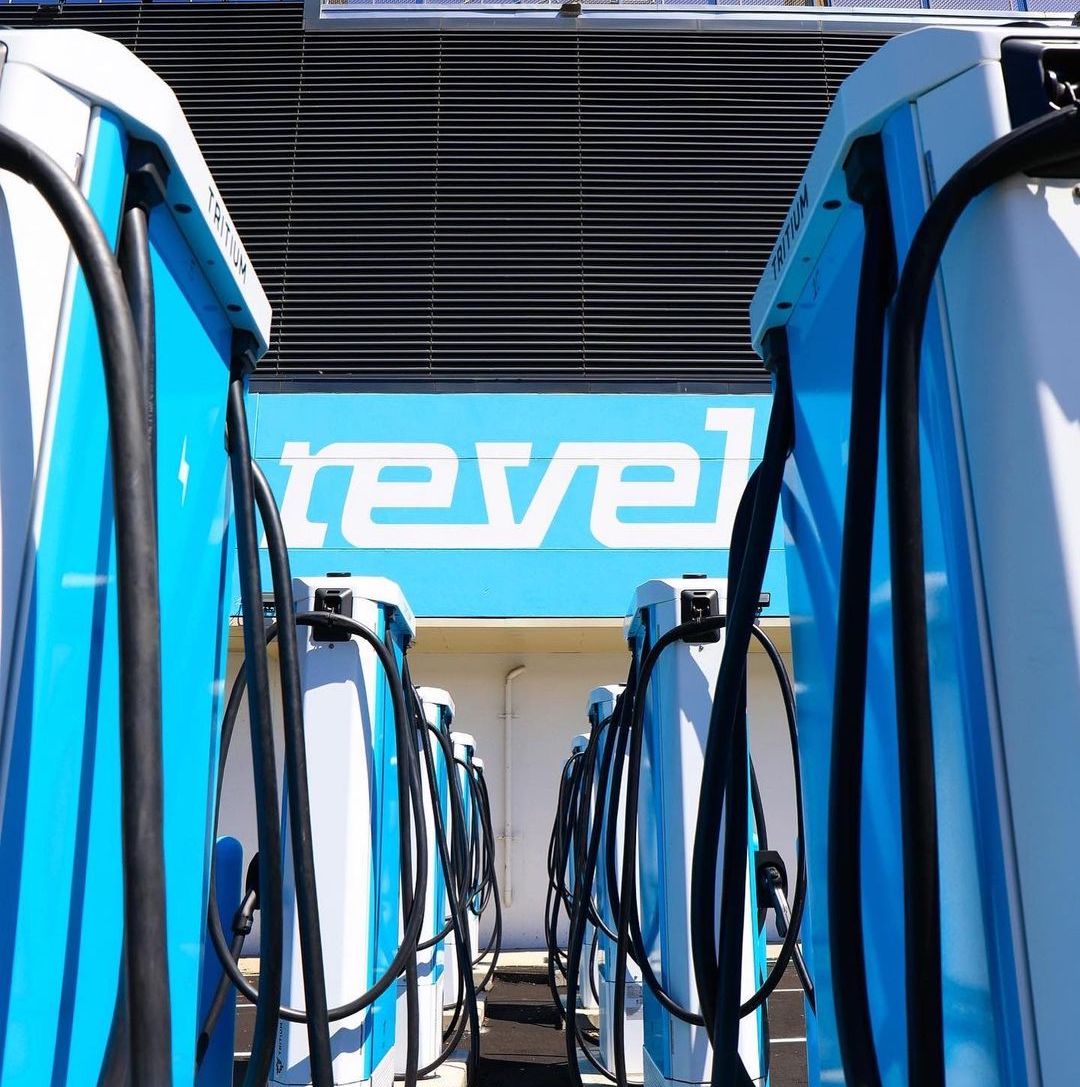
Revel Chargers

Image Credits: Revel

Revel’s chargers will take up about a third of the parking lot at the site, and Revel’s fleet of 50 Teslas that make up its troubled ridehail service also have designated parking where they’ll charge overnight. Reig says this makes energy demand available for individual EV owners at the hours they tend to charge their cars, which is in the morning, afternoon and early evening.

Reig is expecting the biggest usage of the chargers at first to come from Revel’s ridehail fleet, but the NYC Taxi and Limousine Commission (TLC) voted last week to block the issuance of new for-hire vehicle licenses for electric vehicles. When Revel announced its new service in April, it was hoping to skirt by on a loophole in the city’s rules that exempts wheelchair-accessible and electric vehicles from the new vehicle-for-hire cap that was designed to curb the amount of new Uber and Lyft drivers taking over the streets. 

“We’re absolutely working with the TLC,” said Reig. “Obviously we’re disappointed by their recent ruling to take away the EV exemption in the future. But, you know, we’re exploring ways with them right now to get on the road, and we’re going to be finding a solution in the future. We operate legally with every product line always offered, and we’re going to continue to do that here with this business.”


29 Jun 2021

Revel unveils electric vehicle fast charging superhub with 25 chargers in Brooklyn

On a muggy Tuesday morning in Brooklyn, electrified mobility company Revel unveiled its first electric vehicle fast charging superhub. U.S. Secretary of Energy Jennifer Granholm joined the New York-based startup, alongside Revel’s founder and CEO Frank Reig in a ribbon cutting ceremony. 

“Thank you, ⁦Revel, for being an example of what we need in this country[…] Thank you for showing the county how it can be done,” said Granholm at the opening event on Tuesday.

Revel’s superhub will have 25 brand-agnostic, RTM75 chargers from DC fast charging manufacturer Tritium. According to Reig, this Bed-Stuy charging station, which is open 24-7, will be the largest public charging station in North America. 

More than two-thirds of New York City’s energy grid is currently powered by fossil fuels, meaning about a quarter of NYC’s greenhouse gas emissions come from electricity. The state has ambitious plans to require statewide electricity to be 70% renewable by 2030 and 100% carbon-free by 2040. This might be difficult to accomplish given the imminent shutting down of Indian Point’s two nuclear reactors which provide the city with about a quarter of its energy, according to 2018 data from the mayor’s office. In addition, most forms of renewable energy require plenty of space to harness solar or wind power, which will be doubly difficult in a dense and expensive city like New York. 

Speaking of power, the superhub is located at the old Pfizer manufacturing building on Flushing Avenue, a site with seven megawatts of power. 

“There’s enough power at this site and we have built this site in a future-proofing sort of way, so that every single charger can be upgraded in the future without having to dig up any infrastructure,” Reig told TechCrunch. “So if we want to put a 250 or 350 charger in two years from now, three years from now, as cars are able to accept those kinds of speeds, we can do that.”

Revel also chose to place its charging station at the Pfizer building because it’s at “New York City’s urban core,” rather than far out at the airports or in private garages where chargers are inaccessible to the majority of New Yorkers who would ideally like to charge on the street. 

We were on a panel recently about equity, and one of the things that Revel feels very strongly about is making sure not just this site but any site in the future as well, there won’t be parking fees to get access to the charger,” said Reig. “So as opposed to many fast chargers in New York where you have to pay a parking garage $10 to $20 to park your car, and then you have to pay for the charger, this site is completely publicly available 24-7. There are no entrance fees. The only thing you’re paying is electricity itself.”

Charging up a car costs 39 cents per kilowatt hour, which turns into about $15 to $20 for a full charge, and that shouldn’t take more than 15 to 30 minutes. While drivers wait, they can access the redesigned space inside the old Pfizer building, which is now a co-working space for startups and a food giant court, because that’s what Brooklyn does.

Revel Chargers

Image Credits: Revel

Revel’s chargers will take up about a third of the parking lot at the site, and Revel’s fleet of 50 Teslas that make up its troubled ridehail service also have designated parking where they’ll charge overnight. Reig says this makes energy demand available for individual EV owners at the hours they tend to charge their cars, which is in the morning, afternoon and early evening.

Reig is expecting the biggest usage of the chargers at first to come from Revel’s ridehail fleet, but the NYC Taxi and Limousine Commission (TLC) voted last week to block the issuance of new for-hire vehicle licenses for electric vehicles. When Revel announced its new service in April, it was hoping to skirt by on a loophole in the city’s rules that exempts wheelchair-accessible and electric vehicles from the new vehicle-for-hire cap that was designed to curb the amount of new Uber and Lyft drivers taking over the streets. 

“We’re absolutely working with the TLC,” said Reig. “Obviously we’re disappointed by their recent ruling to take away the EV exemption in the future. But, you know, we’re exploring ways with them right now to get on the road, and we’re going to be finding a solution in the future. We operate legally with every product line always offered, and we’re going to continue to do that here with this business.”

29 Jun 2021

Soft Robotics raises another $10M, citing pandemic-related demand

Add Soft Robotics to the long list of automation companies that have seen a boost in investment interest amid the pandemic. The New England-based firm announced this morning a $10 million raise that serves as an extension of the $23 million Series B it announced in January of last year.

The extension was led by Material Impact, Scale Venture Partners and Calibrate Ventures and featured existing investors Tekfen Ventures and industrial robotics giant ABB. The latest round brings the company’s total funding to around $58 million.

Founded in 2013, the company takes a novel approach to picking machines, with a soft, pneumatic-powered gripper that’s ideal for fragile food stuffs that might otherwise be damaged by rigid robotics. Food, of course, has been a prime target for interest in automation during the pandemic, due to labor shortages and fears of disease transmission.

“Today’s industrial robots are unable to deal with product variability or unstructured environments typically found across the labor challenged food supply chain in areas such as agriculture, food processing, and logistics,” Soft Robotics COO Mark Chiappetta said in a release. “With our revolutionary soft grasping, 3D perception, and AI technologies, Soft Robotics unlocks robotic automation by augmenting widely available industrial robots with true hand-eye coordination allowing them to perform tasks that traditionally could only be performed by human workers.”

The round also sees Tyson Food’s investment wing, Tyson Ventures joining the fold. Tyson, which produces poultry, beef and pork in massive volumes, is an existing customer.

“At Tyson Ventures, we are continually exploring new areas in automation that can enhance safety and increase the productivity of our team members,” Tyson Ventures’ Rahul Ray said in the release. “Soft Robotics’ best-in-class robotic technology, computer vision and AI platform have the potential to transform the food industry and will play a key role in any company’s automation journey.”

29 Jun 2021

Beeflow raises $8.3 million to save the bees AND put them to work

Bees are absolutely critical to the health of our agricultural system, ecosystem, and overall wellbeing as a species here on Earth. And yet bee populations are decreasing and extinction concerns are growing.

Beeflow, a startup that today announced the close of a $8.3 million Series A round, is looking to both save the bees and help farmers be more efficient and effective at the same time.

The startup uses proprietary scientific technology that essentially makes bees healthier, particularly in cold weather. A wealth of research led the company to understand that certain plant-based foods and molecules, when fed to the bees, can reduce the mortality rate of bees by up to 70 percent, and help them perform better in colder weather.

You might be wondering what I mean by performance. That’s fair.

Bees are the planet’s natural pollinators. They turn flowers into fruit, spreading pollen from one landing spot to another. Many farmers will ‘rent out’ bees from beekeepers to hang out on their farms and pollinate their plants. In almost every way, the effectiveness of this can’t be measured, and the bees themselves can’t truly be controlled.

Beeflow’s technology ensures that the bees are healthy and strong, and can fly up to 7x more during colder weather than they’d be able to without it. This means that those bees are much more likely to effectively and efficiently pollinate crops for the farmers.

Beyond reducing the mortality rate of bees, the company also offers a second product called ToBEE, which trains the bees to target a specific crop, such as blueberries or almonds.

Combined, these Beeflow products have increased crop yields for farmers up to 90 percent.

Beeflow’s business model is two-fold. They have their own bees that they loan out to farmers for pollination, and also work with beekeepers to bring them into the Beeflow network. Bee keepers do not pay for Beeflow’s technology, but do hand over the rights to their relationships with farmers.

The startup was founded by Matias Viel, who is from Argentina, and is mostly operational in Latin America and the West Coast of the U.S., with plans to expand to the East Coast and Mexico.

“The greatest challenge is operational and around execution,” said Viel. “There is so much demand and we need to scale our team and our operations now.”

The financing round was led by Ospraie Ag Science, with participation from Future Ventures’ Steve Jurvetson, Jeff Wilke, Vectr Ventures, SOSV’s IndieBio and Grid Exponential.

29 Jun 2021

Amazon introduces Reading Sidekick, a kids reading companion for Alexa, and Voice Profiles for Kids

Amazon today announced a new feature that will turn Alexa into a reading companion for children as well as new support for Alexa Voice Profiles for Kids, which personalize the child’s Alexa experience across all Echo devices in the household. The two features go hand in hand, as the Voice Profile allows Alexa to identify who’s speaking, so the device can appropriately respond to a request like “Alexa, let’s read.” Alexa will then start the reading companion experience, which Amazon is calling Reading Sidekick.

This feature isn’t available to all Alexa device owners, as it requires an Amazon Kids+ subscription. This is the $2.99 per month subscription service that also provides families with children access to thousands of kid-friendly books, TV shows, movies, educational apps and games, in addition to premium content for Echo devices, like ad-free radio stations and playlists, Audible books, and exclusive Alexa skills.

Image Credits: Amazon

Once subscribed, the child can then direct Alexa to read with them and they’ll pick up a compatible book or ebook to get started. Alexa will ask what book they’re reading and how much does the child want to read: a lot, a little, or taking turns? The feature works with the hundreds of children’s books for ages 6 to 9 that are included as part of the Amazon Kids+ subscription, including both the print or digital versions. When it’s the child’s turn reading. Alexa will listen and provide encouragement when the child is doing well, and will offer support when the child is struggling.

Meanwhile, support for new Alexa Voice Profiles for Kids will also begin rolling out, starting today. This opt-in feature allows parents or guardians to create a voice profile for each child in their family (up to 4 kids). When enabled, the Alexa experience will be personalized to the individual speaking. That means Alexa will automatically apply the appropriate parental controls that have been configured, automatically filter explicit music, limit calls and messages sent through Alexa only to approved contacts, and restrict the child only to the Alexa skills parents have pre-approved. Alexa will also provide the child with access to kid-friendly games, skills, music, and videos and will provide kid-friendly responses to kids’ inquiries.

While features like these can make the Alexa experience more fun and useful for families, parents have to weigh their comfort with having their children’s voices recorded and analyzed and determine how long they would want such recordings stored. Today, Amazon uses kids’ voice recordings to train its speech recognition and natural language understanding systems in order to improve Alexa’s ability to understand children’s questions and requests. In some number of cases, these recordings are also manually reviewed. Parents who don’t want to participate can delete recordings associated with their child’s history either one-by-one or all at once via the Alexa app Settings. They can also set recordings to automatically delete on an ongoing 3-month or 18-month basis and can delete recordings via voice requests.

However, if the parent chooses not to save the child’s recordings, they’ll not be able to go back through the history to see the requests their child has made over time from the Parent Dashboard.

Every parent will need to make a decision about what’s right for their own household before enabling features like Reading Sidekick or Voice Profiles, or, more broadly about whether they want to bring a smart speaker of any kind into their home.

Amazon says the new Alexa Voice Profiles for Kids should reach all Amazon customers by Friday, July 2. Reading Sidekick is available today.

29 Jun 2021

Co-op raises $5.8M to help online merchants land customers for less

Ask anyone looking to sell online about their customer acquisition costs compared to a few years ago, and you’ll hear a tale of woe. Channels that were once a cost-effective ground for acquiring customers, like various social networks, have become increasingly pricey real estate. Facebook’s recent broaching of the $1 trillion market cap threshold attests to the fact.

But co-op wants to shake up how online sellers find new customers, and it wants to do so with a spirit of collaboration at a discount. The startup announced a $5.8 million round today that closed earlier this month, evidence that it has found backers for its model that has already collected 500 brands.

That final figure matters because co-op is an almost uniquely collaborative company. Brands that sign up to be part of co-op include its technology on their post-purchase page, allowing for other, related items to be shown to customers who just finished buying something. By including the widget, a company’s product will be shown on the post-purchase page of another company.

That sounds anti-capitalist at the very least, which wouldn’t work in a venture-backed world. So, what’s the twist? The post-purchase page widget shows three or four products, giving it extra inventory that it can sell to its partnered brands. Presto, revenue.

The company’s founder and CEO, Conner Sherline, told TechCrunch that his startup can deliver advertising space at around half the cost-per-action of Facebook and other channels; how the economics of its model scale as more brands join will be fascinating to watch.

The startup also offers software tooling, including a post-purchase survey feature that costs 5 cents per order for customers to leverage.

Sherline’s startup appears to be growing quickly. When it raised pre-seed capital last July, it had around 20 brands onboarded to its service. Today, the company is adding another 50 to 100 each month. At that rate, it could reach 1,000 brands in total by the end of the year, barring any deceleration in its ability to attract new brands to its network.

The startup’s early progress attracted Sugar Capital to lead its latest round, which also saw participation from Bessemer Venture Partners and online e-commerce giant Shopify. The Shopify check is interesting; co-op already exists on the Shopify app store, for example. TechCrunch will keep an eye out for more integrations between the two companies, something that could turbo-charge the startup’s growth.

There are a number of places for co-op to expand into. Sherline told TechCrunch in an interview that its collaborative network is the first thing that the company is working on. But with lots of sales data and a wealth of partners, co-op could build out partner networks aimed at other parts of the e-commerce sales life cycle pretty easily, we reckon.

Regardless, the company now has a multiple of the $1.6 million that it had raised before. Let’s see how quickly it can scale its brand base with the new funds.

29 Jun 2021

Arrows raises $2.75M to build out its customer onboarding software

This morning Arrows, a startup building software to help software companies onboard their customers, announced that it has raised a $2.75 million round led by Google’s Gradient Ventures. The round was joined by a host of angels, including funds from Sprout Social founder and CEO Justyn Howard.

Per Arrows CEO Daniel Zarick, the company had bootstrapped until this round. That allowed the startup to allow dozens of smaller investors to take part in this funding event, including 28 micro-checks that it rolled into a single cap-table line-item thanks to an AngelList service that allows for smaller investments to be combined.

Arrows sells to software CEOs and heads of customer success, the people who care the most about ensuring that new customers get up and running with new digital products as quickly as possible. Per Zarick, successful customer onboarding to a new product or service can speed up adoption, helping boost revenue from usage-based products; it’s also generally known that stronger onboarding can also lead to better adoption inside of customer organizations, potentially limiting later churn.

Given the scale of the modern software market, Arrows is selling into fertile ground. That’s the reason that Zarick and his co-founder Benedict Fritz decided to stop being a two-person shop, and raise more capital. They were worried, Zarick explained, about suffocating their company without more capital.

Luckily for Arrows, one investor had already taken a keen eye to their work. Namely Gradient Ventures’ Darian Shirazi, who had reached out a number of times before the startup was even considering raising external funds. Per the Arrows CEO, Shirazi had already sent the startup his own portfolio companies as leads before he invested, some of whom have become customers. So, when Zarick and Fritz decided to pursue venture capital, there was a leading name already on hand.

The $2.75 million round was raised using a SAFE at a single cap, sans discount.

Arrows CEO Daniel Zarick, via YouTube.

Arrows initially launched its service in March, but is revamping its pricing this week, closing its self-serve model for the near-term.

It’s interesting to listen to the CEO of a seed-stage startup discuss evolving from a bootstrapped model to one backed by a good-sized amount of venture funding. Zarick described to TechCrunch in an interview how much his job was changing now that the company is working to scale up to a team of around eight. The company intends to stay at that human scale for a little while.

Per its CEO, Arrows can get along for two years with its current capital sans revenue growth; though we’d expect that now that it has attracted seed capital, other VCs will look to pile on — a trend that we’ve seen often in recent weeks and months.

The Arrows product is also going to evolve in the coming months. While attacking customer onboarding teams’ use of spreadsheets with modern software has worked thus far, the startup has lots of planned work ahead of it, including more integrations with external software. Let’s see how quickly we hear from Arrows again. I’ll wager anyone a high-five that it’s before the end of the year.


29 Jun 2021

Construction robotics company Toggle raises $8M

New York-based construction startup Toggle this morning announced that it has raised an $8 million Series A. The round was led by Tribeca Venture Partners and featured Blackhorn Ventures, Point72 Ventures, New York State and Twenty Seven Ventures. It follows a $3 million seed round raised in late-2019.

Robotics in general have been a massively popular investment target during the pandemic. Construction startups have also begun to heat up. Early this month, Dusty announced a $16.5 million raise for its Field Printer device.

Toggle automates an entirely different part of the construction process. The company’s robotics technology specifically targets rebar, using robotics to assemble the foundational building material at a fraction of the time.

“At a time when global construction is accelerating to an unprecedented pace, Toggle offers a way to add capacity while saving time and cost on some of the largest types of projects,” cofounder and CEO Daniel Blank said in a statement, “We are especially grateful for our partners who are helping us to bring new tools and approaches to the fundamental building block of our built environment with a focus on renewable energy and sustainable urban development.”

Toggle says the new round will go toward expanding production on the tech. That includes increasing headcount and upgrading the production space to a new 50,000 square foot facility.

29 Jun 2021

SaaS-focused Acceleprise rebrands, raises $30M in new capital

TechCrunch has covered Acceleprise several times over the years, including a look at its mid-2020 accelerator startup batch from its three accelerators. The firm has long focused on business-to-business SaaS startups, helping them get their start in a competitive global software market.

As of today, Acceleprise is now Forum Ventures, according to the group’s CEO and managing partner, Michael Cardamone, and it has a bushel of funds to power its work. And befitting its new name, the company is now more than merely a collection of software-focused accelerators.

In addition to a new, larger $17 million fund for its pre-seed work, Forum Ventures has also raised its first seed fund. The new seed vehicle totals $13.2 billion, with Cardamone telling TechCrunch that the group intends to write checks ranging from $100,000 to $650,000 into rounds valued between $1 million and $4 million. It’s an actual seed fund, in other words.

While it’s interesting that Forum has put together a seed fund that will invest both in its accelerator graduates and other SaaS companies, the firm’s new pre-seed investing vehicle is noticeably larger than its preceding accelerator fund. Why is it so much bigger? Per Cardamone, the group added a third accelerator since its last fund, helping explain the size shift.

The technology market is also simply more expensive in every way than it was, and Forum has expanded its staff, so more capital under management makes sense.

There is synergy between the pre-seed and seed funds, of course. Forum can now better defend early ownership in standout companies from its accelerator batches. But why keep the door open to investing in other startups that it didn’t help incubate? It comes back to the company’s new name, it turns out. Cardamone and the team chose Forum Ventures because of the work it has done to build a SaaS community that from time to time spins up companies that didn’t go through Forum’s programs, he said, and it wants to invest in some of them.

Reasonable.

Undergirding Forum’s new raise are results from its earlier funds. Its first accelerator fund, deployed from the end of 2014 through the next two years, has returned “86% of committed capital to date and the rest of the fund is marked at 3.36X and growing with 18 companies still live at various stages,” the firm shared in an email.

Funds 2 and 3 are a bit nascent yet to have similarly concrete returns; we’ll have to wait a bit to see how they perform.

But TechCrunch did want to know, regardless, what impact COVID-19 had on Forum and its various funds and batches. Did they catch a COVID-induced wave? We wondered if some good recent results may have helped the firm raise not only larger funds, but two of them at the same time.

According to Cardamone, the answer is somewhat. In its most recent pre-seed fund, the CEO said that its accelerator cohorts are seeing more startups raise faster seed and Series A rounds. And, as TechCrunch has written lately, they are, at times, raising Series A deals at lower ARR thresholds than we might have expected. So, it’s a good time to be putting pre-seed dollars to work, we reckon, provided that you have the deal flow.

Forum is now 11 people, including six women and one nonbinary individual. That’s about as diverse in gender terms as we’ve seen in the SaaS venture capital world. From its new seed fund, 53% of Forum’s investments have had a woman or otherwise underrepresented founder. Not bad.

Now let’s see if Forum can replicate its early accelerator returns with more capital, more financial vehicles and more people.

29 Jun 2021

Orum raises $52M to help speed up intrabank transfers

Orum, which aims to speed up the amount of time it takes to transfer money between banks, announced today it has raised $56 million in a Series B round of funding.

Accel and Canapi Ventures co-led the round, which also included participation from existing backers Bain Capital Ventures, Inspired Capital, Homebrew, Acrew, Primary, Clocktower and Box Group. The financing comes barely three months after Orum announced a $21 Series A, and brings its total raised to over $82 million.

Orum CEO Stephany Kirkpatrick launched the company in 2019 after working for several years at LearnVest, a personal finance site founded by Alexa von Tobel that was acquired by Northwestern Mutual in 2015 for an estimated $250 million. Tobel went on to form Inspired Capital, a venture capital firm that put money in Orum’s $5.2 million seed round last August.

As a certified financial planner, Kirkpatrick says she saw firsthand what she describes as “deep cracks” in this country’s financial infrastructure. The fact that it takes days for money to move from one bank to another is not only inconvenient for many, but unnecessary, she believes.

“Most Americans are not familiar with the intricacies of ACH [automated clearing house) or why it takes multiple business days to move money between accounts,” Kirkpatrick said. “But none of us can allow money to wait 5-7 days to hit our accounts. It needs to be instant.”

Her mission with Orum is straightforward even if the technology behind it is complex. Put simply, Orum aims to use machine learning-backed APIs to “move money smartly across all payment rails, and in doing so, provide universal financial access.”

Orum’s first embeddable product, Foresight, launched in September of 2020. It’s an automated programming interface designed to give financial institutions a way to move money in real time. The platform uses machine learning and data science to predict when funds are available and to identify any potential risks. Its Momentum product “intelligently” routes funds across payments rails and is powered by banking providers JPMorgan Chase and Silicon Valley Bank.

“They power the back end of our Momentum platform that allows the money to move on a multirail basis,” Kirkpatrick told TechCrunch. “They power our access to real-time payments.”

Orum says it serves a range of enterprise partners, including Alloy, HM Bradley, First Horizon Bank and Zero Financial (which was recently acquired by Avant).

The volume of transactions being conducted with Orum is growing 100% month over month, Kirkpatrick said. Most of its early growth has come from word of mouth. 

The remote-first company prides itself on diversity — in both its employee and investor base. For one, 48% of its 55-person headcount are female, and 48% are “nonwhite,” according to Kirkpatrick. Orum also recently joined the Cap Table Coalition — a partnership between high-growth startups and emerging investors who want to work to close the racial wealth gap — to allocate over 10% of its Series B round to underrepresented founders. For example, the financing includes investors such as the Neythri Features Fund, a group of South Asian women investing in the next generation of female founders and diverse teams.

Jeffrey Reitman, partner at Canapi Ventures (a firm whose LPs mostly consist of banks), told TechCrunch that those bank LPs conduct hundreds of millions of ACH transactions annually, 

“They need a path to achieving a state where funds can be transferred instantly,” he said. “Orum’s product paves the path for many players in financial services and fintech — and beyond — to partake in faster money movement without compromising key risk principles.”

To Reitman, the company’s major differentiators are its team, which he describes as consisting of “the best group of data scientists and engineers in the space.”

“Many of their customers consider the team to be instrumental in helping to set the risk dials on how they fund transactions by teasing out key data and insights from historical transaction data,” he said. “Second, Orum is building one of the densest and most comprehensive data sets around the risks of money movement. Better data means better risk models, and it will be hard for other offerings to match Orum’s approach to building this rich data set.”

Accel Partner Sameer Gandhi, who joined Orum’s board as part of the latest financing, agrees. He believes that in an 18-month period, Orum has built “game-changing technology and an exceptional team.”

“Orum is tackling financial infrastructure from its foundation,” he said.