Year: 2021

29 Jun 2021

Visier raises $125M at a $1B valuation for its big-data approach to HR analytics and planning

The world of work has changed massively in the last year, and with it a rush of startups have emerged with new technology and approaches to improve how it is shaped, and specifically how human resources departments do their jobs. In the latest chapter, Visier, a Canadian startup that has built a big-data engine to ingest and analyze information from disparate human resources and related applications to develop more accurate profiles of people and departments — useful when considering remuneration, promotions, and wider hiring budgets — has raised $125 million (USD), a Series E that the company confirms now values it at $1 billion.

The funding comes on the heels of the company seeing massive growth in particular in the last year, with companies scrambling more than ever before, in a new world of more hybrid and remote work, to get a better grip on how and what teams and individuals are doing. Visier said it now processes employee records for 8,000 customers, large and high-profile enterprises like Adobe, BASF, Bridgestone, Electronic Arts, McKesson, Merck KGaA and Uber that collectively represent some 12 million individual users across 75 countries.

New backer Goldman Sachs Asset Management is leading the round, with previous investors Sorenson Capital, Foundation Capital, Summit Partners, and Adams Street Partners also participating. Visier — pronounced “busier,” which co-founder and chairman John Schwarz joked you are not supposed to be when using its product — has now raised just under $220 million.

As Schwarz described it to me, the challenge that Visier is addressing is that while everyone uses HR management tools like Workday, Success Factors, any number of payroll applications and more — on average 20 applications per department, he said — to chart a lot of basics of how an employee works day to day or month to month, a lot of that data remains in silos and so it’s hard to get a “360” view based on all of it, and that’s before considering how to take that information and benchmark it against other information outside the business.

The solution that Visier provides to address that is a big-data engine that it has built that can connect to any and all of those apps, ingest the data contained in it, match it up to provide visualizations of the current state of things, and increasingly also predictive insights. Today, this is done typically for HR departments, but this has applicability to managers, finance departments and really the employees themselves.

“In the future we want to help everyone understand the policy today, which impacts the outcome tomorrow,” he said in an interview.

The move to build big data analytics targeting particular areas of an organization has been an interesting trend that has played out in other departments too such as sales, finance, risk analysis and other areas. The idea here is not unlike what data scientists have been working on for years with wider analytics questions: tapping troves of data from disparate sources to order it better, match it up with each other, to provide insight into wider trends and activities within an organization.

As data science becomes more democratized — and thanks to advances in no-code and low-code tooling, turned into tools that even non-technical people can implement and use — we will likely see many more use cases where this idea gets applied. After all, data is the new oil, but unlike actual oil, we seem to be supplied with an endless amount of it these days.

And yes, we’ve seen a real rush of HR tools come to the market in recent years — and see a lot of funding in the current climate as their businesses see customer interest rise — they include HR platforms like Hibob, HR aimed at particular verticals like Personio or Factorial, or for distributed workforces like Oyster or Remote, or those that are building supercharged org-charts like ChartHop.

But Visier believes that there are no big-data players looking not to be primary-source repositories of information but big data integrators from other platforms. Schwarz notes that in most cases, the “competition” will be custom-made implementations built by systems integrators using Tableau or something similar but not the same as what it provides in terms of real-time analytics.

“It’s all about using data from other sources,” he said, pointing out that it’s telling that Workday tried to build something like what Visier provides, but that more than half of Visier’s customers also use Workday (meaning whatever is there is not quite doing the trick).

“Access to information about employees and the health of an organization has never been more critical,” said Holger Staude, managing director within Goldman Sachs Asset Management. “We’re excited to partner with Visier at this pivotal moment and support the company’s continued growth.”

29 Jun 2021

Gympass, the corporate wellness unicorn, raises a $220M series E

Gympass, the exercise and corporate wellness unicorn that originated in Brazil, today announced a $220 million Series E. The company has seen tremendous growth in the last few months, as more and more people are vaccinated and flocking back to the gym.

Gympass is like ClassPass, but on steroids. However, unlike ClassPass’ BTC model, Gympass partners with employers who then pay a flat fee for the platform (an app) which then allows their employees to choose from several wellbeing plans that give them access to myriad in-person gyms and studios, and a directory of health apps, such as Calm. The offerings are broken up into the following categories: physical health, emotional health, nutrition and sleep.

According to the company, in May, Gympass saw a record 4 million monthly check-ins across its network of more than 50,000 global partners. In fact, for some of the partners, usage hit above pre-COVID levels. 

Between increased anxiety rates and documented weight gain during the pandemic, it’s clear that people are eager to get active again with the hopes of improving their mental health and their waistlines.

GymPass is the brainchild of Cesar Carvalho, a former McKinsey & Company consultant in Brazil who was always on the road and yearned for a corporate wellness product that would comply with his hectic work schedule.

“Some days I worked from home, other days I worked from the office, and then there was the time I was traveling. I could never go to the gym in one place,” Carvalho told TechCrunch. “I realized that my needs were the same as others,” he said.

He decided to pursue his business idea while he was at Harvard Business School.

“I’m one of those crazy entrepreneurs that drops out of their MBA to start a company, but looking back now, it worked out okay,” he said, later telling TechCrunch that Gympass is now in Brazil, Mexico, Chile, Argentina, the U.S., Germany, Spain, Italy, Ireland, and the U.K. 

Since its launch in São Paulo in 2012, the company achieved product-market fit fairly quickly, and its growth and expansion have been largely organic.

Originally, Gympass was a BTC concept, and one of its first clients was an executive at PricewaterhouseCoopers in Brazil. He liked the product so much that he eventually said to Carvalho, “Can’t I communicate this to my 5000 employees in all the cities where we have offices in Brazil?” With that question – and offer – Carvalho saw the need to pivot and build a B2B company.

After only three years in Brazil, one of his biggest Brazilian clients asked Carvalho to expand to Mexico, because his company had a large presence there and he wanted to offer Gympass to its employees. And so follows most of the expansion stories.

“We expanded to Spain, because we worked with a Spanish bank in Mexico, and they wanted their employees in Spain to have access to our product,” he said.

This round, which doubles the company’s valuation to $2.2 billion, includes participation from SoftBank, General Atlantic, More Strategic Ventures, Kaszek Ventures and Valor. Carvalho plans to use the money to grow the company in the U.S., expand its offerings, and work on making the tech smarter. 

“We want [the app] to be able to recommend the best partners for your complete well-being journey based on your workout patterns, for example: ‘This is the best meditation app for you to use with your workout profile,’” Carvalho said.


29 Jun 2021

4G Clinical’s clinical trial management software attracts over $200M in new funding

The pandemic significantly changed how we do medical research, and now companies are trying to figure out what trends will stay and which ones will go. One that 4G Clinical is hoping will survive the pandemic is a need for speed and flexibility in therapeutics trials. 

4G Clinical creates software to run the back-end of a clinical trial. That means randomizing patients into treatment and placebo groups, locating medicines and placebos, keeping the supply of those medicines stocked, and, at least during the pandemic, delivering those medicines to patients. All of these tasks fall under the umbrella of Randomized Trial Supply Management, or RTSM for short. 

Specifically, 4G Clinical’s software, called Prancer, uses natural language processing to take specific requirements needed to manage a clinical trial, which are often written in long, complex documents, and configures them into a platform.

The fastest the company has been able to move from a phone call to the first dose in a clinical trial was 6 days – a sprint that created the software needed for a COVID-19 study during the pandemic. That was an exceptionally fast case, but in general, 4G Clinical says it can beat standard timelines by considerable margins.

“Most vendors in the world would say that they are probably, you know, between 10 and 16 weeks from, you know, from the kicking off a study until they can dose a patient,” says Dave Kelleher, a company co-founder. “Our typical timeline is generally four to six weeks post spec signature.” 

Generally, large pharmaceutical companies are capable of creating these trial management systems internally. Small companies, however, may not have the capability to do so. 4G Clinical goal is to provide a service that can be of use to both. 4G Clinical has currently designed systems for over 230 companies – though the company would not disclose the specific trials in which its systems are being used. 

4G clinical is also announcing over $200 million in a growth equity round led by Goldman Sachs. Before Goldman, the primary investment came from Boston-based Schooner Capital and First Analysis, a VC firm out of Chicago. 

Kelleher declined to say what the plans for the round were, other than company has plans to pursue more go-to-market strategies and R&D, and ultimately aims to “take up as much air” in the eClinical and RTSM space as possible. 

The eClinical market is expected to reach about $14.7 billion by 2027. RTSM made up about 17 percent of market share in 2020. With the complexity of clinical trials increasing, and the number of trials growing – even after COVID-19 related issues shut many trials down in 2020 – there may be room for more growth. 

Before COVID-19, there was evidence that the amount of clinical trials had steadily been increasing. In 2000, there were 2,119 clinical trials registered at Clinicaltrials.gov. By 2010, 100,208, and by 2020, 362,532 registered by the end of the year (that includes massive slowdowns created by the pandemic for non-COVID research). 

Within that landscape, there is some evidence that sponsors of clinical trials are using more external applications to manage those clinical trials. Of 500 clinical operations professionals respondents surveyed by Veeva (another eClinical company, keep in mind) found that 63 percent were using an RTSM system, up from about 43 percent in 2017. 

4G Clinical, generally, is looking to benefit from the increased public attention to the clinical trials process, and the flexibility that the pandemic has created for sponsors to get creative with clinical trial designs. 

The pandemic did encourage some innovation in this regard. Take, for example, the World Health Organization’s SOLIDARITY trial, which used an adaptive trial design in which multiple drugs could be tested at once. Drugs that showed no promise mid-way through the trial could be dropped (as hydroxychloroquine was in June 2020). The adaptive part, in short, allows for mid-trial tweaks. 

It’s not the traditional design of the gold-standard randomized controlled clinical trial, but it did glean a significant amount of knowledge in a short period of time. After seven months, three of four drugs tested showed no effect on mortality, whereas the fifth remdesivir, showed some limited promise. 

Adaptive trial designs weren’t unheard of before the pandemic – the FDA had actually released guidance on adaptive clinical trials in 2019. But the post-pandemic landscape might encourage more flexibility in this regard, and with it, increase a need for software that can be tweaked to accommodate such changes. 

“I think that we saw some regulatory hurdles reduced as part of this process that allows for more creativity in study design,” says Kelleher. “Probably the most important thing for us is our flexibility, we can make changes to studies very rapidly – to live studies.” 

4G Clinical and other RTSM software like it, are looking to hone tools that already exist within clinical trials – specifically software used to actually run them. It’s an area of research that the team itself has both a personal stake in, and strong industry knowledge. 

Kelleher was diagnosed with Multiple Sclerosis at the age of 23 (a disease to which there is still no definitive cure), and previously founded the Portland-based ACME business consulting. His co-founder Ed Tourtellotte, lost his wife to breast cancer around the same time. Neither have a background in pharmacology, but rather, the team is tackling drug development through streamlining clinical trial software. 

By contrast, other companies aim to streamline clinical trial processes through A.I-based drug target identification, an especially hype-induced area of the space in which investment quadrupled to $13.9 billion between 2019 and 2020. Clinical trial management software may seem more mundane, but it’s still an essential part of running Phase III and most Phase II studies. 

Tourtellotte has designed bespoke software systems for major drug developers, including Pfizer’s Impala system (used in 80 percent of Pfizer’s clinical trials for the past 20 years, says Kelleher) and another system Trident, which was sold to Bioclinica in 2009 (along with Tourtoulette’s company, Tourtellotte Solutions). Trident was utilized by GlaxoSmithKlein for clinical trials in 2010. 

At this point, the company has declined to confirm a total amount of funding, but in 2020, revenue grew 110 percent with just ten percent of its portfolio focused on COVID-19 related projects. 

29 Jun 2021

Alphabet’s Wing launches OpenSky drone airspace authorization app in US

I love testing drones. It’s a lot of fun, and a nice way to mix up my standard review cycle. But I’ve altogether given up on testing them around here. Granted, living in Queens, NY presents a unique combination of obstacles, including population density, two major international airports and a prison – but restrictions have made it next to impossible to fly around here.

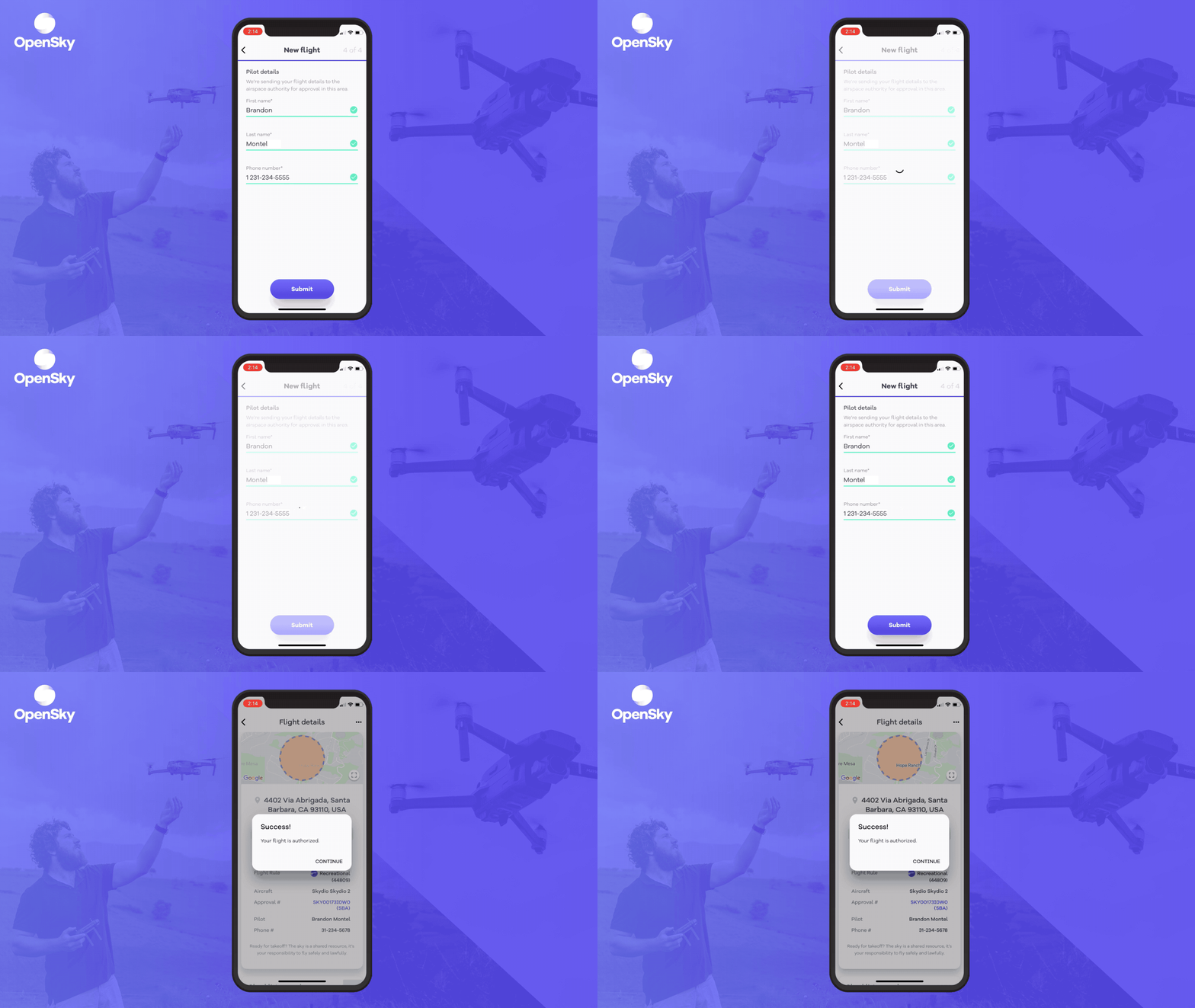
Knowing precisely where the nearest open airspace is can get tricky, particularly in large cities like New York. Today, Alphabet’s drone-delivery subsidiary Wing announced that it’s launching its OpenSky app in the U.S. on Google Play and the iOS App Store.

Image Credits: Wing

The app was launched in Australia back in 2019 for both hobbyist and commercial drone pilots, with help from the Civil Aviation Safety Authority (CASA). The U.S. version was created with input from the FAA for operation in Low Altitude Authorization and Notification Capability (LAANC) airspaces.

Using the app, drone operators can request approval to operate in spaces like those around areas, expediting a process that would traditionally take days or weeks to go through.

“Why is a drone delivery company investing in an operator app?” Wing asks rhetorically in a blog post. “Because with nearly two million registered drones in the U.S. already, regulatory compliance of all drones will allow them to share the sky safely. Moreover, compliance will ultimately expand the uses and benefits of drones — among them emergency response, commercial inspections and contactless delivery — to more people.”

The app is available for users in the U.S. starting today.


29 Jun 2021

Artisan home decor retailer The Citizenry raises $20M in Series B funding

The Citizenry announced today that it raised $20 million in Series B funding in partnership with NextWorld Evergreen. A direct-to-consumer home decor retailer, The Citizenry works with artisans from around the world to produce limited-edition runs of handcrafted, hand-numbered home goods. In October, The Citizenry opened its first brick-and-mortar store in New York City, and with this round of funding, The Citizenry hopes to accelerate its development into a whole-home brand.

Co-Founder Rachel Bentley got her start at Bain & Company, where she worked in strategy consulting in global supply chains.

“I saw a lot of the challenges that were coming as a result of that, tied to income inequality, human rights, and the environment,” Bentley told TechCrunch. “But I also saw the tremendous opportunity that connections of global supply chains can create to hopefully move communities forward.”

Bentley and fellow co-founder Carly Nance, a brand strategist, noticed that there was a gap in the market for premium, thoughtfully crafted home goods. They took the leap to leave their corporate jobs to start The Citizenry with the aim to make a positive global impact and set more socially conscious standards for the home decor industry.

These are lofty goals, but Bentley’s experience in global supply chain strategy helped her develop a business model that prioritizes the fair treatment of workers.

Image Credits: The Citizenry

“One of the biggest challenges in working with artisan communities is that companies are there for one season, they place a large order, and their goal is to get a really high volume at a very low price,” Bentley says. “We came in and took the opposite approach. We tried to identify groups we saw a long term potential with, that we could partner with for the next ten, twenty, fifty years, to really help grow their businesses. Having sustainable income day in and day out, not just seasonally, is where you really start to see change happen.”

The Citizenry is a member of the World Fair Trade Organization (WFTO), and for over eighteen months, they’ve been going through the process to become fully verified through the WFTO’s Guarantee System. This means that the WFTO reviews every partner and conducts several day, in-person examinations of the artisans’ working conditions. On average, The Citizenry pays its artisans double the local minimum wage.

Image Credits: The Citizenry

“Social responsibility is much more important to our generation than previous generations,” Bentley said. “We want to feel good about the way a product was made, because we know we’re going to be living with the ramifications of how it was made, whether that’s environmentally or in terms of human rights.”

Bentley says that the rise in farm-to-table food shopping is indicative of consumers’ transition in values. But spending an extra few dollars on organic produce isn’t quite the same as shelling out $695 for a Portuguese leather headboard. So, The Citizenry may not undercut retailers like IKEA, but their price points are often cheaper than luxury home competitors like Williams-Sonoma, for example. The fact that The Citizenry can even compete with larger retailers while paying livable wages to artisans is a testament to their business model.

Since closing its Series A in 2019, The Citizenry has grown sales over 200%, with repeat customers driving 45% of sales. Over the same period, the company has supported 3,000 global artisan jobs. With its Series B funding, The Citizenry hopes to expand its furniture section — the most shopped category on its website — and invest in expanding its brick-and-mortar business after its SoHo store’s successful launch.

29 Jun 2021

SpaceX plans to use its Starlink internet on Starship orbital launch to demonstrate connection quality

SpaceX’s upcoming Starship orbital test flight could end up being a veritable smorgasbord of its technological capabilities, as the company has filed with the Federal Communications Commission (FCC) to request approval to fly Starlink terminals on the spacecraft in order to “demonstrate high data rate communications” between the new launch system and the ground throughout the course of the trip to space and back.

SpaceX plans to show that its network of Starlink low-Earth orbit satellites can provide “unprecedented volumes of telemetry and enable communications during atmospheric reentry” even during the parts of the launch where communications signals are typically lost due to the presence of “ionized plasma” in the atmosphere during the re-entry phase (via Michael Baylor on Twitter). If it works, it could provide better than ever live data for SpaceX during its test flight, which should help with the Starship and Super Heavy launch system’s development — and it could mean better, more spectacular views for those of us just watching from home via livestream, too.

Including Starlink as the communications method for telemetry and other communications during the launch is definitely a functional improvement for SpaceX if it works as described, but it’s even more of a flex for the company in terms of showing off Starlink’s capabilities. The FCC filing ones that the terminals to be installed on the spacecraft are basically just its existing consumer terminals with new exterior housings, so if it performs well that could attract the attention of more consumer broadband customers.

Plus, SpaceX is also talking a lot about the capabilities of Starlink as a system to replace older, more distant geostationary satellites networks to provide things like connectivity on airplanes, on ships and in other in other transportation modals. Showing that it offers solid performance during a rocket launch is definitely going to encourage partners in those areas.

The filing does specific that its license to operate Starlink on Starship begin on August 1, which means either it’s planned for a launch after the one SpaceX President Gwynne Shotwell said the company is hoping to fly sometime in July, or the date has already likely slipped to the following month.

29 Jun 2021

Connected vehicle data startup Wejo partners with Microsoft, Palantir, Sompo

Connected vehicle data startup Wejo has announced partnerships with Microsoft, Palantir and Sompo Holdings to improve its ability to collect, store and analyze data from millions of connected vehicles around the world. 

This follows the GM-backed startup’s announcement that it would be going public by merging with a special purpose acquisition company, Virtuoso Acquisition Corp., which is expected to close later this year. A $25 million commitment from Microsoft and Sompo, combined with already-committed investors GM and Palantir, bring Wejo’s total PIPE financing to $125 million. 

Palantir has been a previous strategic investor in Wejo. In 2019, the software developer launched a Japanese joint venture with insurance provider Sompo. Now this venture’s partnership with Wejo will give the startup the chance to collect connected vehicle data in Japan, and perhaps the greater Asia-Pacific region. The company already has some live vehicles in Korea, but 95% of its data comes from the U.S., according to Richard Barlow, Wejo’s founder and CEO. Sompo will analyze Wejo’s connected vehicle data using the Palantir Foundry data and analytics platform, according to the company.

“The vast majority of cars now sold globally have this ability to be connected, so there’s a huge opportunity,” Barlow told TechCruch. “We have 11 million live cars on our platform out of a supply base of about 50 million vehicles. We have over 17 OEM partners live on the platform, and we’re processing 16 billion data points a day, a peak of about 40,000 per second, which explains why we’re also excited to be backed by Microsoft and to be migrating to their Azure cloud platform.”

Barlow says Wejo can see 7% of all vehicles moving around New York, 6% around California and 20% around Detroit from partnerships with automakers like GM, Daimler and Hyundai. The company can either hand off raw, anonymized data — collected from vehicles with the consent of the owner — to businesses, developers or governments, or it can perform data analytics for them, which is also where the partnership with Microsoft can come in handy.

“Microsoft came up with a really compelling solution about how we can leverage their machine learning and AI capabilities to actually provide even more incredible products back to OEMs and key industries that want to use connected vehicle data,” said Barlow. “So Microsoft’s Azure doing that heavy lifting is really going to speed up our business.”

According to Wejo, initial applications might include traffic solutions, as well as remote diagnostics, integrated payments, advertising, retail and logistics. The two companies are also discussing the potential of using Wejo for Microsoft’s mapping solutions. Barlow says mapping companies are often typical buyers of Wejo’s data and expects to see more insurance providers. 

“We’ve seen 11 million instances of two vehicles coming together, and in real time, we’re getting data from both those vehicles,” said Barlow. “So we’re starting to preempt and understand the characteristics or behaviours of before and after that collision or that interaction of vehicles.”

Wejo collects data that can recreate a car crash, from how each driver stomped on the brakes to which airbags were deployed to the speed of impact and which sensors were destroyed. It can then share this kind of data back to the insurer to help speed up the claims and recovery process and make repairs be more accurate, said Barlow.  

All of this data demonstrating human driving behaviors in a range of circumstances has been collected over the last seven years, making Wejo an attractive partner for companies developing autonomous technology.

29 Jun 2021

DevOps platform JFrog acquires AI-based IoT and connected device security specialist Vdoo for $300M

JFrog, the company best known for a platform that helps developers continuously manage software delivery and updates, is making a deal to help it expand its presence and expertise in an area that has become increasingly connected to DevOps: security. The company is acquiring Vdoo, which has built an AI-based platform that can be used to detect and fix vulnerabilities in the software systems that work with and sit on IoT and connected devices. The deal — in a mix of cash and stock — is valued at approximately $300 million, JFrog confirmed to me.

Sunnyvale-based, Israeli-founded JFrog is publicly traded on Nasdaq, where it went public last September, and currently it has a market cap of $4.65 billion. Vdoo, meanwhile, had raised about $70 million from investors that include NTT, Dell, GGV and Verizon (disclaimer: Verizon owns TechCrunch), and when we covered its most recent funding round, we estimated that the valuation was somewhere between $100 million and $200 million, making this a decent return.

Shlomi Ben Haim, JFrog’s co-founder and CEO, said that his company’s turn to focusing deeper on security, and making this acquisition in particular to fill out that strategy, are a natural progression in its aim to built out an end-to-end platform for the DevOps team.

“When we started JFrog, the main challenge was to educate the market on what we saw as most important priorities when it comes to building, testing and deploying software,” he said. Then sometime around 2015-2016 he said they started to realize there was a “crack” in the system, “a crack called security.” InfoSec engineers and developers sometimes work at cross purposes, as “developers became too fast” the work they were doing was inadvertently led to a lot of security vulnerabilities.

JFrog has been building a number of tools since then to address that and to bring the collective priorities together, such as its XRay product. And indeed, Vdoo is not JFrog’s first foray into security, but it represents a significant step deeper into the hardware and systems that are being run on software. “It’s a very important leap forward,” Ben Haim said.

For its part, Vdoo was born out of a realization as well as a challenging mission: IoT and other connected devices — a universe of some 50 billion pieces of hardware as of last year — represents a massive security headache, and not just because of the volume of devices: each object uses and interacts with software in the cloud and so each instance represents a potential vulnerability, with zero-day vulnerabilities, CVEs, configuration and hardening issues, and standard incompliances among some of the most common.

While connected-device security up to now has typically focused on monitoring activity on the hardware, how data is moving in and out of it, Vdoo’s approach has been to build a platform that monitors the behavior of the devices themselves on top of that, using AI to compare that behavior to identify when something is not working as it should. Interestingly, this mirrors the kind of binary analysis that JFrog provides in its DevOps platform, making the two complementary to each other.

But what’s notable is that this will give JFrog a bigger play at the edge, since part of Vdoo’s platform works on devices themselves, “micro agents” as the company has described them to me previously, to detect and repair vulnerabilities on endpoints.

While JFrog has built a lot of its own business from the ground up, it has made a number of acquisitions to bolt on technology (one example: Shippable, which it used to bring continuous integration and delivery into its DevOps platform). In this case, Netanel Davidi, the co-founder and CEO of Vdoo (who previously co-founded and sold another security startup, Cyvera, to Palo Alto Networks) said that this was a good fit because the two companies are fundamentally taking the same approaches in their work (another synergy and justification for DevOps and InfoSec being more closely knitted together too I might add).

“In terms of the fit between the companies, it’s about our approach to binaries,” Davidi said in an interview, noting that the two being on the same page with this approach was fundamental to the deal. “That’s only the way to cover the entire pipeline from the very beginning, when they go you develop something, all the way to the device or to the server or to the application or to the mobile phone. That’s the only way to truly understand the context and contextual risk.”

He also made a note not just of the tech but of the talent that is coming on with the acquisition: 100 people joining JFrog’s 800.

“If JFrog chose to build something like this themselves, they could have done it,” he said. “But the uniqueness here is that we have built the best security team, the best security researchers, the best vulnerability researchers, the best reverse engineers, which focus not only on embedded systems, and IoT, which is considered to be the hardest thing to learn and to analyze, but also in software artifacts. We are bringing this knowledge along with us.”

JFrog said that Vdoo will continue to operate as a standalone SaaS product for the time being. Updates that are made will be in aid of supporting the JFrog platform and the two aim to have a fully integrated, “holistic” product by 2022.

Along with the deal, JFrog reiterated financial guidance for the next quarter that will end June 30, 2021. It expects revenues of $47.6 million to $48.6 million, with non-GAAP operating income of $0.5 million to $1.5 million and non-GAAP EPS of $0.00 to $0.01, assuming approximately 104 million weighted average diluted shares outstanding. For Full Year 2021, revenues are expected to be $198 million to $204 million, with non-GAAP operating income between $5 million and $7 million and an approximately 3% increase in weighted average diluted shares. JFrog anticipates consolidated operating expenses to increase by approximately $9-10 million for the remainder of 2021, subject to the acquisition closing.

29 Jun 2021

2U set to acquire non-profit edX for deal north of $600M

2U, a SaaS platform that helps non-profits and colleges run online universities, plans to acquire Harvard and MIT-founded edX for a deal north of $600 million, according to multiple sources. 2U did not immediately respond to requests for comment, and its unclear if this is an all-cash deal.

The deal gives 2U, a company that filed to go public in 2014 and continues to be one of the rare U.S. edtech companies listed on the stock market, a new wave of collaboratively-built content to its software. 2U’s last big acquisition was in 2019, when it paid $750 million to acquire Trilogy education, a company that builds in-person and online bootcamps in collaboration with universities.

EdX was founded in 2012 amid a crop of massive open online course (MOOC) offerings, including Udacity and Coursera. The company, set up as a non-profit, had an alluring promise upon launch: it would help anyone in the world take a Harvard or MIT class, for free. The institutions, of course, had thrown in a cumulative $60 million in donations into edX to keep the operation free. Its own launch came weeks after Coursera, now a public company, announced that Princeton, Stanford, UPenn, and the University of Michigan would host courses on its own online learning platform.

Today, edX, led by president and professor Anant Agarwal, hosts over 3,000 courses led by 15,000 instructors and used by 35 million users. Open edX, the platform’s open source platform, is used by 2,400 learning sites worldwide, according to the organization’s website.

EdX will turn into a public benefit corporation as part of this transaction. Per sources, all profits from the transaction will go into another non-profit manage. d by Harvard and MIT. It’s unclear if all proceeds of the transaction will turn to this non-profit, which will be dedicated to equitable learning, or just a portion.

Part of this transaction is colored by the fact that edX has been transparent with its own financial woes and journey to becoming a self-sustaining business.MIT Provost Rafael Reif had hinted at eventual revenue generation the program first launched, saying in 2012 that “the drive is not to make money..that said, we intend to find a way to support those activities. There are several approaches we are considering, and we don’t want this project to become a drain on the budgets of MIT or Harvard.” In 2018, the same fiscal year it had $37 million in revenue, edX introduced a support fee, alongside its ongoing offering that asks students to pay for a verified certification upon course completion. In announcement, the company wrote that “we believe that we need to move toward a financial model that allows edX and our partners to achieve sustainability and we acknowledge that means moving away from our current model of offering virtually everything for free.”

Now, it seems as though the new transaction and edX’s choice to turn into a public benefit corporation might become the financial model it was looking for. 2U has committed to continuing its edX’s free coursework for at least five years, sources say. After that, the look and access to edX might shift away from that original mission.

29 Jun 2021

Google debuts a new website and set of resources for Americans experiencing food insecurity

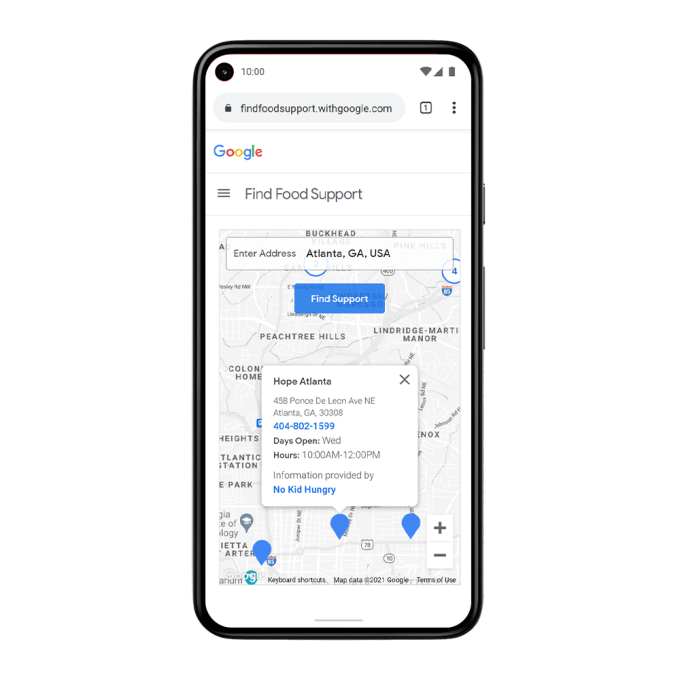
Google today is launching a new suite of resources for people struggling with food insecurity across the U.S. The project includes the launch of a new website, “Find Food Support,” that connects people to food support resources, including hotlines, SNAP information, and a Google Maps locator tool that points people to their local food banks, food pantries and school meal program pickup locations, among other things.

In an announcement, Google explains how the Covid-19 pandemic fueled a worsening food crisis in the U.S., which led to some 45 million people — or 1 in 7 Americans — experiencing food insecurity at some point during 2020. That figure was up 30% over 2019, the company noted. And of those 45 million people, 15 million were children.

While the pandemic’s impacts are starting subside as businesses are reopening and in-person activities are resuming, many children will still go hungry during the summer months when school lunch programs become unavailable.

To help address this need and others related to food insecurity, Google’s new website available at g.co/findfoodsupport offers a combination of food support resources, YouTube videos about the problem of food insecurity in the U.S., and a Google Maps locator tool that will direct people to their nearby food bank or other food support locations.

Google says it worked with organizations including No Kid Hungry, FoodFinder, and the U.S. Department of Agriculture to capture 90,000 places offering free food support across the 50 U.S. states. Using the online tool, website visitors can type in their location to see school meal program pickup sites, food banks and food pantries in their area.

Image Credits: Google

The tool will display the location’s address, phone number and other details — like which days it’s open or business hours.

Although you can find this information in Google Maps directly, it can be more difficult if you don’t know the right keywords to use. For example, a search “food support” returned a combination of charities, food banks and public services alongside businesses with matching keywords, like “Food Lion” and “Lowe’s Foods.” A search for “food assistance” was more complete, but also returned unrelated results, like the “US Food & Drug Administration.” The online tool’s search results will be more precise and accurate.

The new website also highlights other food support information, including SNAP benefit information; support for specific groups, like seniors, children, and families; state-by-state benefit guidelines; and food support hotlines. For those not facing food support issues, it offers information on how to donate money, time or food to those in need.

The site additionally features a handful of YouTube videos published by organizations across the country who are working to address food insecurity issues in their own communities. The videos aim to destigmatize food insecurity by showing how all types of people use food support — including military families, children, and seniors. Google says 1 in 9 active-duty military families experience food insecurity, as do 1 in 6 children, 1 in 3 college students, and over 5 million seniors, for example.

The new site is the result of an effort by Google’s “Food for Good,” headed by Emily Ma. Food for Good originally began as an early stage moonshot project (from Alphabet’s X, formerly Google[x]) known as Project Delta, which focused on creating a smarter food system. The team wanted to find ways to keep food waste out of landfills by better directing food to those who need it most. In December 2020, Ma announced Project Delta would be moving to Google to scale up its work. The core team then joined Google as “Food for Good,” while the food traceability team remained at X to work on broader issues.

Google says it will continue to add more food support locations to the food locator tool going forward, beyond the 90,000 it offers today.