Year: 2021

22 Jun 2021

A newly tech-skeptical FTC will reportedly review Amazon’s acquisition of MGM

Amazon’s purchase of MGM must pass the scrutiny of the FTC, newly chaired by prominent Amazon critic Lina Khan, the Wall Street Journal has reported. While the $8.45M merger is not likely to be stopped, it may provide early indicators of how the agency is revising its approach to mega-corporations consolidating multiple industries with acquisitions like this one.

The proposed acquisition was announced last month, and the addition of MGM’s 4,000 films and 17,000 shows to the Amazon library would be a potent shot in the arm for Prime Video, which like the Amazon storefront itself is meant to be its customers’ default go-to for on-demand media.

As rights change hands and companies shift tactics, the landscape of streaming is ever-changing; while Netflix has focused on original content (and Amazon is not far behind) and Disney has its own stable of standbys, others have begun snapping up the disparate collections of shows and movies that make up the streaming industry’s lucrative long tail.

Yet there is a valid question among regulators of whether content companies like MGM should be owned by platforms like Amazon. As an independent producer of films and TV a company can secure its own licensing deals and operate in direct competition with similar businesses. As a subsidiary of Amazon, it would likely be in large part reduced to an in-house production company for the retail and web giant, not competing on the merits of its products but as part of a multi-industry empire.

FTC Chair Lina Khan — appointed just last week — has been among the foremost critics of the latter business model. Her now famous “Amazon’s Antitrust Paradox” paper asserted that Amazon uses dominance in one industry, like AWS in web hosting, to shore up other less successful arms, like its nascent delivery service. If the latter would fail without the support of the former, the argument (roughly) goes, the company is potentially engaging in anti-competitive behavior enabled by market power.

That the market power and the behavior are in different verticals excused it under the antitrust doctrine of the recent era (so long as consumers didn’t see price increases), but Khan aimed to challenge that doctrine with her paper — and now, as one of the most powerful regulators in the country, she has been given the chance to shape it firsthand.

Such large deals are always reviewed by federal authorities, and in this case the FTC is reportedly in charge, probably because it has already taken on the role of antitrust investigation into Amazon in other circumstances. It’s also handling Facebook (which it has tangled with repeatedly over the years), while the agency’s enforcement partners at the Justice Department took charge of looking into Google and Apple. (The FTC declined to comment, saying it does not confirm the existence of investigations.)

In this case it seems unlikely that the Amazon purchase of MGM will be blocked, seeing as there is certainly real competition in the space and MGM has not been able to make its own way — a sale is almost inevitable. But the review will take place nonetheless, and it will likely elucidate how the FTC has changed its approach to this type of merger.

It’s entirely possible that even in a light-touch approval of this deal there will be opportunity to see new doctrine in play; for example, Amazon’s arguably monopolistic position in ostensibly unrelated markets is likely to take a greater role than under previous FTC leadership. It may even set the stage for more comprehensive and aggressive reviews to come, or perhaps even rewinding previously approved mergers, something Chair Khan has said is a distinct possibility.

22 Jun 2021

Max Q — China’s space station gets a staff

This week, China started staffing up its own space station, and Rocket Lab got the nod from NASA to develop small satellites for the purposes of exploring Mars. Meanwhile, space startups continue to raise money and it doesn’t look like the pace of that is going to slow much heading into summer.

China delivers 3 astronauts to its space station

China has launched astronauts to its space station for the first time, delivering three to the station’s core module, where they’ll remain for a mission that lasts until September. This is the first time China has flown a crewed mission since 2012, and it’s also going to set a record for the longest period of time a Chinese astronaut has remained in space continuously.

This will be a big step forward for China’s space program, and a key evolution of its ambitions to establish a continuous presence in low Earth orbit. China is not an International Space Station partner, and no Chinese nationals have ever set foot aboard that station. The European Space Agency had welcomed overtures for them to participate as a member nation in the ISS last decade, but the US refused.

China has sated outright that it will welcome participation in its space station from foreign astronauts, though there hasn’t been any specific agreements put in place for who those might be, or from what countries.

Rocket Lab will build two orbital research spacecraft for a mission to Mars

Image Credits: Rocket Lab

Rocket Lab has landed a contract of a different sort from its usual business, tapped to build small spacecraft that will go to Mars and perform valuable science and exploration missions on behalf of NASA and its partners. These will make use of Rocket Lab’s Photon platform, which is a satellite platform that it originally developed as one of its value-add offerings for its launch customers.

This is unique for Rocket Lab because the spacecraft its developing won’t be launched aboard a Rocket Lab Electron spacecraft, and will instead fly them on a commercial rocket to be selected by NASA in a separate contract process that will happen later.

The goal is to have these fly to the red planet by 2024, and it’ll help support NASA’s deep space exploration ambitions more broadly.

Startups raise $$

Some interesting funding rounds this week, including $5 million for Hydrosat, a company that’s spotting ground temperature from space and providing that to customers for use in industries like agriculture, wildfire and drought risk, water table information and more.

This kind of data has been monitored by weather and environmental monitoring agencies in the past, but Hydrosat aims to collect it at a frequency that hasn’t been possible before.

Meanwhile, another startup whose entire focus is making sure that companies and other users on the ground can make use of Earth observation data also raised a chunk of cash. Skywatch picked up $17.2 million to help expand its platform, which not only provides access to the data for customers, but can actually also provide the customers themselves, a useful feature for brand new satellite companies.

Join us at TC Sessions: Space in December

Last year we held our first dedicated space event, and it went so well that we decided to host it again in 2021. This year, it’s happening mid-December, and it’s once again going to be an entirely virtual conference, so people from all over the world will be able to join — and you can, too.

22 Jun 2021

Why Amazon should pay attention to Shein

Amazon commands a vast, dominating empire in the world of e-commerce. While its marketplace has proved a boon for businesses trying to get off the ground, many of the more successful companies are now looking beyond the e-commerce giant’s fences, spurred by a desire to compete on their own terms.

This trend has mushroomed as online shopping burgeoned over the past five years. Businesses such as mattress maker Casper, men’s personal care brands Harry’s and Dollar Shave Club, footwear and apparel makers Allbirds and Zaful, gadget store Banggood, and power-bank maker Anker are just a few of the multitude of brands that choose to leverage their own web stores, social media presence and supply chains to build their business and identity without having a marketplace like Amazon get in the way.

Every investor and e-commerce exporter we spoke with noted the genius of Shein’s supply chain management.

Shein, an online-only apparel store that sells the latest in fashion at very affordable prices, is a shining example of this trend. It’s a rage among budget-conscious young adults across Europe, Asia and the Americas: The app was downloaded 14 million times in the United States in March, according to Apptopia, and currently dominates the shopping category in app stores in over 50 countries.

Its success is proof of its belief in bringing the latest trends to the masses as quickly as it can. In the past couple of decades, brands like Zara, H&M and Forever 21 earned themselves the “fast fashion” moniker when they turned the tables on global behemoths such as Gap and Calvin Klein by drastically shortening lead times — the time it takes for clothing to reach the store floor from the designer’s desk.

Shein takes this fast fashion mindset one step further: While brands like Zara and H&M take about three to four weeks to bring clothing from the ramp to the store, Shein uses a combination of real-time customer and predictive analytics, hyperaware fashion designers and an extremely quick and agile supply chain based in China to bring the latest fashion trends from Instagram, Facebook, Reddit and TikTok to its online store in just a week or two.

22 Jun 2021

Super Follows and Ticketed Spaces are coming to Twitter

In Twitter’s latest appeal to one-up competitors from Clubhouse to Patreon, the company announced today that it will begin rolling out applications for Super Follows and Ticketed Spaces.

Twitter first teased the Super Follow feature during an Analyst Day event in February. Super Follows allow creators on Twitter to generate monthly revenue by offering paywalled content to followers who subscribe to them for $2.99, $4.99, or $9.99 per month.

Twitter will only take 3% of creators’ revenue after in-app purchase fees – but, on the App Store and Google Play, in-app purchase fees are 30%, which means that creators will take home about two-thirds of what their followers are paying. Once they exceed $50,000 of lifetime earnings on Twitter, the app will take “20% of future earnings after fees.” When combined with the 30% in-app purchase fee, that leaves creators with about half of their followers’ payments. Meanwhile, Patreon only takes between 5% and 12% of a creator’s earnings (it bypasses in-app purchase fees since it’s a web-based platform). While creators who primarily engage with their audience on Twitter might benefit from having a way to monetize without directing followers to another app, the difference in payout here is stark. Creators might not abandon their existing Patreon systems for Super Follows, but at the very least, this could offer a supplemental income stream.

“Our goal is to elevate people driving the conversations on Twitter and help them earn money,” said senior product manager Esther Crawford. “We updated our revenue share cuts after spending more time thinking about how we could support emerging voices on Twitter.”

Image Credits: Twitter

Ticketed Spaces seem more promising though, since Clubhouse, Spotify Greenroom, and other competitors don’t offer similar options yet (Discord is testing ticketed audio events on its Stage Discovery portal, but they aren’t out yet). Through Ticketed Spaces, users can set their ticket price anywhere between $1 and $999. Creators can also limit how many tickets are sold, which might incentivize someone to actually use the $999 ticket price for a one-on-one conversation with a celebrity (still… yikes?). Twitter will remind attendees that the Ticketed Space is happening through push and in-app notifications.

Clubhouse and Instagram have features that let listeners tip speakers or award badges in a live audio space, but the apps don’t yet allow for advance ticket sales. Another way for top creators to make money on these apps is through Creator Funds. Spotify Greenroom and Clubhouse have both announced plans for Creator Funds, but it’s not yet clear how the earning potential will compare with selling access to Ticketed Spaces on Twitter.

This slew of updates to Twitter comes after activist shareholders attempted to oust CEO Jack Dorsey last year. Now, Twitter is rapidly adding new features and acquiring companies like Revue (a newsletter platform), Ueno (a creative agency), and Breaker (a social podcasting platform).

Image Credits: Twitter

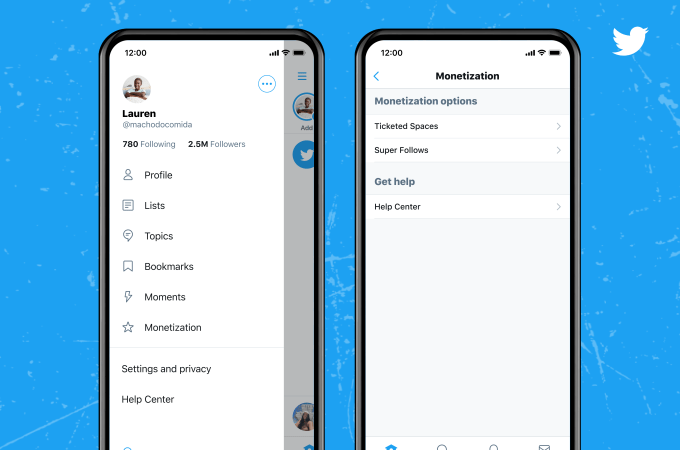
Applications to use Super Follows and Ticketed Spaces are only available on mobile (so, no avoiding the in-app purchase fees) and for people in the U.S. Currently, only iOS users can apply for Super Follows, but Ticketed Spaces applications are available on both iOS and Android. Twitter is adding a brand new Monetization button to the sidebar in the app, where users navigate to see if they’re eligible to apply to be part of the test groups for these features. These features will launch more broadly in the coming months.

22 Jun 2021

Teamsters plan aggressive push to unionize Amazon logistics workers

One of the country’s most powerful unions, the International Brotherhood of Teamsters, confirmed today that it plans to make a nationwide push to unionize Amazon warehouse workers and drivers. And it won’t be a gentle one.

The news was first reported by Motherboard, which obtained a video and resolution announcing the effort. As the organization explained, the plan to unionize Amazon’s growing logistics business has been underway for some time, and the failure in Bessemer to do so — after the grassroots effort faced intense opposition from Amazon itself — illustrates why such an endeavor is necessary.

As Teamsters National Director for Amazon Randy Korgan explained in a recent op-ed on Salon that hinted at the effort:

I see that Teamster locals across the country are already stepping up to meet the challenge by engaging members, building large volunteer organizing committees, building strong community-labor alliances and integrating transformative social justice organizing into their work.

As we saw in the closely-watched National Labor Relations Board (NLRB) election at Amazon’s Bessemer, Alabama warehouse, the company is willing to violate the law and spare no expense to keep its workers from forming a union.

Building genuine worker power at Amazon will take shop-floor militancy by Amazon workers and solidarity from warehousing and delivery Teamsters.

The Teamsters’ plan, assuming a passing vote at this week’s 30th quinquennial International Convention, is to create a special Amazon Division that will fund and aid unionizing efforts in the company’s workforces around the country.

While Amazon repeats loudly and at every possible occasion its commitment to safe and well paid jobs, reports continue to come out of workers in horrendous conditions, callous management, and stagnant wages. As to the last, while Amazon has established a $15 minimum wage at the company, others have pointed out that this is far less than many warehouse workers and drivers were making at other jobs — which have now lowered their compensation to follow Amazon’s lead.

The conflict at Bessemer, in which Amazon was accused of union-busting tactics and dirty tricks to sink a traditional union voting process, has prompted the Teamsters to adopt a different approach.

According to Motherboard, the organization is planning “a series of pressure campaigns involving work stoppages, petitions, and other collective action,” in the hopes that Amazon will find unionization and negotiation preferable. I’ve asked the company for comment on the matter and will update if I hear back.

This is one of the union’s highest priority efforts for the next few years, though it did not specify any particular timeline or budget — no doubt because much of that depends on the situation they find on the ground. But Amazon’s hundreds of thousands of workers represent an enormous untapped working group, the unionization of which could realize similarly enormous sums in benefits for them.

The full text of the resolution will be published when it is provided to the local unions for a vote, at which point it will be embedded below in this article.

22 Jun 2021

Dell Technologies, UserTesting, Movile, Pilot and oVice to offer mini masterclasses at TC Early Stage 2021

Hey you there — early-stage founders. Yes, you. TC Early Stage 2021: Marketing and Fundraising, our mini masterclass in entrepreneurship, is right around the proverbial corner. And by mini we mean it’s just two days — July 8-9. There’s nothing mini about the expert advice, information and actionable tips you’ll glean from attending this event.

Buy your pass today and get ready to learn how to build a better startup without reinventing the wheel (good thing we don’t charge by the cliché).

Day one is packed with presentations by a passel of outstanding subject-matter experts. Don’t miss these sponsored breakout sessions — they cover essential topics such as value-added investing, crafting customer experience, building high-performance teams and how to stand out while fundraising.

Check the agenda for exact times in your specific time zone.

More than Capital – Value Add Investing: There is a wide variety of capital outlets available for entrepreneurs to consider. Today more than ever, founders are seeking out investors that can deliver value add services to support startups throughout their growth journey. Dell Technologies Capital’s Chris Hillock will discuss the firm’s Portfolio Development Practice, and how their team of company builders helps founding team’s establish and hone product market fit, develop scaling strategies, and provide unique access to the Go to Market capabilities of the Dell Technologies Organization. Presented by Dell for Entrepreneurs.

Iterating More Effectively with Feedback: A great product alone is not enough. To be successful, early-stage companies need to optimize all phases of the customer journey. This session will include tactics, best practices, and case studies on how to use customer feedback to understand customer needs, craft more compelling messaging, and improve all phases of the customer experience. Presented by Nate Wright, VP of product marketing at UserTesting.

Inspiring High-performance Teams — The Movile Way: Big dreams – unbelievably big ones – can really help people see the future. And they will rally your team to move faster, together. Learn the proven methodology taught at universities like Harvard and Stanford to create a highly effective, “can do” culture to catapult your startup to the next level. And continue to attract and retain talent, because sizable ambitions inspire teams based on Movile’s wildly successful “Mobile Dream” internship and recruitment program. Presented by Patrick Hruby, CEO, and Luciana Carvalho, VP, at Movile.

Standing Out During Your Fundraising Process: Fundraising is never easy, but the right preparation can make all the difference. Three-time founder Waseem Daher joins Katie Myrick, Pilot’s GM, to share the KPIs investors look for, which questions they ask, and what you need to succeed at the various stages of investment. Currently CEO of Pilot, which specializes in bookkeeping, tax and CFO services for high-growth startups, Waseem is a three-time entrepreneur with two successful exits. Presented by Pilot.

How to survive high-speed startup growth during COVID-19 and retooling for growth opportunities in post-pandemic: On a journey to build a virtual real estate world? Meet oVice — an early-stage startup that witnessed massive growth and became the top virtual space in Japan in less than one year. In this session, you will hear from CFO, Daniel Buckley and Shinji Asada, CEO of One Capital and lead investor of oVice, on how to effectively scale as you grow without imploding. Presented by oVice.

TC Early Stage 2021: Marketing and Fundraising takes place on July 8-9. Grab a pass today and take maximum advantage of this mini masterclass.

Is your company interested in sponsoring or exhibiting at Early Stage 2021 – Marketing & Fundraising? Contact our sponsorship sales team by filling out this form.

22 Jun 2021

First drive: 2021 Mercedes-Benz S-Class

Mercedes-Benz has used the “best or nothing” tagline to market its vehicles for the last 21 years. To ensure its 2021 Mercedes-Benz S580 sedan ticks that “best” box, the German automaker has loaded its flagship vehicle with technology, including an infotainment system that learns to anticipate its owner’s needs, some new rear-steering tricks and upgrades to its advanced driver assistance features.

With a price tag that starts at a steep $110,850, it’s the luxury car for the exceedingly well-heeled executive who wants the top-of-the-line Mercedes sedan with all the bells and whistles modern driving and living requires — and then some.

In S-Class tradition, the sedan is still a big baller. The new version gets longer (by 1.3-inches) and taller (by 0.4-inches), making more space for passengers and cargo. The base 2021 Mercedes-Benz S500 comes with all-wheel drive and a new inline six-cylinder engine that makes 429 horsepower and 384 lb-ft of torque. That’s a 60-plus horsepower bump over the last generation model. The S580 that I drove also came with all-wheel drive and a smooth, powerful and quiet 4.0-liter twin-turbo V8 that makes 496 horsepower and 516 lb-ft of torque. Both versions also get a 48-volt onboard mild hybrid system.

With a price tag that starts at $110,850, it’s the luxury car for the exceedingly well-heeled executive who wants the top-of-the-line Mercedes sedan with all the bells and whistles modern driving and living requires.

Mercedes has always touted its “human-centered innovation” in its S-Class. Initially, the automaker used technology to improve safety (things like ensuring that the doors wouldn’t suddenly spring open in a crash in the 1950s and crumple zones in the1960s). Since the 1990s, the brand has focused on making driving, parking and navigation less clunky and difficult to use. For example, it had an optional voice recognition package in 1996 that allowed you to activate your carphone (remember those‽) with a voice command.

Mercedes has continued to push the technology envelope, most recently launching an all-electric counterpart to the S Class called the EQS. The 2021 S-Class might mark a new generation of the executive hauler, and it has plenty of technology to offer, but it doesn’t quite outshine the all-electric EQS.

Driver assistance

Mercedes-Benz 2021 S Class

Image Credits: Mercedes-Benz

Mercedes has long been a player in the advanced driver assistance system space, debuting an adaptive cruise control feature called Distronic in 1998.

In the 2021 S-Class, ADAS gets an upgrade (called Drive Pilot) that includes a total of 22 sensors and cameras all around the vehicle, which send information to five multicore processors that can analyze the driving situation 1,000 times per second and adapt the suspension accordingly.

All that’s to say, the car “sees” and responds to road conditions, other vehicles, road signs, pedestrians and cyclists, and then should respond like a human driver would.

On the drive from Los Angeles to Montecito (about 130 miles if you take the freeway the whole way), on both winding mountain and ocean roads and stop-and-go traffic on LA’s heinous, concrete block 405 freeway, I kept the S580 in adaptive cruise for most of the trip. The system worked as intended, with the S-Class accelerating and stopping at the appropriate times as I crept along in bumper-to-bumper traffic, from the 105 to the 101. What’s more: I wasn’t exhausted (and pissed off) when I arrived at my destination after a meandering six hours on the road.

Even when a texting Angeleno decided to change lanes, nearly side-swiped my car and narrowly avoided driving into the backseat of the vehicle ahead, the adaptive cruise system maintained control. I was paying attention as this incident unfolded, but Mercedes has designed its system to ensure drivers are attentive even as the ADAS features handle some of the driving tasks.

Touch sensors inside the car and on the steering wheel as well as eye-tracking and facial recognition cameras monitor the attentiveness of the driver. Take your hands off the sensors, and the driver’s display will alert you to your wandering ways, disengaging the ADAS system after a few seconds.

The eye detection and facial monitoring is used to recognize typical signs of drowsiness and driver inattention, and displays a warning message prompting the driver to take a break. There’s also a new microsleep warning that tracks the driver’s eyelid movements by a camera in the driver display.

2021-Mercedes-Benz S Class

Image Credits: Mercedes-Benz

Mercedes claims that the 2021 S-Class is prepped for Level 4 autonomous driving and, in their September announcement of the new vehicle, executives said that “Level 3 conditional driving is near.” The hardware in the vehicle is meant to support that ultimate goal.

Those 22 sensors and cameras are now capable of recognizing speed limit signs, construction zones and other road hazards, which, at times, I found a little annoying. There were some stretches where the posted speed limit dropped to 55, and when ADAS was engaged, the S-Class would suddenly slow to match the posted speed. That’s great when traffic around you isn’t still moving at 70-plus miles per hour, but in quick-moving traffic, it’s unnerving.

The new S-Class is also outfitted with a lane-changing assistant that helps the driver safely make a lane change without disengaging the ADAS system. Flip on the blinker while operating cruise control (and keeping your eyes up and hands on the wheel), and the S-Class will safely maneuver the sedan from one lane to the other, provided all is clear, centering it in the lane, with very little input from the driver.

In addition to the ADAS advancements, Mercedes has upgraded its parking assistant, as well. When optioned with its branded Intelligent Park Pilot, the S-Class “could” conceivably park itself in multilevel automated valet parking (AVP) structures without a human in the vehicle. As Mercedes notes, though, that would only be available in properly equipped parking structures and “provided that national legislation permits such operation.”

The new S-Class has gotten so large (overall it’s as long as most midsized SUVs on the market today), Mercedes integrated new rear-axle steering, which can turn the rear wheels in both directions up to an angle of 10 degrees, which reduces the turning radius by nearly seven feet.

Mercedes has also paired this with an advanced air suspension system that acts both to soften the ride and adapt to float you over rough roads, while providing an additional layer of safety using those sensors and cameras around the car. If a side impact is impending, the system can lift the body of the car by about three inches in a few tenths of a second to protect passengers.

AI Assistant

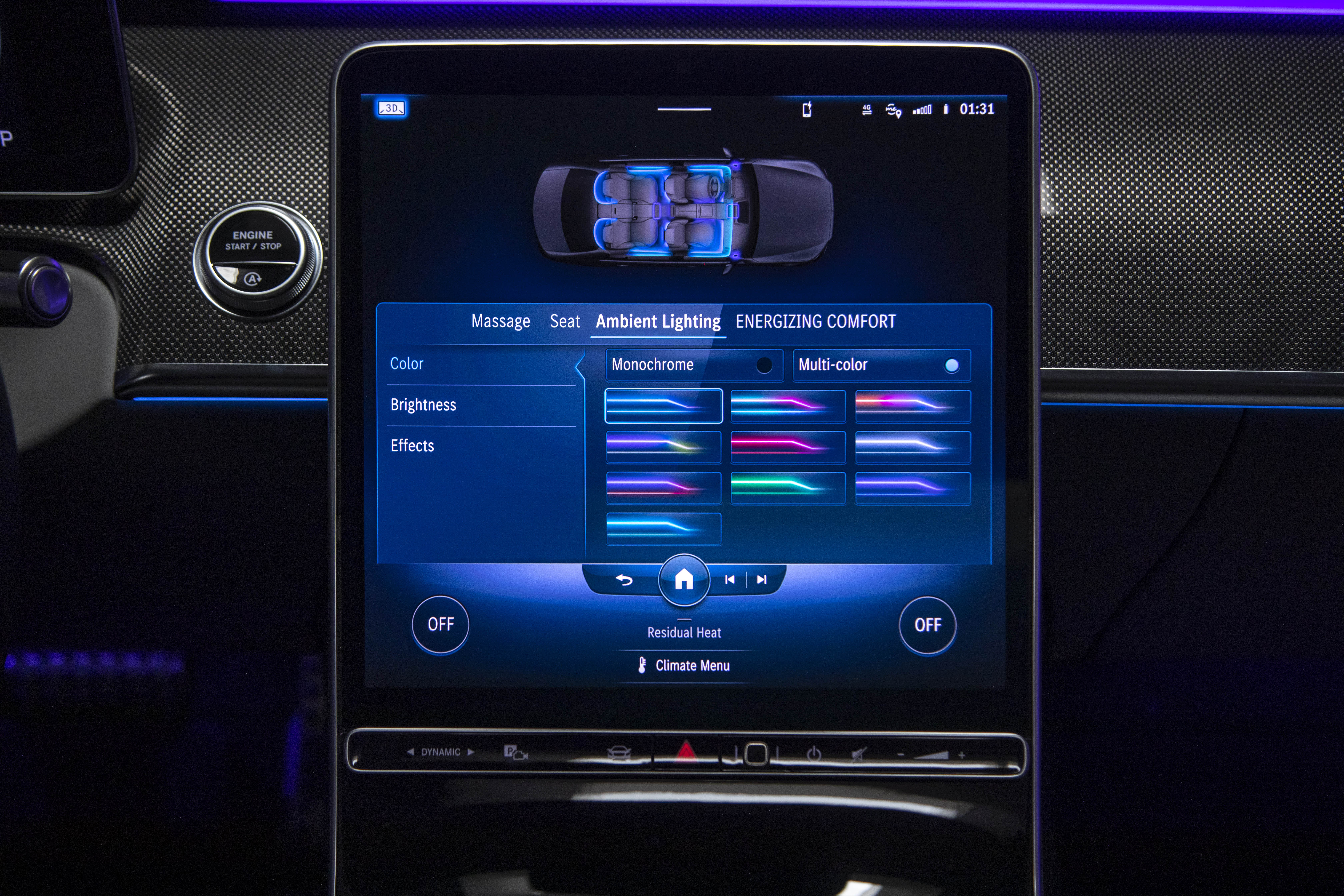
Unlike the EQS that my counterpart, Tamara Warren, drove, there was no 56-inch Hyperscreen in the $148,000-plus S580 I drove. Instead, a single 12.8-inch OLED screen that stretches from dash to armrest graces the center stack and is the control hub of the vehicle. Here you can do everything from control the fragrance that emanates from a diffuser in the glovebox to access Mercedes wellness features. The screen is bright and clear in high-noon sun with no glare and surprisingly not distracting at night.
2021-Mercedes-Benz S Class

Image Credits: Mercedes-Benz

However, one of the most impressive features in the new S-Class is the crystal clear and tremendously impressive 3D, augmented reality, head-up display projected onto the windshield. You can move your head around and still see the display from any angle in the driver’s seat. It’s even somewhat visible from the passenger seat. Use the infotainment system (known as MBUX, short for Mercedes Benz User Experience) to navigate to a destination of choice and as you approach offramps, turns and your final location, blue augmented-reality arrows pop up in the HUD and over a video feed of the road ahead in the center stack indicating which lane you should be in, where your turn is and showing exactly where the address you’re looking for is. You can also turn the feature off and change the driver’s instrument display if it gets too distracting, using the touch-capacitive buttons on the steering wheel.

Mercedes says that the computing power of MBUX has increased by 50% compared to the system in the previous model, and the memory bandwidth is 41,790 MB/s powered by NVIDIA Xavier (versus the Tegra 3 in the last generation). That translates to almost no stuttering, load lag or confusion on the system’s part.

Plus, it also helps the very good, natural language voice recognition system work almost perfectly. You can use touch-capacitive buttons on the steering wheel to activate the voice assistant or simply say the key phrase, “Hey, Mercedes,” to activate voice commands. Do everything from ask the system to look something up for you (provided you have connectivity), change the temperature, run one of Mercedes preprogrammed wellness programs (changes lighting, temperature and massage settings), call your parents, or navigate to a new location and the system almost never misses a beat. The only trouble I had with it was when trying to use voice control to navigate to an address with more than four numbers in it. (e.g., 12345 West Elm Street). After a few tries, I resorted to plugging it in on the very intuitive, easy-to-use touchscreen on the center stack.

While I didn’t spend enough time with the new S-Class to try some of the more advanced AI features it offers, Mercedes says that MBUX can do everything from integrate your connected home into the system to navigate to your favorite spots, just like the one in the EQS. In theory, you can then ask the system to turn on your home lights, and it will learn when you like to start the espresso machine on your drive home., As you drive regular routes and ask the system to perform tasks like make calls, or navigate to a specific place each day, the AI will learn your habits. Eventually, it will simply ask you if you’d like to call your office at a specific time or set a route to your favorite restaurant.

Packed to the gills with tons of features, technology and amenities that make driving a lot more comfortable and a lot less stressful, it’s no wonder that the S-Class has already garnered several accolades, including World Luxury Car of the Year (Disclosure: I am a World Car Juror). If luxury is all about seamless and invisible technology that makes long drives feel more like a spa day, then the 2021 Mercedes-Benz S Class has it in spades.


22 Jun 2021

10 ways founders can manage their mental health while fundraising

Entrepreneurs’ mental health and stress management started to be more widely discussed amid the pandemic, but for many seasoned entrepreneurs, the topic is still taboo. Now that the world seems to be inching toward a new normal, some founders, investors and mental health experts find themselves asking whether we need to consider mental health moving forward if it wasn’t an issue before the pandemic.

We do. For one, it absolutely was an issue before the pandemic. Furthermore, what drives the mental health epidemic among entrepreneurs is their propensity to accept risk.

What drives the mental health epidemic among entrepreneurs is their propensity to accept risk.

“Entrepreneurs bring in a lot of vulnerability into their jobs, and when combined with the risks they are required to take, the vulnerability can be exacerbated when those risks don’t work out,” said Michael Freeman, a clinical professor of psychiatry at the University of California San Francisco School of Medicine and founder of Econa. “And in most cases, it doesn’t work out, and so they are more vulnerable to feeling mental health symptoms and entering a downward spiral. The reverse is also true. When entrepreneurs are knocking it out of the park, they are vulnerable to a different set of mental health challenges.”

So how do we address these issues and train entrepreneurs to sharpen and maintain their mental acuity, particularly when things get tough while fundraising?

It’s simple: prevention and awareness. In terms of prevention, Freeman said it comes down to destigmatizing entrepreneur mental health differences, celebrating entrepreneur mental health superpowers and adopting a downside-prevention lifestyle.

“With mental health, as is true with many things medical, an ounce of prevention is worth a pound of cure,” Freeman said. “For entrepreneurs who want to prevent mental health issues, they need to start by taking a lifestyle risk factor assessment.”

According to Freeman, there are five ways entrepreneurs can support their mental health. (If you or someone you know is feeling hopeless and depressed, please call the National Suicide Prevention Hotline at 800-273-8255.)

  1. Sleep. The most significant role of sleep is to help your brain power up and stay awake during the day. Allowing your mind and your body to recover can have a profound preventative effect. You can’t pitch if you can’t keep your eyes open.
  2. Exercise, and make sure you sweat. Entrepreneurs should get at least 45 minutes of exercise a day, including an intensity that makes you sweat twice a week. It not only has health benefits: It enhances executive functioning, meaning it improves your ability to focus and get things done. It also helps you regulate your emotions when you’re listening to a VC completely shred your idea so you don’t become despondent after a call. When you’re fundraising, your ability to think clearly can be the difference between getting a yes and a no.
  3. Get and keep friends that have nothing to do with business. Entrepreneurship is a lonely profession at times. Aside from work, you want to have a small but engaged circle of friends and loved ones, and be careful not to let your relationships devolve into the blur of work. Keep those relationships and allow them to support you when work gets rough.
  4. Eat well, and eat strategically. Many entrepreneurs live at or below the poverty line at some point in their journey, and when you’re under pressure with limited resources, eating junk and fast food is the wrong tradeoff to make because they aren’t good for cognitive functioning, among many other health consequences.
  5. Address mental health concerns in weeks, not months. When entrepreneurs don’t manage concerns quickly, they can turn into adverse outcomes. “If mental health symptoms are prolonged … it can lead to more severe mental health consequences,” Freeman said. “The adverse personal outcomes include anything from experiencing more serious mental health issues to disrupting social relationships and performance falloffs at work. The adverse business outcomes that may result include bankruptcy, losing employees, alienating strategic alliance partners and scaring away potential investors.”

Awareness begins by gaining an understanding of the factors that could exacerbate your stress levels and impact your ability to complete a successful raise, and then planning accordingly. Things that could raise your stress levels include everything from your pre-raise financial status and health history to gender, race, industry attitudes, institutional barriers and even citizenship.

“Entrepreneurs of color, immigrants and women are far more conscious of the glass ceiling,” Freeman said. “It can be a factor in your mental health while you’re raising. … People from groups that have been otherized in one way or another have different obstacles that are difficult to overcome overall, as well as from a mental health perspective.”

Kerry Schrader, the co-founder of SaaS platform Mixtroz, knows all too well how these things can impact you while fundraising. Although she and her daughter Ashlee Ammons did eventually raise more than a million dollars, the pressure of potentially being the next Black women to do so was overwhelming.

“We stopped holding onto the pressure of being the 37th and 38th Black women to raise over $1 million,” she said. “We got caught up thinking, if we’re not successful, then we will be the reason other Black women are not funded. Honestly, we decided to remove that additional layer of stress from our thinking and just focused on running a profitable business that people could get behind and hoping for the same grace the majority of our white male counterparts get upon failure: Another chance and more funding, which we knew was and still is not the norm.”

According to Schrader, there was little information available about how to manage their mental health while fundraising, leading her and her daughter to try a variety of methods before finding something that made sense.

Based on her experience, here are five more ways entrepreneurs can manage their mental health while fundraising.

  1. Find a counselor or therapist to help navigate your increased stress level. There’s a slow shift that has helped entrepreneurs reframe therapy from something that you do as a reaction to being overwhelmed to a preventative method that helps you thrive. “I leveraged BetterHelp to talk with someone while I raised,” Schrader said. “By communicating to a third party, I could say anything. Venting privately allowed me to reframe my conversations with investors more effectively. By having a qualified professional to speak to, I was able to shift my mindset from, ‘You’re doing me a big favor’ to ‘I have an exciting opportunity and I’m allowing you to invest early.’ Counseling helped a lot.”
  2. Give yourself an out. Goal-setting is a great way to keep things on track, but it can create an illusion that you’re not going to be successful if you’re not constantly moving toward a finite endpoint. “Initially, we started putting criteria for what actions we would take if we did not hit certain milestones,” Schrader said. “Instead of feeling like we could put ourselves in a position of failure, we had rules for when it would be time to end the business and go back to our careers. Having an agreed-upon ‘out’ with my co-founder … was great for my mental health. And here we are, years later, still in the game and mostly sane.”
  3. Leverage your team. You can’t go it alone. Be willing to rely on your team to move your startup forward and preserve your health. “Shortly after we closed our friends and family round, I was diagnosed with breast cancer,” Schrader said. “I was going to radiation, surgery and treatments while I was raising. I was pitching from the hospital bed. But when you’re fundraising, it never stops. That’s when my daughter decided it was time to commit full time. As a family, we realized we needed to lean on each other if we were going to be successful long term.”
  4. Remain flexible with your plans. When you’re just starting, you focus too much on set plans. But when you dig into the backstories of prominent entrepreneurs, you’ll find that they pivoted as needed and learned on the go. “There were times during our raise when we had to be able to cope with weekly, daily and even hourly changes to our plan,” Schrader said. “I describe it as buying a plane, learning to fly the plane and then looking for a hangar to refuel all at the same time. You can try to organize all you want, but I don’t know how much planning you can do.”
  5. Be intentional about the type of stress you’re willing to deal with for money. When you’re fundraising, the obvious goal is to secure a check. But some entrepreneurs agree to untenable terms in order to receive capital. It’s important to know your limits before you walk into the room. “When someone thinks they have the upper hand they will try to see how much stuff they can push you for. Don’t forget your why. … When you know what you can take without losing yourself, stand your ground,” Schrader said. “And remember, even as an entrepreneur, declining is always an option, specifically if the decision to decline protects your sanity.”

If you or someone you know is feeling hopeless and depressed, please call the National Suicide Prevention Hotline at 800-273-8255.

22 Jun 2021

Airbank centralizes all your business bank accounts and financial data

Meet Airbank, a startup that is taking advantage of open banking regulation and related APIs to aggregate all your bank accounts. Focused on startups and small and medium companies, the company wants to build an all-in-one banking interface to access financial data, initiate payments, manage cash flow and more.

Airbank just raised a $3 million (€2.5 million) seed round led by Pia d'Iribarne and Jean de la Rochebrochard at New Wave, with Speedinvest and Tiny VC also participating. A handful of business angels are also joining the round, such as Cris Conde (Executive in Residence at Accel), Luca Ascani (Accel scout) and Marc McCabe (Sequoia scout).

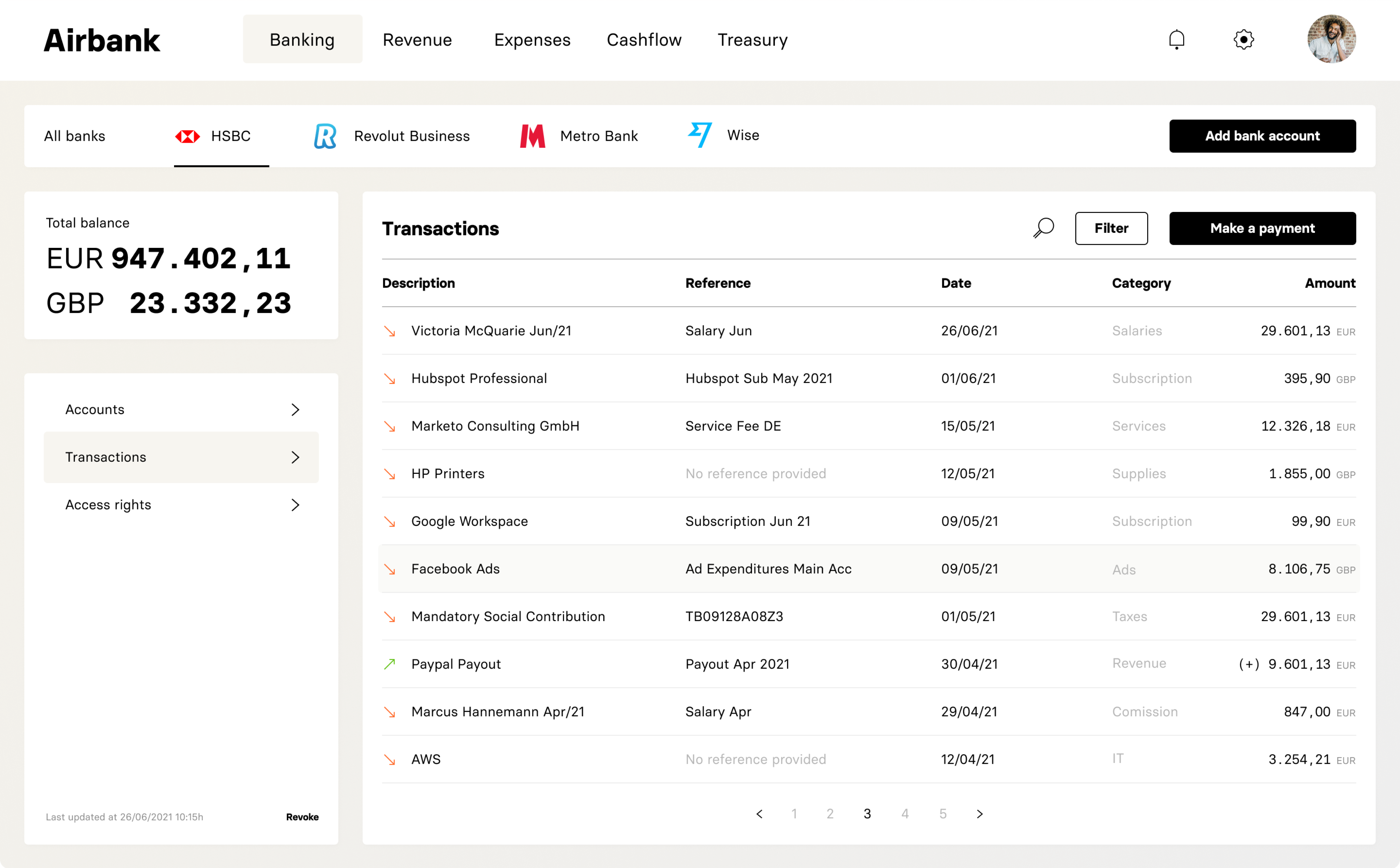
The startup’s value proposition is quite simple and can be easily explained in one screenshot. With Airbank, you can enter your login information for all the bank accounts and related accounts that you use. After that, you can view everything from your Airbank account:

Image Credits: Airbank

Many companies have to deal with multiple bank accounts for several reasons — you may have opened one bank account when you incorporated your company, another bank account to request a loan, a Wise Business account for low foreign transaction fees, a Revolut Business account to get debit cards for everyone, etc.

In addition to bank accounts, chances are you’re also generating revenue with Stripe, PayPal or Shopify. Many executives lose a ton of time connecting to web portals, exporting data as CSV files, importing those files in Microsoft Excel and consolidating all that information.

Airbank automatically refreshes your balances across several accounts. You can see your total balance in multiple currencies. It can also help you reconcile transactions with outstanding invoices as you can search across multiple accounts at once.

This is just a starting point as Airbank wants to become the only interface for all your banking needs. You can categorize transactions, see how much you’re spending with each supplier, track recurring payments and export everything to Google Sheets or Microsoft Excel. Soon, you’ll be able to use Airbank for cash flow forecasting and automatic reconciliation with your Xero or Quickbooks data.

Open banking isn’t limited to account aggregation. With proper APIs, you should be able to initiate payments from a third-party product. And Airbank plans to take advantage of that as the company is working on payments. As you can manage access rights, Airbank could act as the payment portal for the finance team.

“Open banking has enabled smooth integrations with banks, which we can utilize to offer richer banking and payments experiences for our users. Our vision is to build an all-in-one finance hub that connects all your financial accounts in one place. Our integrations will bring bill payments, expense management, and FX all in a single product that is easy to use,” co-founder and CEO Christopher Zemina said in a statement.

Other startups have been working on cash flow management, such as Agicap, and B2B payments, such as Libeo and Upflow. Airbank is starting with account aggregation and wants to tackle B2B finance in a holistic manner.

Vertical SaaS products have been booming lately. And there’s a reason why the space is quite competitive. There’s still a ton of stuff to do around B2B fintech and specialized software-as-a-service products.

22 Jun 2021

Lidar company Quanergy to go public via $1.4B SPAC deal

Quanergy Systems, the Sunnyvale, California-based lidar company, said Tuesday it has agreed to merge with special purpose acquisition fund CITIC Capital Acquisition Corp., a Chinese blank-check firm affiliated with the country’s largest state-owned investment conglomerate.

The deal, which puts an implied valuation on Quanergy at $1.4 billion, is expected to close in the second half of 2021. After closing, the transaction will inject the lidar company with around $278 million in pro forma net cash, including $40 million in private investment in public equity (PIPE) funding.

Lidar is an essential component of most autonomous driving systems – the notable exception being Tesla’s stack, which is attempting to develop a pure vision-based system to support its pursuit of automated driving (Tesla vehicles are not autonomous today and have what is considered a Level 2 advanced driver assistance system). Quanergy is a developer of solid state silicon lidar units, which pulses a low-power laser through an optical phased array to measure the distance and shape of objects. Historically, lidar sensors involved moving parts – generally some mechanism to rotate the laser so it can scan the surrounding area. The company also develops perception software that interprets the sensor data.

Quanergy has had a bumpy road to the NYSE. The company generated a lot of hype after it announced in 2016 that it had developed a lidar that cost $250 or less (for reference, around the same time Velodyne was selling a lidar sensor for $75,000). The news shot the company to unicorn status and incited talks of a potential initial public offering, Bloomberg reported. But excitement was tempered after Quanergy hit technical roadblocks.

Then the company announced in January 2020 that CEO and co-founder Louay Eldada would be leaving the company. Kevin Kennedy took over as interim CEO, then became the permanent leader in April. Quanergy says it has more than 350 customers and 40 partnerships globally, across both the automotive and internet of things sectors. Its investors include automakers Daimler and Geely, as well as Samsung and Enterprise.

Quanergy says the proceeds from the SPAC transaction will be used to accelerate research and development, pay down debt and fund working capital. Upon closing, Quanergy will be listed on the NYSE under the ticker symbol “QNGY.”

The SPAC, CITIC Capital Acquisition Corp., is sponsored by CITIC Capital Holdings Limited, an investment firm backed by Chinese conglomerate CITIC Group. Quanergy must file for clearance with the Committee on Foreign Investment in the United States (CFIUS). The company anticipates CFIUS greenlighting the deal because CITIC would keep its stake in the company below 10%, and Quanergy does not record any personal driver data, Reuters reported.

Quanergy is not the first lidar company to go public via a SPAC merger. Others include AEye, which will merge with CF Finance Acquisition Corp. III at a $2 billion deal, and Volvo-partnered Luminar at a $3.4 billion valuation.