Year: 2021

22 Jun 2021

India orders antitrust investigation against Google over alleged abuse of Android’s dominance in smart TV market

India’s antitrust watchdog has ordered an investigation into allegations that Google has abused the dominant position of Android in the country’s smart TV market. The news comes hours after the European Union opened a formal antitrust investigation into allegations that Google abuses its leading role in the advertising-technology sector.

In its initial review, the Competition Commission of India, which began looking into these allegations last year, said Google had breached certain anti-competitive laws.

“Google makes AOSP available to any third parties under an open- source license, however, the AOSP license does not grant OEMs, the right to distribute Google’s proprietary apps such as Play Store, YouTube, etc. referred to as Google Applications in TADA. The AOSP license further does not grant OEMs, the right to use the Android logo and other Android related trademarks,” it said in a 24-page order.

“In order to be able to preinstall Google’s proprietary apps, device manufacturers have to commit to comply with the ACC (Android Compatibility Commitments) for all devices based on Android manufactured/distributed/sold by them; and in order to be able to preinstall any proprietary app of Google, e.g. Play Store, device manufacturers will have to preinstall the entire suite of Google apps,” the order adds.

Google has denied any wrongdoing. “We are confident that our smart TV licensing practices are in compliance with all applicable competition laws,” a company spokesperson said in a statement.

About 8 million smart TV sets were sold in India in 2019, over 60% of which were powered by Google’s Android operating system.

It’s a tough week for American giants in India. On Monday evening, the world’s second largest internet market proposed tough e-commerce rules that could hurt Amazon and Walmart’s Flipkart.

Tuesday’s order is the third ongoing antitrust case investigation that India has opened against Google. Late last year, India’s antitrust watchdog opened an investigation into Google for allegedly abusing the dominant position of its app store to promote its payments service in the South Asian nation.

This is a developing story. More to follow…

22 Jun 2021

Oyster, an HR platform for distributed workforces, snaps up $50M on a $475M valuation

The future of work is long on long-distance, and today a startup that’s built a platform to help organizations hire global talent and build out those remote workforces is announcing a round of funding on the heels of strong growth.

Oyster — which provides tools to help with hiring, onboarding, payroll, benefits and salary management services for both contractors and full-time employees working outside of an organization’s home country — has closed a Series B of $50 million.

We understand that the funding is coming in at a $475 million valuation, six times the company’s valuation when it last raised money — a $20 million round just four months ago. The company itself has seen business grow “exponentially” since then, said Tony Jamous, London-based Oyster’s CEO who co-founded the company with Jack Mardack. The company now works with 80 large businesses, he said, helping them fill knowledge worker roles.

Stripes is leading the Series B, with previous backers Emergence Capital and The Slack Fund, as well as new investor Avid Ventures, also participating.

Jamous told me back in February that the idea for building Oyster was first planted when he was working at his first startup, Nexmo (which eventually he sold to Vonage), after being faced with the challenges of hiring talent internationally, and specifically the millions the company invested to build out the infrastructure to do so itself, since every country has very specific procedures for employing people and handling all of the contractural, tax, and regulatory details related to that.

Oyster’s mission has been to  make it possible for any company to hire wherever they want, without going through that pain themselves, making the “world their oyster,” so to speak.

While that in itself is a great idea that definitely fills a need for businesses, it has also been compounded by recent changing tides. Not only are more people wanting to work further afield, but at “home”, many companies — especially those who need to fill knowledge worker roles — are facing talent shortages. All of this is driving even more demand for sourcing and hiring candidates from further afield, and a culture in the workplace that it’s possible to work well even if you are not in the same physical space.

“What’s happening in the world is that there’s a talent shortage, and also there’s no need to be in the office anymore,” he said. “When it comes to tapping into the global talent pool, if you think about it, if you’re a London-based company, then the chances that your best talent is in London is less than 1%. So by tapping into the global talent pool, suddenly you’re dramatically increasing your chances, especially if you depend on talent as as a key source of your success.”

The number of startups in the market today targeting the remote working opportunity — helping companies source and hire people wherever they happen to be located — and Oyster is not the only one of them raising big money to scale. Others include Deel, which is now valued at $1.25 billion; Turing; Papaya Global (now also valued at over $1 billion); Remote, and many more.

Oyster is not — yet? — in the business of helping to source or vet potential hires, but once someone is identified and an organization wants to make an offer, Oyster provides a seamless way to handle the rest, including giving advice on whether it’s best to hire the person as a contractor or full time employee (the trend here, he said, is full-time), how to handle benefits based on the country in which the talent is based; and other aspects of remuneration, again particular to each local market. Pricing ranges from $29 per person, per month for contractors, to $399 for working with full employees, to other packages for larger deployments.

The company also has a public service mission in all this. Jamous himself originally hails from Lebanon and has a particular mission to help people from less high-profile parts of the world, and emerging countries, also get on the career ladder. In this day and age, since relocation and migration are no longer a must-do, it opens up a lot of opportunities for people that didn’t exist before. Oyster applied for, and now has B-Corp certification, which it’s using to fill out that global employment and talent mandate.

This is not just for greater good, though. There are actual talent shortages, and a recent study from Korn Ferry, cited by Oyster, found that 1.5 billion knowledge workers will be entering the workforce in the next decade from emerging economies. Building tools to help hire and manage that talent makes business sense.

“We’re thrilled to partner with Stripes for the next chapter of growth and positive impact for Oyster,” said Jack Mardack, co-Founder of Oyster, in a statement. “Investors like Stripes, Emergence, Slack Fund, Avid, and PeopleTech Partners among others, who share in our passion for the Oyster mission and vision for the future of work, give us the rocket fuel we need to change the world by unblocking access to job opportunities for everyone.”

“The transition to remote work is one of the most fundamental macro trends in business today and COVID-19 accelerated that transition by 10 years,” said Saagar Kulkarni, partner at Stripes, in a statement. “Oyster makes it seamless for any company to hire the best person for each job, removing location as a barrier. Tony and the team have built the best software product in the market and are poised to build a market-defining company. We are thrilled to join the entire Oyster team on their mission to level the playing field for the global workforce.”

22 Jun 2021

Vantage raises $4M to help businesses understand their AWS costs

Vantage, a service that helps businesses analyze and reduce their AWS costs, today announced that it has raised a $4 million seed round led by Andreessen Horowitz. A number of angel investors, including Brianne Kimmel, Julia Lipton, Stephanie Friedman, Calvin French Owen, Ben and Moisey Uretsky, Mitch Wainer and Justin Gage, also participated in this round

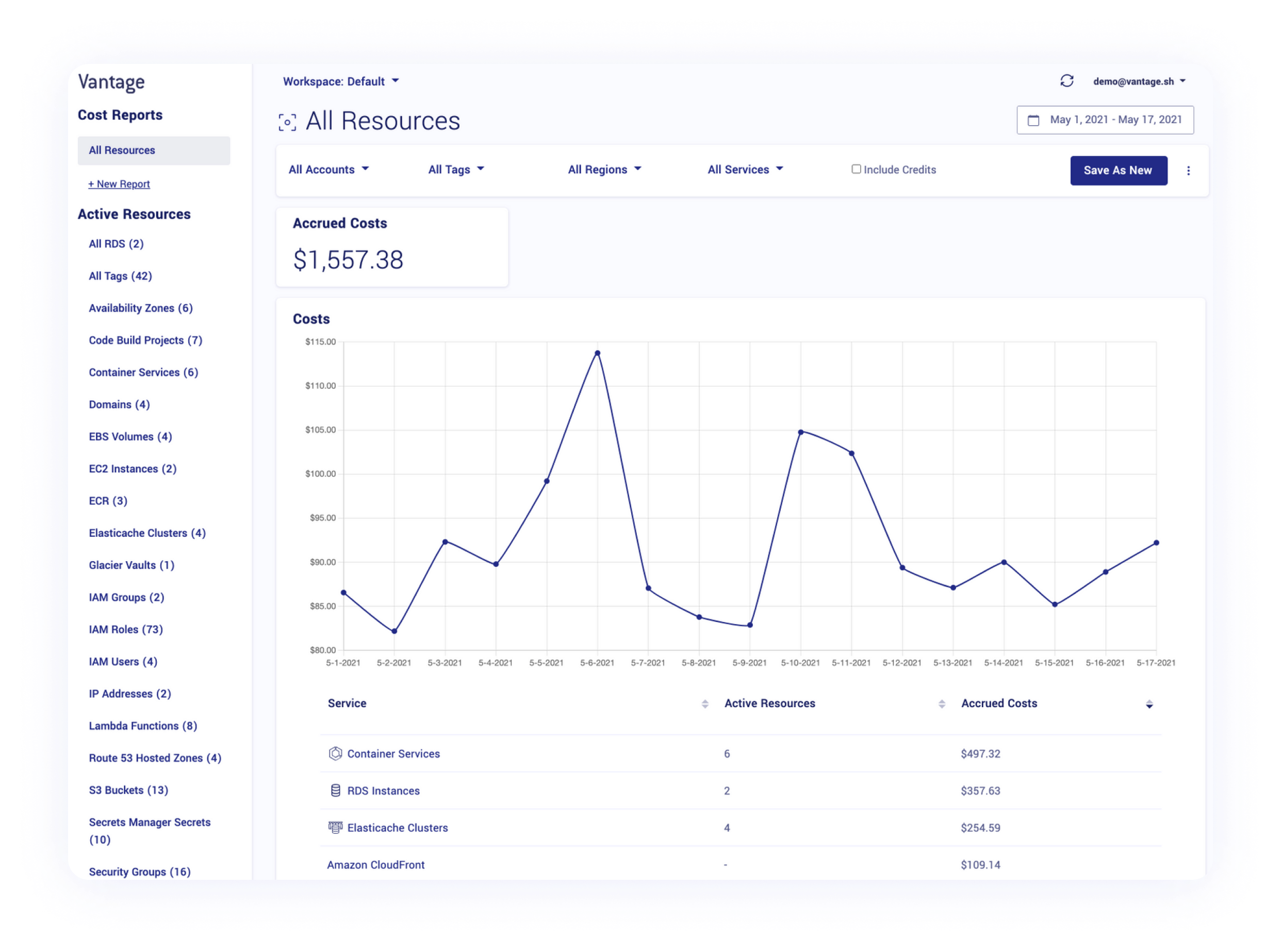
Vantage started out with a focus on making the AWS console a bit easier to use — and help businesses figure out what they are spending their cloud infrastructure budgets on in the process. But as Vantage co-founder and CEO Ben Schaechter told me, it was the cost transparency features that really caught on with users.

“We were advertising ourselves as being an alternative AWS console with a focus on developer experience and cost transparency,” he said.”What was interesting is — even in the early days of early access before the formal GA launch in January — I would say more than 95% of the feedback that we were getting from customers was entirely around the cost features that we had in Vantage.”

Image Credits: Vantage

Like any good startup, the Vantage team looked at this and decided to double down on these features and highlight them in its marketing, though it kept the existing AWS Console-related tools as well. The reason the other tools didn’t quite take off, Schaechter believes, is because more and more, AWS users have become accustomed to infrastructure-as-code to do their own automatic provisioning. And with that, they spend a lot less time in the AWS Console anyway.

“But one consistent thing — across the board — was that people were having a really, really hard time twelve times a year, where they would get a shock AWS bill and had to figure out what happened. What Vantage is doing today is providing a lot of value on the transparency front there,” he said.

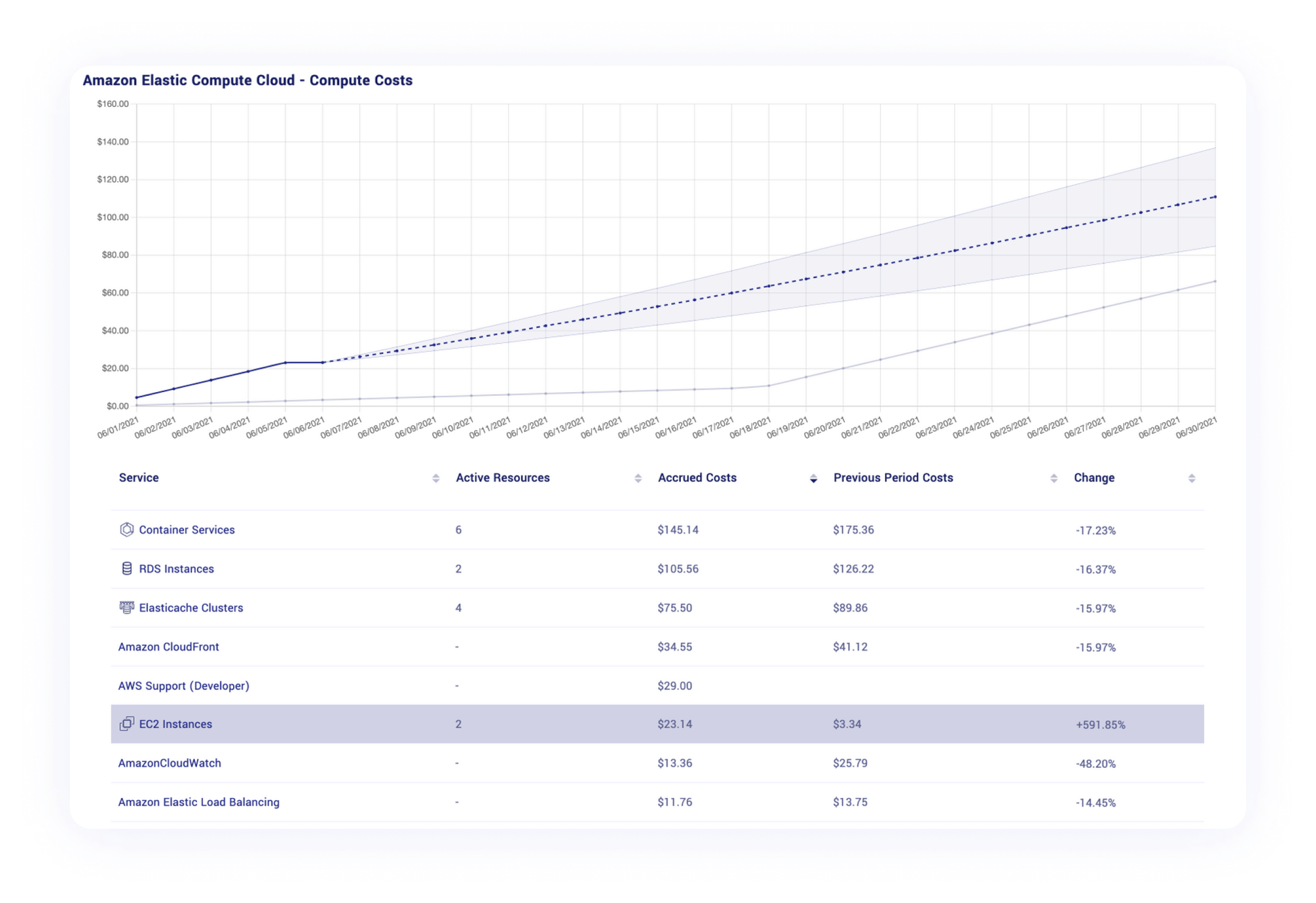
Over the course of the last few months, the team added a number of new features to its cost transparency tools, including machine learning-driven predictions (both on the overall account level and service level) and the ability to share reports across teams.

Image Credits: Vantage

While Vantage expects to add support for other clouds in the future, likely starting with Azure and then GCP, that’s actually not what the team is focused on right now. Instead, Schaechter noted, the team plans to add support for bringing in data from third-party cloud services instead.

“The number one line item for companies tends to be AWS, GCP, Azure,” he said. “But then, after that, it’s Datadog Cloudflare Sumo Logic, things along those lines. Right now, there’s no way to see, P&L or an ROI from a cloud usage-based perspective. Vantage can be the tool where that’s showing you essentially, all of your cloud costs in one space.”

That is likely the vision the investors bought in as well and even though Vantage is now going up against enterprise tools like Apptio’s Cloudability and VMware’s CloudHealth, Schaechter doesn’t seem to be all that worried about the competition. He argues that these are tools that were born in a time when AWS had only a handful of services and only a few ways of interacting with those. He believes that Vantage, as a modern self-service platform, will have quite a few advantages over these older services.

“You can get up and running in a few clicks. You don’t have to talk to a sales team. We’re helping a large number of startups at this stage all the way up to the enterprise, whereas Cloudability and Cloud Health are, in my mind, kind of antiquated enterprise offerings. No startup is choosing to use those at this point, as far as I know,” he said.

The team, which until now mostly consisted of Schaechter and his co-founder and CTO Brooke McKim, bootstrapped to company up to this point. Now they plan to use the new capital to build out its team (and the company is actively hiring right now), both on the development and go-to-market side.

The company offers a free starter plan for businesses that track up to $2,500 in monthly AWS cost, with paid plans starting at $30 per month for those who need to track larger accounts.

22 Jun 2021

Brave’s non-tracking search engine is now in beta

Pro-privacy browser Brave, which has been testing its own brand search engine for several months — operating a waitlist where brave (ha!) early adopters could kick the tyres of an upstart alternative in Internet search — has now launched the tool, Brave Search, in global beta.

Users interested in checking out Brave’s non-tracking search engine, which is built on top of an independent index and touted as a privacy-safe alternative to surveillance tech products like Google search, will find it via Brave’s desktop and mobile browsers. It can also be reached from other browsers via search.brave.com — so doesn’t require switching to Brave’s browser to use.

Brave Search is being offered as one of multiple search options that users of the company’s eponymous browser can pick from (including Google’s search engine). But Brave says it will make it the default search in its browser later this year.

As we reported back in March, the company acquired technology and developers who had previously worked on Cliqz, a European anti-tracking search-browser combo which closed down in May 2020 — building on a technology they’d started to develop, called Tailcat, to form the basis of the Brave-branded search engine.

The (now beta) search engine has been tested by more than 100,000 “early access users” at this point, per Brave. It’s made this video ad to tout its “all in one” alternative to Google search + Chrome.

The company recently passed 32M monthly active users (up from 25M back in March) for its wider suite of products — which, as well as its flagship pro-privacy browser, includes a news reader (Brave News), and a Firewall+VPN service.

Brave also offers privacy-preserving Brave Ads for businesses wanting to reach its community of privacy-preferring users.

Growing public awareness of surveillance based business models has been building momentum for pro-privacy consumer tech for a number of years. And several players which started out with a strong focus on one particular pro-privacy product (such as a browser, search engine or email) have been expanding into a full suite of products — all under the same non-tracking umbrella.

As well as Brave, there’s the likes of DuckDuckGo — which offers non-tracking search but also a tracker blocker and an email inbox protector tool, among other products, and reckons it now has between 70M-100M users overall; and Proton, the maker of e2e-encrypted email service ProtonMail but also a cloud calendar and file storage as well as a VPN. The latter recently confirmed passing 50M users globally.

There is also Apple itself too, of course — a Big Tech giant that competes with Google and the adtech complex by promising users a privacy premium to drive sales of its hardware and services. (At the start of this year Apple said there are now over 1BN iOS users globally — and over 1.65BN Apple devices.)

Tl;dr: The market for privacy consumer tech is growing.

Still, even Apple doesn’t try to compete against Google search which perhaps underlines the scale of the challenge involved in trying to poach users from the search behemoth. (Albeit, Apple extracts massive payments from Google to preload the latter’s search engine onto iOS devices — which does conflict with (and complicate) its wider, pro-privacy, pro-user promises while also adding a nice revenue boost for Apple… ).

DuckDuckGo has, by contrast, been at the non-tracking search coalface for years — and turning a profit since 2014. Though clearly not in the same profit league as Apple. But, more recently, it’s also taken in rare tranches of external funding as its investors spy growing opportunity for private search.

Other signs of expanding public appetite to protect people’s information from commercial snoopers include the surge of usage for e2e encrypted alternatives to Facebook-owned WhatsApp — such as Signal — which saw a download spike earlier this year, after the advertising giant announced unilateral changes to WhatsApp’s terms of service.

Credible players that have amassed a community of engaged users around a core user privacy promise are well positioned to ride each new wave of privacy interest — and cross sell a suite of consumer products where they’ve been able to expand their utility. Hence Brave believing the time is right for it to dabble in search.

Commenting in a statement, Brendan Eich, CEO and co-founder of Brave, said: “Brave Search is the industry’s most private search engine, as well as the only independent search engine, giving users the control and confidence they seek in alternatives to big tech. Unlike older search engines that track and profile users, and newer search engines that are mostly a skin on older engines and don’t have their own indexes, Brave Search offers a new way to get relevant results with a community-powered index, while guaranteeing privacy. Brave Search fills a clear void in the market today as millions of people have lost trust in the surveillance economy and actively seek solutions to be in control of their data.”

Brave touts its eponymous search offering as having a number of differentiating features vs rivals (including smaller rivals) — such as its own index which it also says gives it independence from other search providers.

Why is having an independent index important? We put that question to Josep M. Pujol, chief of search at Brave, who told us: “There are plenty of incentives for censorship and biases, either by design, or what is even more difficult to combat, unintentional. The problem of search, and how people access the web, is that it is a mono-culture, and everybody knows that while it’s very efficient, it’s also very dangerous. A single disease can kill all the crops. The current landscape is not fail-tolerant, and this is something that even users are becoming aware of. We need more choices, not to replace Google or Bing, but to offer alternatives. More choices will entail more freedom and also get back to real competition, with checks and balances.

“Choice can only be achieved by being independent, as if we do not have our own index, then we are just a layer of paint on top of Google and Bing, unable to change much or anything in the results for users’ queries. Not having your own index, as with certain search engines, gives the impression of choice, but in reality such engine ‘skins’ are the same players as the big-two. Only by building our own index, which is a costly proposition, will we be in a position to offer true choice to the users for the benefit of all, whether they are Brave Search users or not.”

Although, for now, it’s worth noting that Brave is relying on some provision from other search providers — for specific queries and in areas like image search (where, for example, it says it’s currently fetching results from Microsoft-owned Bing) — to ensure its results achieve adequate relevancy.

Elsewhere it also says it’s relying upon anonymized contributions from the community to improve and refine results — and is seeking to live up to wider transparency claims vis-a-vis the search index (which it also claims has “no secret methods or algorithms to bias results”; and for which it will “soon” be offering “community-curated open ranking models to ensure diversity and prevent algorithmic biases and outright censorship”).

In another transparency step Brave is reporting the percentage of users’ queries that are independent by showing what it bills as “the industry’s first search independence metric” — meaning it displays the ratio of results coming exclusively from its own index.

“It is derived privately using the user’s browser as we do not build user profiles,” Brave notes in a press release. “Users can check this aggregate metric to verify the independence of their results and see how results are powered by our own index, or if third-parties are being used for long tail results while we are still in the process of building our index.”

It adds that Brave Search will “typically be answering most queries, reflected by a high independence metric”. Although if you’re performing an image search, for example, you’ll see the the independence metric take a hit (but Brave confirms this will not result in any tracking of users).

“[Transparency] is a key principle at Brave, and there will also be a global independence metric for Brave Search across all searches, which we will make publicly available to show how we are progressing towards complete independence,” it adds.
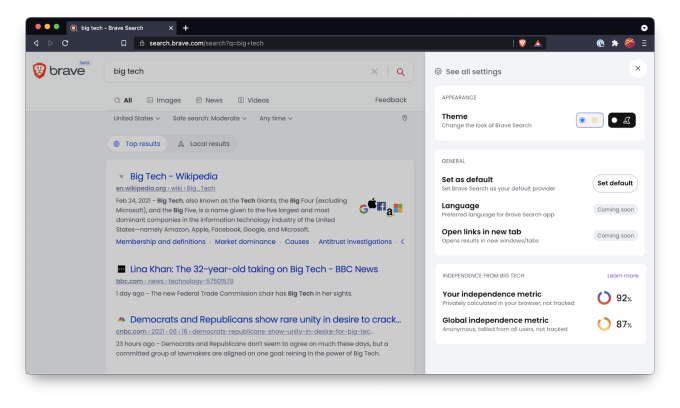
Example of Brave’s ‘independence metric’ for search results (Image credits: Brave)

On the monetization side, Brave says it will “soon” be offering both a paid ad-free version of search in the future and an ad-supported free version — while still pledging “fully anonymous” search. Though it specifies that it won’t be flipping the ad switch during the early beta phase.

“We will offer options for both ad-free paid search and ad-supported free search later,” it notes. “When we are ready, we will explore bringing private ads with BAT revenue share to search, as we’ve done for Brave user ads.”

Users of the search engine who do not also use Brave’s own browser will be served contextual ads.

“In Brave Search via the browser, strong privacy guarantees for opt-in ads are a norm and a brand value that we uphold,” adds Pujol, confirming that users of its search and browser are likely to get the same type of ad targeting.

Asked about pricing of the forthcoming ad-free version of the search engine he says: “Although we have not finalized the launch date or the price yet, our ad-free paid search will be affordable because we believe search, and access to information, should be available on fair terms for everyone.”

In an interesting recent development in Europe, Google — under pressure from antitrust regulators — has agreed to ditch a pay-to-play auction model for the choice screen it offers regional users of its Android platform, letting them pick a default search engine from list with a number of rivals and its own brand Google search. The move should expand the number of alternative search engines Android users in Europe are exposed to — and could help chip away at some of Google’s search marketshare.

Brave previously told us it would not participate in Google’s paid auction — but Pujol says that if the new model is “truly free to participate” it will likely take part in future.

“Google and free-to-participate seem difficult to believe, given plenty of precedents but if this model is indeed truly free to participate, without contracts or non-disclosure agreements, then we would likely participate,” he says. “After all, Brave Search is open to everyone who would like to use it, and we are open and happy to put Brave Search on any platform.”

“We have localized browsers throughout the European market, so in addition to growth via the Brave browser growing, we intend to grow Brave Search’s usage by marketing our best-in-class privacy on all media that reach prospective users,” he adds.


22 Jun 2021

The early-stage venture capital market is weird and chaotic

When SoftBank announced its first Vision Fund back in 2017, TechCrunch gawked at the size of the fundraising vehicle and its $100 million minimum check size. Noting a few of its early deals, we wrote that “the party is just getting started.”

Little did we know how accurate that quip would become. The Vision Fund poured capital into a host of companies with big plans, or what could at least be construed as grandiose hypotheses about the future. And after deploying $98.6 billion in a blizzard of deals, SoftBank left the venture capital market changed.

It’s not a stretch to say that the Vision Fund helped make the venture capital game faster in terms of deal pacing and larger in terms of deal scale. The Vision Fund was also content to write checks at amped valuations, leading some investors to privately carp about lost deals.

“Strange” may be the best way to describe today’s venture capital market, at least in the United States.

Today’s venture capital market is currently enduring another wave of venture capital angst, this time driven by Tiger Global. Tiger often writes smaller checks than what SoftBank’s capital cannon wielded, but its pace and willingness to invest a lot, very early, at prices that other investors balk at, is making waves.


The Exchange explores startups, markets and money. Read it every morning on Extra Crunch or get The Exchange newsletter every Saturday.


And while Tiger races to build what increasingly appears to be a private index fund of software startups that have reached some sort of scale or growth, the venture capital market is seeing its traditional benchmarks tied to different tiers of investment molt, meld, or disappear altogether.

Old metrics that would ready a startup for a successful Series A are antiquated clichés. As are round sizes for Series A startups; it’s increasingly common for seed-stage startups to reload their accounts several times before approaching an A, and Series B rounds often resemble the growth-stage deals of yesteryear.

It’s confusing, and not Tiger’s fault, per se; the Tiger rush is a variation on the Vision Fund’s own venture disruption. And the Vision Fund followed in the footsteps of a16z, which raised large, rapid funds early in its life and garnered a reputation at the time for having a willingness to pay more than other venture capital firms for the same deal.

Where does all the change leave us? In a fascinating, if turbulent, market for startup fundraising.

For example, The Exchange caught up with Rudina Seseri of Glasswing Ventures the other week to chat about AI startups. During our conversation concerning venture capital dynamics, Seseri said something incredibly interesting: With as much seed capital as there is in the market today, she’s seeing startups raise later Series As than before. But, she added, with the creep of late-stage capital into the earlier stages of venture investing, Series B rounds can happen rapidly after a company raises an A.

So, slow As and fast Bs. We wanted to dig more into the concept, so we asked a number of other investors about her view. We’re tackling the question in two parts, focusing on the U.S. market today and the rest of the world later this week.

What we found out is that while Seseri’s view regarding late As and early Bs is correct for many startups, it really depends on whether they are on the radar of later-stage firms. And yes, some of the investors mentioned Tiger in their responses. Let’s dive in to understand what founders are really dealing with.

22 Jun 2021

Merlyn Mind emerges from stealth with $29M and a hardware and software solution to help teachers with tech

We’ve chronicled, in great detail, the many layers of technology, services and solutions, that have been wrapped around the world of education in recent years — and especially in the last year, which became a high watermark for digital learning tools because of Covid-19. Today, a startup called Merlyn Mind is coming out of stealth with a proposition that it believes helps tie a lot of this together in the K-12 classroom — a “digital assistant” that comes in the form of a piece of custom hardware and software to “read” natural voice and remote control commands from a teacher to control multimedia apps on a screen of choice. Along with this, Merlyn Mind is announcing $29 million in initial funding to build out its vision.

The funding is being led by specialist edtech investor Learn Capital, with other unnamed investors participating. It comes after Merlyn Mind spent about three years quietly building its first release and more recently piloting the service in 50+ classrooms in more than 20 schools.

Co-founded by longtime IBM scientists Satya Nitta (the CEO), Ravi Kokku, and Sharad Sundararajan — all of whom spent several years leading education efforts in IBM’s Watson AI research division — Merlyn Mind is coming to the market with a patented, vertically integrated solution to solve what Nitta told me in an interview he believes and has seen first-hand to be a fundamental pain point in the world of edtech.

In effect, education and technology may have now been merged into a single term as far as the tech world is concerned, but in terms of practical, on-the-ground application, many teachers are not making the most of the tools they have in the classroom. The majority are, he believes, facing “cognitive overload” (which is not to mention the kids, who themselves probably are facing the same: a problem for it to tackle down the road, I hope), and they need help.

To be fair, this problem existed before the pandemic, with research from McKinsey & Co. published in 2020 (and gathered earlier) finding that teachers were already spending more than half of their time on administrative tasks, not teaching or thinking about how and what to teach or what help specific students might need. Other research from Learn Platform found that teachers potentially have as many as 900 different applications that they can use in a classroom (in practice, Nitta told me a teacher will typically use between 20 and 30 applications, sites and tech services in a day, although even that is a huge amount).

Post-Covid-19, there are other kinds of new complications to grapple with on top of all that. Not only are many educators now playing catch-up because of the months spent learning at home (it’s been widely documented that in many cases, students have fallen behind), but overall, education is coming away from our year+ of remote learning with a much stronger mandate to use more tech from now on, not less.

The help that Merlyn Mind is proposing comes in the form of what the startup describes as an “AI hub.” This includes a personal assistant called Symphony Classroom, a kind of Alexa-style voice interface tailored to the educational environment and built on a fork of Android; a smart speaker that looks a bit like a soundbar; and a consumer-style remote that can be used also for navigation and commands.

These then work with whatever screen the teacher opts to use, whether it is a TV, or an interactive whiteboard, or something else; along with any other connected devices that are used in the classroom, to open and navigate through different apps, including various Google apps, NearPod, Newsela, and so on. (That could potentially also include kids’ individual screens if they are being used.)

The idea is that if a teacher is in the middle of a lesson on a specific topic and a question comes up that can best be answered by illustrating a concept through another app, a teacher can trigger the system to navigate to a new screen to find that information and instantly show it to the students. The system can also be used to find a teacher’s own materials on file. The demo I saw worked well enough, although I would love to see how an ordinary teacher — the kind they’re hoping will use this — would fare.

Everyone knows the expression “hardware is hard,” so it’s interesting to see Merlyn addressing its problem with a hardware-forward approach.

Nitta was very ready with his defense for this one:

“I’ll tell you why we built our own hardware,” he told me. “There’s a bunch of AI processing that’s happening on the device, for various reasons, including latency and security. So it’s kind of an edge AI appliance. And the second thing is the microphones. They are designed for the classroom environment, and we wanted to have complete control over the tooling of these microphones for the processing, for the environment, and that is very hard to do. If you are taking a third-party microphone array off the shelf, it’s impossible, actually, you simply cannot.”

The startup’s early team is rounded out with alums from the likes of HP Education, Amazon, Google, Facebook, Broadcom and Roku to help build all of this, knowing the challenges they were tackling, but also the payoff once it would be finished if it all works.

“We have a very, very talented team, and we basically said, right, this is going to be a lot of hard work that will take us three and a half years. We have to build our own piece of hardware… and we ended up building the entire voice stack from from scratch ourselves, too,” Nitta continued. “It means we have end to end control of everything from the hardware all the way to the language models.”

He did point out though that over time, there will be some elements that will be usable without all the hardware, in particular when a teacher may suddenly have to teach outside the classroom again in a remote learning environment.

It’s a very ambitious concept, but where would education and learning be if not for taking leaps once in a while? That’s where investors stand on the startup, too.

“Just as we saw with the breakthrough edtech company Coursera which reached IPO this year and was started a decade ago by two machine learning professors, in today’s hypercompetitive market the best edtech companies need to start with an advanced technological core,” said Rob Hutter, founder and managing partner of Learn Capital. “Merlyn is one of the first companies to focus on the enhancement of live teaching in classrooms, and it is developing a solution that is so intuitive it allows teachers to leverage technology with mastery while using minimal effort.  This is a very promising platform.”

The proof will be in how it gets adopted when it finally launches commercially later this year, with pricing to be announced later.

22 Jun 2021

How much to pay yourself as a SaaS founder

“If you’re the founder of a seed-stage [company and] you’re worried about your electricity staying on this month, then your salary is too low. If you’re saving $10,000/mo, then your salary is probably higher than necessary,” investor Leo Polovets wrote in a Twitter thread.

Ultimately, a good test is to ask how you’ll feel if your startup fails: Will you wonder if your salary contributed to its fall? Or will you regret sacrificing more than you can recover?

This tweet is just one of many in a now burgeoning conversation about how founder pay needs to change. The startup and investor communities are beginning to realize that many founders can’t go without pay for months.

Founders of SaaS startups are at an advantage in this scenario as the sector now has many companies generating revenue almost from day one, sometimes without needing to raise any funding at all.

However, the success still doesn’t tell founders how much to pay themselves, or what others are doing. To help with this, we’ve gathered insights from founders and VCs and narrowed down the most important factors and benchmarks to guide your decision.

A framework for compensation

Founder compensation is often referred to as a “founder salary,” but anchoring the conversation around the salary framework can create the wrong expectation. For example, you could try to establish a correlation between what you plan to pay yourself and your past or current value on the job market. Instead, the data we gathered indicates that founders typically take a pay cut from their previous salaries.

Chris Sosnowski is an interesting example: Before he “took the plunge” at the beginning of 2020 to work full time on his water data management startup Waterly, he used to earn “well over” $100,000. But he says his previous salary wasn’t a key factor when he set his compensation. “I decided to pay myself based on what I thought it would take to keep the company running,” he wrote to TechCrunch.

That brings to mind deferred compensation, which will be familiar to anyone who owns equity. Having put his own money into the company and owning the majority of it, Sosnowski is set to be compensated for his efforts if all goes well. “For the record, I do hope to pay myself back [a] salary for the year or so [it is] reduced like this,” he said.

22 Jun 2021

Firm creates open framework to help VCs and founders address racial inequity

In 2017, Paul Hawken published a book compiling a set of concrete actions people could take to combat climate change called The Climate Drawdown. Inspired by this, Seth Bannon, founding partner at Fifty Years, a firm that provides seed funding for companies aiming to make the world a better place, decided to do something similar to address systemic racism, and the Racial Inequity Drawdown was born.

Today, the company is revealing this document to the world and “open sourcing” it with the goal of making the framework part of the conversation to address racial inequity in startup investing and in the broader world.

Bannon, like many people, was looking for ways to better understand the impact of racism in the wake of George Floyd’s murder last year. He began to think about it, much like climate change, as a huge, multi-dimensional set of problems. He wanted to understand the scope of these problems to use his investment capital to help address some of these issues.

“So we incubated the Racial Inequity Drawdown at 50 years and the reason we did is because we got excited about finding and funding companies that addressed racial inequity in the same way we do the climate crisis or disease or all these other things — and it’s really hard because it’s such a multi-dimensional issue,” he said.

As a starting point, he decided to create a document similar to the Climate Drawdown that looked at these issues in a single place to help him and his firm understand the scope of the problem, and to help them look at their investments through a racial equity lens.

“We started to pull together resources just for ourselves, so that we could have racial equity be a lens that we use for our own investing and we were like, ‘Oh my God, there’s a lot here.'”

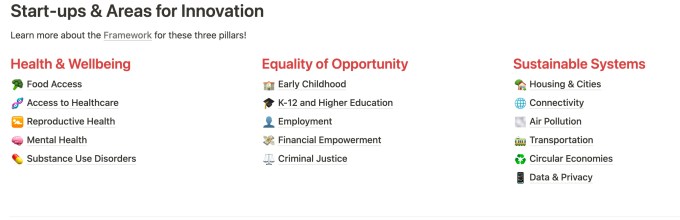
That led to one of the company’s fellows taking ownership of the project with the goal of fleshing out a comprehensive document. The resulting framework is built on three pillars or broad sets of categories including Health & Wellbeing, Equality of Opportunity and Sustainable Systems with each pillar including different elements of the racial inequity problem that need to be addressed. And each sub-category includes a detailed definition of the problem, key terms, a set of companies and organizations currently working on the issue and what still needs to be done (perhaps openings for startup ideas).

Three broad pillars of Racial Inequity Drawdown Document

Image Credits: 50 Years

To make it more than a document created in-house, Bannon and his team wanted to take it a step further, so he brought in a group of college students to begin reaching out to communities of color to participate in this initiative and bring it to life.

One of those students is Elizabeth Poku, a rising Sophomore at Princeton, who said she was drawn to the project as a way to flip the script on racism. “What I hope to do in the future is really hijack existing systems and structures that used to put down and oppress people and make sure we’re changing those narratives, changing those systems to really work for those that they were putting down,” she explained.

She saw the Racial inequity Drawdown as a way to help to do this and joined the team, helping to write some sections of the document including the one on the impact of lack of access to healthcare on people of color. She says that the team then reached out to communities working on the problem and began to compile resources into a database including startups that have been working to solve the different elements documented in the framework.

Bannon says that investors, who want to build racial equity as a lens into their investment process can use this document as a guide, and it also acts as a signal that a firm cares about this as it allocates resources to different startups, certainly that’s the case for Fifty Years.

“Part of this for us was just defining what that means, and now we have a really great start here. And then second is letting entrepreneurs know that we care about racial equity as a lens, and that if you are addressing racial equity, that’s going to be a big plus in our book.”

He added, “Obviously, that doesn’t mean we’re definitely going to be able to fund you, but that’s going to be a big plus, and we’re excited about that and attacking racial inequity through technology and entrepreneurship.”

The firm sees today’s launch as a starting point, one that others can build on and add to the conversation, and build on this initial framework. At the same time, it gives members of the startup ecosystem, whether that’s entrepreneurs or investors, a way to start looking at their investments or projects through this racial equity lens.

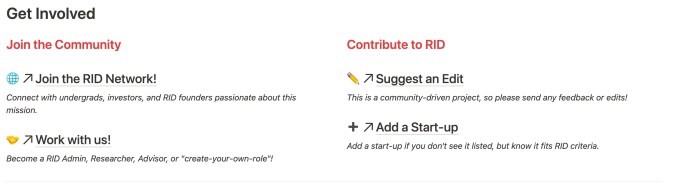
Ways to get involved with the Racial Inequity Drawdown project

Image Credits: Fifty Years

“We really want to make this drawdown start the conversation and make sure this is at the forefront of people’s minds. That’s our main goal. So yes, if that includes helping community members really find out how they can [help] these startups get into the tech world, that’s definitely part of our mission,” Poku explained.

22 Jun 2021

Australian fintech Zeller lands $50M AUD led by Spark Capital at a $400M AUD valuation

Zeller, a Melbourne-based fintech founded by former Square executives to serve small- to mid-sized businesses, has raised $50 million AUD (about $37.5 million USD) led by Spark Capital, the investment firm whose portfolio also includes Twitter, Slack and Coinbase. Zeller’s valuation is now $400 million AUD (about $301 million USD).

The funding included participation from returning investors Square Peg, Apex Capital Partners and Addition, and brings Zeller’s total raised in under a year to $81 million AUD. This amount includes a pre-launch Series A led by Addition, the investment firm started by Lee Fixel, and seed funding.

Zeller was founded last year by Ben Pfisterer, Square’s former Asia Pacific and Australia head, and Dominic Yap, the fintech’s former strategy and growth lead. The company launched its first products for small businesses on May 4, including EFTPOS (electronic funds transfer at point of sale) terminals, business accounts and cards.

The company says more than 1,500 Australian businesses signed up in the month after its launch, and weekly payment volume has been growing 200%. About 80% of businesses who started using Zeller switched from Australia’s four biggest banks, citing their desire for lower fees and better customer support.

Zeller’s new funding will be used to grow its research and engineering hub, including filling 18 new engineering roles that will support Zeller’s plan to become a fully-regulated business bank.

In a press statement, Spark Capital investor James Kuklinski said, “From our first meeting with Ben, we knew we wanted to be a part of Zeller. Australia’s business banking landscape is dominated by a small group of incumbents, and is ripe for disruption through simpler, more transparent pricing, best-in-class technology and better customer service.”


22 Jun 2021

MAJORITY raises $19 million for its mobile banking service for migrants

More than a million people migrate to the U.S. each year. Upon their arrival, they face challenges in opening a local bank account and accessing financial services at regular rates.

These challenges for migrants, a significant portion of whom also need to send money home, have persisted globally for decades, despite large government support programs.

Now an entrepreneur, who in his previous venture fought exorbitant phone tariff charges to help people make phone calls at low-cost, believes he has found the solution — and definitely a vote of confidence from investors.

MAJORITY said on Tuesday it has raised $19 million in its seed funding. The financial round was led by Valar Ventures while Avid Ventures, Heartcore Capital and several prominent Nordic fintech unicorn founders participated in it.

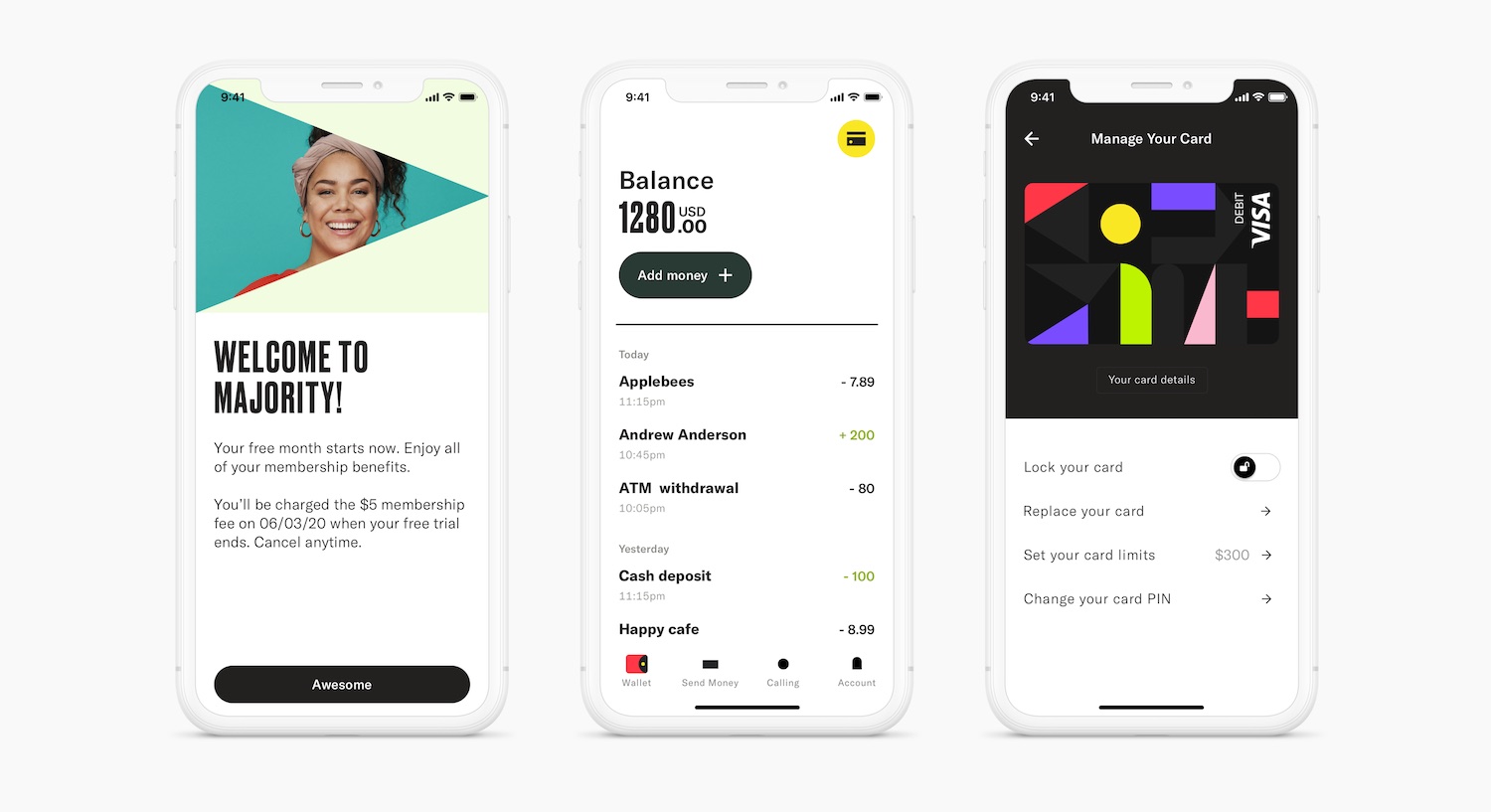
The two-year-old startup operates an eponymous mobile banking service. MAJORITY, whose name is a play on bringing financial inclusion to more people, runs a subscription service where it charges $5 a month to individuals and provides them with a range of financial services including an FDIC-insured bank account with early direct deposit at no overdraft fee, a debit card, mobile credit, and at-cost international phone calls.

Credit: Majority

Another reason why so many migrant communities are apprehensive of opening accounts with traditional banks, said Magnus Larsson (pictured above), founder and chief executive of MAJORITY, is that they don’t feel welcome there.

“You might not speak the language, or understand the cultural differences,” he said. To tackle this, MAJORITY has hired customer and sales relation representatives from various communities to work with customers to understand their needs.

Houston and Stockholm-headquartered MAJORITY also runs a community on its app to help individuals who have moved to the U.S. find familiar people and a “home” environment, he said. “Customers there find how to get a VISA as well as things like information about places to do local shopping,” he said.

“As veterans within the migrant tech sector, the team behind MAJORITY has already established themselves as builders of disruptive solutions for the world’s immigrants,” said James Fitzgerald, Founding Partner at Valar Ventures. “By supporting them for continued growth, we are confident that they will bring better and well-needed banking services to immigrants in the U.S.”

Starting today, the service is available in all 50 U.S. states and complies with local regulations, said Larsson, who previously served as the chief executive of Swedish technology firm Rebtel. Sutton Bank is MAJORITY’s banking partner.

The startup plans to deploy the new funding to expand its product offerings and broaden its team of about 80 people currently. “Since we are a company of immigrants for immigrants, we also look forward to hiring diverse talent that exists within the different immigrant communities we serve. This is more important now than ever given that many have been hit hard by the pandemic,” he said.