Year: 2021

17 Jun 2021

Gusto makes first acquisition, buying Ardius to expand into R&D tax credits

Free money from the government sounds like winning the lottery, but the reality is that most tech startups and even local retail businesses and restaurants can potentially qualify for tax credits related to research and development in the United States. Those credits, which is what helps tech giants keep their tax rates to near zero, are hard for smaller companies to receive because of extensive documentation requirements and potential audit costs.

So a number of startups have been launched to solve that gap, and now, larger companies are entering the fray as well.

Gusto, which started off with payroll for SMBs and has since expanded into employee on-boarding, insurance, benefits, and other HR offerings, today announced that it is acquiring Ardius, a startup designed to automate tax compliance particularly around R&D tax credits.

The Los Angeles-based company was founded by Joshua Lee in 2018, who previously had worked for more than a decade at accounting firm EY. Terms of the deal were not disclosed, and Ardius will run as an independent business with the entire team transitioning to Gusto.

The strategy here is simple: most R&D credits require payroll documentation, data that is already stored in Gusto’s system of record. Ardius in its current incarnation was designed to tap into a number of payroll data providers and extract that data and turn it into verifiable tax documents. With this tie-up, the companies can simply do that automatically for Gusto’s extensive number of customers.

Joshua Reeves, co-founder and CEO of Gusto, said that the acquisition falls in line with the company’s long-term focus on customers and simplicity. “We want to bring together technology, great service, [and] make government simpler,” he said. “In some ways, a lot of stuff we’re doing — make payroll simpler, make healthcare simpler, make PPP [loans] and tax credits simpler — just make these things work the way they’re intended to work.” The company presumably could have built out such functionality, but he noted that “time to market” was a crucial point in making Ardius the company’s first acquisition.

Tomer London, co-founder and chief product officer, said that “we’ve been looking at this space for a long time because it kind of connects to one of our original product principles of building a product that is opinionated,” he said. In a space as complicated as HR, “we want to be out there and be an advisor, not just a tool. And this is just such a great example of where you can take the payroll data that we already have and in just a few clicks and in a matter of a few days, get access to really important cash flow for a business.” He noted that tax credits is “something that’s been on our roadmap for a long time.”

Gusto works with more than 100 third-party services that integrate on top of its platform. Reeves emphasized that while Ardius is part of Gusto, all companies — even those who might compete directly with the product — will continue to have equal access to the platform’s data. In its release, the company pointed out that Boast.ai, Clarus, Neo.Tax, and TaxTaker are just some of the other tax products that integrate with Gusto today.

Of course, Ardius is just one of a number of competitors that have popped up in the R&D and economic development tax credit space. MainStreet, which I last profiled in 2020 for its seed round, just raised $60 million in funding in March led by SignalFire. Meanwhile, Neo.tax, which I also profiled last year, has raised a total of $5.5 million.

Reeves was sanguine about the attention the space is garnering and the potential competition for Ardius. When it comes to R&D tax credits, “whatever creates more accessibility, we’re a fan of,” he said. “It’s great that there’s more awareness because it’s still under-utilized frankly.” He emphasized that Gusto would be able to offer a more vertically-integrated solution given its data and software than other competitors in the space.

While the pandemic particularly hit SMBs, who often lacked the financial wherewithal of larger companies to survive the crisis, Gusto actually expanded its business as new companies sprouted up. Reeves said the company grew its customer base 50% in its last fiscal year, which ended in April. It “turns out in a health pandemic and in an economic crisis, things like payroll and accessing health care are quite important,” he said. Gusto launched a program to help SMBs collect the government’s stimulus PPP loans.

The company’s main bases of operation are in San Francisco, Denver and New York City, and the company has a growing contingent of remote workers, including the Ardius crew, who will remain based in LA. While Reeves demurred on future acquisitions, Gusto’s focus on expanding to a comprehensive financial wellness platform for both employees and businesses would likely suggest that additional acquisitions may well be in the offing in the future.
17 Jun 2021

5 tips for brands that want to succeed in the new era of influencer marketing

If I told you a decade ago that a spin bike would be a social community, you’d have had a good laugh. But that’s precisely what Peloton is: A spin bike with a social community where the instructors are the influencers.

Peloton is just one example of how social is being integrated into every aspect of the customer experience in an increasingly digital world. Whether it’s considering a new restaurant to check out, a movie to see or a product to buy, most people look at reviews before making a final decision. They want social proof as an indicator of quality and relevance.

Influencers are a natural byproduct of this desire for social validation, and as social permeates the customer journey, creators have become an essential source of validation and trust.

Influencers are a natural byproduct of this desire for social validation, and as social permeates the customer journey, creators have become an essential source of validation and trust. Indeed, social validation is what social platforms are built on, so it’s a significant component of how we derive relevance online — and the deeper integration of social is changing the dynamic between brands and digital creators.

The shifting economy of creator monetization

Brand sponsorships are the holy grail for creators hoping to monetize their online influence. According to an eMarketer report, brand partnerships are still the No. 1 source of revenue for most digital creators.

However, digital creators have a lot more monetization options to choose from, thanks to Patreon, affiliate platforms, paid content platforms and platform revenue sharing, making it easier to earn a living without relying so heavily on brand sponsorships.


Have you worked with a talented individual or agency who helped you find and keep more users?
Respond to our survey and help us find the best startup growth marketers!


As a result, creators are diversifying their revenue streams, which, for some creators, allows them to be more selective about the brands they work with. What’s more, creators aren’t reliant on just one channel or one form of revenue.

YouTube creators probably have the most diversified revenue, often combining brand sponsorships, subscription models, affiliate deals, tipping/donations, their line of branded products and revenue share. However, it’s important to note that not all monetization options apply to every creator. But with so many options to choose from, making a living as a digital creator is more accessible than ever.

Here are a few of the ways online creators can monetize their content:

Ad revenue sharing: Advertising is the most traditional form of revenue for online creators. With this model, ads are injected into and around the creator’s content, and they make a certain percentage of revenue based on impressions. However, the revenue split can vary based on the platform, and some platforms have a specific threshold creators must hit before they can participate in ad revenue sharing.

Affiliate marketing: Similar to advertising or a brand sponsorship, affiliate marketing is an agreement for a share of revenue based on products sold. This kind of arrangement generally works best when the creator has a blog, website or YouTube account. Affiliate links allow the influencer to proactively choose the products they want to talk about and earn from, rather than having to wait for a brand deal to come their way.

17 Jun 2021

Lordstown Motors reverses claims about “binding orders” for electric pickup truck

Lordstown Motors does not have binding orders from customers for its electric Endurance pickup truck — a reversal from claims made earlier this week by company executives in an effort to restore confidence in the troubled company, according to a regulatory filing released Thursday.

Lordstown Motors interim CEO Angela Strand and President Rich Schmidt made a series of statements Tuesday at an Automotive Press Association event that drove up shares in the company, including that it has enough “binding orders” from customers to fund limited production of its electric pickup truck through May 2022. Those comments came just a day after an executive shakeup that included the resignation of the company’s CEO and CFO.

It appears those “binding orders” were more like agreements to maybe lease or buy, according to a document Lordstown filed with the U.S. Securities and Exchange Commission. The filing has caused shares of Lordstown to fall more than 4%.

The document reads:

To clarify recent remarks by company executives at the Automotive Press Association online media event on June 15, although these vehicle purchase agreements provide us with a significant indicator of demand for the Endurance, these agreements do not represent binding purchase orders or other firm purchase commitments. As previously disclosed in our Form 10-K/A for the year ended December 31, 2020, filed with the Securities and Exchange Commission on June 8, 2021, to date, we have engaged in limited marketing activities and we have no binding purchase orders or commitments from customers.

Lordstown notes in the SEC filing that an important aspect of its sales and marketing strategy involves pursuing relationships with specialty upfitting and fleet management companies. For instance, in March 2021 Lordstown announced an agreement with ARI, a fleet management affiliate of Holman Enterprises. Under the agreement, ARI “would use reasonable efforts to facilitate orders from its leasing clients for the Endurance over a three-year time period on the terms set forth in the agreement.”

Lordstown has also entered into vehicle purchase agreements with additional specialty upfitting and fleet management companies as a component of that strategy, the company explained. This might sound like a binding order, but it’s not,  as the following language in the SEC doc makes more clear.

“These vehicle purchase agreements generally include a projected buyer order schedule over the 3- to 5-year life of the agreement, and may be terminated by either party at will on 30 days’ notice,” the filing from Lordstown reads. “They do not commit the counterparties to purchase vehicles, but we believe that they provide us with a significant indicator of demand for the Endurance.”

The reversal from Lordstown is just the latest in a string of issues at the newly public company. Lordstown Motors is an offshoot of the now former CEO Steve Burns’ other company, Workhorse Group, a battery-electric transportation technology company that is also publicly traded. Workhorse holds a 10% stake in Lordstown Motors. Lordstown Motors went public after merging with special-purpose acquisition company DiamondPeak Holdings Corp., with a market value of $1.6 billion.

In March, Hindenburg Research, the short-seller firm whose report on Nikola Motor led to an SEC investigation and the resignation of its founder, said it had taken a short position on Lordstown Motors, causing shares to plummet 21%. Hindenburg said at the time that its short position was based on a company has “no revenue and no sellable product, which we believe has misled investors on both its demand and production capabilities.”

Hindenburg disputes that the company has booked 100,000 pre-orders for its electric pickup truck, a stat shared by Lordstown Motors in January. The short seller says that “extensive research reveals that the company’s orders appear largely fictitious and used as a prop to raise capital and confer legitimacy.” The firm goes further and alleges that Lordstown founder and CEO Steve Burns paid consultants for every truck pre-order as early as 2016 while he was leading Workhorse.

Two months later, Lordstown reported in its first-quarter earnings that production volumes of the Endurance would likely be half — from around 2,200 vehicles to just 1,000 — due to a lack of funding.


17 Jun 2021

China launches 3 astronauts to its new space station core module

Three Chinese astronauts have docked at China’s space station core module, named Tianhe, for the first time.

The three astronauts flew to space as part of the Shenzhou 12 mission, China’s first crewed mission since 2012. They will call the core module of the Tiangong space station home until September, making it the longest crewed space mission in China’s history.

The three men, Commander Nie Haisheng, Liu Boming and Tang Hongbo, arrived to their final destination just over seven hours after taking off from Jiuquan Satellite Launch Center in northwest China. Nie had been to low Earth orbit twice before: once on the Shenzhou 6 mission in 2005 and again aboard the Shenzhou 10 eight years later. Boming has also been to space, once in 2008.

The men will be busy during their tenure in orbit. Their mission marks the third of a series of eleven planned launches through 2022, all aimed at getting China’s first space station up and running. The goal of the Shenzhou 12 is to bring the core module into service, test its systems and ensure it is ready for subsequent stages of station assembly. Of the eight remaining launches, three more are expected to be crewed.

Building its own space station is a logical step for China, a country that has not been shy about its space ambitions in the recent years. It especially makes sense considering that China is barred from boarding the International Space Station after Congress passed a law in 2011. However, that does not mean that China’s space station will always be for its own exclusive use, country officials said during a news conference Wednesday.

Ji Qiming, an assistant director with the Shenzhou program, said that China “welcome[s] co-operation in this regard in general,” the BBC reported. “It is believed that, in the near future, after the completion of the Chinese space station, we will see Chinese and foreign astronauts fly and work together,” he said.

As part of its burgeoning space program, the Chinese rover Zhurong touched down on Mars last month, making China the only country besides the United States to land a robot on the planet.

17 Jun 2021

Amazon’s Appstore lowers its cut of developer revenue for small businesses, adds AWS credits

Amazon is following in the footsteps of app store giants, Apple and Google, with this week’s introduction of its Amazon Appstore Small Business Accelerator Program. The new program will reduce the commissions Amazon takes on app developer revenues for qualifying smaller businesses. Previously, Amazon’s Appstore took a 30% cut of revenue, including that from in-app purchases. Now, it will take only 20% from developers who earned up to $1 million in the prior calendar year. The program will additionally offer AWS credits.

This program’s structure is similar to Apple’s App Store Small Business Program, announced in late 2020, which reduced Apple’s cut to 15% for developers who earn up to a $1 million threshold, after which they’re moved to the higher 30% standard rate. This rate then continues as they enter the following year. Google, more recently, took a slightly different course, by lowering the commissions to 15% on the first $1 million of developer revenue earned through the Play billing system each year.

Amazon’s cut remains larger at 20%, but that’s because it’s offering developers a different type of perk: AWS credits.

The company says developers with less than $1 million in Appstore revenue in a calendar year will receive 10% of their revenue as promotional credit for AWS services. This includes infrastructure technologies like compute, storage, and databases–to emerging technologies, such as machine learning and artificial intelligence, data lakes and analytics, and Internet of Things, notes Amazon. This brings total program benefits up to an equivalent of 90 percent of revenue, Amazon says.

If the developer’s revenue exceeds $1 million during the current year, they’ll revert to the standard royalty rate and no longer receive the AWS credits for the rest of the year.

And if the developer’s revenue in a future year drops below $1 million, they’ll become eligible for the Small Business program again in the next calendar year.

“By helping small businesses get started with AWS through credits, we are making it easier for them to build and grow their app businesses,” noted Amazon Appstore Director, Palanidaran Chidambaram, in an announcement. “AWS gives developers easy access to a broad range of technologies so they can innovate faster and build nearly anything they can imagine,” he added.

The changes to app store commission structures come at a time when tech giants are seeing increasing regulatory pressure over the nature of their businesses, which larger app publishers, including Basecamp, Spotify, Epic Games and others have argued are anticompetitive. Epic is also suing Apple over its app store fees, in a potentially precedent-setting case. In response, Apple and Google lowered fees for smaller businesses as a gesture of goodwill — and one that wouldn’t significantly impact their own app store platform revenues.

Amazon says the new program will launch in Q4 2021, and more details about how to participate will be provided at that time.

17 Jun 2021

Neo4j raises Neo$325m as graph-based data analysis takes hold in enterprise

Databases run the world, but database products are often some of the most mature and venerable software in the modern tech stack. Designers will pixel push, frontend engineers will add clicks to make it more difficult to drop out of a soporific Zoom call, but few companies are ever willing to rip out their database storage engine. Too much risk, and almost no return.

So it’s exceptional when a new database offering breaks through the barriers and redefines the enterprise.

Neo4j, which offers a graph-centric database and related products, announced today that it raised $325 million at a more than $2 billion valuation in a Series F deal led by Eurazeo, with additional capital from Alphabet’s venture wing GV. Eurazeo managing director Nathalie Kornhoff-Brüls will join the company’s board of directors.

That funding makes Neo4j among the most well-funded database companies in history, with a collective fundraise haul of more than half a billion dollars. For comparison, MongoDB, which trades on Nasdaq, raised $311 million in total according to Crunchbase before its IPO. Meanwhile, Cockroach Labs of CockroachDB fame has now raised $355 million in funding, including a $160 million round earlier this year at a similar $2 billion valuation.

The past decade has seen a whole new crop of next-generation database models, from scale-out SQL to document to key-value stores to time series and on and on and on. What makes graph databases like Neo4j unique is their focus on the connections between individual data entities. Graph-based data models have become central to modern machine learning and artificial intelligence applications, and are now widely used by data analysts in applications as diverse as marketing to fraud detection.

CEO and co-founder Emil Eifrem said that Neo4j, which was founded back in 2007, has hit its growth stride in recent years given the rising popularity of graph-based analysis. “We have a deep developer community of hundreds of thousands of developers actively building applications with Neo4j in any given month, but we also have a really deep data science community,” he said.

In the past, most business analysis was built on relational databases. Yet, inter-connected complexity is creeping in everywhere, and that’s where Eifrem believes Neo4j has a durable edge. As an example, “any company that ships stuff is tapping into this global fine-grain mesh spanning continent to continent,” he suggested. “All of a sudden the ship captain in the Suez Canal … falls asleep, and then they block the Suez Canal for a week, and then you’ve got to figure out how will this affect my enterprise, how does that cascade across my entire supply chain.” With a graph model, that analysis is a cinch.

Neo4j says that 800 enterprises are customers and 75% of the Fortune 100 are users of the company’s products.

We last checked in with the company in 2020 when it launched 4.0, which offered unlimited scaling. Today, Neo4j comes in a couple of different flavors. It’s a database that can be either self-hosted or purchased as a cloud service offering which it dubs Aura. That’s for the data storage folks. For the data scientists, the company offers Neo4j Graph Data Science Library, a set of comprehensive tools for analyzing graph data. The company offers free (or “community” tiers), affordable starting tiers and full-scale enterprise pricing options depending on needs.

Development continues on the database. This morning at its developers conference, Neo4j demonstrated what it dubbed its “super-scaling technology” on a 200 billion node graph with more than a trillion relationships between them, showing how its tools could offer “real-time” queries on such a large scale.

Unsurprisingly, Eifrem said that the new venture funding will be used to continue doubling down on “product, product, product” but emphasized a few major strategic initiatives as critical for the company. First, he wants to continue to deepen the company’s partnerships with public cloud providers. It already has a deep relationship with Google Cloud (GV was an investor in this round after all), and hopes to continue building relationships with other providers.

It’s also seeing a major uptick in interest from the APAC region. Eifrem said that the company recently opened up an office in Singapore to accelerate its sales in the broader IT market there.

Overall, “We think that graphs can be a significant part of the modern data landscape. In fact, we believe it can be the biggest part of the modern data landscape. And this round, I think, sends a clear signal [that] we’re going for it,” he said.

Erik Nordlander and Tom Hulme of GV were the leads for that firm. In addition, DTCP and Lightrock newly invested and previous investors One Peak, Creandum, and Greenbridge Partners joined the round.

17 Jun 2021

Google announces EPYC-based Tau virtual machines for Cloud

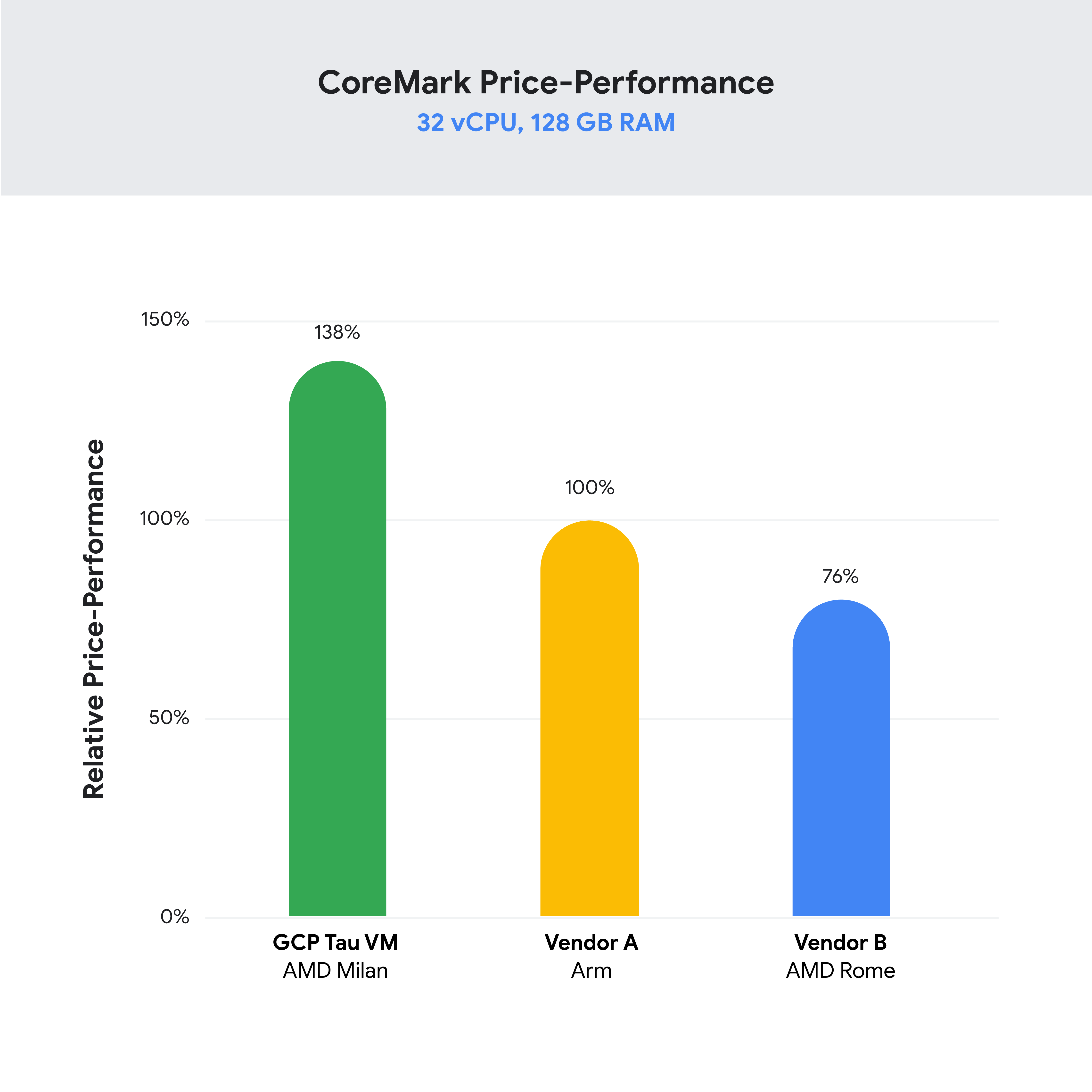
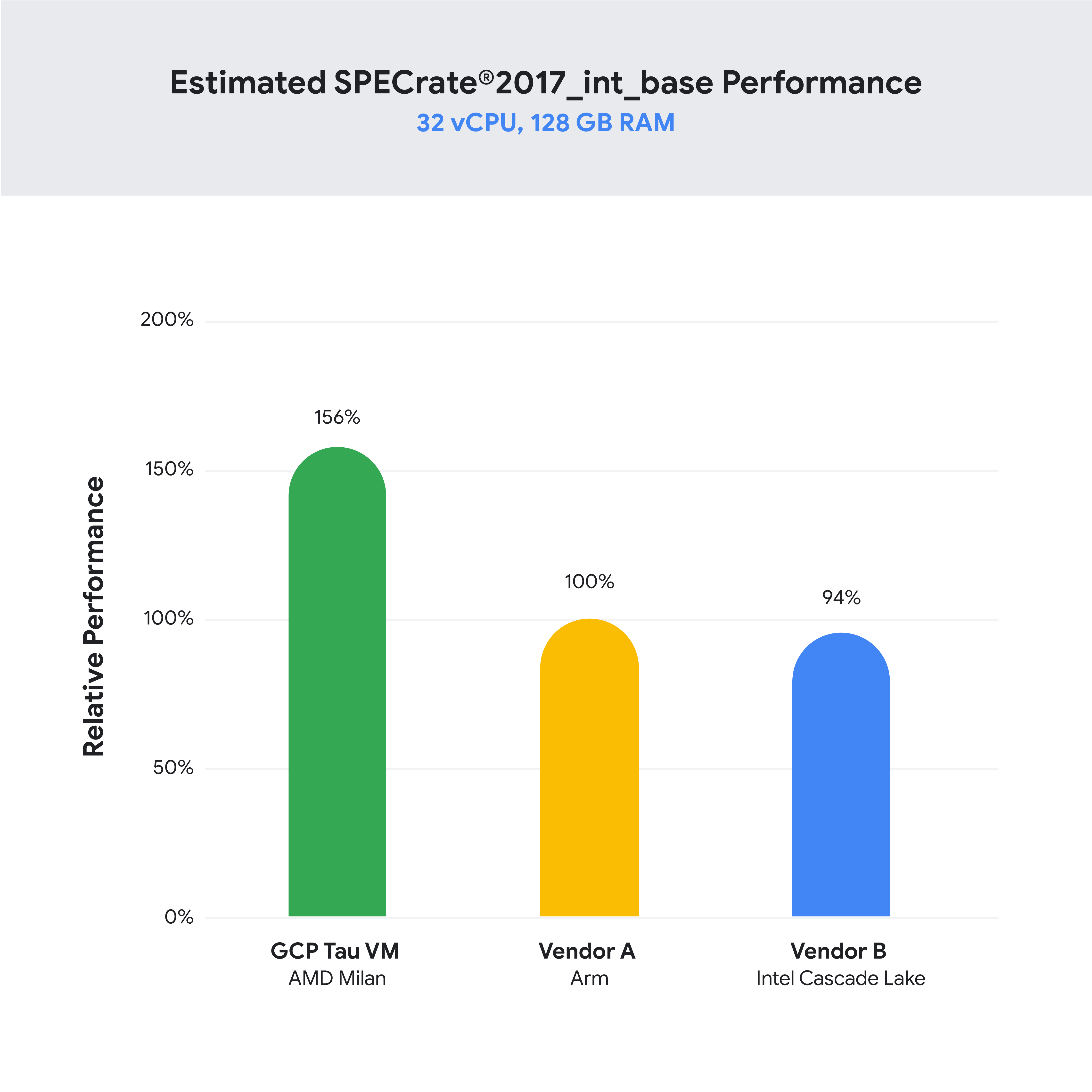
Google this morning announced the launch of Tau, a new family of virtual machines built on AMD’s third-gen EPYC processor. According to the company, the new x86-compatible system offers a 42% price-performance boost over standard VMs. Google notably first started utilizing AMD EPYC processors for Cloud back in 2017, while Amazon Cloud’s offerings date back to 2018.

Google claims the Tau family “leapfrogs” existing cloud VMs. The systems come in a variety of configurations, ranging up to 60vCPUs per VM, and 4GB of memory per vCPU. Networking bandwidth goes up to 32 Gbps, and they can be coupled with a variety of different network attached storage.

“Customers across every industry are dealing with more demanding and data-intensive workloads and looking for strategic ways to speed up performance and reduce costs,” Google Cloud CEO Thomas Kurian said in a press release.  “Our work with key strategic partners like AMD has allowed us to broaden our offerings and deliver customers the best price performance for compute-heavy, business-critical applications– all on the cleanest cloud in the industry.”

Image Credits: Google

Google has already signed up some high-profile customers for an early trial, including Twitter, Snap and DoIT.

“High performance at the right price point is a critical consideration as we work to serve the global public conversation,” Twitter Platform Lead Nick Tornow said in a blog post. “We are excited by initial tests that show potential for double digit performance improvement. We are collaborating with Google Cloud to more deeply evaluate benefits on price and performance for specific compute workloads that we can realize through use of the new Tau VM family.”

Image Credits: Google

The Tau VMs will be arriving for Google Cloud in Q3 of this year. The company has already opened the system up to clients for pre-registration. Pricing is dependent on the configuration. For example, a 32vCPU VM sporting 128GB RAM will run around $1.35 an hour.

17 Jun 2021

Karin Tsai, director of engineering at Duolingo will be speaking at TechCrunch City Spotlight: Pittsburgh on June 29

TechCrunch City Spotlight: Pittsburgh is getting closer, with impressive featured speakers including Carnegie Mellon University President Farnam Jahanian and Mayor Bill Peduto. However, we’ve saved the best for last: our last speaker is Karin Tsai, director of engineering at Duolingo, a $2.4 billion business that is all about making language learning fun and accessible.

The event will be held on June 29, so make sure to register here (for free) to listen to these conversations, enjoy the pitch off, and network with local talent.

Tsai joined Duolingo in 2012 as one of its first engineers, and first-hand witnessed the growth of the company from a scrappy startup into a 400-person global business. Her timestamp on the company has made her a key decision-maker in many of its biggest decisions, from which features to scrap to how to monetize without compromising its mission of providing free education to all.

One thing to note is that even though a whimsical owl and creative UX might seem straightforward, the language learning universe is controversial and requires healthy debate – and testing – for anyone within it.

“We’re trying to do things that no other apps really tackle: How do we create an experience that actually makes you extremely proficient in a language while accommodating the expectations from our learners” to be fun and convenient, Tsai told me when I interviewed her for my Duolingo EC-1. “Balancing efficacy with engagement is something that we constantly struggle with.”

In this chat, Tsai will break down how Duolingo turned to A/B testing to answer some of its biggest questions. We’ll also chat about more meta topics, as when to give up on measuring the unmeasurable, and when tests fail and instinct reigns supreme. Tsai admitted to me once that Duolingo spent years trying to figure out how to find a metric that could encompass learning comprehension and engagement in one fell swoop.

“What used to freeze us is that we thought we would need such a metric to make progress,” she explained. “And I think what honestly liberated us was saying essentially, ‘Screw it.’ We couldn’t make progress waiting for a learning metric.”

I’ll be interviewing Tsai, so anyone who registers for this event is welcome to throw me questions for her that I’ll try to embed in my chat.

Tsai will give us the startup builder perspective, while Mayor Peduto will speak to the challenges of building a startup ecosystem, and Carnegie Mellon University President Farnam Jahanian will discuss how to go from student to startup with the correct resources.

Don’t forget to register for this free event on June 29th (click here to register) so you can watch these chats and riff with audience members during networking opportunities. If you’re an early-stage startup founder based in Pittsburgh, you should apply to pitch your startup (click here to apply). Expect to do a live two-minute pitch, get feedback from local VCs, and maybe even win our pitch-off.

I can’t wait to see you there!

17 Jun 2021

Last-mile, landscaping and leaping robots

I spoke to Refraction AI co-founder/CTO Matthew Johnson-Roberson on the occasion of the Michigan startup’s $4.2 million seed raise. This week we posted a Q&A where he answers a wider range of topics about the delivery robotics company, and this bit jumped out at me:

It still boggles my mind that nobody has tried to copy what we’re doing. There were 10 or 12 sidewalk robot companies in early 2015, 2016 and 2017. Many of them, with a few exceptions, went out of business.

Refraction autonomous delivery robot

Image Credits: Refraction

The first part of the quote points to seemingly obvious truths that are still worth reiterating here. First: If you spot a need in the market you believe you can address, go for it. Second: There are likely even more opportunities for robotics and automation than we’ve considered. The second sentence seemingly negates the second point to some degree, but more than anything, I think it’s an indictment of how merciless this industry can be.

High risk/high reward, and all that, but even with a great idea, smart people and a healthy raise, bad timing can still land you flat on your face. For now, it seems, the timing is right. Delivery robotics are very much an industry that has been accelerated by the pandemic, in terms of interest, innovation and, of course, funding.

FedEx-Nuro

Image Credits: Nuro

As I noted last week, I spoke to Gatik co-founder and chief engineer Apeksha Kumavat, Nuro head of operations Amy Jones Satrom and Starship Technologies co-founder and CTO Ahti Heinla at last week’s TC Sessions: Mobility event. Here’s what Kumavat had to say about that acceleration:

Even before the pandemic hit, this whole e-commerce trend was already on the rise. No one wants their deliveries to be done after a week or two weeks. Everyone is expecting them to be done on the same day, as well as curbside pickup options. There was already a rise in the expectations of e-commerce and on-demand deliveries even before the pandemic hit. Post-March 2020, what we have seen is a huge increase in that trajectory.

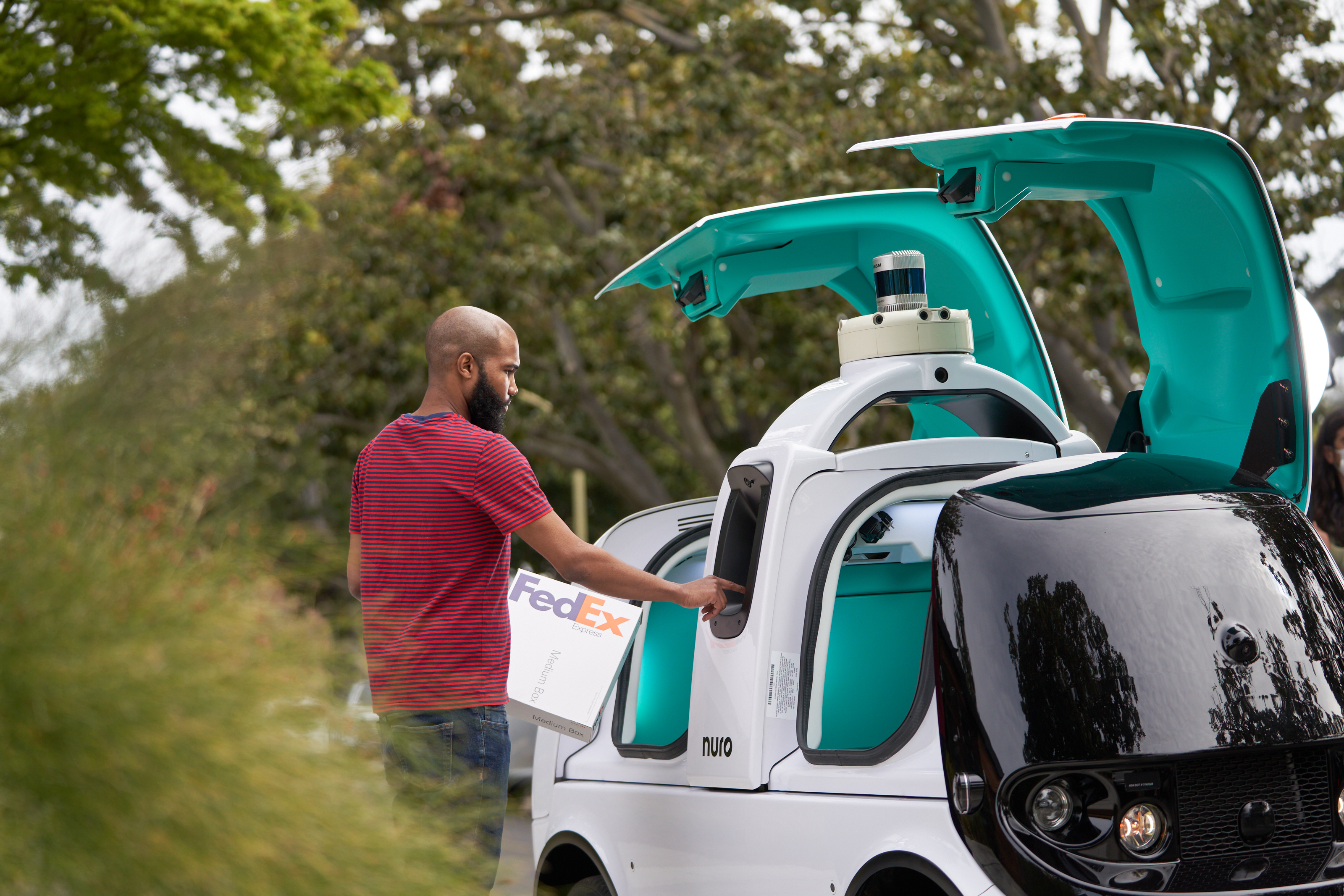
More big news from Nuro (try saying that five times, fast), the delivery company just signed a deal with FedEx, marking a big step into package delivery.

Image Credits: Scythe Robotics

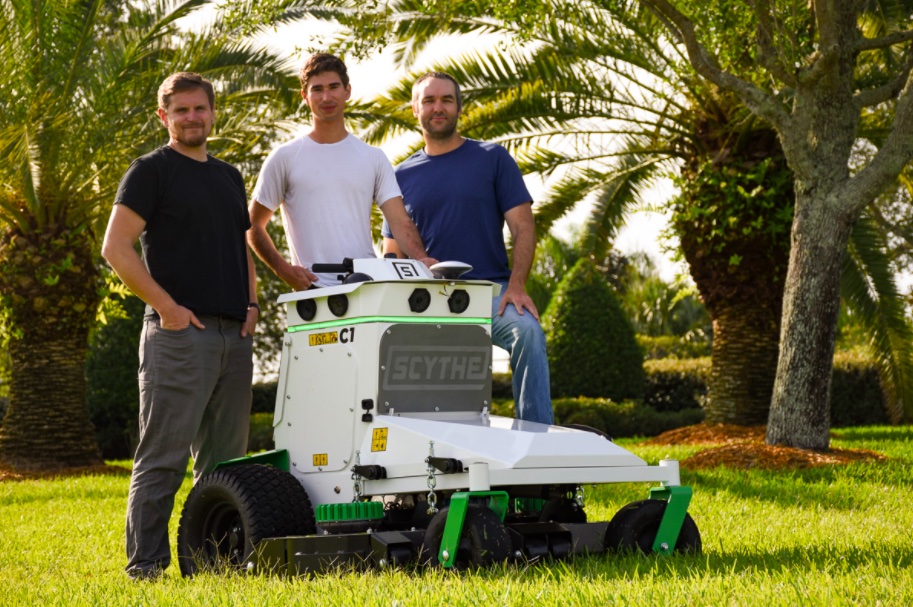
This week, I also spoke to another pair of robotics startups that have emerged from the pandemic with sizable rounds. Boulder-based Scythe emerged from stealth with a $13.8 million Series A, bringing its total funding to $18.6 million. The company specializes in landscaping robotics, starting with a mower. Given the potential market size, I’m honestly surprised there aren’t more companies doing this.

Interestingly, the company is offering a RaaS (robotics as a service) model, which is becoming increasingly popular in the space. Here it’s charging customers based on the number of acres mowed.

Image Credits: Dusty Robotics

Bay Area-based Dusty Robotics, meanwhile, raised a $16.5 million Series A, bringing its total raised to $23.7 million. Construction is a huge potential market with a lot of interest and players. Dusty’s offering is interesting and fairly unique, effectively printing plans on the floor of a construction site. The company likens it to “Ikea Instructions.” Here’s co-founder and CEO, Tessa Lau:

We just released our third-generation hardware platform, which was designed from the ground up by our team in Mountain View to be purpose-built for producing accurate and speedy layout on construction sites. We’ve been working on this product since fall of 2018 and have incorporated lessons learned from completing over 1 million square feet of production layout into this third-generation design.

And for good measure, here’s a fun one from Tencent Robotics.

IEEE Spectrum spotted the robot, which was actually announced a few weeks ago. According to the paper where Ollie appeared, the wheeled robot is more experimental than practical, but it’s capable of some pretty impressive feats none the less:

Experimental results demonstrate that the linear output regulation can maintain the standing of the robot, and that nonlinear controller can balance the robot under an initial starting angle far away from the equilibrium point, or under a changing robot height.

There isn’t a ton of info about Ollie available yet, but it sure is fun to watch.


17 Jun 2021

Instagram’s TikTok rival, Reels, rolls out ads worldwide

Instagram Reels are getting ads. The company announced today it’s launching ads in its short-form video platform and TikTok rival, Reels, to businesses and advertisers worldwide. The ads will be up to 30 seconds in length, like Reels themselves, and vertical in format, similar to ads found in Instagram Stories. Also like Reels, the new ads will loop, and people will be able to like, comment, and save them, the same as other Reels videos.

The company had previously tested Reels ads in select markets earlier this year, including India, Brazil, Germany, and Australia, then expanded those tests to Canada, France, the U.K. and the U.S. more recently. Early adopters of the new format have included brands like BMW, Nestlé (Nespresso), Louis Vuitton, Netflix, Uber, and others.

Instagram tells us the ads will appear in most places users view Reels content, including on the Reels tab, Reels in Stories, Reels in Explore, and Reels in your Instagram Feed, and will appear in between individual Reels posted by users. However, in order to be served a Reels ad, the user first needs to be in the immersive, full-screen Reels viewer.

Image Credits: Instagram

The company couldn’t say how often a user might see a Reels ad, noting that the number of ads a viewer may encounter will vary based on how they use Instagram. But the company is monitoring user sentiment around ads themselves, and the overall commercially of Reels, it says.

Like Instagram’s other advertising products, Reels ads will launch with an auction-based model. But so far, Instagram is declining to share any sort of performance metrics around how those ads are doing, based on tests. Nor is it yet offering advertisers any creator tools or templates that could help them get started with Reels ads. Instead, Instagram likey assumes advertisers already have creative assets on hand or know how to make them, because of Reels ads’ similarities to other vertical video ads found elsewhere, including on Instagram’s competitors.

While vertical video has already shown the potential for driving consumers to e-commerce shopping sites, Instagram hasn’t yet taken advantage of Reels ads to drive users to its built-in Instagram Shops, though that seems like a natural next step as it attempts to tie the different parts of its app together.

But perhaps ahead of that step, Instagram needs to make Reels a more compelling destination — something other TikTok rivals, which now include both Snap and YouTube — have done by funding creator content directly. Instagram, meanwhile, had made offers to select TikTok stars directly.

The launch of Instagram Reels ads follows news of TikTok’s climbing ad prices. Bloomberg reported this month that TikTok is now asking for more than $1.4 million for a home page takeover ad in the U.S., as of the third quarter, which will jump to $1.8 million by Q4 and more than $2 million on a holiday. Though the company is still building its ads team and advertisers haven’t yet allocated large portions of their video budget to the app, that tends to follow user growth — and TikTok now has over 100 million monthly active users in the U.S.

Both apps, Instagram and TikTok, now have over a billion monthly active users on a global basis, though Reels is only a part of the larger Instagram platform. For comparison, Instagram Stories is used by some 500 million users, which demonstrates Instagram’s ability to drive traffic to different areas of its app. Instagram declined to share how many users Reels has as of today.