Year: 2021

17 Jun 2021

A security bug in Google’s Android app put users’ data at risk

Until recently, Google’s namesake Android app, which more than five billion installs to date, had a vulnerability that could have allowed an attacker to quietly steal personal data from a victim’s device.

Sergey Toshin, founder of mobile app security startup Oversecured, said in a blog post that the vulnerability has to do with how the Google app relies on code that is not bundled with the app itself. Many Android apps, including the Google app, reduce their download size and the storage space needed to run by relying on code libraries that are already installed on Android phones.

But the flaw in the Google app’s code meant it could be tricked into pulling a code library from a malicious app on the same device instead of the legitimate code library, allowing the malicious app to inherit the Google app’s permissions and granting it near-complete access to a user’s data. That access includes access to a user’s Google accounts, search history, email, text messages, contacts and call history, as well as being able to trigger the microphone and camera, and access the user’s location.

The malicious app would have to be launched once for the attack to work, Toshin said, but that the attack happens without the victim’s knowledge or consent. Deleting the malicious app would not remove the malicious components from the Google app, he said.

A Google spokesperson told TechCrunch that the company fixed the vulnerability last month and it had no evidence that the flaw has been exploited by attackers. Android’s in-built malware scanner, Google Play Protect, is meant to stop malicious apps from installing. But no security feature is perfect, and malicious apps have slipped through its net before.

Toshin said the Google app vulnerability is similar to another bug discovered by the startup in TikTok earlier this year, which if exploited could have allowed an attacker to steal a TikTok user’s session tokens to take control of their account.

Oversecured has found several other similar vulnerabilities, including Android’s Google Play app and more recently apps pre-installed on Samsung phones.

17 Jun 2021

Deep reinforcement learning will transform manufacturing as we know it

If you walk down the street shouting out the names of every object you see — garbage truck! bicyclist! sycamore tree! — most people would not conclude you are smart. But if you go through an obstacle course, and you show them how to navigate a series of challenges to get to the end unscathed, they would.

Most machine learning algorithms are shouting names in the street. They perform perceptive tasks that a person can do in under a second. But another kind of AI — deep reinforcement learning — is strategic. It learns how to take a series of actions in order to reach a goal. That’s powerful and smart — and it’s going to change a lot of industries.

Two industries on the cusp of AI transformations are manufacturing and supply chain. The ways we make and ship stuff are heavily dependent on groups of machines working together, and the efficiency and resiliency of those machines are the foundation of our economy and society. Without them, we can’t buy the basics we need to live and work.

Startups like Covariant, Ocado’s Kindred and Bright Machines are using machine learning and reinforcement learning to change how machines are controlled in factories and warehouses, solving inordinately difficult challenges such as getting robots to detect and pick up objects of various sizes and shapes out of bins, among others. They are attacking enormous markets: The industrial control and automation market was worth $152 billion last year, while logistics automation was valued at more than $50 billion.

Deep reinforcement learning consistently produces results that other machine learning and optimization tools are incapable of.

As a technologist, you need a lot of things to make deep reinforcement learning work. The first piece to think about is how you will get your deep reinforcement learning agent to practice the skills you want it to acquire. There are only two ways — with real data or through simulations. Each approach has its own challenge: Data must be collected and cleaned, while simulations must be built and validated.

Some examples will illustrate what this means. In 2016, GoogleX advertised its robotic “arm farms” — spaces filled with robot arms that were learning to grasp items and teach others how to do the same — which was one early way for a reinforcement learning algorithm to practice its moves in a real environment and measure the success of its actions. That feedback loop is necessary for a goal-oriented algorithm to learn: It must make sequential decisions and see where they lead.

In many situations, it is not feasible to build the physical environment where a reinforcement learning algorithm can learn. Let’s say you want to test different strategies for routing a fleet of thousands of trucks moving goods from many factories to many retail outlets. It would be very expensive to test all possible strategies, and those tests would not just cost money to run, but the failed runs would lead to many unhappy customers.

For many large systems, the only possible way to find the best action path is with simulation. In those situations, you must create a digital model of the physical system you want to understand in order to generate the data reinforcement learning needs. These models are called, alternately, digital twins, simulations and reinforcement-learning environments. They all essentially mean the same thing in manufacturing and supply chain applications.

Recreating any physical system requires domain experts who understand how the system works. This can be a problem for systems as small as a single fulfillment center for the simple reason that the people who built those systems may have left or died, and their successors have learned how to operate but not reconstruct them.

Many simulation software tools offer low-code interfaces that enable domain experts to create digital models of those physical systems. This is important, because domain expertise and software engineering skills often cannot be found in the same person.

Why would you go through all this trouble for a single algorithm? Because deep reinforcement learning consistently produces results that other machine learning and optimization tools are incapable of. DeepMind used it, of course, to beat the world champion of the board game of Go. Reinforcement learning was part of the algorithms that were integral to achieving breakthrough results with chess, protein folding and Atari games. Likewise, OpenAI trained deep reinforcement learning to beat the best human teams at Dota 2.

Just like deep artificial neural networks began to find business applications in the mid-2010s, after Geoffrey Hinton was hired by Google and Yann LeCun by Facebook, so too, deep reinforcement learning will have an increasing impact on industries. It will lead to quantum improvements in robotic automation and system control on the same order as we saw with Go. It will be the best we have, and by a long shot.

The consequence of those gains will be immense increases in efficiency and cost savings in manufacturing products and operating supply chains, leading to decreases in carbon emissions and worksite accidents. And, to be clear, the chokepoints and challenges of the physical world are all around us. Just in the last year, our societies have been hit by multiple supply chain disruptions due to COVID, lockdowns, the Suez Canal debacle and extreme weather events.

Zooming in on COVID, even after the vaccine was developed and approved, many countries have had trouble producing it and distributing it quickly. These are manufacturing and supply chain problems that involve situations we could not prepare for with historical data. They required simulations to predict what would happen, as well as how we could best address crises when they do occur, as Michael Lewis illustrated in his recent book “The Premonition.”

It is precisely this combination of constraints and novel challenges that take place in factories and supply chains that reinforcement learning and simulation can help us solve more quickly. And we are sure to face more of them in the future.

17 Jun 2021

eqtble, a platform that uses data analytics to create healthier workplaces, raises $2.7M seed

A composite photo of eqtble founders Ethan Veres, Gabe Horwitz and Joseph Ifiegbu

eqtble founders (from l to r): Ethan Veres, Gabe Horwitz and Joseph Ifiegbu

“People are the backbone of any organization. People are more important than the product. Without people, you don’t have a product,” says Joseph Ifiegbu, who is Snap’s former head of human resources technology and also previous lead of WeWork’s People Analytics team.

Ifiegbu’s startup, called eqtble, wants to give HR teams the same kind of detailed analytics that product, sales and marketing departments have had for a long time, with the goal of creating more engaged and inclusive workplaces. The company, a Y Combinator alum, announced today it has raised $2.7 million in seed funding, led by Initialized Capital, with participation from SB Opportunity Fund, RS Ventures and other venture capital firms and angel investors.

Ifiegbu joined WeWork’s People Analytics team in 2017, when the company had a total of about 2,000 employees. By the time he left in 2020, that number had grown to 15,000 people. One of Ifiegbu’s first hires at WeWork was Gabe Horwitz, the first data scientist on the People Analytics’ team and now eqtble’s co-founder and chief product officer. The startup’s third co-founder and chief technology officer is Ethan Veres.

At many companies, especially ones that are growing quickly, workforce data is scattered across different HR software, including human resources information systems (HRIS), engagement platforms, benefit programs and employee surveys.

Because information is so fragmented, companies can miss important correlations. For example, they might not see the links between why top employees are quitting and how long it typically takes to promote people, or overlook pay inequality. This in turn impacts a company’s culture, including its approach to diversity, equity and inclusion, and ability to retain talented people.


As WeWork was rapidly scaling, the People Analytics team built tools to analyze data from across the company.

“There were a lot of questions being asked, like what is our promotion like? What is our attrition, are we hiring more men than women? There were all these questions and bottlenecks in our processes, and we wanted to have an understanding of our employees,” says Ifiegbu. “So we built systems to capture all that data, clean it, structure it and deliver dashboard insights to our leadership.”

The process took about two years, and the People Analytics team eventually grew to 15 people. Ifiegbu and Horwitz realized there were many companies that needed the same kind of analytics, but didn’t have WeWork’s resources. This prompted them to start working on eqtble.

“It took us such a long time and quite a bit of money because we had this team [at WeWork],” he says. “So how do we build something that delivers these insights to them, but doesn’t take that much time to do it, because we realize it’s very important that leadership and decision makers have the data to make decisions about their employees.”

How eqtble works

The current version of eqtble can be onboarded in six weeks, and Ifiegbu says the company’s goal is to shorten that process to just two days. Eqtble is sector agnostic and its target customers are high-growth companies that have between 250 to about 3,000 employees.

The human resources analytics platform can collect data from more than 100 sources (including Workday, ADP, Oracle, PeopleSoft, Qualtrics and Culture Amp, to name a few), and deliver insights and visualizations about four main areas: talent recruitment, workforce, engagement (including attrition, or when workers quit) and compensation.

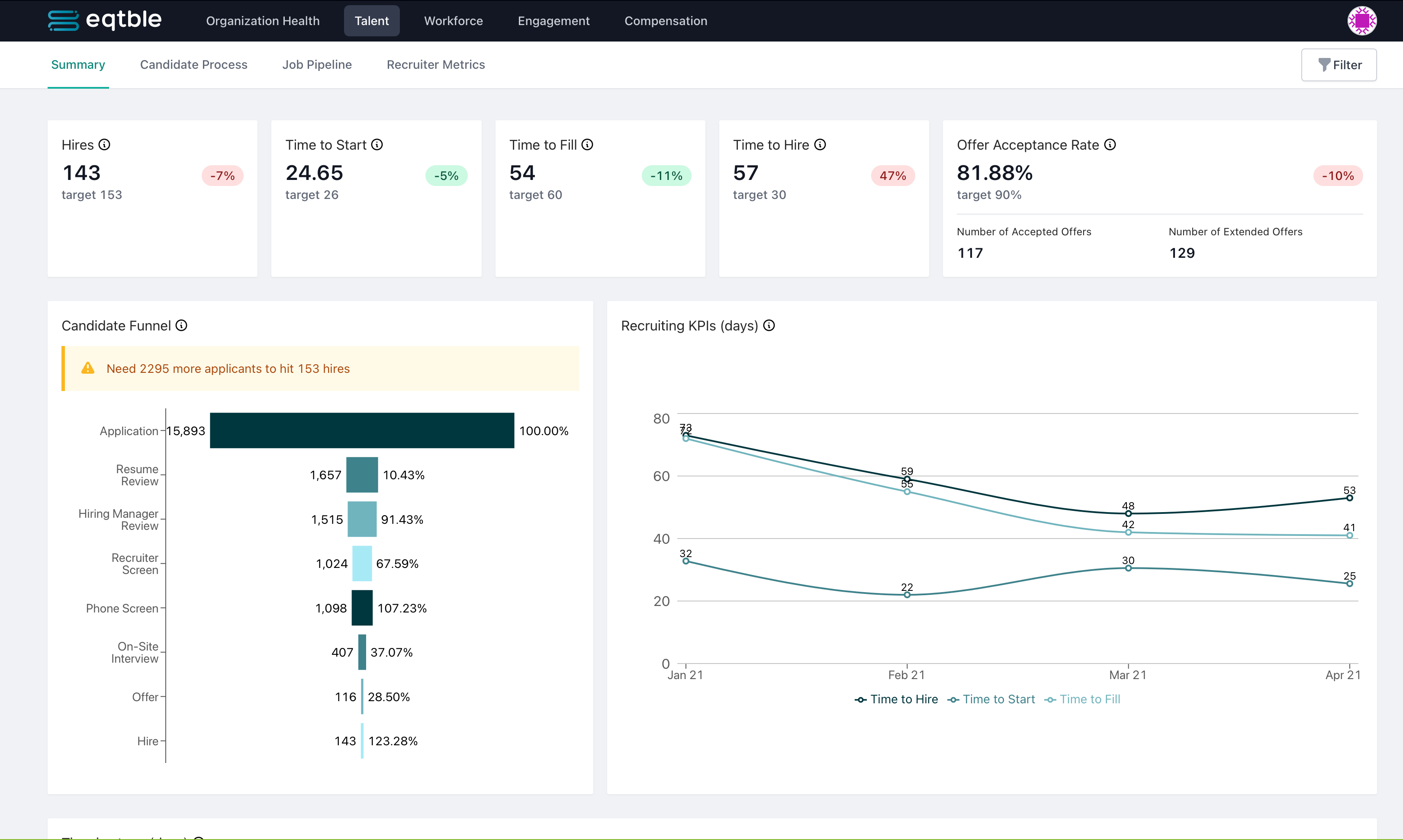
A screenshot of HR analytics eqtble's dashboard

One of eqtble’s summary dashboards

One of the things the platform can help HR teams do is identify why top candidates are declining offers.

For example, one of eqtble’s clients realized that their hiring managers were being passed more applications than they had time to look at. This created a bottleneck, because they weren’t able to interview people quickly enough. Other clients saw that candidates were dropping out because the interview process was too long.

“If you as an organization are saying ‘we’re going to have six rounds of interviews, it’s going to take three months to interview, you’re going to lose out on good candidates,” says Ifiegbu. “Other people are closing candidates within one to two weeks.”

Using data to increase diversity, equity and inclusion

It’s easy for a company to make DEI pledges, but even the best of intentions don’t result in progress if an organization isn’t willing to scrutinize itself. Because eqtble combines data from across a company, it can highlight potential issues before decision makers realize what is happening.

“Last year, all the companies were saying, ‘oh, we’re going to do this, we’re going to do all these things,’ and it’s like, ok, great, you can say anything, but the truth is you cannot change what you don’t measure,” says Ifiegbu.

For example, a company might be be proud of having a workforce that is divided equally between men and women, or that has a large percentage of people of color, when the reality is that many of them aren’t getting raises or being promoted into management roles.

“That 50/50 doesn’t mean anything if you don’t see representation at higher levels for women and people of color. What we’re doing is showing you a picture of your organization. If you can see the different parts of it, you can see the parts you can improve on and take actionable steps, not just lip service for the media,” says Ifiegbu. “Eqtble surfaces places you can improve or places where you are doing well so you can keep doing that.”

Ifiegbu is excited that the HR analytics space is gaining attention. “I feel like using data to drive decisions is such an important thing, and ultimately builds a healthier company.”

The seed funding will be used to grow eqtble’s engineering team and its platform’s machine learning and visualization capabilities, and user acquisition.

In a statement, Initialized Capital partner and president Jen Wolf said, “Important organizational issues like DEI or equitable compensation are not simply a box a company can check, they take honest commitment. Companies willing to make that commitment shouldn’t have to wait months or be discouraged by the financial investment it takes to understand the data they already own to make these meaningful changes. The eqtble team knows how to solve this, and they’re empowering other companies to do so.”

17 Jun 2021

Former Athenahealth CEO Jonathan Bush returns to entrepreneurship with new startup

Jonathan Bush, the CEO and co-founder of Athenahealth, is a controversial figure in the controversial field of healthcare.

Over two decades after he started the now-public healthcare company, Bush lost Athenahealth to Elliott Management, an activist investor that bought the company alongside Veritas Capital. During this tense period of time, domestic violence allegations surfaced from his ex-wife, Sarah Seldon. Bush took responsibility for what he described as “regrettable incidents” that happened 14 years ago during a “particularly difficult personal time” in his life. Seldon, who TechCrunch attempted to reach for this story, made a statement then too, explaining that she and him have a “co-parenting relationship” with “respect, collaboration and love.”

After these public incidents, Bush went quiet and only later re-emerged as the executive chairman of Firefly Health, a primary care startup.

Now, Bush is back once again, this time as the co-founder of a new startup that aims to re-invent the digital health data stack, Zus. The company wants to create a shared data platform that doctor’s, regardless of specialty or location, can access to better understand their patients. Think of it as massive, fancy Google Doc built for healthcare, that healthtech startups can use to kickstart their solutions, faster.

Along with its launch, Zus announced today that it has raised a $34 million Series A led by Andreessen Horowitz, with participation from F-Prime Capital, Maverick Ventures, Rock Health, Martin Ventures and Oxeon Investments.

Bush’s venture-backed return to entrepreneurship may come as a surprise to some, including himself.

“I loved running Athena very much, all 22 years,” he said. “But I also loved fourth grade, and I don’t want to go back. I didn’t feel like I wanted to run a company again.” He changed his mind for two reasons: first, he expects that building a platform company will be different, and potentially less controversial, than building a traditional services business. Second, he sees “strong calling” to bring his tool to life amid a broader digital health boom.

“These digital health companies will largely not work, if they aren’t dramatically accelerated,” he said. “All of them now are facing this quandary: that it’s very hard to hire engineers, enormous regulation and complexity, one too many types of complexity associated with building technologies in medicine.”

With Zus, he’s trying to create capacity. The company has a lot of plans, which includes a growing library of software tools around patient relationship management, a data aggregation service that helps standardize medical records for sharing purposes, a platform that sits atop this information so that multiple doctors can access the same information, and a patient portal that lets users understand how their data is shared and accessed.

So far, the platform is being used by four partners: Cityblock Health, Dorsata, Firefly Health, which is Bush’s previous employer, and Oak Street Health.

Part of the company’s existence can be tied to recent regulation progress. The 21st Century Cures Act gave patients the right to access their medical records, and by next year, third parties can access that same data as well. Many think this newfound data portability could seed a massive new generation of healthcare apps, although there are some concerns about if patients know what they are signing up for.

Mimi Liu, chief technology officer of Firefly Health, said in a statement that Zus will help build out the parts of its infrastructure stack that can be commoditized, bringing its roll-out time from years to weeks and months. She added that its clinical value proposition will be improved because of the “downstream network effect that comes as a result of information sharing.”

A16z, who led the round, is an investor in Firefly Health, as well as a number of healthcare startups like Incredible Health, Omada, PatientPing, and Cedar.

Julie Yoo, general partner at Andreessen Horowitz, said that Zus embodies its digital health stack thesis, which argues need for “infrastructure platforms that serve the large and rapidly growing population of digital health companies, such that each company no longer has to build the same underlying tech and operations components over and over again, from scratch.”

When asked about Zus’ differentiation, Yoo said that the company will create a community-based marketplace for digital health companies to set up and trade notes, which she thinks has not yet existed in the sector.

“If anything, one might say that the precursor to this concept was the More Disruption Please (MDP) program at athenahealth, which makes Jonathan Bush uniquely qualified to build this more modern version of said concept,” she said. The MDP program was launched by Bush in 2017 with the goal of filling 200 seats in the Athenahealth’s San Francisco office with upccoming entreprepreneurs in healthcare.

Zus isn’t the first company to try to start an AWS for healthcare, and in fact there are numerous companies that all work on the different services that Zus wants to one day own, from administrative workflow to patient data retrieval. But, its holistic approach at a time when regulation is changing and investment is booming, along with an experienced founder with the right connections, could prepare it well for what’s to come.

17 Jun 2021

Twine raises $3.3M to add networking features to virtual events

Twine, a video chat startup that launched amid the pandemic as a sort of “Zoom for meeting new people,” shifted its focus to online events and, as a result, has now closed on $3.3 million in seed funding. To date, twine’s events customers have included names like Microsoft, Amazon, Forrester, and others, and the service is on track to do $1 million in bookings in 2021, the company says.

The new round was led by Moment Ventures, and included participation from Coelius Capital, AltaIR Capital, Mentors Fund, Rosecliff Ventures, AltaClub, and Bloom Venture Partners. Clint Chao, founding Partner at Moment, will join twine’s board of directors with the round’s close.

The shift into the online events space makes sense, given twine’s co-founders —  Lawrence Coburn, Diana Rau, and Taylor McLoughlin — hail from DoubleDutch, the mobile events technology provider acquired by Cvent in 2019.

Coburn, previously CEO of DoubleDutch, had been under a non-compete with its acquirer until December 2020, which is one reason why he didn’t first attempt a return to the events space.

The team’s original idea was to help people who were missing out on social connections under Covid lockdowns find a way to meet others and chat online. This early version of twine saw some small amount of traction, as 10% of its users were even willing to pay. But many more were nervous about being connected to random online strangers, twine found.

So the company shifted its focus to the familiar events space, with a specific focus on online events which grew in popularity due to the pandemic. While setting up live streams, text chats and Q&A has been possible, what’s been missing from many online events was the casual and unexpected networking that used to happen in-person.

“The hardest thing to bring to virtual events was the networking and the serendipity — like the conversations that used to happen in an elevator, in the bar, the lobby — these kinds of things,” explains Coburn. “So we began testing a group space version of twine — bringing twine to existing communities as opposed to trying to build our own, new community. And that showed a lot more legs,” he says.

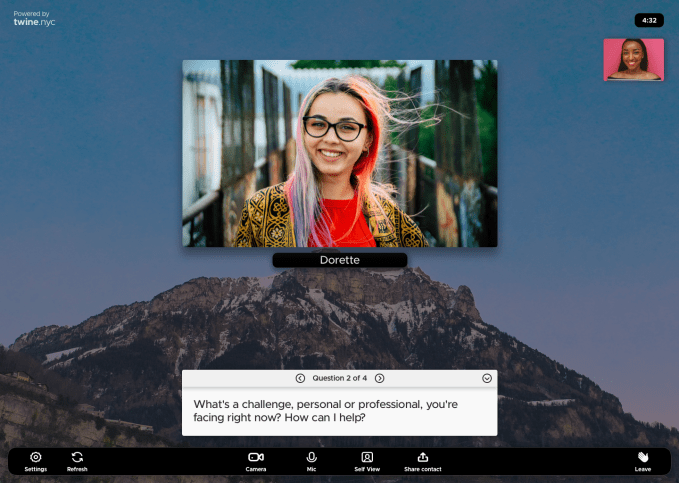
By January 2021, the new events-focused version of twine was up-and-running, offering a set of professional networking tools for event owners. Unlike one-to-many or few-to-many video broadcasts, twine connects a small number of people for more intimate conversations.

“We did a lot of research with our customers and users, and beyond five [people in a chat], it turns into a webinar,” notes Coburn, of the limitations on twine’s video chat. In twine, a small handful of people are dropped into a video chat experience– and now, they’re not random online strangers. They’re fellow event attendees. That generally keeps user behavior professional and the conversations productive.

Event owners can use the product for free on twine’s website for small events with up to 30 users, but to scale up any further requires a license. Twine charges on a per attendee basis, where customers buy packs of attendees on a software-as-a-service model.

The company’s customers can then embed twine directly in their own website or add a link that pops open the twine website in a separate browser tab.

Coburn says twine has found a sweet spot with big corporate event programs. The company has around 25 customers, but some of those have already used twine for 10 or 15 events after first testing out the product for something smaller.

“We’re working with five or six of the biggest companies in the world right now,” noted Coburn.

Image Credits: twine

Because the matches are digital, twine can offer other tools like digital “business card” exchanges and analytics and reports for the event hosts and attendees alike.

Despite the cautious return to normal in the U.S., which may see in-person events return in the year ahead, twine believes there’s still a future in online events. Due to the pandemic’s lasting impacts, organizations are likely to adopt a hybrid approach to their events going forward.

“I don’t think there’s ever been an industry that has gone through a 15 months like the events industry just went through,” Coburn says. “These companies went to zero, their revenue went to zero and some of them were coming from hundreds of millions of dollars. So what happened was a digital transformation like the world has never seen,” he adds.

Now, there are tens of thousands of event planners who have gotten really good at tech and online events. And they saw the potential in online, which would sometimes deliver 4x or 5x the attendance of virtual, Coburn points out.

“This is why you see LinkedIn drop $50 million on Hopin,” he says, referring to the recent fundraise for the virtual conference technology business. (The deal was reportedly for less than $50 million). “This is why you see the rounds of funding that are going into Hoppin and Bizzabo and Hubilo and all the others. This is the taxi market, pre-Uber.”

Of course, virtual events may end up less concerned with social features when they can offer an in-person experience. And those who want to host online events may be looking for a broader solution than Zoom + twine, for example.

But twine has ideas about what it wants to do next, including asynchronous matchmaking, which could end up being more valuable as it could lead to better matches since it wouldn’t be limited to only who’s online now.

With the funding, twine is hiring in sales and customer success, working on accessibility improvements, and expanding its platform. To date, twine has raised $4.7 million.

17 Jun 2021

Industrial cybersecurity startup Claroty raises $140M in pre-IPO funding round

Claroty, an industrial cybersecurity company that helps customers protect and manage their Internet of Things (IoT) and operational technology (OT) assets, has raised $140 million in its latest, and potentially last round of funding. 

With the new round of Series D funding, co-led by Bessemer Venture and 40 North, the company has now amassed a total of $235 million. Additional strategic investors include LG and I Squared Capital’s ISQ Global InfraTech Fund, with all previous investors — Team8, Rockwell Automation, Siemens, and Schneider Electric — also participating. 

Founded in 2015, the late-stage startup focuses on the industrial side of cybersecurity. Its customers include General Motors, Coca-Cola EuroPacific Partners, and Pfizer, with Claroty helping the pharmaceutical firm to secure its COVID-19 vaccine supply chain. Claroty tells TechCrunch it has seen “significant” customer growth over the past 18 months, largely fueled by the pandemic, with 110% year-over-year net new logo growth and 100% customer retention. 

It will use the newly raised funds to meet this rapidly accelerating global demand for The Claroty Platform, an end-to-end solution that provides visibility into industrial networks and combines secure remote access with continuous monitoring for threats and vulnerabilities. 

“Our mission is to drive visibility, continuity, and resiliency in the industrial economy by delivering the most comprehensive solutions that secure all connected devices within the four walls of an industrial site, including all operational technology (OT), Internet of Things (IoT), and industrial IoT (IIoT) assets,” said Claroty CEO Yaniv Vardi.

To meet this growing demand, the startup is planning to expand into new regions and verticals, including transportation government-owned industries, as well as increase its global headcount. The company, which is based in New York, currently has around 240 employees. 

Claroty hasn’t yet made any acquisitions, though CEO Yaniv Vardi tells TechCrunch that this could be part of the startup’s roadmap going forward.

“We’re waiting for the right opportunity at the right time, but it’s definitely part of the plan as part of the financial runway we just secured,” he said, adding that this latest funding round will likely be the company’s last before it explores a potential IPO.

“We are thinking that this is a pre-IPO funding round,” he said. “The end goal here is to be the market leader for industrial cybersecurity. One of the mascots can be going public with an IPO, but there are different options too, such as SPAC.”

The funding round comes amid a sharp increase in cyber targeting organizations that underpin the world’s critical infrastructure and supply chains. According to a recent survey carried out by Claroty, the majority (53%) of US industrial enterprises have seen an increase in cybersecurity threats since the start of 2020. The survey of 1,110 IT and OT security professionals also found that over half believed their organization is now more of a target for cybercriminals, with 67% having seen cybercriminals use new tactics amid the pandemic. 

“The number of attacks, and impact of these attacks, is increasing significantly, especially in verticals like food, automotive, and critical infrastructure. Vardi said. “That creates a lot of risk assessments public companies had to do, and these risks needed to be addressed with a security solution on the industrial side.”

17 Jun 2021

Nylas, maker of APIs to integrate email and other productivity tools, raises $120M, passes 40k developers

Companies like Stripe and Twilio have put APIs front and center as an effective way to integrate complex functionality that may not be core to your own technology stack but a necessary part of your wider business. Today, a company that has taken that model to create an effective way to integrate email, calendars and other tools into other apps using APIs is announcing a big round of funding to expand its business.

Nylas, which describes itself as a communications API platform — enabling more automation particularly in business apps by integrating productivity tools through a few lines of code — has raised $120 million in funding, money that it will be using to continue expanding the kinds of APIs that it offers, with a focus in particular not just on productivity apps, but AI and related tools to bring in more automation into workflows.

Nylas is not disclosing its valuation, but this is a very significant step up for the company comes at a time when it is seeing strong traction.

This is more than double what Nylas had raised up to now ($55 million since being founded in 2015), and when it last raised — a $16 million Series B in 2018 — it said it had “thousands of developers” among its users. Now, that number has ballooned to 40,000, with Nylas processing some 1.2 billion API requests each day, working out to 20 terabytes of data, daily. It also said that revenue growth tripled in the last 12 months.

The Series C is bringing a number of interesting names to Nylas’s cap table. New investor Tiger Global Management is leading the round, with previous backers Citi Ventures, Slack Fund, 8VC and Round13 Capital also participating. Other new backers in this round include Owl Rock Capital, a division of Blue Owl (which itself is a division of insurance giant State Farm); Stripe co-founders Patrick Collison and John Collison; Klarna CEO Sebastian Siemiatkowski; and Tony Fadell.

As with other companies in the so-called API economy, the gap and opportunity that Nylas has identified is that there are a lot of productivity tools that largely exist in their own silos — meaning when a person wants to use them when working in an application, they have to open a separate application to do so. At the same time, building new, say, tools, or building a bridge to integrate an existing application, can be time-consuming and complex.

Nylas first identified this issue with email, and its integration to make it easier to use it — and the data that is housed in one’s email system (such as contacts and communicating with them) — in other apps picked up a lot of followers, leading the company to expand into other areas that today include scheduling and calendaring, a neural API to build in tools like sentiment analysis or productivity automation; and security integrations to streamline the Google OAuth security review process (used for example in an app geared at developers).

“The fundamental shift towards digital communications and connectivity has resulted in companies across all industries increasingly leaning on developers to solve critical business challenges and build unique and engaging products and experiences. As a result, APIs have become core to modern software development and digital transformation,” Gleb Polyakov, co-founder and CEO of Nylas, said in statement. “Through our suite of powerful APIs, we’re arming developers with the tools and applications needed to meet customer and market needs faster, create competitive differentiation through powerful and customized user experiences, and generate operational ROI through more productive and intelligently automated processes and development cycles. We’re thrilled to continue advancing our mission to make the world more productive and are honored to have the backing of distinguished investors and entrepreneurs.”

Indeed, the rise of Nylas and the function it fulfills is part of a bigger shift we’ve seen in businesses overall: as organizations become more digitized and use more cloud-based apps to get work done, developers have emerged as key mechanics to help that machine run. A bigger emphasis on APIs to integrate services together is part of their much-used toolkit, one of the defining reasons for investors backing Nylas today.

“Companies are rapidly adopting APIs as a way to automate productivity and find new and innovative ways to support modern work and collaboration,” said John Curtius, a partner at Tiger, in a statement. “This trend has become critical to creating frictionless and meaningful data-driven communications that power digital transformation. We believe Nylas is uniquely positioned to lead the future of the API economy.” Curtius is joining the board with this round.

17 Jun 2021

Internxt gets $1M to be ‘the Coinbase of decentralized storage’

Valencia-based startup Internxt has been quietly working on an ambitious plan to make decentralized cloud storage massively accessible to anyone with an Internet connection.

It’s just bagged $1M in seed funding led by Angels Capital, a European VC fund owned by Juan Roig (aka Spain’s richest grocer and second wealthiest billionaire), and Miami-based The Venture City. It had previously raised around half a million dollars via a token sale to help fund early development.

The seed funds will be put towards its next phase of growth — its month-to-month growth rate is 30% and it tells us it’s confident it can at least sustain that — including planning a big boost to headcount so it can accelerate product development.

The Spanish startup has spent most of its short life to date developing a decentralized infrastructure that it argues is both inherently more secure and more private than mainstream cloud-based apps (such as those offered by tech giants like Google).

This is because files are not only encrypted in a way that means it cannot access your data but information is also stored in a highly decentralized way, split into tiny shards which are then distributed across multiple storage locations, with users of the network contributing storage space (and being recompensed for providing that capacity with — you guessed it — crypto).

“It’s a distributed architecture, we’ve got servers all over the world,” explains founder and CEO Fran Villalba Segarra. “We leverage and use the space provided by professionals and individuals. So they connect to our infrastructure and start hosting data shards and we pay them for the data they host — which is also more affordable because we are not going through the traditional route of just renting out a data center and paying them for a fixed amount of space.

“It’s like the Airbnb model or Uber model. We’ve kind of democratized storage.”

Internxt clocked up three years of R&D, beginning in 2017, before launching its first cloud-based apps: Drive (file storage), a year ago — and now Photos (a Google Photos rival).

So far it’s attracting around a million active users without paying any attention to marketing, per Villalba Segarra.

Internxt Mail is the next product in its pipeline — to compete with Gmail and also ProtonMail, a pro-privacy alternative to Google’s freemium webmail client (and for more on why it believes it can offer an edge there read on).

Internxt Send (file transfer) is another product billed as coming soon.

“We’re working on a G-Suite alternative to make sure we’re at the level of Google when it comes to competing with them,” he adds.

The issue Internxt’s architecture is designed to solve is that files which are stored in just one place are vulnerable to being accessed by others. Whether that’s the storage provider itself (who may, like Google, have a privacy-hostile business model based on mining users’ data); or hackers/third parties who manage to break the provider’s security — and can thus grab and/or otherwise interfere with your files.

Security risks when networks are compromised can include ransomeware attacks — which have been on an uptick in recent years — whereby attackers that have penetrated a network and gained access to stored files then hold the information to ransom by walling off the rightful owner’s access (typically by applying their own layer of encryption and demanding payment to unlock the data).

The core conviction driving Internxt’s decentralization push is that files sitting whole on a server or hard drive are sitting ducks.

Its answer to that problem is an alternative file storage infrastructure that combines zero access encryption and decentralization — meaning files are sharded, distributed and mirrored across multiple storage locations, making them highly resilient against storage failures or indeed hack attacks and snooping.

The approach ameliorates cloud service provider-based privacy concerns because Internxt itself cannot access user data.

To make money its business model is simple, tiered subscriptions: With (currently) one plan covering all its existing and planned services — based on how much data you need. (It is also freemium, with the first 10GB being free.)

Internxt is by no means the first to see key user value in rethinking core Internet architecture.

Scotland’s MaidSafe has been trying to build an alternative decentralized Internet for well over a decade at this point — only starting alpha testing its alt network (aka, the Safe Network) back in 2016, after ten years of testing. Its long term mission to reinvent the Internet continues.

Another (slightly less veteran) competitor in the decentralized cloud storage space is Storj, which is targeting enterprise users. There’s also Filecoin and Sia — both also part of the newer wave of blockchain startups that sprung up after Bitcoin sparked entrepreneurial interest in cryptocurrencies and blockchain/decentralization.

How, then, is what Internxt’s doing different to these rival decentralized storage plays — all of which have been at this complex coal face for longer?

“We’re the only European based startup that’s doing this [except for MaidSafe, although it’s UK not EU based],” says Villalba Segarra, arguing that the European Union’s legal regime around data protection and privacy lends it an advantage vs U.S. competitors. “All the others, Storj, plus Sia, Filecoin… they’re all US-based companies as far as I’m aware.”

The other major differentiating factor he highlights is usability — arguing that the aforementioned competitors have been “built by developers for developers”. Whereas he says Internxt’s goal is be the equivalent of ‘Coinbase for decentralized storage’; aka, it wants to make a very complex technology highly accessible to non-technical Internet users.

“It’s a huge technology but in the blockchain space we see this all the time — where there’s huge potential but it’s very hard to use,” he tells TechCrunch. “That’s essentially what Coinbase is also trying to do — bringing blockchain to users, making it easier to use, easier to invest in cryptocurrency etc. So that’s what we’re trying to do at Internxt as well, bringing blockchain for cloud storage to the people. Making it easy to use with a very easy to use interface and so forth.

“It’s the only service in the distributed cloud space that’s actually usable — that’s kind of our main differentiating factor from Storj and all these other companies.”

“In terms of infrastructure it’s actually pretty similar to that of Sia or Storj,” he goes on — further likening Internxt’s ‘zero access’ encryption to Proton Drive’s architecture (aka, the file storage product from the makers of end-to-end encrypted email service ProtonMail) — which also relies on client side encryption to give users a robust technical guarantee that the service provider can’t snoop on your stuff. (So you don’t have to just trust the company not to violate your privacy.)

But while it’s also touting zero access encryption (it seems to be using off-the-shelf AES-256 encryption; it says it uses “military grade”, client-side, open source encryption that’s been audited by Spain’s S2 Grupo, a major local cybersecurity firm), Internxt takes the further step of decentralizing the encrypted bits of data too. And that means it can tout added security benefits, per Villalba Segarra.

“On top of that what we do is we fragment data and then distribute it around the world. So essentially what servers host are encrypted data shards — which is much more secure because if a hacker was ever to access one of these servers what they would find is encrypted data shards which are essentially useless. Not even we can access that data.

“So that adds a huge layer of security against hackers or third party [access] in terms of data. And then on top of that we build very nice interfaces with which the user is very used to using — pretty much similar to those of Google… and that also makes us very different from Storj and Sia.”

Storage space for Internxt users’ files is provided by users who are incentivized to offer up their unused capacity to host data shards with micropayments of crypto for doing so. This means capacity could be coming from an individual user connecting to Internxt with just their laptop — or a datacenter company with large amounts of unused storage capacity. (And Villalba Segarra notes that it has a number of data center companies, such as OVH, are connected to its network.)

“We don’t have any direct contracts [for storage provision]… Anyone can connect to our network — so datacenters with available storage space, if they want to make some money on that they can connect to our network. We don’t pay them as much as we would pay them if we went to them through the traditional route,” he says, likening this portion of the approach to how Airbnb has both hosts and guests (or Uber needs drivers and riders).

“We are the platform that connects both parties but we don’t host any data ourselves.”

Internxt uses a reputation system to manage storage providers — to ensure network uptime and quality of service — and also applies blockchain ‘proof of work’ challenges to node operators to make sure they’re actually storing the data they claim.

“Because of the decentralized nature of our architecture we really need to make sure that it hits a certain level of reliability,” he says. “So for that we use blockchain technology… When you’re storing data in your own data center it’s easier in terms of making sure it’s reliable but when you’re storing it in a decentralized architecture it brings a lot of benefits — such as more privacy or it’s also more affordable — but the downside is you need to make sure that for example they’re actually storing data.”

Payments to storage capacity providers are also made via blockchain tech — which Villalba Segarra says is the only way to scale and automate so many micropayments to ~10,000 node operators all over the world.

Discussing the issue of energy costs — given that ‘proof of work’ blockchain-based technologies are facing increased scrutiny over the energy consumption involved in carrying out the calculations — he suggests that Internxt’s decentralized architecture can be more energy efficient than traditional data centers because data shards are more likely to be located nearer to the requesting user — shrinking the energy required to retrieve packets vs always having to do so from a few centralized global locations.

“What we’ve seen in terms of energy consumption is that we’re actually much more energy efficient than a traditional cloud storage service. Why? Think about it, we mirror files and we store them all over the world… It’s actually impossible to access a file from Dropbox that is sent out from [a specific location]. Essentially when you access Dropbox or Google Drive and you download a file they’re going to be sending it out from their data center in Texas or wherever. So there’s a huge data transfer energy consumption there — and people don’t think about it,” he argues.

“Data center energy consumption is already 2%* of the whole world’s energy consumption if I’m not mistaken. So being able to use latency and being able to send your files from [somewhere near the user] — which is also going to be faster, which is all factored into our reputation system — so our algorithms are going to be sending you the files that are closer to you so that we save a lot of energy from that. So if you multiple that by millions of users and millions of terabytes that actually saves a lot of energy consumption and also costs for us.”

What about latency from the user’s point of view? Is there a noticeable lag when they try to upload or retrieve and access files stored on Internxt vs — for example — Google Drive?

Villalba Segarra says being able to store file fragments closer to the user also helps compensate for any lag. But he also confirms there is a bit of a speed difference vs mainstream cloud storage services.

“In terms of upload and download speed we’re pretty close to Google Drive and Dropbox,” he suggests. “Again these companies have been around for over ten years and their services are very well optimized and they’ve got a traditional cloud architecture which is also relatively simpler, easier to build and they’ve got thousands of [employees] so their services are obviously much better than our service in terms of speed and all that. But we’re getting really close to them and we’re working really fast towards bringing our speed [to that level] and also as many features as possible to our architecture and to our services.”

“Essentially how we see it is we’re at the level of Proton Drive or Tresorit in terms of usability,” he adds on the latency point. “And we’re getting really close to Google Drive. But an average user shouldn’t really see much of a difference and, as I said, we’re literally working as hard as possible to make our services as useable as those of Google. But we’re ages ahead of Storj, Sia, MaidSafe and so forth — that’s for sure.”

Internxt is doing all this complex networking with a team of just 20 people currently. But with the new seed funding tucked in its back pocket the plan now is to ramp up hiring over the next few months — so that it can accelerate product development, sustain its growth and keep pushing its competitive edge.

“By the time we do a Series A we should be around 100 people at Internxt,” says Villalba Segarra. “We are already preparing our Series A. We just closed our seed round but because of how fast we’re growing we are already being reached out to by a few other lead VC funds from the US and London.

“It will be a pretty big Series A. Potentially the biggest in Spain… We plan on growing until the Series A at at least a 30% month-to-month rate which is what we’ve been growing up until now.”

He also tells TechCrunch that the intention for the Series A is to do the funding at a $50M valuation.

“We were planning on doing it a year from now because we literally just closed our [seed] round but because of how many VCs are reaching out to us we may actually do it by the end of this year,” he says, adding: “But timeframe isn’t an issue for us. What matters most is being able to reach that minimum valuation.”

*Per the IEA, data centres and data transmission networks each accounted for around 1% of global electricity use in 2019


17 Jun 2021

Hydrosat raises $5M seed round to deliver ground temperature data to customers

A lot of information can be gleaned about a surface area just by taking the ground temperature data. If a crop field is under stress, for example, the ground temperature will be elevated long before there’s any actual indication of the stress on the plant itself, Hydrosat CEO and co-founder Pieter Fossel explained to TechCrunch. Now, with a new $5 million injection in seed funding, he hopes to launch Hydrosat’s first surface temperature analytics product for customers.

The seed round was led by Cultivation Capital’s newly launched Geospatial Technologies Fund with participation by Freeflow Ventures, the Yield Lab, Expon Capital, Techstars, Industrious Ventures, Synovia Capital, and the University of Michigan.

The geospatial data analytics startup, which started at the end of 2017, plans to gather surface temperature data using satellites equipped with thermal infrared sensors. Beyond agricultural data, surface temperature can also provide information about wildfire risk, water stress and drought – all important variables if you believe, as Fossel does, that climate change is already starting to exert forces on the planet.

While ground temperature data is collected by legacy institutions like NASA and the European Space Agency (ESA), it’s not gathered at a very high frequency – sometimes a specific location’s ground temperature is only read every 16 days or so – or at a high resolution. Hydrosat hopes to fill in those existing data gaps. The company also collects data on other bands, using a multispectral infrared camera, but its primary value proposition is in its thermal data.

The first satellite will head to low-Earth orbit with Loft Orbital on a SpaceX Falcon 9 rocket in the second half of 2022. That mission is named after Hydrosat’s former CEO, Jakob van Zyl, who passed away from heart attack about a year ago. Although the launches add a certain flair, Fossel stressed that the company is “a content company and a data company first.”

“We’re also developing some applications that sit on top of that [surface temperature] product that are geared towards crop yield forecasting, drought detection, and irrigation management,” he said. “Because these are all fundamentally driven by water stress and all of those applications are fundamentally enabled by our core product, which is land surface temperature data.”

Hydrosat’s first customers have been governments, in the form of a contract with the ESA and three SBIR contracts with the U.S. Air Force and Department of Defense. But through the raise, the company can start to deliver its product to commercial customers, who may include agribusinesses, insurance companies, and even other companies that want to do analytics on top of its collection of ground surface data.

“[Hydrosat] will probably start in agriculture, which is our core focus, but it could branch out across industries, because temperature is a signal of a whole host of activities beyond our focus, which is environment, water, stress, food,” he explained. “Temperature is also a signal of economic activity. There’s a lot of cool use cases for temperature, from kind of a defense and security standpoint, as well.”

Looking to the future, Hydrosat has plans to launch a 16-satellite constellation to enable global monitoring. But that’s only the medium-term focus, Fossel said. The company’s long-term plans could include launching additional satellites, adding additional bands to deepen its data offerings, or building out its analytics layer. “Beyond that, it’s really about providing the underlying data that enables some of these applications in drought, food security, water stress, wildfire, and defense and security,” he added.

17 Jun 2021

Unit raises $51M in Accel-led Series B to grow its banking-as-a-service platform

We’ve all heard the phrase, “Every company is a fintech.” 

But these days, that’s becoming more and more true as an increasing number of companies that are not even in the financial services space seek to add a fintech component to their offering.

A group of startups poised to benefit from this shift are those offering banking as a service. One such startup, Unit, has raised $51 million in a Series B round to further its goal of making it possible for companies and fintechs alike to build banking products “in minutes.”

Silicon Valley-based Accel led the round for Unit, bringing the company’s total raised since its 2019 inception to nearly $70 million. Existing backers Better Tomorrow Ventures, Aleph, Flourish Ventures and TLV Partners also participated in the latest financing

Founders Itai Damti and Doron Somech are no strangers to growing companies. The pair previously co-founded — and bootstrapped — Leverate, a Tel Aviv-based B2B trading tech provider. Unit has dual headquarters in Tel Aviv and New York City.

Damti and Somech founded Unit in late 2019 and spent the first year stealthily building out the platform with the mission of empowering companies to embed financial services into their product, accelerating their time to market. Unit officially launched its platform in late 2020, and over the last three months, it has seen deposit volume grow by more than 300% and new end users by 600% (albeit from a small base).

With its platform, Unit touts, companies in a variety of industries — such as freelance or creator economy and personal financial management, for example — can build financial products directly into their software. This gives them the ability to build and launch next-gen bank accounts, cards, payment and lending products. Customers include Wethos, Lance, Benepass, Moves and Tribevest, among others.

“Our mission is to expand financial access for all and we do it by empowering the next generation of fintech builders,” Damti said. Only about 20% of its customers are what might be considered true fintechs, he said. The remaining 80% are companies that are not but rather want to embed banking as a service into their offering.

Unit, Damti claims, takes what was once “a very expensive and complex process of 18 months” that includes finding and managing a bank relationship, building a compliance team and building a tech stack “that gets you to a competitive banking offering, and turns it into one API and one dashboard that helps companies launch accounts cards, payments and lending within five weeks.”

In conjunction with the funding, Unit is also announcing today a new offering, Unit Go, which it says allows companies to create live bank accounts and issue physical and virtual cards in minutes. Founders and developers can try it out by creating a free account, building in Unit’s live environment and testing their products using real funds. Unit Go is currently in beta and will be available to the public in the fall of 2021. 

The company plans to use its new capital to grow its headcount of 26 and fast-track its Unit Go offering. It also wants to expand its platform into additional financial products, software development kits (SDKs) and integrations. (It’s already integrated with Plaid, for example).

Of course, Unit is not the only startup in the burgeoning banking-as-a-service (BaaS) space. It competes with the likes of Railbank, Treasury Prime and Stripe. Damti believes there are a few things that help differentiate Unit in the increasingly crowded space.

For one, according to Damti, Unit intentionally “put compliance at the front and center of what we do.” As evidence of that, earlier this year, it tapped Amanda Swoverland to serve as its chief compliance officer. 

Secondly, Damti emphasizes that Unit is not a matchmaker or marketplace along the lines of Synctera.

“We are acting as a company that connects banks to the tech ecosystem and banks are critical vendors and partners to us, but we see them as a built-in element within Unit, because we believe that the most excellent experience in this ecosystem can only come from software companies,” Damti told TechCrunch. 

And finally, he notes, Unit is technically distinct in that it is actually building a ledger, which Damti describes as “the most critical and sensitive part of the ecosystem.”

By owning the ledger and not delegating, he said, Unit is “able to offer a radically better experience.”

“As far as the transaction environment, the cleanliness of the data that we provide and the fees that our customers are able to control and tweak, owning that ledger piece is super critical for the experience,” Damti said.  

Accel partner Amit Kumar notes that in recent years, the landscape has shifted from hundreds of fintech startups “trying to beat incumbents with slightly better products” to thousands of tech companies trying to launch fintech businesses in their verticals.

“Unit’s strong emphasis on managing compliance addresses the risk typically associated with offering banking services and allows customers to bring these products to market much faster than previously possible,” he told TechCrunch. “Unit is building the platform to power the next generation of fintech.”