Year: 2021

16 Jun 2021

E3 2021 wrap-up

E3 2021 kicked off with news about E3 2022. Kind of a funny way to start a show, as Mayor Eric Garcetti told the crowd, “we look forward to seeing you in-person, here in the City of Angels, in 2022.” Also a bit funny when the mayor’s video game show announcement has less confetti and Minions than his state-reopening speech, but that’s something for another post.

It’s understandable, of course, that E3’s organizers led with that news. The 2021 show was, like so many other things over the past year-and-a-half, a historic anomaly. After opting to skip the 2020 show altogether (understandably), it went ahead with the first — and for the time being, last — all virtual event.

The virtual event always seems like a good idea, in theory. In practice, results vary wildly depending on a number of factors, not the least of which is content. Many shows have an uphill battle when it comes to moving all online. CES, I think, was a struggle, due in part to the size of the show, but also the content. As ubiquitous as consumer electronics are, I don’t see wide swaths of the internet champing at the bit to watch a presentation from anyone but, say, Apple and maybe Samsung.

E3 doesn’t have that problem. The show already had a leg up, having moved away from industry-only to something more hybrid years ago. Unlike other shows I attend regularly, people in downtown LA actually get a bit of a buzz when E3 comes to town. Everyone’s a gamer and most are excited about some piece of upcoming news. Uber and Lyft drivers love to tell you about it that week.

It follows that the show’s online presence is immense. The days leading up to the event, E3-related content was trending all over the place — people watch trailers, argue about the trailers, stream about the trailers and argue about other people’s streams about the trailers on their own streams. It’s a recipe for success around a virtual event — especially coming after a year when, even before the latest Xbox and PlayStation were released, the industry was already setting records amid the pandemic.

Of the big three, Microsoft won, hands down. Sorry, Sony, you can’t win if you don’t play. Nintendo was solid, but not spectacular. But more on that in a moment.

I talked a fair bit about the Xbox press conference in the last one of these. But the long and short of it is Microsoft won on two flanks: sheer volume and Game Pass titles. That last bit feels about as close to a silver bullet as we’re going to see in this generation of consoles. Likely Sony is going to have its own virtual event in the near future — but it’s going to be a tough act to follow.

In all, Microsoft showed off 30 games (and a fridge), a whopping 27 of which will be available on Game Pass, if there were any doubt as to how all-in the company is on its subscription service. And, of course, there’s the fact that this was billed as a Microsoft/Bethesda event, which shows you how important that massive acquisition is to the future of Xbox.

As for Nintendo, let’s be honest. Anything that didn’t include the long-rumored Switch Pro was going to be a disappointment. The original Switch is four years old and due for a big upgrade, beyond the Switch Lite and a refresh with added battery. It’s time for that HD screen — the thing would sell like hotcakes next holiday.

Thing is, the Switch had a spectacular 2020. Even with an initial supply chain shortage (something all three current consoles are guilty of), it did gangbusters during the pandemic, due in no small part to the arrival of a long-awaited new Animal Crossing game. A low-pressure, social title between fuzzy animals was precisely what the world needed last year, and Nintendo was happy to deliver.

There’s also a good chance that Nintendo is dealing with continued supply chain issues around the new components. So while it seems likely the Pro is on the way (see: the new Guardians of the Galaxy game), we’ll likely have to wait until next year.

We’ll also have to wait until next year for Breath of the Wild 2, but at least the sequel to the much-loved Zelda game had the decency to show up this year. And, of course, we’ve got a bunch of great-looking titles coming for the system. Some highlights.

Some old-school 2D side-scrolling hotness for Metroid Dread.

Hey, neat, a Game and Watch with some classic Zelda titles.

Talk about long-awaited, Shin Megami Tensai V has been teased since 2017.

Mario Party Superstars is coming October 29, with 100 mini-games.

Super Monkey Ball Banana Mania arrives October 5, doing what Super Monkey Ball does best.

In addition to all of the Square-Enix and Ubisoft stuff we discussed last time, Capcom gave us updates to Monster Hunter Stories 2: Wings of Ruin and Resident Evil Village.

That about does it. See you next year in LA. But maybe leave the Minion costumes at home (sorry Mr. Mayor).
16 Jun 2021

Lincoln’s first EV will arrive in 2022 with three more to follow

Lincoln Motor will launch its first all-electric vehicle in 2022 followed by three other EVs as part of the luxury brand’s goal to electrify its entire portfolio by the end of the decade.

The first EV will come to market just in time for Lincoln’s 100th birthday celebration — and nearly four years since initial reports emerged that the brand was aiming to electrify its lineup. Like GM’s luxury brand Cadillac, Lincoln doesn’t have an all-electric vehicle in its lineup. But Lincoln is keen to catch up and has set a lofty target for half of its global sales to be zero-emissions vehicles by 2025. These new vehicles fall under Ford’s commitment to invest $30 billion into electric vehicles through 2025.

The announcement by  Lincoln follows a string of EV-related news from Ford and its competitors. On Wednesday, rival GM said it planned to invest $35 billion in EVs and autonomous vehicles — an $8 billion increase from its financial commitment made back in November 2020.

The Lincoln EV was originally going to be built on Rivian’s skateboard platform. However, those plans were scrapped in April 2020. The companies said at the time that they still plan to co-develop a vehicle in the future. A Lincoln spokesperson confirmed those co-development plans were still intact, but did not reveal any more information.

For now, Lincoln’s electric vehicles will be based on a new, dedicated EV architecture developed by Ford. The automaker announced in May during its Capital Markets Day for investors that it was developing two flexible platforms, one for smaller SUVs, sedans and another for larger pickups. This is a different architecture used in the current Ford’s Mustang Mach-E and upcoming Ford F-150 Lightning.

The new flexible platform, which allow for rear-wheel and all-wheels vehicles, is expected to underpin EV versions of the Lincoln Aviator and Ford Explorer.

According to Lincoln, the automaker’s first fully electric car will join the likes of plug-in hybrid SUVs Aviator and Corsair. Lincoln has not yet revealed what model the new EV will take, but it hinted the design might be similar to the Lincoln Zephyr Reflection concept sedan revealed at Auto Shanghai this year, made specifically for the Chinese market. Lincoln’s electric car will be available for sale in both the United States and China.

Lincoln also shared information on the interior of its new EV, attempting to make it a minimalistic and expansive space with a panoramic roof vista to create a more airy feel, one that befits a “sanctuary” as the automaker is referring to its vehicle. Perhaps most notable is the upcoming EVs will have a digital platform built off the Android operating system, which will allow the company to offer third-party apps and services and update the software remotely.

The vehicle will also be equipped with an advanced driver-assist features, including hands-free driving on certain highways.

16 Jun 2021

Experts from Ford, Toyota and Hyundai outline why automakers are pouring money into robotics

Automakers’ interest in robotics is not a new phenomenon, of course: Robots and automation have long played a role in manufacturing and are both clearly central to their push into AVs. But recently, many companies are going even deeper into the field, with plans to be involved in the wide spectrum of categories that robotics touch.

At TC Sessions: Mobility 2021, we spoke to a trio of experts at three major automakers. Max Bajracharya of Toyota Research Institute, Mario Santillo of Ford and Ernestine Fu of Hyundai Motor Group joined us to discuss their companies’ unique approaches to robotics.

Why are automakers so interested in robotics?

Let’s get the simple question out of the way first, shall we? Moving beyond existing investments in manufacturing and autonomous vehicles, why do so many carmakers seem so bullish about companies like Boston Dynamics and Agility Robotics?

Bajracharya: I think all automakers are recognizing that there won’t be the automotive business in the future as it is today. A lot of automakers, Toyota included, are looking for what’s next. Automakers are very well positioned to leverage what they already know about robotics and manufacturing to take on the robotics market. (Timestamp: 1:01)

The role of concept vehicles

Concept cars are nothing new in the industry, but even still, Hyundai’s recently announced Ultimate Mobility Vehicle (UMV) was pretty wild, with large, extending legs that help it walk off-road.

16 Jun 2021

Harry Stebbings turns up the volume on 20VC with new $140M fund

Harry Stebbings, the well-known podcaster behind ‘20 minute VC’, announced today that he raised a duo of funds for 20VC, the venture capital fund he launched off of his show’s success. The pair of funds – one for early-stage and one for growth stage – total to $140 million in assets under management, plucked from LPs including MIT, Spotify’s founder Daniel Ek and RIT Capital partners.

The total is a 15X increase from Stebbings’ inaugural $8.3 million fund, launched less than a year ago.

Stebbings said that his early-stage fund, 20VC Early, will invest checks between $250,000 to $750,000, while his growth-stage fund, 20VC Explorer, will invest in Series B onwards, with checks between $1 million to $5 million.

The 20VC portfolio already includes a few reported unicorns, including audio app Clubhouse and virtual event organizer Hopin. But, maybe more notable, is what his assumed success – as a 24 year-old who has won a spot in competitive deals and raised a massive venture capital fund – means for the way that tech is evolving.

First, media experience, and the ability to spout useful content in a noisy world, is being increasingly valued as an asset in the modernizing world of VC. This week, Andreessen Horowitz launched Future, a full-fledged media operation that will cover trends in startups and tech.Stebbings’ podcast, which has over 200,000 subscribers and 80 million downloads to date, has cultivated an audience by interviewing tech’s elite, from Twitter co-founder Biz Stone to Slack founder Stewart Butterfield and to A16z’s Angela Strange. Those connections getting leveraged into dollars is a proof point of this growing idea, and sometimes meme, that Twitter followers can help anyone start a rolling fund.

Which brings me to my second point, which is that Stebbings raising such a massive tranche of capital could quiet some of the worry around emerging fund managers being unable to, well, 15X their initial micro-funds. In other words: you might be able to get a few of your buddies to venture to throw some checks in, but how do you get a full endowment to sign on board? Based on recent conversations I’ve had with emerging fund managers, it’s hard to get institutions, the ones with real check-writing power, on board for new funds because they only have so much capital allocated toward venture. It’s even harder for diverse, underrepresented founders. Whether or not Stebbings is a one-off is unclear, but we do at least know that venture backers are viewing his rolodex as a key competitive advantage, and asset in the wild world of investing.


At the end of the day, media is venture and venture is media. Stebbings sits at the intersection of that trend, and with $140 million more, it will be interesting to see what he does next, and if returns come for the ride.

16 Jun 2021

SoftBank Vision Fund 2 leads $140M funding in Vishal Sikka’s Vianai

Vianai Systems, an AI startup founded by former chief executive of Indian IT services giant Infosys, said on Wednesday it has raised $140 million in a round led by SoftBank Vision Fund 2.

The two-year-old startup said a number of industry luminaries also participated in the new round, which brings its total to-date raise to at least $190 million. The startup raised $50 million in its Seed financing round, but there’s no word on the size of its Series A round.

Details about what exactly the Palo Alto-headquartered startup does is unclear. In a press statement, Dr. Vishal Sikka said the startup is building a “better AI platform, one that puts human judgment at the center of systems that bring vast AI capabilities to amplify human potential.” Sikka, 54, resigned from the top role at Infosys in 2017 after months of acrimony between the board and a cohort of founders.

Vianai helps its customers amplify the transformation potential within their organizations using a variety of advanced AI and ML tools with a distinct approach in how it thoughtfully brings together humans with technology. This human-centered approach differentiates Vianai from other platform and product companies and enables its customers to fulfill AI’s true promise,” the startup said.

The startup claims it has already amassed many of the world’s largest and most respected businesses including insurance giant Munich Re as its customers.

Its investors include Jim Davidson (co-founder of Silver Lake), Henry Kravis and George Roberts (co-founders of KKR), and Jerry Yang (founding partner of AME and co-founder of Yahoo). Dr. Fei-Fei Li (co-director of the Stanford Institute for Human-Centered AI), has joined Vianai Systems’ advisory board.

“With the AI revolution underway, we believe Vianai’s human-centered AI platform and products provide global enterprises with operational and customer intelligence to make better business decisions,” said Deep Nishar, Senior Managing Partner at SoftBank Investment Advisers, in a statement. “We are pleased to partner with Dr. Sikka and the Vianai team to support their ambition to fulfill AI’s promise to drive fundamental digital transformations.”

16 Jun 2021

Facebook will begin beaming advertisements into virtual reality

Well, it was only a matter of time.

Advertising giant Facebook announced Wednesday that they’re going to begin testing advertising inside virtual reality titles on its Oculus platform soon. The first roll-out is limited enough, with Facebook testing ads inside a single gaming shooter title: Blaston from Resolution Games. They are interestingly not rolling this out with a first-party title, though I’m sure integration with Oculus Studio titles is inevitable.

“For now, this is a test with a few apps—once we see how this test goes and incorporate feedback from developers and the community, we’ll provide more details on when ads may become more broadly available across the Oculus Platform and in the Oculus mobile app,” a company blog post reads.

Users will be able to mute, hide or see information on why they are being served an ad in its current form.

It’s an unsurprising development for a platform that Facebook has long been bankrolling with little regard for current revenues, nevertheless Facebook liekly realizes that there are going to be plenty of privacy questions and addressed some of them head-on. The biggest admission is that Facebook says they will not be using any data stored locally on the Oculus headset, including images from the device’s cameras to target ads. They also say, somewhat less emphatically, that “have no plans to use movement data to target ads.”

Facebook is likely realizing that they probably should’ve published a blog post years ago declaring that they were indeed not using smartphone microphones to monitor conversations and target ads (mainly because they have access to better personal information via adtech data partners anyway, but I digress) before those narratives took off. Facebook specifically notes they don’t use audio conversations on the headset for ad targeting.

Virtual reality has been a labor of future-minded thinking for Facebook since the beginning, they’ve spent billions bankrolling the ecosystem and this move seems to signal that they believe they’ve wandered over some sort of adoption hump and are nearing the time to start more aggressively monetizing.

16 Jun 2021

To win post-pandemic, startups need remote-first growth teams

Growth leaders used to build key relationships across a company while working together in a real-life office. Those relationships could carry over through the pandemic, but let’s say you’re a new company and you’re remote-first.

How do you build this complex collaboration from scratch?

Growth marketer and investor Susan Su tells us that the solution is not just more software tools. In the interview below, she says that after the pandemic, startup founders will need to develop a mentality that places growth at the center of company strategy.

Consultants and agencies can be great additions to this effort, especially if they have previously solved the types of problems you face. (In fact, TechCrunch is asking founders who have worked with growth marketers to share a recommendation in this survey. We’ll use your answers to find more experts to interview.)

Su is currently the head of portfolio strategy for Sound Ventures, previously a growth leader at Stripe and the first hire at Reforge. She also shared a few thoughts on market opportunities after the pandemic in the full interview below. E-commerce is mainstream for good, she says, even as we all try to step away from screens more often. However, many social and mobile sectors are mature, and it’s going to be even harder for startups to compete as real-world activities absorb more time.

Don’t forget: Susan Su will also appear at our Early Stage virtual event on July 8 (and answer questions directly).

How are you seeing startups manage changes in user engagement as more people exit pandemic lockdowns and adjust their daily lives?

As we exit the pandemic, I expect that we’ll see a natural and obvious spike in some consumer activity that will roll up to midsized businesses and enterprises. Just like with the onset of the pandemic, we’ll see uneven results across sectors:

E-commerce boomed during the pandemic but was really an augmentation of an already-accelerating trend towards digital commerce and streamlined logistics. I don’t think we backtrack from e-commerce because habit formation around online shopping has been building for years; we would be backtracking to an age long before 2020, and that’s not going to happen.

New social-mobile experiences also boomed during the pandemic, but there’s still a valid question around whether 15 months or so is enough time to become part of the ingrained infrastructure of daily life. We are living in an age of mature platforms, so every new service is stealing time away from an existing service. As with pre-pandemic growth, their success rests upon fast-accumulating network effects and great, sticky core product experience. Now that we have parks, friends and dinners out calling to us again, it’s a real test of how compelling some of these new value propositions really are, and whether they can continue to demonstrate their relevance in a more hybridized online-offline world.

That said, the pandemic was an enormous constraint on human society and [the] economy, and these kinds of constraints often breed innovation that doesn’t go away. We will evolve, but we can never go back. It sounds cheesy but it’s true.

Some aspects of the pandemic, like remote work, appear to have radically changed certain industries. How will these societal changes impact how the typical startup thinks about growth?

Growth will always be growth — that is, a process of iterative experimentation to identify and solve customer problems, and then scale those solutions in order to reach and convert bigger and bigger audiences. Platform changes like iOS 14 or Facebook’s periodic algorithm adjustments will have a bigger impact in the near term on the technical functioning of growth, and these aren’t specifically pandemic-related.

One area to watch is how growth teams are built and operated. Growth is a horizontal function that touches many different parts of the org, including product, engineering, marketing, comms and design. Many startup teams have already been working with collaboration tools even while they sat in the same office, but growth is about more than just using tools. The most effective growth leaders succeed by building relationships across the organization; it’s like the fable of Stone Soup — you’re creating this meal that will feed everyone, but you also need each person to bring a pinch of salt, or a dash of pepper, or one carrot, and that requires socialization and relationship-building. I’ll be very interested to see how new growth leaders onboard remote-only teams and what approaches they take to this “networking” need within the function.

From the days of growth hacking on social platforms, growth marketing is now an established part of the world. But it’s not necessarily the main expertise of a startup founder, even if it needs to be. So, how should they think about addressing growth marketing in 2021? What are the essentials they should do in their roles?

Every founder needs to have a growth mentality. They don’t need to memorize all the right buttons to push in an ads dashboard, but they need to be familiar and comfortable with the core work of gap-finding. That said, founders are by definition entrepreneurial — their company exists because they saw an opportunity that no one else did, and this is the fundamental work of growth as well.

Founders will fail if they adopt a mentality that someone else can or should do it for them. The founder’s job is to supply ambition and opinions, and then magnetize high-quality talent to come and pull the levers and bring their creative vision to life. There are many people who can do growth marketing — that is, they know how the platforms work, they understand the rules and the playbooks. But there are very few who can come up with truly visionary strategies that change the game altogether — those people become founders, and those companies become household names. So for a founder, I’d say the most important growth work is to continue to know your market and customer better than anyone else in the whole world, have an opinion about what’s missing, and work to bring the best talent to come in alongside you and be a thought partner, not just a button pusher.

With limited resources, how should early-stage companies think about what to focus on?

This is going to depend on the goals of your company. Are you planning to raise money and need to demonstrate certain KPIs? Are you bootstrapping and need to keep the lights on? Resources should always be allocated to the most strategic purposes, with the longest-term view you can afford. For some companies, this could mean forgoing revenue to focus on viral or word-of-mouth-driven user acquisition to demonstrate to future investors that there’s something special here. For other companies, perhaps in lower volume categories like enterprise, it’s about bringing a few strategic logos into the family as a signal to later customers and other stakeholders, including future employees and investors.

One thing that early-stage companies should always be focused on is building a top-shelf employer brand. You will only ever be as good as the talent you attract to your company, and interestingly growth can actually play a role in this. The best designers, engineers and product people are often flowing towards the companies that have the best growth. In that way, it’s a highly strategic role and function.

What do startups continue to get wrong?

You can’t truly outsource growth or any other core function; you can’t tack on customer acquisition after product development. At the end of the day, if you really think about it, all a company is, is a customer-acquisition engine. This needs to be core; wake up every day and think about growth, not just to hit revenue or user KPIs, but to build the company that the best people are clamoring to work at. It’s not about finding someone sufficient to solve your near-term problems; it’s about framing problems in a way that’s so compelling to the most creative, hardest working people so that they can’t get it out of their heads. Go for talent moonshots, and figure out how to close them. The rest will fall in line from there.

When should a founder feel comfortable getting help from an outside expert or agency?

Anytime. Agencies are great. They are an extension of your talent, and the best agencies aren’t selling you — they have to be sold on your problem because they have their pick of companies just like yours. That’s the agency or outside expert you want to work with, because they’ll have a priceless perspective from the other best-in-class founders and teams they’ve worked with that they can bring to your challenge. Any agency can run Facebook ads (it’s not rocket science), but you want to find the team that’s solved the gnarliest problems for your hero companies. Then you’ll get not just an ads manager, but a teacher.


16 Jun 2021

Facebook rolls out new tools for Group admins, including automated moderation aids

Facebook today introduced a new set of tools aimed at helping Facebook Group administrators get a better handle on their online communities and, potentially, help keep conversations from going off the rails. Among the more interesting new tools is a machine learning-powered feature that alerts admins to potentially unhealthy conversations taking place in their group. Another lets the admin slow down the pace of a heated conversation, by limiting how often group members can post.

Facebook Groups are today are significant reason why people continue to use the social network. Today, there are “tens of millions” of groups, that are managed by over 70 million active admins and moderators worldwide, Facebook says.

The company for years has been working to roll out better tools for these group owners, who often get overwhelmed by the administrative responsibilities that come with running an online community at scale. As a result, many admins give up the job and leave groups to run somewhat unmanaged — thus allowing them to turn into breeding grounds for misinformation, spam and abuse.

Facebook last fall tried to address this problem by rolling out new group policies to crack down on groups without an active admin, among other things. Of course, the company’s preference would be to keep groups running and growing by making them easier to operate.

That’s where today’s new set of features come in.

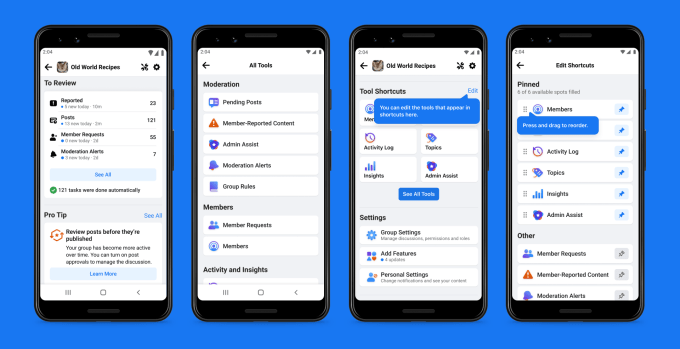
A new dashboard called Admin Home will centralize admin tools, settings and features in one place, as well as present “pro tips” that suggest other helpful tools tailored to the group’s needs.

Image Credits: Facebook

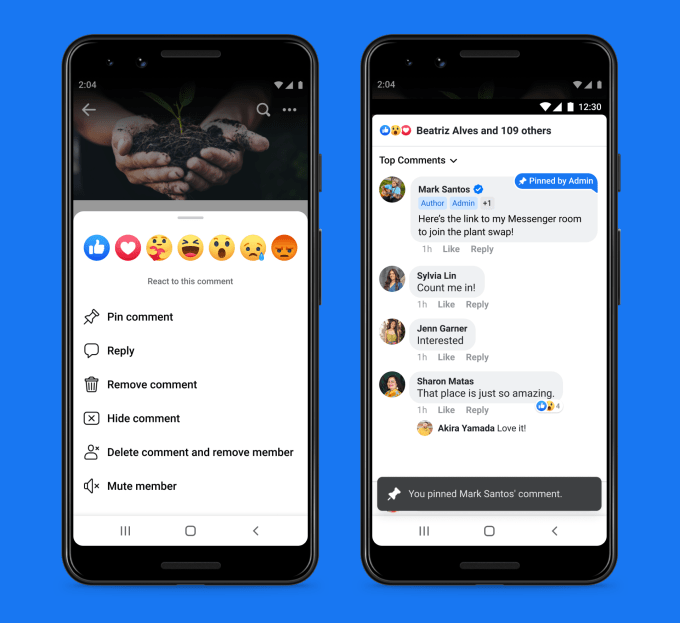
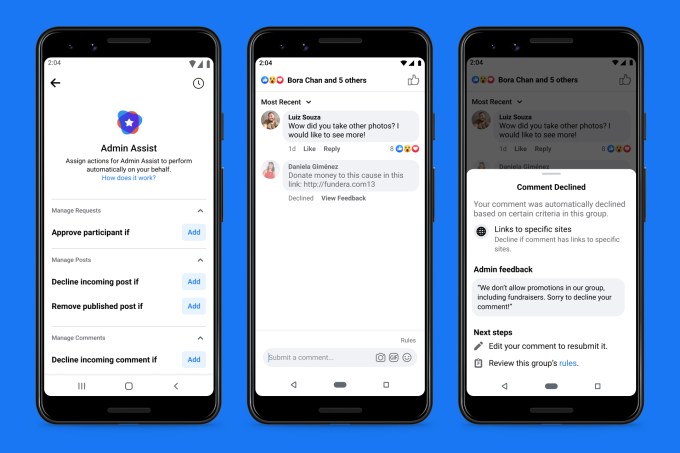
Another new Admin Assist feature will allow admins to automatically moderate comments in their groups by setting up criteria that can restrict comments and posts more proactively, instead of forcing admins to go back after the fact and delete them, which can be problematic — especially after a discussion has been underway and members are invested in the conversation.

For example, admins can now restrict people from posting if they haven’t had a Facebook account for very long or if they had recently violated the group’s rules. Admins can also automatically decline posts that contain specific promotional content (perhaps MLM links! Hooray!) and then share feedback with the author of the post automatically about why those posts aren’t allowed.

Admins can also take advantage of suggested preset criteria from Facebook to help with limiting spam and managing conflict.

Image Credits: Facebook

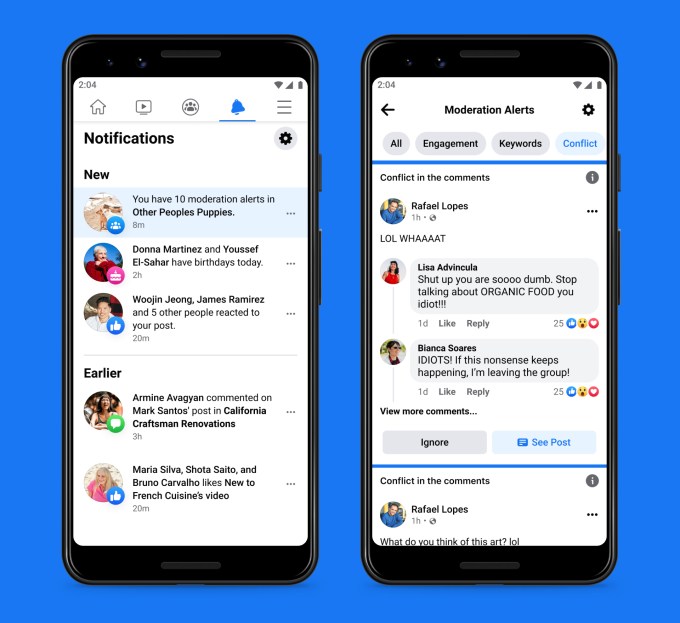
One notable update is a new moderation alert type dubbed “conflict alerts.” This feature, currently in testing, will notify admins when a potentially contentious or unhealthy conversation is taking place in the group, Facebook says. This would allow an admin to quickly take an action — like turning off comments, limiting who could comment, removing a post, or however else they would want to approach the situation.

Conflict alerts are powered by machine learning, Facebook explains. Its machine learning model looks at multiple signals, including reply time and comment volume to determine if engagement between users has or might lead to negative interactions, the company says.

This is sort of like an automated expansion on the Keyword Alerts feature many admins already use to look for certain topics that lead to contentious conversations.

Image Credits: Facebook

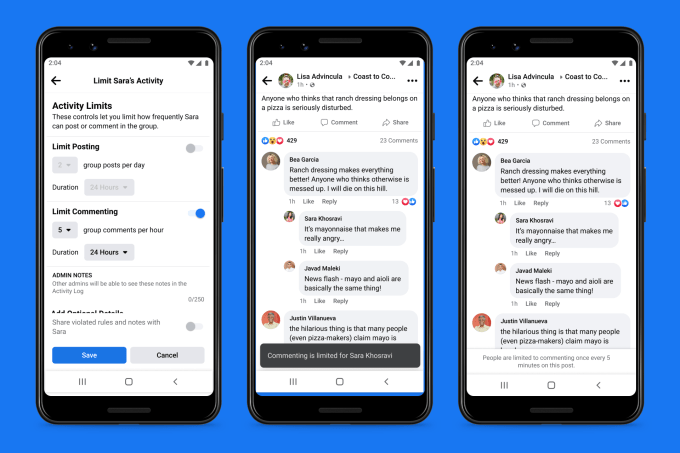
A related feature, also new, would allow admins to also limit how often specific members could comment, or how often comments could be added to posts admins select.

When enabled, members can leave 1 comment every 5 minutes. The idea here is that forcing users to pause and consider their words amid a heated debate could lead to more civilized conversations. We’ve seen this concept enacted on other social networks, as well — such as with Twitter’s nudges to read articles before retweeting, or those that flag potentially harmful replies, giving you a chance to re-edit your post.

Image Credits: Facebook

Facebook, however, has largely embraced engagement on its platform, even when it’s not leading to positive interactions or experiences. Though small, this particular feature is an admission that building a healthy online community means sometimes people shouldn’t be able to immediately react and comment with whatever thought first popped into their head.

Additionally, Facebook is testing tools that allow admins to temporarily limit activity from certain group members.

If used, admins will be able to determine how many posts (between 1 and 9 posts) per day a given member may share, and for how long that limit should be in effect for (every 12 hours, 24 hours, 3 days, 7 days, 14 days, or 28 days). Admins will also be able to determine how many comments (between 1 and 30 comments, in 5 comment increments) per hour a given member may share, and for how long that limit should be in effect (also every 12 hours, 24 hours, 3 days, 7 days, 14 days, or 28 days).

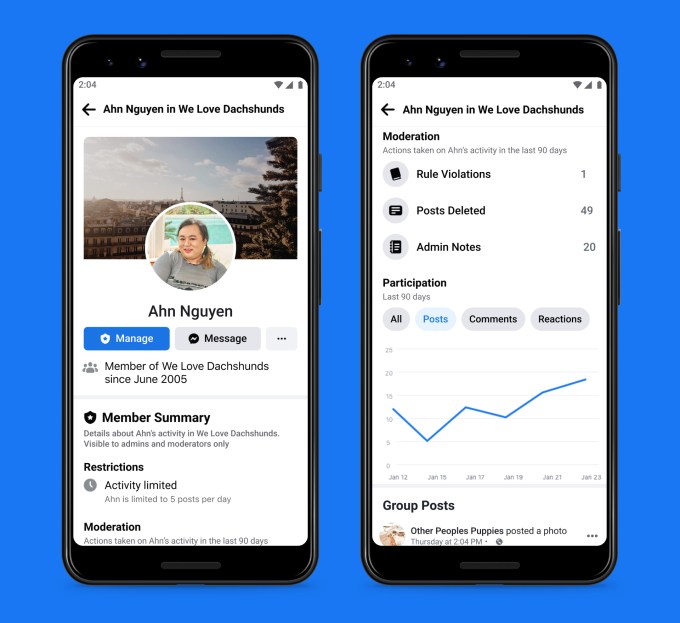
Along these same lines of building healthier communities, a new member summary feature will give admins an overview of each member’s activity on their group, allowing them to see how many times they’ve posted and commented, have had posts removed, or have been muted.

Image Credits: Facebook

Facebook doesn’t say how admins are to use this new tool, but one could imagine admins taking advantage of the detailed summary to do the occasional cleanup of their member base by removing bad actors who continually disrupt discussions. They could also use it to locate and elevate regulator contributors without violations to moderator roles, perhaps.

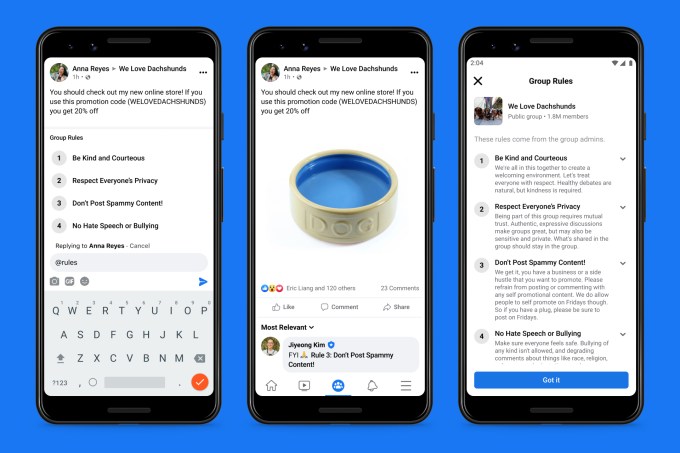
Admins will also be able to tag their group rules in comment sections, disallow certain post types (e.g. Polls or Events), and submit an appeal to Facebook to re-review decisions related to group violations, if in error.

Image Credits: Facebook

Of particular interest, though a bit buried amid the slew of other news, is the return of Chats, which was previously announced.

Facebook had abruptly removed Chat functionality back in 2019, possibly due to spam, some had speculated. (Facebook said it was product infrastructure.) As before, Chats can have up to 250 people, including active members and those who opted into notifications from the chats. Once this limit is reached, other members will not be able to engage with that specific chat room until existing active participants either leave the chat or opt out of notifications.

Now, Facebook group members can start, find and engage in Chats with others within Facebook Groups instead of using Messenger. Admins and moderators can also have their own chats.

Notably, this change follows on the heels of growth from messaging-based social networks, like IRL, a new unicorn (due to its $1.17B valuation), as well as the growth seen by other messaging apps, like Telegram, Signal and other alternative social networks.

Image Credits: Facebook

Along with this large set of new features, Facebook also made changes to some existing features, based on feedback from admins.

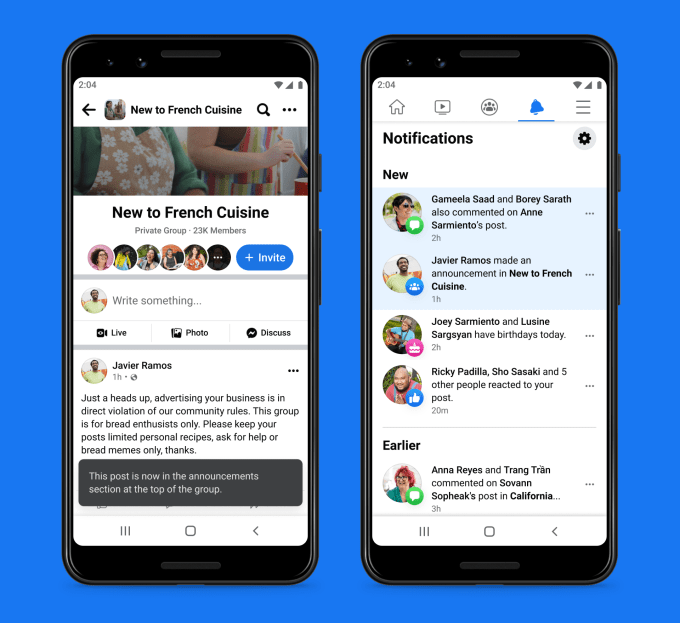
It’s now testing pinned comments and introduced a new “admin announcement” post type that notifies group members of the important news (if notifications are being received for that group).

Plus, admins will be able to share feedback when they decline group members.

Image Credits: Facebook

The changes are rolling out across Facebook Groups globally in the coming weeks.

16 Jun 2021

Investors Clara Brenner, Quin Garcia and Rachel Holt on SPACs, micromobility and how COVID-19 shaped VC

Few people are more closely tapped into the innovations in the transportation space than investors. They’re paying close attention to what startups and tech companies are doing to develop and commercialize autonomous vehicle technology, electrification, micromobility, robotics and so much more.

Clara Brenner, co-founder and managing partner of Urban Innovation Fund; Quin Garcia, the managing director of AutoTech Ventures; and Rachel Holt, co-founder and general partner of Construct Capital talked (and debated) about how the pandemic affected the venture world and deal flow; why AutoTech Ventures was hesitant to invest in micromobility; on how to incentivize micromobility; and, of course, their take on the rise of mergers with special purpose acquisition companies as a route to going public. They also shared their thoughts on the most overlooked opportunities they are interested in within the transportation space.

How the COVID-19 pandemic shaped VC

The COVID-19 pandemic turned the world upside down, and VC was no exception. Holt and Garcia explained some of the effects they saw on startups — both new and existing — over the past year.

Holt: There was enough dislocation in transportation, and in some other areas, that happened through COVID, that it’s just the time when, whether it’s buyers or cities or others are just evaluating what the new world order should look like. And I think that just creates a lot of opportunity. … When you have a shock to the system like COVID, it creates just an opportunity for everyone, whether it’s inside companies, whether it’s founders, or whether it’s cities and governments and other entities to take a step back and say, OK, what do we want the next five years to look like? (Timestamp: 4:18, 4:55)

16 Jun 2021

Google updates its kids online safety curriculum with lessons on gaming, video and more

Google announced today it’s updating and expanding its digital safety and citizenship curriculum called Be Internet Awesome, which is aimed at helping school-aged children learn to navigate the internet responsibly. First introduced four years ago, the curriculum now reaches 30 countries and millions of kids, says Google. In the update rolling out today, Google has added nearly a dozen more lessons for parents and educators that tackle areas like online gaming, search engines, video consumption, online empathy, cyberbullying and more.

The company says it had commissioned the University of New Hampshire’s Crimes Against Children Research Center to evaluate its existing program, which had last received a significant update back in 2019, when it added lessons that focused on teaching kids to spot disinformation and fake news.

The review found that program did help children in areas like dealing with cyberbullying, online civility and website safety, but recommended improvements in other areas.

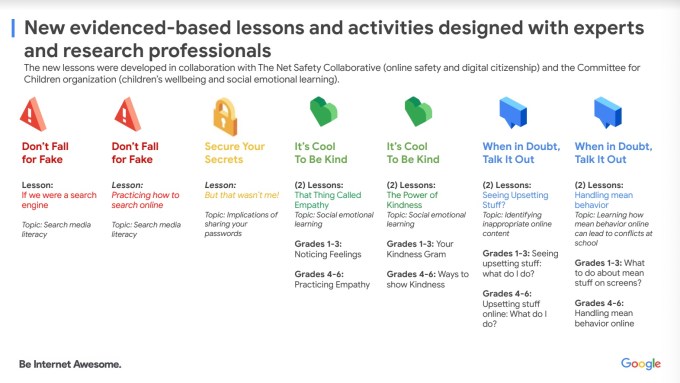
Google then partnered with online safety experts like Committee for Children and The Net Safety Collaborative to revise its teaching materials. As a result, it now has lessons tailored to specific age groups and grade levels, and has expanded its array of subjects and set of family resources.

The new lessons include guidance around online gaming, search engines and video consumption, as well as social-emotional learning lessons aimed at helping students address cyberbullying and online harassment.

For example, some of the new lessons discuss search media literacy — meaning, learning how to use search engines like Google’s and evaluating the links and results it returns, as a part of an update to the program’s existing media literacy materials.

Other lessons address issues like practicing empathy online, showing kindness, as well as what to do when you see something upsetting or inappropriate, including cyberbullying.

Concepts related to online gaming are weaved into the new lessons, too, as, today, kids have a lot of their social interactions in online games which often feature ways to interact with other players in real-time and chat.

Here, kids are presented with ideas related to being able to verify an online gamer’s identity — are they really another kid, for example?  The materials also explain what sort of private information should not be shared with people online.

Image Credits: Google

Among the new family resources, the updated curriculum now points parents to the recently launched online hub, families.google, which offers a number of tips and information about tools to help families manage their tech usage.

For example, Google updated its Family Link app that lets parents set controls around what apps can be used and when, and view activity reports on screen time usage. It also rolled out parental control features on YouTube earlier this year, aimed at families with tweens and teens who are too old for a YouTube Kids account, but still too young for an entirely unsupervised experience.

Google says the updated curriculum is available today to parents, families, teachers and educators, via the Be Internet Awesome website.