Year: 2021

14 Jun 2021

Stripe goes beyond payments with Stripe Identity to provide AI-based ID verification for transactions and much more

A number of startups (eg, here, here, here and here) have fashioned themselves as the “Stripe for identity verification”, providing an easy way for developers to integrate ID authentication into a platform. Today, Stripe is stepping in to fill that need itself: the company is launching a new product called Stripe Identity — a self-serve tool that companies can use to verify user identities, with Stripe managing the customer data in an encrypted format, using computer vision and machine learning to “read” and match up government IDs with live selfies.

Stripe says the service works in as little as 15 seconds.

The service is launching in beta starting today in 30 countries, the company said, but in the meantime, it’s already quietly been in use by select partners. They include Discord (as part of its ID verification feature); Peerspace (which runs ID verification when onboarding users and merchants); Shippo (when when it identifies high-risk users, asks them to verify themselves); and other unnamed customers who are using it to prevent account takeovers.

Developers can go here to request access, and it sounds like Stripe will be talking more about the service in general during Stripe Sessions, its developer conference, later this week.

“Businesses have been asking us for an easy and fast way to verify identities online. Stripe Identity offers them just that,” said Rob Daly, Head of Engineering for Stripe Identity. “Now, any internet business—from a five-person startup to a multinational enterprise—can begin securely verifying the identities of their users in a matter of minutes, not weeks or months.”

If you look at the list of early users, something significant stands out: Identity is another example of how Stripe is extending its reach as a powerhouse provider of services to businesses that extend well beyond payments.

Of course, payments remains at the heart of Stripe, and identity verification definitely has a connection to that — it can help with preventing e-commerce fraud, for starters — but as you can see, ID authentication also covers a number of other use cases, such as in helping prevent account takeovers, or to verify someone’s age, or to comply with other “know your customer” regulations, or to stamp out bots and trolls: no payments necessary. For this reason, Stripe’s confirmed that you don’t have to be an existing Stripe customer in order to use Stripe Identity.

Identity verification has become an important and widely-used component of the process of enabling online interactions, whether monetary or otherwise. And it has something in common with payments that makes it a ripe candidate for building as an API-enabled service: both are complex to build, requiring the integration of a number of disparate technologies and third-party data providers. Since building something like that is not likely the core competency of the companies that require ID verification, that leaves the door open for third-party companies to build that tech and provide it as a service.

Stripe is far from being the only one working in this field: others include Jumio (which raised a big round earlier this year); Onfido (reportedly planning an IPO); Veriff; Berbix; Passbase and more.

In the case of Stripe, the company is offering customers two ways to use Stripe Identity. Like Stripe’s payments product, it can be integrated into a checkout or other workflow by way of some lines of code. But it can also be offered as a service outside of that, by way of a verification link issued just around suspicious transactions or other users that are identified as high-risk.

While Stripe has made a number of acquisitions to expand its technology and services — last week’s launch of Stripe Tax, for example, complemented its acquisition of Tax Jar earlier this year — Stripe Identity was built in-house, the company says, and has been in use for the better part of 10 years by the company to verify merchants as part of its own onboarding and anti-fraud checks.

“We know from experience how much work it takes to build a rigorous and secure system for global identity verification,” said Delia Pawelke, Head of Global Risk Strategy and Onboarding Policy at Stripe, in a statement. “With Stripe Identity, we’re making our advanced compliance infrastructure available to all of our users. For an online business, verifying someone’s identity is now as easy as accepting a payment.” In turning its internal tool into an external product, Stripe tweaked the verification service somewhat, providing more guidance for photo-taking for example.

Stripe said that fees will be charged “per transaction,” but didn’t disclose to TechCrunch what those fees will be. We’ll update this post as we learn more.


14 Jun 2021

The Pill Club takes on primary care with $41.9M in fresh funding

In January, former Uber executive Liz Meyerdirk took over as chief executive of The Pill Club. The company, which offers an online birth control prescription and delivery service to hundreds of thousands of women, had hit record revenues, crossing $100 million in annual run rate for the first time in its 4-year history.

She found the bridge between ride-sharing to healthcare to be smoother than some might expect, saying that she focused on how to apply technology “to logistics for an everyday use case, [to know] how that simplifies your everyday life.”

Now, six months into her new job, Meyerdirk announced that her company has raised more capital to capitalize off of the momentum in women’s health right now. The Pill Club announced today that it has raised a $41.9 million Series B extension round led by Base 10. Existing investors including ACME, Base10, GV, Shasta Ventures and VMG participated in the round, as well as new investors including Uber’s Dara Khosrowshahi and Honey’s George Ruan and iGlobe.

The extension round comes over 2 years after the company announced its initial Series B investment, a $51 million financing led by VMG Partners. After reportedly being valued at $250 million, the company declined to provide its latest valuation, other than saying that the extension was an up-round.

When a customer joins The Pill Club, they are given a medical questionnaire and a digital form to input personal information. The company gives them a sense of how much the service will cost, and if the price works, it connects them to a nurse either live or via text.

“In a happy case, you can see a nurse immediately, “ she said. “Obviously if it’s midnight, we haven’t figured that out yet.” The nurse walks though different options, since, Meyerdirk added, “contraception is not one size fits all.”

Once a customer makes a decision, The Pill Club can then prescribe birth control for pick-up at a nearby pharmacy, available within two or three days.

The Pill Club launched in 2016 with an at-home delivery service of birth control. Between 2016 and January 2021, it launched in 43 states plus the District of Columbia. It has added 5 new states in the past six months, and plans to get to 50 states by the end of 2021.

The company makes money from a nurse visit fee, insurance reimbursement for prescription drugs, and cash patients who aren’t covered by insurance.

The chief executive views a big part of its value proposition as embedding with existing insurance plans of its customers, including Medi-CAL and Family PACT. In the last three months, 16% of The Pill Clubs’ new patients were on Medicaid.

“You’ve got companies like Oscar [Health] that are reimagining health insurance, and you’ve got Ro, Hims and Hers, who are [taking] cash as a primary…way to serve..patients,” she said. “That’s fantastic for those who can afford it, but for us, because so much of our value system is around access to equity, we believe everyone should have the right to get access to birth control.”

The company believes that it has to work within the system of insurance to have true innovation.

“Telemedicine that ignores the reality of insurance is always going to have a limited piece of the pie,” a spokesperson from the company said said. “Cash-only systems simply aren’t a product built for a scale. A truly innovative healthcare platform exists within the realities of the system.”

By women, for women

Long-term, the Pill Club wants to replace the old model of going to a primary care provider for annual visits with ongoing care for women.

“I’m generally healthy [but] I actually do have questions on mammograms…colonoscopies, or anything,” Meyerdirk said. “And being able to have a person other than my mom” to talk to that doesn’t require a trip to the doctor or urgent care, is the gap that The Pill Club wants to fill.

“We think it’s too good to be true, when we actually get what we deserve,” Meyerdirk said when describing women’s health. Part of her goal going forward is to think bigger, beyond contraception, and figure out how The Pill Club could bring a digital refresh to other areas of women’s health.

In March, the company launched a dermatology pilot, and also expanded its 2020 period care pilot. A portion of the new capital is earmarked toward launching new services for its members.

The Pill Club also shared the diversity metrics of its 350-person staff as part of its announcement.

The Pill Club has 72% of employees identifying as women, and 28% of employees identifying as male. The executive leadership similarly sees predominantly women, with the ratio being 62.5% women and 37.5% male. As for racial diversity, the overall company identifies as 33% white, 19% Asian, 16% Hispanic or Latino and 14% Black or African American, with 13% of employees declined to identify.

“We’re by women for women,” Meyerdirk said. “It’s very, very different when you’re by men, for women.” Her appointment came as The Pill Club’s founder and former chief executive officer Nick Chang, stepped down from day to day operations. He didn’t take a board seat, but does still have shares in the company.

Liz Meyerdirk, chief executive of The Pill Club.

The wave of prescription, for-delivery medication is only getting bigger, with The Pill Club joined by startups such as Nurx and Simply Health, and bigger corporations such as Walmart and Amazon.

“The idea of creating more choice and flexibility across healthcare is long overdue,” she said. “Everyone deserves to have great options when they consider who can best address their daily needs.”

14 Jun 2021

Enterprise AI platform Dataiku launches managed service for smaller companies

Dataiku is going downstream with a new product today called Dataiku Online. As the name suggests, Dataiku Online is a fully managed version of Dataiku. It lets you take advantage of the data science platform without going through a complicated setup process that involves a system administrator and your own infrastructure.

If you’re not familiar with Dataiku, the platform lets you turn raw data into advanced analytics, run some data visualization tasks, create data-backed dashboards and train machine learning models. In particular, Dataiku can be used by data scientists, but also business analysts and less technical people.

The company has been mostly focused on big enterprise clients. Right now, Dataiku has more than 400 customers, such as Unilever, Schlumberger, GE, BNP Paribas, Cisco, Merck and NXP Semiconductors.

There are two ways to use Dataiku. You can install the software solution on your own, own-premise servers. You can also run it on a cloud instance. With Dataiku Online, the startup offers a third option and takes care of setup and infrastructure for you.

“Customers using Dataiku Online get all the same features that our on-premises and cloud instances provide, so everything from data preparation and visualization to advanced data analytics and machine learning capabilities,” co-founder and CEO Florian Douetteau said. “We’re really focused on getting startups and SMBs on the platform — there’s a perception that small or early-stage companies don’t have the resources or technical expertise to get value from AI projects, but that’s simply not true. Even small teams that lack data scientists or specialty ML engineers can use our platform to do a lot of the technical heavy lifting, so they can focus on actually operationalizing AI in their business.”

Customers using Dataiku Online can take advantage of Dataiku’s pre-built connectors. For instance, you can connect your Dataiku instance with a cloud data warehouse, such as Snowflake Data Cloud, Amazon Redshift and Google BigQuery. You can also connect to a SQL database (MySQL, PostgreSQL…), or you can just run it on CSV files stored on Amazon S3.

And if you’re just getting started and you have to work on data ingestion, Dataiku works well with popular data ingestion services. “A typical stack for our Dataiku Online Customers involves leveraging data ingestion tools like FiveTran, Stitch or Alooma, that sync to a cloud data warehouse like Google BigQuery, Amazon Redshift or Snowflake. Dataiku fits nicely within their modern data stacks,” Douetteau said.

Dataiku Online is a nice offering to get started with Dataiku. High-growth startups might start with Dataiku Online as they tend to be short on staff and want to be up and running as quickly as possible. But as you become bigger, you could imagine switching to a cloud or on-premise installation of Dataiku. Employees can keep using the same platform as the company scales.

14 Jun 2021

Anrok raises $4.3M to solve sales tax for SaaS companies

It’s easier than ever to build a product and sell it around the United States, or the world. But if you want to do so without incurring the wrath of any particular state, or nation-state, you’d best have your tax matters in order. This is why Stripe’s news last week that it has built tax-focused tooling to help its customers manage their state bills mattered.

But for SaaS companies, things can be more complicated from a tax perspective. That’s what Anrok, a startup working to build sales tax software for SaaS firms, told TechCrunch.

The company’s CEO, Michelle Valentine, said that modern software companies need specialized help. And her startup is announcing a $4.3 million fundraise today to back its efforts. The capital event was led by Seqouia and Index, the latter firm a place where Valentine used to work.

Anrok delivers its service via an API, and charges based on the total dollar value of sales that it helps a customer manage. Its percentage-fee falls with volume, and you can’t pay more than 0.19% of managed revenue, so it’s pretty cheap regardless, given how strong software gross margins tend to be.

The Anrok founding team: Michelle Valentine, and Kannan Goundan. Via the company.

Valentine said that there are three things that make SaaS tax issues more complex than other products. The first deals with addresses. Software companies have to pay sales tax where customers are located, and often only have partial information. Anrok will help with that problem. The CEO also said that variable SaaS billing makes charging the right amount of tax an interesting issue, and that states have tax laws specifically aimed at the software market that must be navigated.

So, a more mass-market solution might not be the best fit for SaaS companies looking to avoid both trouble with states and the work of handling tax matters themselves.

It’s not hard to see why Anrok was able to raise capital. The company is early-stage with its first customers onboarded, so it’s not posting the sort of revenue growth that investors covet at the later stages. What then were its more fetching attributes? From our perspective, on-demand pricing and a simply gigantic market.

Sure, Anrok is serving SaaS businesses, but it’s doing so using what could be described as a post-SaaS business model; on-demand, or usage-based pricing is an increasingly popular way to charge for software products today, putting Anrok closer to the cutting edge in business-model terms. And the company’s market is essentially every software business out there. That’s a lot of TAM to carve into, something that investors love to see.

14 Jun 2021

Could Claap, an asynchronous video meetings platform, end the tyranny of Zoom calls?

Because of the pandemic, we’re all a lot more familiar with remote working than we used to be, whether we like it or not. But the remote tools of the pre-pandemic era – Slack, Trello, Zoom, Asana, etc, etc, etc – are, if we admit it to ourselves, barely scratching the surface of what we really need to be productive. Luckily a new era of remote-working tools is fast emerging. As I recently tweeted, we need to think far more in asynchronous terms if remote working is to be productive (and healthy!), long term.

Older tools can offer asynchronous collaboration, but a new wave of tools is coming. Loom, for instance, is one-way video for ’show and tell’. It’s raised $203.6M – however, it has a drawback: it doesn’t have many collaboration features.

Now a new European startup hopes to address this.

Claap, an asynchronous meeting platform with video and collaboration, thinks it might have part of the solution and a private beta launch is planned for this month.

It’s now raised $3 million in pre-seed funding from LocalGlobe, Headline, E.Ventures, Kima Ventures and angels including Front co-founder Mathilde Collin, Oyster co-founder Tony Jamous, Nest and GoCardless founder Matt Robinson and Automattic’s head of product Aadil Mamujee. It also includes a group of 30 angels such as Ian Hogarth (Songkick), Olivier Godement (Stripe), Roxanne Varza (Station F), Chris Herd (FirstBase), and Xavier Niel (Kima), Shane Mac (investor in Remote).

We all now know that what were previously small catch-ups are now 30-minute Zoom calls, which are pointless. ‘Asynchronous meetings’ could be the way forward.

Claap says its product allows employees to record a short video update on a topic, allow others to comment on the relevant part, and set a due date for team members to respond. Colleagues then view the video and respond in their own time. Claap bulls itself as the remote working equivalent of the ‘quick hallway catch-up’. It integrates with other workplace tools such as Trello or Jira so that when a decision is made on a project, it’s recorded for everyone on the team to see and refer back to. A subscription model is planned which will have a sliding scale depending on team size.

Because it doesn’t require real-time interaction, you don’t need t find a time that suits everyone for a meeting, so in fact the ‘meeting’ sort of disappears. . Instead, the platform creates a space for feedback and iterations.

Founders Robin Bonduelle and Pierre Touzeau looked at solutions already adopted by companies such as Automattic, and GitLab. Touzeau was previously at 360Learning which employed a strict limiting policy for meetings. Bonduelle has 10 years of product management experience, working at various startups and scaleups including Ogury where he was VP of Product, and Rocket Internet. He developed asynchronous communication habits while managing 50 people across 4 different countries and time zones. Touzeau has worked for businesses including L’Oreal and 360Learning, where he was most recently VP of Marketing.

However, asynchronous communication is not always perfect. As we know, Emails and Slack messages can go unread. Video MIGHT be the solution.

Robin Bonduelle, co-founder and CEO at Claap, said: “After a year of working remotely, people are realizing the benefits of not working in an office but at the same time grappling with one of its worst consequences: back-to-back video meetings. A query that in the office would take five minutes to solve now takes at least 30, leaving everyone more exhausted in the process. Claap is designed to solve this issue, allowing colleagues the tools to keep them engaged and connected but without taking up all their time. It’s a new meeting format that allows people to make quick decisions.”

Touzeau said: “Meetings are a necessary part of working, but it doesn’t need to be your entire day. Asynchronous meetings are the key to freeing up our calendars but making sure work still gets done and deadlines are met. We’re excited by the potential Claap has to empower people to work from anywhere.”

George Henry, General Partner at LocalGlobe, said: “We were impressed with Robin and Pierre’s vision and the potential for Claap to allow employees to connect on a project when they need to and facilitate the ability to work from anywhere.”

Jonathan Userovici, Partner at Headline, said: “Zoom may have been the go-to enterprise app over the past 12 months but for the thousands of businesses that are now going to be remote-first, video conferencing alone won’t be enough to keep teams connected and get work done. Claap is the challenger tool to end video-calling fatigue.”

14 Jun 2021

Europe needs to back browser-level controls to fix cookie consent nightmares, says privacy group

European privacy group noyb, which recently kicked off a major campaign targeting rampant abuse of the region’s cookie consent rules, has followed up by publishing a technical proposal for an automated browser-level signal it believes could go even further to tackle the friction generated by endless ‘your data choices’ pop-ups.

Its proposal is for an automated signal layer that would enable users to configure advanced consent choices — such as only being asked to allow cookies if they frequently visit a website; or being able to whitelist lists of sites for consent (if, for example, they want to support quality journalism by allowing their data to be used for ads in those specific cases).

The approach would offer a route to circumvent the user experience nightmare flowing from all the dark pattern design that’s made cookie consent collection so cynical, confusing and tedious — by simply automating the yeses and noes, thereby keeping interruptions to a user-defined minimum.

In the European Union cookie consent banners mushroomed in the wake of a 2018 update to the bloc’s privacy rules (GDPR) — especially on websites that rely on targeted advertising to generate revenue. And in recent years it has not been unusual to find cookie pop-ups that contain a labyrinthine hell of opacity — culminating (if you don’t just click ‘agree’) — to vast menus of ‘trusted partners’ all after your data. Some of which are pre-set to share information and require the user to individually toggle each and every one off.

Such stuff is a mockery of compliance, rather than the truly simple choice envisage by the law. So noyb’s earlier campaign is focused on filing scores of complaints against sites it believes aren’t complying with requirements to provide users with a clear and free choice to say no to their data being used for ads (and it’s applying a little automation tech there too to help scale up the number of complaint it can file).

Its follow-up here — showing how an advanced control layer that signals user choices in the background could work — shares the same basic approach as the ‘Do Not Track’ proposals originally proposed for baking into web browsers all the way back in 2009 but which failed to get industry buy-in. There has also been a more recent US-based push to revive the idea of browser-level privacy control — buoyed by California’s California Consumer Privacy Act (CCPA), which took effect at the start of last year, and includes a requirement that businesses respect user opt-out preferences via a signal from their browser.

However noyb’s version of browser-level privacy control seeks to go further by enabling more granular controls — which it says it necessary to better mesh with the EU’s nuanced legal framework around data protection.

It points out that Article 21(5) of the GDPR already allows for automatic signals from the browser to inform websites in the background whether a user is consenting to data processing or not.

The ePrivacy Regulation proposal, a much delayed reform of the bloc’s rules around electronic privacy has also included such a provision.

However noyb says development to establish such a signal hasn’t happened yet — suggesting that cynically manipulative consent management platforms may well have been hampering privacy-focused innovation.

But it also sees a chance for the necessary momentum to build behind the idea.

For example, it points to how Apple has recently been dialling up the notification and control it offers users of its mobile platform, iOS, to allow people to both know which third party apps want to track them and allow or deny access to their data — including giving users a super simple ‘deny all third party tracking’ option backed into iOS’ settings.

So, well, why should Internet users who happen to be browsing on a desktop device not have a set of similarly advanced privacy controls too?

EU lawmakers are also still debating the ePrivacy Regulation reform — which deals centrally with cookies — so the campaign group wants to demonstrate how automated control tech could be a key piece of the answer to so-called ‘cookie consent fatigue’; by giving users a modern toolset to shrink consent friction without compromising their ability to control what happens with their data.

In order to work as intended automated signals would need to be legally binding (to prevent adtech companies just ignoring them) — and having a clear legal basis set out in the ePrivacy Regulation is one way that could happen within fairly short order.

The chance at least is there.

There have been concerns that the ePrivacy reform — which was stalled for years — could end up weakening the EU’s data protection framework in the face of massive adtech industry lobbying. And the negotiation process to reach a final text remains ongoing. So it’s still not clear where it’s going to end up.

But, earlier this year, the European Council agreed its negotiating mandate with the other EU institutions. And, on cookies, the Council said they want companies to find ways to reduce ‘cookie consent fatigue’ among users — such as by whitelisting types of cookies/providers in their browser settings. So there is at least a potential path to legislate for an effective browser-level control layer in Europe.

For now, noyb has published a prototype and a technology specification for what it’s calling the ADPC (aka Advanced Data Protection Control). The work on the framework has been carried out by noyb working with the Sustainable Computing Lab at the Vienna University of Economics and Business.

The proposal envisages web pages sending privacy requests in a machine-readable way and the ADPC allowing the response to be transmitted using header signals or via Java Script. noyb likens the intelligent management of queries and automatic responses such a system could support to an email spam filter.

Commenting in a statement, chairman Max Schrems said: “For Europe, we need more than just an ‘opt-out’ so that it fits into our legal framework. That’s why we call the prototype ‘Advanced’ Data Protection Control, because it’s much more flexible and specific than previous approaches.

“ADPC allows intelligent management of privacy requests. A user could say, for example, ‘please ask me only after I’ve been to the site several times’ or ‘ask me again after 3 months.’ It is also possible to answer similar requests centrally. ADPC thus allows the flood of data requests to be managed in a meaningful way.”

“With ADPC, we also want to show the European legislator that such a signal is feasible and brings advantages for all sides,” he added. “We hope that the negotiators of the member states and the European Parliament will ensure a solid legal basis here, which could be applicable law in a short time. What California has done already, the EU should be able to do as well.”

The Commission has been contacted for comment on noyb’s ADPC.

While there are wider industry shifts afoot to depreciate tracking cookies altogether — with Google proposing to replace current adtech infrastructure supported by Chrome with an alternative stack of (it claims) more privacy respecting alternatives (aka its Privacy Sandbox) — there’s still plenty of uncertainty over what will ultimately happen to third party cookies.

Google’s move to end support for tracking cookies is being closely scrutinized by regional antitrust regulators. And just last week the UK’s Competition and Markets Authority (CMA), which is investigating a number of complaints about the plan, said it’s minded to accept concessions from Google that would mean the regulator could order it not to switch off tracking cookies.

Moreover, even if tracking cookies do finally crumble there is still the question of what exactly they get replaced with — and how alternative adtech infrastructure could impact user privacy?

Google’s so-called ‘Privacy Sandbox’ proposal to target ads at cohorts of users (based on bucketed ‘interests’ its technology will assign them via on-device analysis of their browsing habits) has raised fresh concerns about the risks of exploitative and predatory advertising. So it may be no less important for users to have meaningful browser-level controls over their privacy choices in the future — even if the tracking cookie itself goes away.

A browser-level signal could offer a way for a web user to say ‘no’ to being stuck in an ‘interest bucket’ for ad targeting purposes, for example — signalling that they prefer to see only contextual ads instead, say.

tl;dr: The issue of consent does not only affect cookies — and it’s telling that Google has avoided running the first trials of its replacement tech for tracking cookies (FLoCs, or federated learning of cohorts) in Europe.


14 Jun 2021

Niantic is working with Hasbro on a Pokémon GO-style Transformers game

Niantic has encouraged the world to roam the streets as Pokémon trainers and wizards… next up? Time to transform and roll out.

80’s mega toy Transformers is the latest IP to partner with Niantic to build a map-heavy, geolocation-centric game.

Details are still a bit light, but here’s just about everything we know:

  • It’ll be called Transformers: Heavy Metal. They’ve put up a pre-registration page here.
  • It’s being built in collaboration with Hasbro, TOMY, and Seattle game team Very Very Spaceship.
  • Players will be a part of the “will join the Guardian Network, a group of humans who have banded together with the Autobots in a war against the Decepticons”
  • It’s built on Niantic’s Lightship platform, the same underlying engine that powers Pokémon GO, Harry Potter Wizards Unite, and the still in-development Catan: World Explorers.
  • When’s it arriving? Nothing too specific yet, but it’ll launch in “select markets” soon, and then globally “later this year”. This staged rollout tends to be Niantic’s approach; Pokémon GO landed first in Japan, while Catan was quietly rolled out in New Zealand last year.

They’ve only released a bit of concept art so far, and it suggests gameplay not unlike GO and Wizards Unite:

Image Credits: Niantic

Will this one take over the world the way Pokémon GO did in the summer of 2016? Maybe not — that one hit a lot of the right notes at the right time, the perfect blend of novelty and nostalgia. But Wizards Unite has found enough of an audience that it’s still in active development two years after launch, so it seems Niantic sees room for more map-centric games.

14 Jun 2021

Google opens Workspace to everyone

Google today announced that it is making Workspace, the service formerly known as G Suite (and with a number of new capabilities), available to everyone, including consumers on free Google accounts. The core philosophy behind Workspace is to enable deeper collaboration between users. You can think of it as the same Google productivity apps you’re already familiar with (Gmail, Calendar, Drive, Docs, Sheets, Slides, Meet, Chat, etc.), but with a new wrapper around it and deeper integrations between the different apps.

For individual users who want more from their Workspace, there will also be a new paid offering, though Google isn’t saying how much you’ll have to pay yet. With that, users will get access to “premium capabilities, including smart booking services, professional video meetings and personalized email marketing, with much more on the way.” We’ll likely hear more about this later this year. This new paid offering will be available “soon” in the U.S., Canada, Mexico, Australia, Brazil and Japan.

Consumers will have to switch from the classic Hangouts experience (RIP) to the new Google Chat to enable it — and with this update, all users will now have access to the new Google Chat, too. Until now, only paying G Suite/Workspace users had access to this new Workspace user experience.

“Collaboration doesn’t stop at the workplace — our products have been optimized for broad participation, sharing and helpfulness since the beginning,” said Javier Soltero, VP and GM, Google Workspace. “Our focus is on delivering consumers, workers, teachers and students alike an equitable approach to collaboration, while still providing flexibility that allows these different subsets of users to take their own approach to communication and collaboration.”

Image Credits: Google

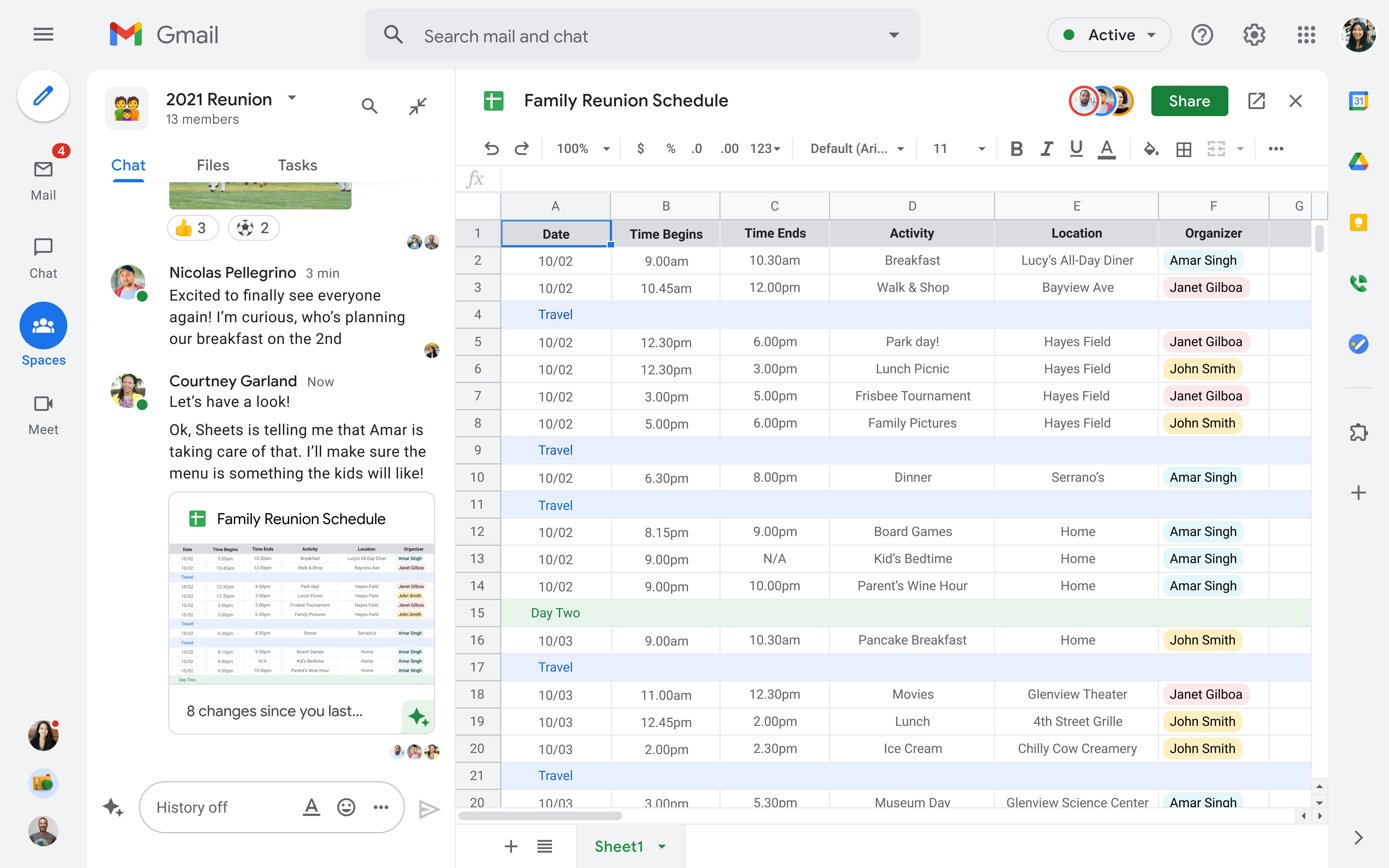
Once enabled, users will encounter quite a few user interface changes. The left rail, for example, will look a little bit like the bottom bar of Gmail on iOS and Android now, with the ability to switch between Mail, Chat, Meet and Spaces (which — yeah — I’m not sure anybody really understands this one, but more about this later). The right rail will continue to bring up various plugins and shortcuts to features like Google Calendar, Tasks and Keep.

A lot of people — especially those who simply want Gmail to be Gmail and don’t care about all of this collaboration stuff in their private lives — will hate this. But at least for the time being, you can still keep the old experience by not switching from Hangouts to the new Google Chat. But for Google, this clearly shows the path Workspace is on.

Image Credits: Google

“Back in October of last year, we announced some very significant updates to our communication and collaboration product line and our business, starting with the new brand and identity that we chose around Google Workspace that’s meant to represent what we believe is the future direction and real opportunity around our product — less around being a suite of individual products and more around being an integrated set of experiences that represent the future of work,” Soltero explained in a press briefing ahead of today’s announcement.

And then there is “Spaces.” Until now, Google Workspace features a tool called “Rooms.” Rooms are now Spaces. I’m not quite sure why, but Google says it is “evolving the Rooms experience in Google Chat into a dedicated place for organizing people, topics, and projects in Google Workspace.”

Best I can tell, these are Slack-like channels where teams can not just have conversations around a given topic but also organize relevant files and upcoming tasks, all with an integrated Google Meet experience and direct access to working on their files. That’s all good and well, but I’m not sure why Google felt the need to change the name. Maybe it just doesn’t want you to confuse Slack rooms with Google rooms. And it’s called Google Workspace, after all, not Workroom. 

New features for Rooms/Spaces include in-line topic threading, presence indicators, custom statuses, expressive reactions and a collapsible view, Google says.

Both free and paid users will get access to these new Spaces once they launch later this year.

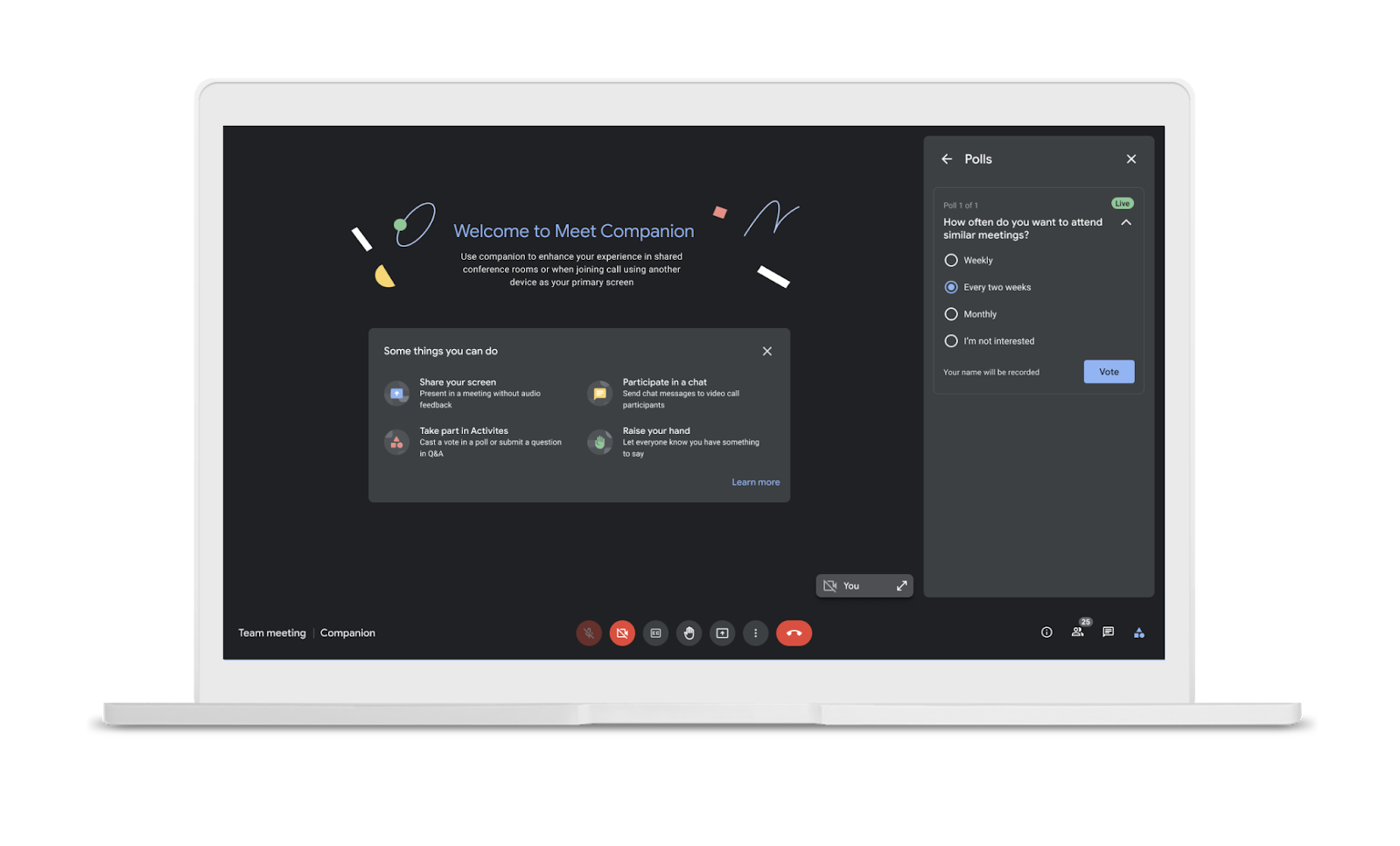
But wait, there’s more. A lot more. Google is also introducing a number of new Workspace features today. Google Meet, for example, is getting a companion mode that is meant to foster “collaboration equity in a hybrid world.” The idea here is to give meeting participants who are in a physical meeting room and are interacting with remote participants a companion experience to use features like screen sharing, polls, in-meeting chat, hand raise and Q&A live captions on their personal devices. Every participant using the companion mode will also get their own video tile. This feature will be available in September.

Image Credits: Google

Also new is an RSVP option that will allow you to select whether you will participate remotely, in a meeting room (or not at all), as well as new moderation controls to allow hosts to prevent the use of in-meeting chat and to mute and unmute individual participants.

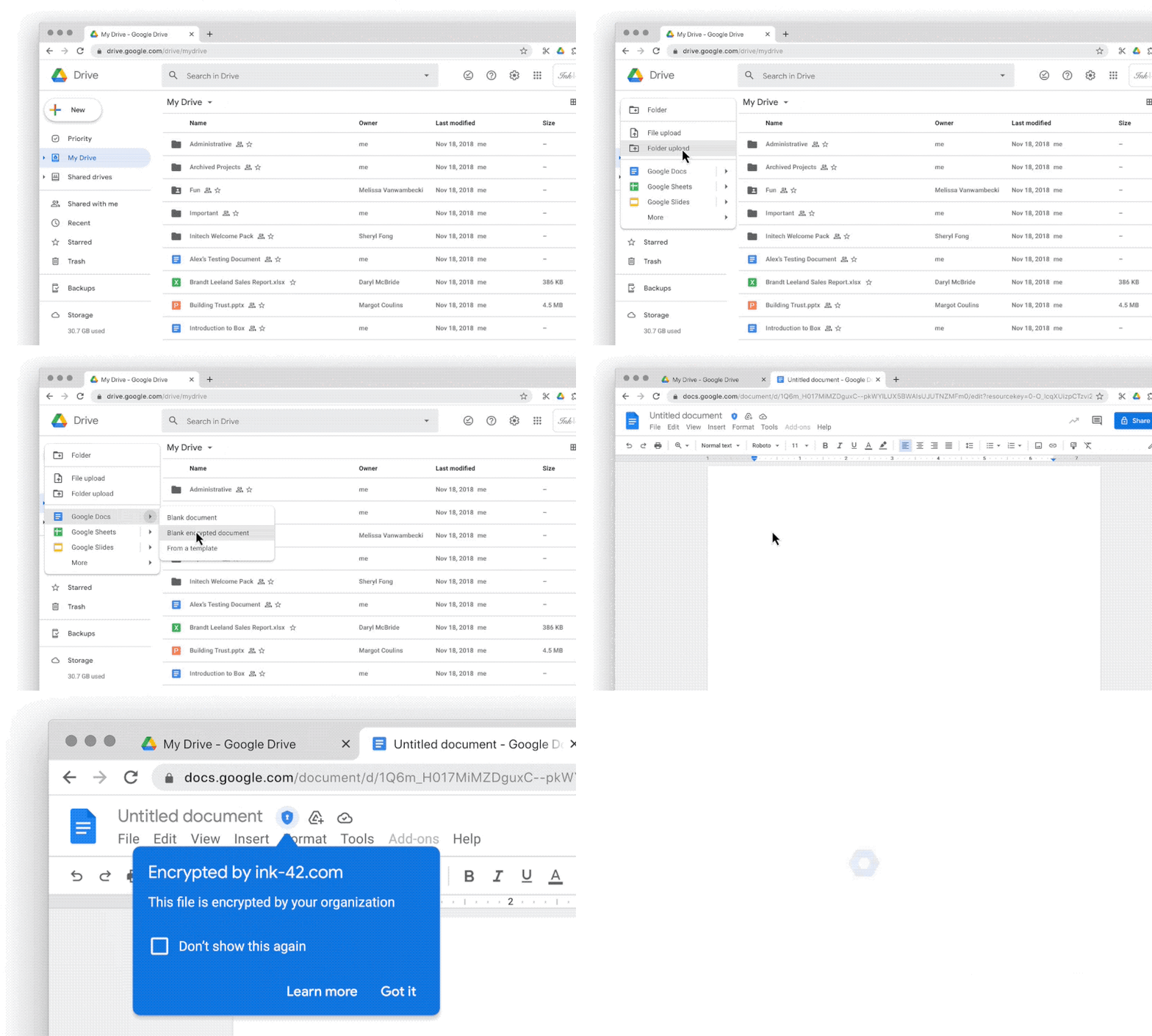
On the security side, Google today also announced that it will allow users to bring their own encryption keys. Currently, Google encrypts your data, but it does manage the key for you. To strengthen your security, you may want to bring your own keys to the service, so Google has now partnered with providers like Flowcrypt, Futurex, Thales and Virtru to enable this.

With Client-side encryption, customer data is indecipherable to Google, while users can continue to take advantage of Google’s native web-based collaboration, access content on mobile devices, and share encrypted files externally,” writes Google directors of product management Karthik Lakshminarayanan and Erika Trautman in today’s announcement.

Image Credits: Google

Google is also introducing trust rules for Drive to give admins control over how files can be shared within an organization and externally. And to protect from real phishing threats (not those fake ones your internal security organization sends out every few weeks or so), Google is also now allowing admins to enable the same phishing protections it already offers today to content within an organization to help guard your data against insider threats.

14 Jun 2021

Google will let enterprises store their Google Workspace encryption keys

As ubiquitous as Google Docs has become in the last year alone, a major criticism often overlooked by the countless workplaces who use it is that it isn’t end-to-end encrypted, allowing Google — or any requesting government agency — access to a company’s files. But Google is finally addressing that key complaint with a round of updates that will let customers shield their data by storing their own encryption keys.

Google Workspace, the company’s enterprise offering that includes Google Docs, Slides and Sheets, is adding client-side encryption so that a company’s data will be indecipherable to Google.

Companies using Google Workspace can store their encryption keys with one of four partners for now: Flowcrypt, Futurex, Thales, or Virtru, which are compatible with Google’s specifications. The move is largely aimed at regulated industries — like finance, healthcare, and defense — where intellectual property and sensitive data are subject to intense privacy and compliance rules.

(Image: Google / supplied)

The real magic lands later in the year when Google will publish details of an API that will let enterprise customers build their own in-house key service, allowing workplaces to retain direct control of their encryption keys. That means if the government wants that company’s data, they have to knock on their front door — and not sneak around the back by serving the key holder with a legal demand.

Google published technical details of how the client-side encryption feature works, and will roll out as a beta in the coming weeks.

Tech companies giving their corporate customers control of their own encryption keys has been a growing trend in recent years. Slack and cloud vendor Egnyte bucked the trend by allowing their enterprise users to store their own encryption keys, effectively cutting themselves out of the surveillance loop. But Google has dragged its feet on encryption for so long that startups are working to build alternatives that bake in encryption from the ground up.

Google said it’s also pushing out new trust rules for how files are shared in Google Drive to give administrators more granularity on how different levels of sensitive files can be shared, and new data classification labels to mark documents with a level of sensitivity such as “secret” or “internal”.

The company said it’s improving its malware protection efforts by now blocking phishing and malware shared from within organizations. The aim is to help cut down on employees mistakenly sharing malicious documents.

14 Jun 2021

Motorway’s auction platform for second-hand cars raises $67.7M Series B led by Index Ventures

Motorway, is a UK startup that allows professional car dealers to bid in an auction for privately-owned cars for sale. The startup has had rapid success by removing a lot of friction in the process. It’s now raised £48m / $67.7m in a Series B round led by Index Ventures, along with new investors BMW i Ventures and Unbound. Existing investors Latitude and Marchmont Ventures also participated. The funding will be used to extend its platform and grow the current 160-strong team.

The startup allows consumers to sell their car for up to £1,000, by uploading its details via a smartphone. Over 3,000 professional car dealers then bid for the vehicle in a daily online auction. The highest offer wins the car, which is then collected for free by the winning dealer inside 24 hours. 

Motorway says it has sold 65,000 cars since its launch in 2017 and seen sales hit £50m in May 2021 alone, £2.5m of transactions a day, and more than 4,000 completed car sales a month. With only 5% of all vehicles in the UK sold online right now, there is plenty of headroom for this market to grow.
 
Tom Leathes, CEO of Motorway, said: “For half a century, inefficient offline processes have led to bad deals and a bad experience for both car sellers and car dealers. Motorway has fundamentally changed a broken experience where everyone ends up dissatisfied – and we’ve transformed it with a superior online experience where everybody wins. Cutting out the middlemen leaves both the consumer and car dealer with a better deal, all from home and without the stress. Our incredible growth so far is testament to our focus on delivering more value through technology – and this investment will provide us with the fuel to take Motorway to the next level.”
 
Danny Rimer, Partner at Index Ventures, said: “We’re always looking to invest in companies that are truly disrupting an industry and meeting a real customer need. We have found that in Motorway. The team has built an incredibly powerful platform, underpinned by great technology and a deep understanding of the challenges both consumers and car dealers face. Motorway has quickly become the first port of call for tens of thousands of people selling their car.” 
 
Motorway previously raised £14m in venture funding since it was founded by Tom Leathes, Harry Jones and Alex Buttle in 2017.

Speaking to me over interview Leathes added: “COVID has been a real accelerator of something that was already happening. The car industry is moving online and that’s partly about people buying their next car online, but it’s also about dealers changing their behavior, how they do business, where they buy their cars. It forced that change which they resisted for a long time, and now they’re embracing it, so it’s a fundamental shift in the industry. And this is why we see such a massive opportunity to provide the rails to help both sides of the marketplace to move online.”

Rimer added: “It’s rare that you have founders who have worked together across multiple successful and less successful startups who have that scar tissue and success, and are now going for a much bigger opportunity. The business model is really an important one for us because instead of owning inventory and then having to get rid of your inventory, sort of like the difference between Nat-a-Porter and Farfetch. Motorway’s marketplace is just like Farfetch – they don’t have any inventory, which means that just by merely making that platform happen for buyers and sellers, they win. So there’s a lot less risk associated with what the money is going to be used for when building the business.”