Year: 2021

11 Jun 2021

Freelancer marketplace Toptal sues Andela and ex-employees, alleging theft of trade secrets

The war for talent in the tech world can be brutal — and so, it turns out, can the war between platforms that help companies source it. In the latest developement, Toptal — a marketplace for filling engineering and other tech roles with freelance, remote workers — has filed a lawsuit against direct competitor Andela and several of its employees, alleging the theft of trade secrets in pursuit of “a perfect clone of its business”, according to the complaint. All of the Andela employees previously worked at Toptal.

Toptal’s lawsuit, filed in the Supreme Court of the State of New York and embedded below, alleges that the employees reneged on confidentiality, non-solicitation and non-compete agreements with Toptal. Toptal also alleges interference with contract, unfair competition and misappropriation of trade secrets.

While both Toptal and Andela have built businesses around the idea of remote freelancers filling tech jobs — a concept that has increased in profile and acceptance as people shifted to remote work during the pandemic — the pair only emerged as very direct competitors in the last year or so.

Toptal was co-founded by CEO Taso Du Val in 2010, and since then it has grown to become one of the world’s most popular on-demand talent networks. The company matches skilled tech personnel like engineers, software developers, designers, finance experts and product managers to clients across the globe. According to company data, it currently serves over 1,000 clients in more than 10 countries.

Andela, on the other hand, only recently turned to using a similar approach. Founded in 2014 in Lagos, Andela’s original business model was based on building physical hubs to source, vet, train and house talent across the continent. It did this in Kenya, Nigeria, Rwanda and Uganda.

However, Andela struggled with scaling and operating that business model, and in 2019 it laid off 400 developers. Early last year as the pandemic took hold, it laid off a further 135 employees. However this time around it did so with a strategy pivot in mind: after testing satellite models in Egypt and Ghana, the talent company decided to go forego physical hubs completely and go remote, first across Africa in 2020 and globally this year.

“We thought, ‘What if we accelerated [the African remote network] and just enabled applicants from anywhere?’ Because it was always the plan to become a global company. That was clear, but the timing was the question,” Andela CEO Jeremy Johnson told TechCrunch in April.

Yet Toptal believes Andela’s choice to scrap its hubs and source remote talent from everywhere was specifically to replicate Toptal’s business model — and success.

“Until recently, Andela operated an outsourcing operation focused on in-person, on-site hubs in Africa,” Toptal notes in the complaint.Over the course of the past year, Andela has moved away from its prior focus on in-person hubs situated in Africa and is engaging in a barely disguised attempt to become a clone of Toptal.”

Toptal claims that for Andela to pull off a “perfect clone of its business,” it poached key Toptal employees to exploit their knowledge, and that the ex-employees knowingly breached their confidentiality and non-solicitation obligations to Toptal.

Companies often try to uncover each other’s trade secrets by poaching, and many blatantly copy a competitor and do so without repercussions. On top of this, these two are hardly the only two places to for tech talent to connect with remote freelance job opportunities. Others include Fiverr, Malt, Freelancer.com, LinkedIn, Turing, Upwork and many more.

In a global economy with an estimated 1 billion so-called knowledge workers, and with freelancers accounting for some 35% of the world’s workforce, it’s a pretty gigantic market, which you could alternately look at as a major opportunity, but also a ripe field for many players with multiple permutations of the marketplace concept.

So why is Toptal crying foul play? The company says its ex-employees have not only revealed Toptal’s trade secrets and confidential information to compete unfairly but are also poaching additional Toptal personnel, clients and the talent that Toptal matches and sources to clients.

The ex-employees cited by Toptal include Sachin Bhagwata, vice president of enterprise; Martin Chikilian, head of talent operations; Courtney Machi, vice president of product; and Alvaro Oliveira, executive vice president of talent operations. Toptal says three additional former employees in non-executive roles breached express covenants not to compete in their agreements with Toptal.

While some of the allegations focus on the expertise of the employees, one of the trade secret allegations more directly references Toptal’s technology.

Toptal claims Machi tapped into her extensive knowledge of Toptal’s “proprietary software platform” and used that to help transform Andela “from a group of outsourcing hubs situated in various African locations into a fully remote, global company like Toptal.”

Asked to comment on the suit, Johnson at Andela said he believes Toptal is suing Andela for being competitive.

“With regards to the situation overall, I can say that frivolous lawsuits are the price of doing anything that matters,” he told TechCrunch in an email. “And this is the kind of baseless bullying and fear tactics that make employees want to leave in the first place. We will defend ourselves and our colleagues vigorously.”

Toptal has an unconventional story for a company that started only a decade ago. It is one of the few companies in the Valley that doesn’t issue stock options to its investors or employees. Even Du Val’s co-founder, Breanden Beneschott, was ousted from the company without any shares, according to an article from The Information.

How did it pull this off? In 2012, Toptal raised a $1.4 million seed via convertible notes and investors were entitled to 15% of the company, according to The Information article.

But there was one condition: Toptal had to raise more money.

However, the company hasn’t needed to secure additional capital because of its profitability and growing revenue ($200 million annually as of 2018, per The Information). So investors are stuck in limbo — as are employees who joined hoping that the company would raise money down the line so their stock options would convert.

The Information story strikes a distinct note of resentment, noting that some employees felt “tricked out of stock in a company that Du Val has said publicly is worth more than $1 billion.”

Given that situation, TechCrunch asked Du Val if he thought it played any role in employee departures, and ex-employee relations.

“The issuance of stock options does not excuse theft of trade secrets,” he replied. “Also, there are more than 800 full-time people at Toptal [but] the complaint names seven individual defendants.”

The full complaint is embedded below.

11 Jun 2021

The huge TAM of fake breaded chicken bits

Hello and welcome back to Equity, TechCrunch’s venture capital-focused podcast, where we unpack the numbers behind the headlines.

We’re closing our survey soon, so this is your last chance (probably) to get your voice heard!

Despite it being a short week, as always, it was a busy, busy time. We had Grace on the dials today, and Danny, Natasha, and Alex making chit-chat about the tech world. As with every week this year, we had to cut and cut and cut to get the show down to size. Here’s what made it in in the end:

Thanks for hopping along with us this week and every week. Quick programming note: Natasha will take Alex’s spot on the Monday show for next week since he’s out, so be nice, and send her stuff to mention.

Equity drops every Monday at 7:00 a.m. PST, Wednesday, and Friday morning at 7:00 a.m. PST, so subscribe to us on Apple PodcastsOvercastSpotify and all the casts.

11 Jun 2021

Volkswagen says a vendor’s security lapse exposed 3.3 million drivers’ details

Volkswagen says more than 3.3 million customers had their information exposed after one of its vendors left a cache of customer data unsecured on the internet.

The car maker said in a letter that the vendor, used by Volkswagen, its subsidiary Audi, and authorized dealers in the U.S. and Canada, left the customer data spanning 2014 to 2019 unprotected over a two-year window between August 2019 and May 2021.

The data, which Volkswagen said was gathered for sales and marketing, contained personal information about customers and prospective buyers, including their name, postal and email addresses, and phone number.

But more than 90,000 customers across the U.S. and Canada also had more sensitive data exposed, including information relating to loan eligibility. The letter said most of the sensitive data was driver’s license numbers, but that a “small” number of records also included a customer’s date of birth and Social Security numbers.

Volkswagen did not name the vendor, and a company spokesperson did not immediately comment.

It’s the latest security incident involving driver’s license numbers in recent months. Insurance giants Metromile and Geico admitted earlier this year that their quote forms had been abused by scammers trying to obtain driver’s license numbers. Several other car insurance companies have also reported similar incidents involving the theft of driver’s license numbers. Geico said it was likely an effort by scammers to file and cash fraudulent unemployment benefits in another person’s name.

Volkswagen’s letter, however, did not say if the company had evidence that the data exposed by the vendor was misused.


11 Jun 2021

Google won’t end support for tracking cookies unless UK’s competition watchdog agrees

Well this is big. The UK’s competition regulator looks set to get an emergency brake that will allow it to stop Google ending support for third party cookies, a technology that’s currently used for targeting online ads, if it believes competition would be harmed by the depreciation going ahead.

The development follows an investigation opened by the Competition and Markets Authority (CMA) into Google’s self-styled ‘Privacy Sandbox’ earlier this year.

The regulator will have the power to order a standstill of at least 60 days on any move by Google to remove support for cookies from Chrome if it accepts a set of legally binding commitments the latter has offered — and which the regulator has today issued a notification of intention to accept.

The CMA could also reopen a fuller investigation if it’s not happy with how things are looking at the point it orders any standstill to stop Google crushing tracking cookies.

It follows that the watchdog could also block Google’s wider ‘Privacy Sandbox’ technology transition entirely — if it decides the shift cannot be done in a way that doesn’t harm competition. However the CMA said today it takes the “provisional” view that the set of commitments Google has offered will address competition concerns related to its proposals.

It’s now opened a consultation to see if the industry agrees — with the feedback line open until July 8.

Commenting in a statement, Andrea Coscelli, the CMA’s chief executive, said:

“The emergence of tech giants such as Google has presented competition authorities around the world with new challenges that require a new approach.

“That’s why the CMA is taking a leading role in setting out how we can work with the most powerful tech firms to shape their behaviour and protect competition to the benefit of consumers.

“If accepted, the commitments we have obtained from Google become legally binding, promoting competition in digital markets, helping to protect the ability of online publishers to raise money through advertising and safeguarding users’ privacy.”

In a blog post sketching what it’s pledged — under three broad headlines of ‘Consultation and collaboration’; ‘No data advertising advantage for Google products’; and ‘No self-preferencing’ — Google writes that if the CMA accepts its commitments it will “apply them globally”, making the UK’s intervention potentially hugely significant.

It’s perhaps one slightly unexpected twist of Brexit that it’s put the UK in a position to be taking key decisions about the rules for global digital advertising. (The European Union is also working on new rules for how platform giants can operate but the CMA’s intervention on Privacy Sandbox does not yet have a direct equivalent in Brussels.)

That Google is choosing to offer to turn a UK competition intervention into a global commitment is itself very interesting. It may be there in part as an added sweetener — nudging the CMA to accept the offer so it can feel like a global standard setter.

At the same time, businesses do love operational certainty. So if Google can hash out a set of rules that are accepted by one (fairly) major market, because they’ve been co-designed with national oversight bodies, and then scale those rules everywhere it may create a shortcut path to avoiding any more regulator-enforced bumps in the future.

So Google may see this as a smoother path toward the sought for transition for its adtech business to a post-cookie future. Of course it also wants to avoid being ordered to stop entirely.

More broadly, engaging with the fast-paced UK regulator could be a strategy for Google to try to surf over the political deadlocks and risks which can characterize discussions on digital regulation in other markets (especially its home turf of the U.S. — where there has been a growing drumbeat of calls to break up tech giants; and where Google specifically now faces a number of antitrust investigations).

The outcome it may be hoping for is being able to point to regulator-stamped ‘compliance’ — in order that it can claim it as evidence there’s no need for its ad empire to be broken up.

Google’s offering of commitments also signifies that regulators who move fastest to tackle the power of tech giants will be the ones helping to define and set the standards and conditions that apply for web users everywhere. At least unless or until any more radical interventions rain down on big tech.

What is Privacy Sandbox?

Privacy Sandbox is a complex stack of interlocking technology proposals for replacing current ad tracking methods (which are widely seen as horrible for user privacy) with alternative infrastructure that Google claims will be better for individual privacy and also still allow the adtech and publishing industries to generate (it claims much the same) revenue by targeting ads at cohorts of web users — who will be put into ‘interest buckets’ based on what they look at online.

The full details of the proposals (which include components like FLoCs, aka Google’s proposed new ad ID based on federated learning of cohorts; and Fledge/Turtledove, Google’s suggested new ad delivery technology) have not yet been set in stone.

Nonetheless, Google announced in January 2020 that it intended to end support for third party cookies within two years — so that rather nippy timeframe has likely concentrated opposition, with pushback coming from the adtech industry and publishers concerned it will have a major impact on their ad revenues when individual-level ad targeting goes away.

The CMA began to look into Google’s planned depreciating of tracking cookies after complaints that the transition away from tracking cookies to a new infrastructure of Google’s devising will merely increase Google’s market power — by locking down third parties’ ability to track Internet users for ad targeting while leaving Google with a high dimension view of what people get up to online as a result of its expansive access to first party data (gleaned through its dominance for consumer web services).

The executive summary of today’s CMA notice lists its concerns that without proper regulatory oversight Privacy Sandbox might:

  • distort competition in the market for the supply of ad inventory and in the market for the supply of ad tech services, by restricting the functionality associated with user tracking for third parties while retaining this functionality for Google;
  • distort competition by the self-preferencing of Google’s own advertising products and services and owned and operated ad inventory; and
  • allow Google to exploit its apparent dominant position by denying Chrome web users substantial choice in terms of whether and how their personal data is used for the purpose of targeting and delivering advertising to them.

At the same time, privacy concerns around the ad tracking and targeting of Internet users are undoubtedly putting pressure on Google to retool Chrome — given that other web browsers have been stepping up efforts to protect their users from online surveillance by doing stuff like blocking trackers for years.

Web users hate creepy ads — which is why they’ve been turning to ad blockers in droves. Numerous major data scandals have also increased awareness of privacy and security. And — in Europe and elsewhere — digital privacy regulations have been toughened up or introduced in recent years. So the line of ‘what’s acceptable’ for ad businesses to do online has been shifting.

The key issue is how privacy and competition regulation interacts — and potentially conflicts — with the very salient risk that ill-thought through and overly blunt competition interventions could essentially lock in privacy abuses of web users as a result of a legacy of weak enforcement around online privacy, which allowed for rampant, consent-less ad tracking and targeting of Internet users to develop and thrive in the first place.

Poor privacy enforcement coupled with banhammer-wielding competition regulators does not look like a good recipe for protecting web users’ rights.

However there is cautious reason for optimism here.

Last month the CMA and the UK’s Information Commissioner’s Office (ICO) issued a joint statement in which they discussed the importance of having competition and data protection in digital markets — citing the CMA’s Google Privacy Sandbox probe as a good example of a case that requires nuanced joint working.

Or, as they put it then: “The CMA and the ICO are working collaboratively in their engagement with Google and other market participants to build a common understanding of Google’s proposals, and to ensure that both privacy and competition concerns can be addressed as the proposals are developed in more detail.”

Although the ICO’s record on enforcement against rights-trampling adtech is, well, non-existent.

So its preference for regulatory inaction in the face of adtech industry lobbying should off-set any quantum of optimism derived from the bald fact of the UK’s privacy and competition regulators’ ‘joint working’. (The CMA, by contrast, has been very active in the digital space since gaining, post-Brexit, wider powers to pursue investigations. And in recent years took a deep dive look at competition in the digital ad market, so it’s armed with plenty of knowledge. It is also in the process of configuring a new unit that will oversee a pro-competition regime which the UK explicitly wants to clip the wings of big tech.)

What has Google committed to?

The CMA writes that Google has made “substantial and wide-ranging” commitments vis-a-vis Privacy Sandbox — which it says include:

  • A commitment to develop and implement the proposals in a way that avoids distortions to competition and the imposition of unfair terms on Chrome users. This includes a commitment to involve the CMA and the ICO in the development of the Proposals to ensure this objective is met.
  • Increased transparency from Google on how and when the proposals will be taken forward and on what basis they will be assessed. This includes a commitment to publicly disclose the results of tests of the effectiveness of alternative technologies.
  • Substantial limits on how Google will use and combine individual user data for the purposes of digital advertising after the removal of third-party cookies.
  • A commitment that Google will not discriminate against its rivals in favour of its own advertising and ad-tech businesses when designing or operating the alternatives to third-party cookies.
  • A standstill period of at least 60 days before Google proceeds with the removal of third party cookies giving the CMA the opportunity, if any outstanding concerns cannot be resolved with Google, to reopen its investigation and, if necessary, impose any interim measures necessary to avoid harm to competition.

Google also writes that: “Throughout this process, we will engage the CMA and the industry in an open, constructive and continuous dialogue. This includes proactively informing both the CMA and the wider ecosystem of timelines, changes and tests during the development of the Privacy Sandbox proposals, building on our transparent approach to date.”

“We will work with the CMA to resolve concerns and develop agreed parameters for the testing of new proposals, while the CMA will be getting direct input from the ICO,” it adds.

Google’s commitments cover a number of areas directly related to competition — such as self-preferencing, non-discrimination, and stipulations that it will not combine user data from specific sources that might give it an advantage vs third parties.

However privacy is also being explicitly baked into the competition consideration, here, per the CMA — which writes that the commitments will [emphasis ours]:

Establish the criteria that must be taken into account in designing, implementing and evaluating Google’s Proposals. These include the impact of the Privacy Sandbox Proposals on: privacy outcomes and compliance with data protection principles; competition in digital advertising and in particular the risk of distortion to competition between Google and other market participants; the ability of publishers to generate revenue from ad inventory; and user experience and control over the use of their data.

An ICO spokeswoman was also keen to point out that one of the first commitments obtained from Google under the CMA’s intervention “focuses on privacy and data protection”.

In a statement, the data watchdog added:

“The commitments obtained mark a significant moment in the assessment of the Privacy Sandbox proposals. They demonstrate that consumer rights in digital markets are best protected when competition and privacy are considered together.

“As we outlined in our recent joint statement with the CMA, we believe consumers benefit when their data is used lawfully and responsibly, and digital innovation and competition are supported. We are continuing to build upon our positive and close relationship with the CMA, to ensure that consumer interests are protected as we assess the proposals.”

This development in the CMA’s investigation raises plenty of questions, large and small — most pressingly over the future of key web infrastructure and what the changes being hashed out here between Google and UK regulators might mean for Internet users everywhere.

The really big issue is whether ‘co-design’ with oversight bodies is the best way to fix the market power imbalance flowing from a single tech giant being able to combine massive dominance in consumer digital services with duopoly dominance in adtech.

Others would say that breaking up Google’s consumer tech and Google’s adtech is the only way to fix the abuse — and eveything else is just fiddling while Rome burns.

Google, for instance, is still in charge of proposing the changes itself — regardless of how much pre-implementation consultation and tweaking goes on. It’s still steering the ship and there are plenty of people who believe that’s not an acceptable governance model for the open web.

But, for now at least, the CMA wants to try to fiddle.

It should be noted that, in parallel, the UK government and CMA are speccing out a wider pro-competition regime that could result in deeper interventions into how Google and other platform giants operate in the future.

For now, though, Google is probably feeling pretty happy for the opportunity to work with UK regulators. If it can pull oversight bodies deep down in the detail of the changes it wants to make that’s likely a far more comfortable spot for Mountain View vs being served with an order to break its business up — something the CMA has previously taken feedback on.

Google has been contacted with questions on its Privacy Sandbox commitments.

11 Jun 2021

Temasek and General Atlantic in talks to back Indian neobank Open

Bangalore-based neobank Open is in advanced stages of talks to raise about $100 million, according to two sources familiar with the matter.

Temasek, the Singaporean government’s sovereign wealth fund, and General Atlantic are positioning to co-lead the Series C financing round, which values the Indian startup at pre-money $600 million, the sources told TechCrunch, requesting anonymity as the matter is private. Open was valued at about $150 million in its Series B funding round two years ago.

Existing investor Tiger Global, PayPal, which shuttered its domestic operations in the world’s second largest internet market early this year, as well as Google and Amazon are in talks to participate in the new round, the sources said.

Indian news outlet Economic Times first reported about the size of the imminent round and identified Google and Amazon as probable investors earlier this week. The round hasn’t closed yet so terms may change and not all investors may end up backing Open. The startup’s founder and chief executive Anish Achuthan declined to comment.

Open operates as a neobank that offers nearly all the features of a bank with additional tools to serve the needs of businesses. The startup offers its clients services such as automated account, payment gateway, credit cards, automated bookkeeping, cash flow management, and tax and compliance management solutions.

Realizing the opportunity that they can’t tap the entire market, several banks in India have in recent years started to collaborate with fintech startups to expand their reach in the South Asian nation.

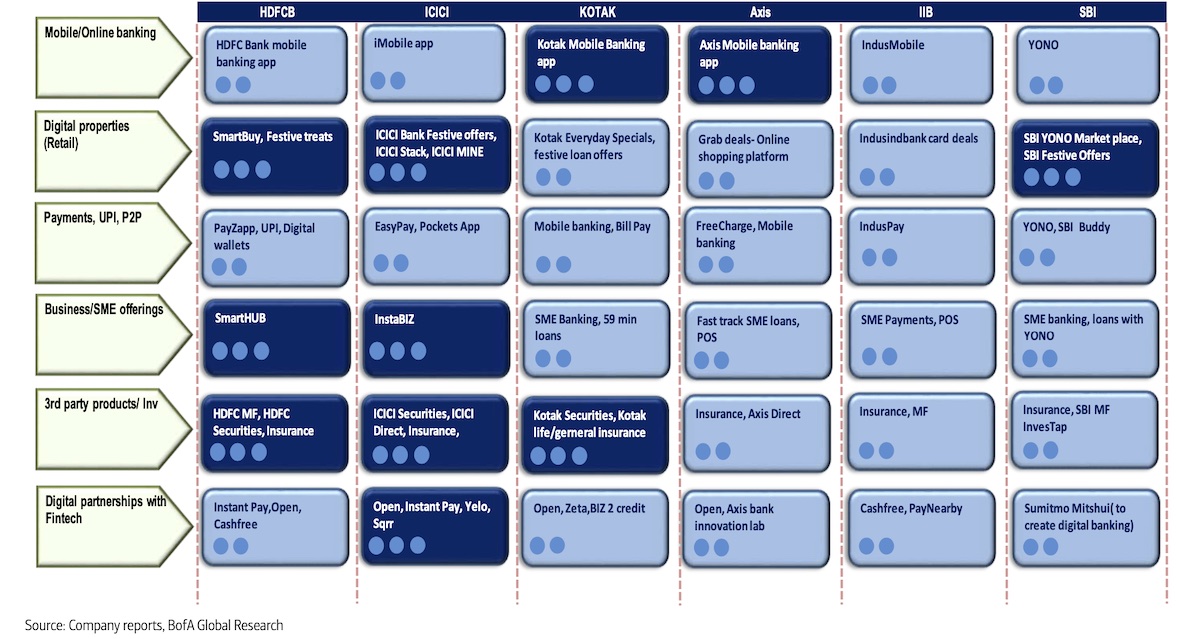
“Banks are doing their best to defend their turf by focusing on several fronts – eco system building (led by HDFC Bank), open approach to fintech partnerships (led by ICICI Bank), overall digital experience as an acquisition tool (led by Kotak and Axis) etc. But [they] continue to play catchup as they lack the focus/ expertise in each channel (Banking super apps and APIs are fast becoming hygiene). Fintech revenues are already ~10% of private banks’ fee income, but could grow >3x in the next 3 years,” wrote analysts at Bank of America in a report late last year.

“Banks no doubt want to own the pipe and relationships, but are unlikely to succeed except in very specific segments,” they added.

In recent months, however, some banks have begun to reevaluate their engagement strategy with neobanks, Indian news and analysis publication the CapTable reported last month.

11 Jun 2021

Fresha raises $100M for its beauty and wellness booking platform and marketplace

Beauty and wellness businesses have come roaring back to life with the decline of Covid-19 restrictions, and a startup that’s built a platform that caters to the many needs of small enterprises in the industry today is announcing a big round of funding to grow with them.

Fresha — a multipurpose commerce tool for independent wellness and beauty businesses such as hair, nail and skin salons, yoga instructors and more, based first and foremost around a completely free platform for those businesses to schedule bookings from customers — has picked up $100 million.

Fresha plans to use the funds to expand the list of countries where it operates, to grow the categories of companies that use its services (mental health practitioners is one example; fitness is another), and to build more services complementing what it already provides, helping customers do their work by providing them with more insights and data about what they do already. It will also be making acquisitions to expand its customer base.

General Atlantic is leading this Series C, with Huda Kattan, Michael Zeisser of FMZ Ventures, and Jonathan Green of Lugard Road Capital also participating, along with past investors Partech, Target Global and FJ Labs.

Fresha has raised $132 million to date, and it’s not disclosing its valuation. But as a point of reference, when it closed its Series B (as Shedul; the company rebranded in February 2020), it was valued at $105 million.

Chances are that figure is significantly higher now.

Fresha’s current range of services include a free-to-use platform for booking appointments; free software for managing accounts; a payments service that includes both a physical point of sale and digital interface; and a wider marketplace both to provide goods to the businesses (B2B); and for the businesses to sell goods to customers (B2C).

The London-based company has 50,000 business customers and 150,000 stylists and professionals in 120+ countries (mostly in the U.K., the U.S., Canada, Australia, New Zealand and Europe), with some 250 million appointments booked to date.

And while many businesses did have to curtail how they operated (and in some countries had to stop operating altogether) Fresha found that it was attracting a lot of new business in part because of its “free” model that meant customers didn’t have to pay to maintain a booking platform at a time when they weren’t taking bookings, but could use Fresha to generate revenues in other ways (such as through the sale of goods, vouchers for future services, and more.)

So in a year when you might have thought that a company based around providing services to industries that were hard hit by Covid would have also been hard-hit, in fact Fresha saw a 30x increase in card payment transactions versus the year before, and more than $12 billion worth of booking appointments made on its platform.

In a market that is very crowded with tech companies building platforms to book beauty (and other) services and to manage the business of independent retailers — they include giants like Lightspeed POS, as well as smaller players like Booksy (which also recently raised) and StyleSeat but also players like Square and PayPal, and many others — the core of Fresha’s offering is a booking platform built as a totally free product.

Why free? To attract more users to its other services (such as payments, which do come at a price), and because co-founders William Zeqiri (CEO) and Nick Miller (product chief) — pictured above, respectively left and right — think this the only way to build a business like this in a crowded market.

“We believe that software is a commodity,” said Zeqiri in an interview. “A lot of our competitors are beating each other on price to the bottom. We wanted to consolidate the supply side of the software, gather data about the businesses, how they use what they use.”

That data led, first, to identifying the need for and building out  single all the time and launch its B2B and B2C marketplaces, and the idea is that it will likely lead to more products as it continues to mature, whether its better analytics for its current customers so that they can better price or develop their services accordingly; or entirely new tools for new categories of users.

Meanwhile, the services that it already provides like payments have taken off like a shot, not least because they’ve served a need for any virtual transactions like selling vouchers or items.

Miller noted that while a lot of its customers actually interface with tech with a lot of reluctance — they are the essence of “physical” retailers when you think about it — they also found themselves having to use more digital services simply because of circumstances. “Looking back at what happened, tech adoption accelerated for our customers,” said Miller. He said that current customers usage for the point-of-sale systems and online payments is roughly equal.

Looking ahead, Fresha’s investor list is notable for its strategic mix and might shed some light on how it grows. Kattan, a “beauty influencer” and the founder of Huda Beauty, is investing by way of HB Investments, a strategic venture arm; while Zeisser’s FMZ focuses on “experience economy” investments today, but he himself has a long history working at tech companies building marketplaces, including years with Alibaba as head of its U.S. investment practice. These speak to areas where Fresha is likely interested in expanding its reach — more marketplace activity; and perhaps more social media angles and exposure for its customers at a time when social media really has become a key way for beauty and wellness businesses to market themselves.

“Fresha has emerged as a leader powering the beauty and wellness industry,” said Aaron Goldman, Global Co-head of financial services and MD at General Atlantic, in a statement. “William, Nick and the Fresha team have built a product that is resonating with the market and creating long-term value through the intersection of its payments, software and marketplace offerings. We are thrilled to be partnering with the company and believe Fresha has significant opportunity to further scale its innovative platform.”

“I’ve witnessed first-hand the positive impact Fresha has for beauty entrepreneurs,” added Kattan. “The company is a force for good in the growing community of beauty professionals around the globe, who are increasingly adopting a self-employed approach. By making top business software accessible without any subscription fees, Fresha lets professionals focus on what they do best — offering great experiences for their customers.”

11 Jun 2021

Tiger Global in talks to invest in Classplus at over $250 million valuation

Tiger Global is in talks to lead a $30 million round in Indian edtech startup Classplus, according to sources familiar with the matter.

The new round, which includes both primary investment and secondary transactions, values the five-year-old Indian startup at over $250 million, two sources told TechCrunch.

The new round follows another ~$30 million investment that was led by GSV recently, one of the sources said.

Classplus — which has built a Shopify-like platform for coaching centers to accept fees digitally from students, and deliver classes and study material online — also raised $10.3 million in September last year from Falcon Edge’s AWI, cricketer Sourav Ganguly and existing investors RTP Global and Blume Ventures. That round had valued Classplus at about $73 million, according to research firm Tracxn.

Classplus didn’t respond to a request for comment. Sources requested anonymity as the matter is private.

As tens of millions of students — and their parents — embrace digital learning apps, Classplus is betting that hundreds of thousands of teachers and coaching centers that have gained reputation in their neighborhoods are here to stay.

The startup is serving these hyperlocal tutoring centers that are present in nearly every nook and cranny in India. “Anyone who was born in a middle-class family here has likely attended these tution classes,” said Mukul Rustagi, co-founder and chief executive of Classplus, told TechCrunch last year. “These are typically small and medium setups that are run by teachers themselves. These teachers and coaching centers are very popular in their locality. They rarely do any marketing and students learn about them through word-of-mouth buzz,” he said.

Rustagi described Classplus as “Shopify for coaching centers.” Like Shopify, the service does not serve as a marketplace that offers discoverability to these teachers or coaching centers. Instead, it offers a way for these teachers to leverage its tech platform to engage with customers.

This year, Tiger Global has backed — or in talks to back — about two dozen startups in India.

11 Jun 2021

Elon Musk reveals the Tesla Model S Plaid

Tesla finally held the long-awaited, and once rescheduled, “delivery event” for its ultra-fast Model S Plaid at its factory in Fremont, California. The electric vehicle company will begin with 25 deliveries on Friday evening, expanding to several hundred cars per week and a thousand cars per week in the next quarter, CEO Elon Musk said at the event.

There were no huge surprises with the newest iteration of the Model S, which features a new battery pack design, an improved heat pump, carbon over-wrapped rotors on the motors and a new record for drag coefficient of 0.208, a figure that Musk emphasized as perhaps a poke at up-and-comer Lucid Motors. The Lucid Air, which is slated to go into production later this year, has a drag coefficient of 0.21.

While wielding a sledgehammer as prep for “breaking a few records,” Tesla Model S designer Franz von Holzhausen kicked off the event, introducing Musk himself, who drove a shiny black Model S around the test track, gliding right onto stage to the dulcet sounds of dubstep.

“This is nine years since we delivered the first model S, the first car produced here in Fremont, so almost a decade, and I think we’ve really taken it to a whole new level with Plaid,” said Musk to an audience of adoring fans. “Some of you may know that our product plan is stolen from Spaceballs, we’ve gone Plaid speed. So…why make this really fast car, that’s crazy fast and everything, and I think there is something that’s quite important to the future of sustainable energy, which is that we’ve got to show that an electric car is the best car, hands down. It’s gotta be clear, like, man, sustainable energy cars can be the fastest cars, can be the safest cars, can be the most kick ass cars in every way.”

The four-door electric sedan goes from 0 to 60 in 1.99 seconds, which Musk says breaks the two-second barrier that no production car has ever been able to break. It produces 1,020 horsepower, has a top speed of 200 miles per hour (with the proper tires) and can complete a quarter mile in 9.23 seconds, according to Musk and the company’s website. The battery can travel 390 miles on a single charge, but Musk added the car can go to 412 miles with the dual motor configuration (The Model S Plaid has a tri-motor set up). The improved charging speed gives drivers 187 miles of range in just 15 minutes.

The new Model S also has a new battery pack, but Musk didn’t elaborate past that detail. He spent considerable time describing the carbon-sleeved rotors for the motor, which Musk claims is a first for a production electric motor due to the difficulty of pulling it off. The end result is a motor that goes up to 20,000 RPM.

The new heat pump that powers the Plaid’s HVAC system has 30% better cold weather range and requires 50% less energy for cabin heating and freezing conditions, meaning little degradation in cold weather, said Musk.

elon musk tesla model s plaid

Image Credits: Screenshot/Tesla

The interior of the Model S also has a number of updates, some that have already been revealed, including a yoke steering wheel — which has raised eyebrows and has the attention of the National Highway Traffic Safety Administration — a panoramic main screen and ventilated front seats. The GPU is apparently at the level of a PlayStation 5. (TechCrunch noticed that someone was playing CD Projekt Red’s Cyberpunk 2077 in the vehicle at one point during the event).

The software of the car is designed to learn from the driver’s behavior, adapting to the driver’s needs so that if, say, you tend to back out of your driveway in a certain way, the car geocodes to that location and eventually does that action for you via the autopilot system.

“It’ll just keep minimizing the amount of input that you need to do until the car just read your mind,” said Musk.

The first deliveries of the vehicle, which starts at $129,990, come the same week Musk officially announced plans to cancel production of the Model S Plaid+, what was meant to be a faster version of the Plaid version of the Model S. Tesla stoped taking pre-orders for the vehicle on its website back in May, prompting speculation that the Plaid+ was off the table.

“Model S goes to Plaid speed this week,” Musk tweeted on Sunday. “Plaid+ is canceled. No need, as Plaid speed is just so good.”

Musk described driving it as akin to powering a spaceship in a tweet due to the car’s indescribable “limbic resonance,” whatever that means.

11 Jun 2021

Archer Aviation reveals 2-seater demonstration aircraft, a “stepping stone” toward commercial operations

Archer Aviation unveiled its autonomous electric two-seater aircraft dubbed “Maker” on Thursday, which it will use for testing as it works towards certification of a larger piloted five-seater announced in March 2020.

The aircraft unveiled on Thursday is not what would take to the skies should the company reach commercial operation in 2024. However, Archer’s Head of Certification Eric Wright told TechCrunch that starting with an autonomous vehicle allows the company to move through the testing process more efficiently.

“The [two-seater] Maker aircraft is a stepping stone in the path to certification,” Wright explained. He said it was a “a testbed that really helps us to increase our knowledge and awareness on say, the flight control systems and the electric propulsion and the things that we’re putting into the certified aircraft, and to help the [Federal Aviation Administration] gain confidence in that design as we as we put it through its paces, and of course, they will be involved in in watching that development occur.”

Both Maker and the unnamed five-seater aircraft bear similarities in their specs: both have a “tilt-rotor” design, meaning that of the total 12 rotors on the aircraft, the front six can tilt position. This tilting mechanism is what allows the aircraft to ascend vertically like a helicopter and move forward like an airplane.

The two also have six independent battery packs each for safety purposes, as the rest of the batteries should operate even in the case that one fails. It’s these batteries that give the crafts a 60-mile range at 150 miles per hour. While the two-seater design has a 40-foot wingspan and clocks in at around 3,300 pounds, the larger aircraft will likely weigh more, Wright said.

The Palo Alto-based company also said it anticipates Maker will generate only 45 decibels of sound from 2,000 feet. The noise specification is especially important for electric vertical take-off and landing (eVTOL) companies that have air taxi aspirations. Mass adoption will only likely be acceptable – both by the public and by regulators – if the aircraft is sufficiently quiet.

Archer had been slowly trickling information on Maker over the past few months, including releasing a high-quality rendering of the two-seater after the company announced it had landed a $1 billion order with United. The event on Thursday marks the first time the public has been able to see an actual aircraft from the startup that’s valued at $3.8 billion.

When asked why the debut aircraft is autonomous, Wright said it would help the company move more efficiently through the testing and validation process. “By making the vehicle autonomous you can do things quicker without having the pilot in the aircraft actually having to fly it,” Wright said. “So you can look at the response that the aircraft has to the inputs, from an autonomous standpoint, much quicker, much more efficiently.”

While it may be years yet that autonomous air taxis are ferrying people across cities, Archer, like other eVTOL developers, does see autonomy in its long-term blueprint – as operational aircraft, rather than simply facilitating a larger certification process.

“If we’re going to have a really large impact on transportation, I think it’s really difficult to think about doing that in a piloted way really long term,” Archer CEO Brett Adcock told TechCrunch in a separate interview. “I think piloted is for sure the right way to enter the market as relates to getting into the airspace and getting certified and making that happen, basically, right away. And then I think over time, in order to drive up safety for both passengers and the network, it’s really going to be important to move to autonomous airspace. So I think [autonomy] is inevitable to the extent the industry scales really well and gets big.”

The three-year-old startup aims to launch commercial operations in 2024 starting in Los Angeles and Miami. The company’s system simulation team is using a simulation tool called Prime Radiant to determine where to place its vertiports. That team is led by the former head of data science at Uber Elevate, Uber’s air mobility arm that was later sold to Joby Aviation in December 2020.

Adcock also said the company’s had conversations with ride-sharing companies about working together to integrate the first- and last-mile car trips that will inevitably be needed with the air taxi routes.

In advance of the proposed 2024 launch date, Goldstein said the company is working with its partner, the automaker Stellantis, on two facilities: one that would deliver traditional aerospace volumes in the hundreds of aircraft per year, and a future facility that would build an even higher volume.

Archer has similar manufacturing needs as an automaker, Goldstein said, “where we use lightweight carbon fiber for a lot of the parts, we have electric motors, batteries all that like autos do.” 

11 Jun 2021

SoftBank, Uber, Tencent set to reap rewards from Didi IPO

After years of speculation, Didi Chuxing, China’s ride-sharing behemoth, finally unveiled its IPO filing for the U.S., giving a glimpse into its money-losing history.

Didi didn’t disclose the size of its raise. Reuters reported the company could raise around $10 billion at a valuation of close to $100 billion.

Cheng Wei, Didi’s 38-year-old founder owns 7% of the company’s shares and controls 15.4% of its voting power before the IPO, according to the prospectus. Major shareholder SoftBank Vision Fund owns 21.5% of the company, followed by Uber with 12.8% and Tencent at 6.8%.

The nine-year-old company, which famously acquired Uber’s China operations in 2016, is more than a ride-hailing platform now. It has a growing line of businesses like bike-sharing, grocery, intra-city freight, financial services for drivers, electric vehicles and Level 4 robotaxis, which it defines as “the pinnacle of our design for future mobility” for its potential to lower costs and improve safety.

Didi set up an autonomous driving subsidiary that banked $500 million from SoftBank in May last year. The unit now operates a team of over 500 members and a fleet of over 100 autonomous vehicles.

For the twelve months ended March, Didi served 493 million annual active users and saw 41 million transactions on a daily basis.

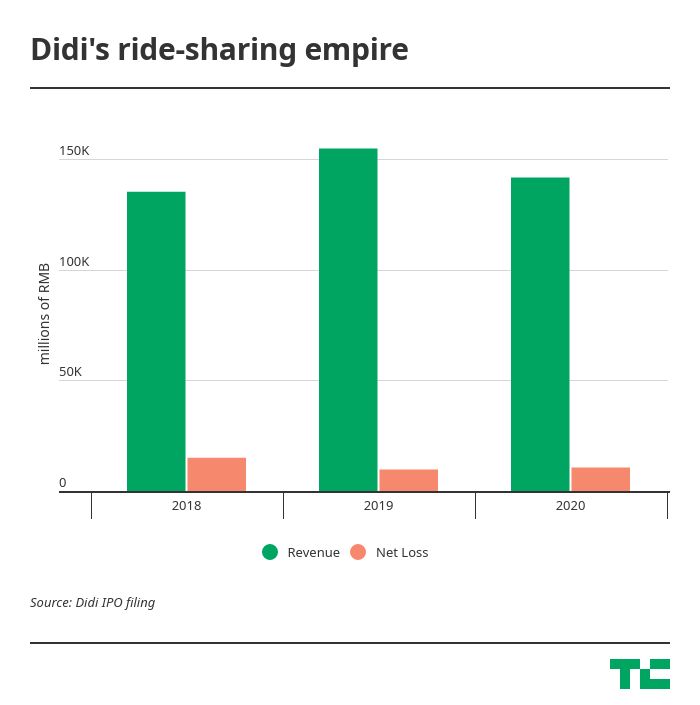
Didi had been operating in the red from 2018 to 2020, when it finished the year with a $1.6 billion net loss, but managed to turn the tide in the first quarter of 2021 by racking up a net profit of $837 million, which it recognized was primarily due to the investment income from the deconsolidation of Chengxin, its cash-burning grocery group buying initiative, and an equity investment disposal.

Revenue from the quarter also more than doubled year-over-year to $6.6 billion. China accounts for over 90% of Didi’s revenues as of late. The company has tried to expand its presence in a dozen overseas countries like Brazil, where it bought local ride-hailing business 99 Taxis.

Of its mobility revenues in China, more than 97% came from ride-hailing between 2018 and 2020. Taxi hailing, chauffeur and carpooling, a lucrative business that was revamped following two deadly accidents, made up a trifling share.

Didi plans to spend 30% of its IPO proceeds on shared mobility, electric vehicles, autonomous driving and other technologies. 30% will go towards its international expansion and another 20% will be used for new product development.