Year: 2021

09 Jun 2021

Branch raises $50M to offer bundled auto & home insurance via an API

Branch Insurance, a startup offering bundled home and auto insurance, has raised $50 million in a Series B funding round led by Anthemis Group.

Acrew, Cherry Creek Holdings and existing backers Greycroft, HSCM Bermuda, American Family Ventures, SignalFire, SCOR P&C Ventures, Foundation Capital and Tower IV also participated in the round. With this latest financing, Columbus, Ohio-based Branch has raised $82.5 million in total funding since its 2017 inception.

With so many players in the insurtech space, it can get tough distinguishing the various offerings. Branch claims that it is unique in that it is able to provide customers with “an instant insurance offer” for bundled home and auto insurance “within seconds” using just a few pieces of information.

Co-founder and CEO Steve Lekas began his career at Allstate, where he went on to hold roles in underwriting, technology and product management. He then went on to build Esurance’s first online home insurance business.

But in the back of his mind, Lekas yearned to figure out a way to make insurance more accessible for more people. And so he teamed up with Joe Emison, and Branch was born.

“The industry is structurally flawed and it harms consumers. Complicated policies, rising costs and marketing warfare all contribute to a vicious cycle that results in overpriced insurance,” said Lekas. “We are a full-stack insurance company transforming the way people think about their home and car insurance.”

Branch, he claims, is the only insurance company that he is aware of that can bind insurance through an API, and the only one that can bundle auto and home insurance in a single transaction.

Another way Branch is unique, according to Lekas, is that it can be embedded into the buying experience. In other words, the company has partnered with companies such as Rocket Mortgage and ADT to integrate insurance at the point of sale in their products. For example, if a person is closing on a home, they have the option of purchasing Branch insurance at the same time.

Branch co-founder and CEO Steve Lekas. Photo: Robb McCormick Photography

“Every home or car policy starts with another transaction,” Lekas said. “Insurance is a product that exists only because of the other transaction. It’s never before been possible to embed in that primary purchase before.”

This distribution model means that Branch shells out less to acquire customers and thus, it claims, is able to offer premiums for a lower price than competitors.

“In just two clicks, a consumer can have home and car insurance or just home and we’ll cancel the old insurance on their closing date, and transmit all the data to their existing mortgage,” Lekas said.

Branch also offers its insurance direct-to-consumer and through agencies.

The company plans to use its new capital in part to accelerate its rollout across the U.S. so that it can sign more such partnerships where it can embed its offering. Currently, Branch has more than 30 partnerships of varying sizes, and is “adding more every week” as it launches in more states.

“It’s really hard to move quickly,” Lekas said. “The system is built to make you move slowly. Every state regulator has to approve individually and independently with their own rules.”

Lekas predicts Branch will be available in more than 80% of the U.S. before the year’s out.

Branch has seen increased momentum since its $24 million Series A in July 2020.

Specifically, the startup says it has achieved a 435% growth in its partner channel, 660% growth in active policies and a 734% increase in active premium less than one year after its last raise.

Anthemis Group Partner Ruth Foxe Blader notes that Branch marks her firm’s first investment from its new growth fund.

Blader says she has invested in insurance innovation over the past decade, and is particularly attracted to insurtech businesses that represent three things: significant technology and data science innovation; significant product innovation and significant cultural innovation.

“Branch easily ticks those boxes,” Blader told TechCrunch. “Branch’s products are both embedded and bundled, making them less expensive and more convenient to purchase, and less likely to leave customers with critical protection gaps.”

The startup, she added, effectively combines data science and technology to create “unique, automatic product bundles.”

With what it describes as a “built-for-savings” structure, Branch said it has created connected home discounts as well as programs that reward members for making referrals and practicing safe driving behaviors, for example.

Branch also has formed a nonprofit, SafetyNest, to help those who are un- or underinsured.

09 Jun 2021

ShelfLife, a marketplace for raw materials, raises $3 million seed round

Two years ago, Lillian Cartright teamed up with some fellow Harvard Business School students to launch a new spiked seltzer brand called Astrid. Despite all the tools that make launching a D2C brand easier than it’s ever been, the team ran into complications when it came to securing raw materials.

This piece of the supply chain is still stuck in the past, according to Cartright, who explained that most of it is still based around trade shows, powered by referrals and personal connections and plenty of phone calls.

That’s when the idea for ShelfLife was born. The company, cofounded by Cartright and John Cline, is aiming to build a directory and marketplace of raw material suppliers based on what brands actually, specifically need, allowing them to secure quotes quickly.

The current system is set up to benefit the large incumbent CPG brands, but the industry is shifting. Craft beverages, in particular, are growing in popularity and the pandemic encouraged consumers to buy more bottled, box, and canned goods online.

In fact, Cartright says that 50 food and beverage brands are launched every single day. But the small, new brands don’t have an easy way to procure materials. For Cartright and Astrid, it was so complicated that it led her and her team to abandon the project.

“I instead took that experience kind of ran with it,” said Cartright. “There are thousands of other people that want to launch brands in the food and beverage space. There are no resources when it comes to supply chain. There’s something there, and this entire space is going to end up digitizing in the very near term.”

In beta, ShelfLife charges a small fee for use of the software, and is manually procuring supplier quotes on behalf of brands. The funding will, in part, go towards automating that process as much as possible to scale on both the brand and supplier side.

One of the challenges of that is that not all suppliers love the idea of being compared to one another, all on one page. Cartright argues that the shifting landscape of the industry means that lead generation around new brands is growing in importance, and a trend that suppliers should get ahead of.

Eventually, Cartright wants to shift the ShelfLife business model to a commission structure that would come out of the budget suppliers usually reserve for field sales reps. The company also wants to build products around financing for the brands, as many suppliers require upfront payment, which can be taxing on a small brand.

The funding round was co-led by Switch Ventures and Kindred Ventures, with participation from NextView Ventures, Ben Zises (SuperAngel.vc), Ilia Papas (former CTO of Blue Apron), and Elena Donio (former President of SAP Concur) among others.

09 Jun 2021

The imbalanced landscape of hormonal health

Hello and welcome back to Equity, TechCrunch’s venture capital-focused podcast, where we unpack the numbers behind the headlines.

For this week’s deep dive, Alex, Natasha, and Chris dug into the world of hormonal health, a sub-sector within the massive (and booming) world of digital health.

The show was inspired by Natasha’s latest Extra Crunch piece: “Hormonal Health is a massive opportunity: Where are the unicorns?”. To round out the show, we asked one of the featured founders, Dr. Elizabeth Ruzzo, to hop on the mic and help us understand if hormonal health is at its infancy, or at an inflection point, in tech.

The tl;dr before we hop into the show is that hormones — while constantly evolving and changing — are center node for a ton of health conditions that disproportionately impact women. These can include mental health issues, infertility, diabetes, and more. If you’re someone interested in the world of digital health and always read about the Ro’s and Hinge Health’s of the ecosystem, this episode will teach you what else there is that deserves equal – if not more – attention.

Here’s what we got into:

  • We started with landscaping! We defined the term “hormonal health” and got a sense of market size, as to show the opportunity there is to innovate here right now.
  • Ruzzo walked us through the opportunity in pro-active medicine, as well as how investors reacted to her pitch when she was first raising her seed round.
  • We ping-ponged around different reasons as to why hormonal health is an underserved category, starting with stigma and ending with stigma.
  • This post from a set of venture capital investors discussing the market opportunity that women’s health may have for founders and VCs alike.
  • Then we got into Modern Fertility’s acquisition by Ro, and why Ruzzo and many in the digital health community were surprised at the outcome. That said, it’s still one of the rare exits, and as far as unicorns go, there are virtually no companies valued at over $1 billion that focus explicitly on women’s hormonal health.
  • Shifting gears, the trio turned to startups working on PCOS, one of the most common hormonal conditions out there that impacts one in ten women. Former Ro director Rachel Blank announced today that she is starting a company in this world, Allara.
  • To round out the conversation we touched on the recent Veera venture capital round, and closed with a short discussion concerning the the term “femtech” and why it’s not so good.

Don’t forget to take the Equity survey, and we’ll chat you on Friday morning!

Equity drops every Monday at 7:00 a.m. PST, Wednesday, and Friday morning at 7:00 a.m. PST, so subscribe to us on Apple PodcastsOvercastSpotify and all the casts.

09 Jun 2021

Voice AIs are raising competition concerns, EU finds

The European Union has been digging into the competition implications of AI-powered voice assistants and other Internet of Things (IoT) connected technologies for almost a year. Today it’s put out a first report discussing potential concerns that EU lawmakers say will help inform their wider digital policymaking in the coming years.

A major piece of EU legislation introduced at the back of last year is already set to apply ex ante regulations to so-called ‘gatekeeper’ platforms operating in the region, with a list of business practice ‘dos and don’ts’ for powerful, intermediating platforms being baked into the forthcoming pan-EU Digital Services Act.

But if course applications of technology don’t stand still. The bloc’s competition chief, Margrethe Vestager, has also had her eye on voice assistant AI technologies for a while — raising concerns about the challenges being posed for user choice as far back as 2019, when she said her department was “trying to figure out how access to data will change the marketplace”.

The Commission took a concrete step last July when it announced a sectoral inquiry to examine IoT competition concerns in detail.

It’s now published a preliminary report, based on polling more than 200 companies operating in consumer IoT product and services markets (in Europe, Asia and the US) — and is soliciting further feedback on the findings (until September 1) ahead of a final report due in the first half of next year.

Among the main areas of potential competition concern it found are: Exclusivity and tying practices in relation to voice assistants and practices that limit the possibility to use different voice assistants on the same smart device; the intermediating role of voice assistants and mobile OSes between users and the wider device and services market — with the concern being this allows the owners of the platform voice AI to control user relationships, potentially impacting the discoverability and visibility of rival IoT services.

Another concern is around (unequal) access to data. Survey participants suggested that platform and voice assistant operators gain extensive access to user data — including capturing information on user interactions with third-party smart devices and consumer IoT services as a result of the intermediating voice AI.

“The respondents to the sector inquiry consider that this access to and accumulation of large amounts of data would not only give voice assistant providers advantages in relation to the improvement and market position of their general-purpose voice assistants, but also allow them to leverage more easily into adjacent markets,” the Commission writes in a press release.

A similar concern underlies an ongoing EU antitrust investigation into Amazon’s use of third party merchants’ data which it obtains via its ecommerce marketplace (and which the Commission believes could be illegally distorting competition in online retail markets).

Lack of interoperability in the consumer IoT sector is another concern flagged in the report. “In particular, a few providers of voice assistants and operating systems are said to unilaterally control interoperability and integration processes and to be capable of limiting functionalities of third-party smart devices and consumer IoT services, compared to their own,” it says.

There’s nothing very surprising in the above list. But it’s noteworthy that the Commission is trying to get a handle on competitive risks — and start mulling potential remedies — at a point when the adoption of voice assistant AIs is still at a relatively early stage in the region.

In its press release, the Commission notes that usage of voice assistant tech is growing worldwide and expected to double between 2020 and 2024 (from 4.2BN voice AIs to 8.4BN) — although only 11% of EU citizens surveyed last year had already used a voice assistant, per cited Eurostat data.

EU lawmakers have certainly learned lessons from the recent failure of competition policy to keep up with digital developments and rein in a first wave of tech giants. And those giants of course continue to dominate the market for voice AIs now (Amazon with Alexa, Google with its eponymous Assistant and Apple’s Siri). So the risks for competition are crystal clear — and the Commission will be keen to avoid repeating the mistakes of the past.

Still, quite how policymakers could look to tackle competitive lock-in around voice AIs — whose USP tends to be their lazy-web, push-button and branded convenience for users — remains to be seen.

One option, enforcing interoperability, could increase complexity in a way that’s negative for usability — and may raise other concerns, such as around the privacy of user data.

Although giving users themselves more say and control over how the consumer tech they own works can certainly be a good idea, at least provided the platform’s presentation of choices isn’t itself manipulative and exploitative.

There are certainly plenty of pitfalls where IoT and competition is concerned — but also potential opportunities for startups and smaller players if proactive regulatory action can ensure that dominant platforms don’t get to set all the defaults once again.

Commenting in a statement, Vestager said: “When we launched this sector inquiry, we were concerned that there might be a risk of gatekeepers emerging in this sector. We were worried that they could use their power to harm competition, to the detriment of developing businesses and consumers. From the first results published today, it appears that many in the sector share our concerns. And fair competition is needed to make the most of the great potential of the Internet of Things for consumers in their daily lives. This analysis will feed into our future enforcement and regulatory action, so we look forward to receiving further feedback from all interested stakeholders in the coming months.”

The full sectoral report can be found here.


09 Jun 2021

Commit raises $6M seed round to match senior engineers to startups they want to work for

Commit, a Vancouver, Canada-based startup that has a unique approach to matching up engineers looking for a new job to early-stage startups that want to hire them, today announced that it has raised a $6 million seed round. Accomplice led the round, with participation from Kensington Capital Partners, Inovia and Garage Capital. 

The company, which focuses on working with remote-first startups, launched in 2019, with co-founders Greg Gunn (CEO) and Beier Cai (CTO), who met as early employees at Hootsuite, bootstrapping the company while they worked out the details of how they wanted Commit to work.

“I was an EIR [at Inovia Capital] and I just saw all these amazing founders that were coming in with world-changing ideas. They raised money, but their biggest challenge was getting an engineer to join them,” Gunn explained.


Beier Cai, Co-founder & CTO, Greg Gunn, Co-founder & CEO, , Tiffany Jung, VP, Strategy & Ops Image Credits: Commit

In his experience, founders typically look for senior full-stack tech leads to join their company, but it’s exactly those senior engineers that are often already in very comfortable roles at larger companies and taking a bet on an early-stage startup — or even a succession of early-stage startups — is often not the most pragmatic choice for them.

After talking to dozens of engineers, the founders found that many didn’t want to lose the support network they had built inside their current company, both from fellow engineers but also the kind of institutional support you get through formal and informal mentorship and personal development opportunities that most large tech companies offer. In addition, as Gunn noted, “hiring at early-stage startups sucks.” Senior engineers don’t want to have to go through a bunch of technical interviews anymore that test their whiteboarding skills but say very little about their actual capabilities as an engineer.

So the team decided to figure out ways to remove these barriers. Like a VC firm, it vets the startups and startup founders it works with, so the engineers that come to Commit know that these are serious companies with at least some prospect of raising funding and allowing their engineers to shape their trajectory and grow into what is potentially an early leadership role.

Meanwhile, it vets the engineers by giving them a technical interview so they can get started without having to do another one for every interview with the companies that partner with Commit. As Gunn noted, so far, the average engineer Commit has worked with only met 1.6 vetted founders before they started a pilot project together.

To mitigate some of the fiscal risks of leaving a large tech company, Commit actually pays the engineers it works with a salary until they find a job. Currently, around 90% of the engineers that start pilot projects with their prospective employees end up in full-time employment.

Image Credits: Commit

In addition to matching up founders and engineers, it also offers its community members access to an active remote-first community of fellow engineers for peer support and career advice, as well as coaching and other transition services.

In the backend, Commit uses a lot of data to match founders and engineers, but Gunn noted that while the team is very selective and has a tight profile for the people it partners with, it is committed to building a diverse pool of founders and engineers. “The thing we’re combating is the fact that these opportunities have been unevenly distributed,” he said. “Even within the Valley […] you have to be from a socio-economic class to even have access to those opportunities. For us, our whole business model is live where you want to live, but then get access to whatever opportunities you have.” Later this year, Commit plans to launch a project that specifically focuses on hiring diversity.

Commit’s startup partners currently include Patch, Plastiq, Dapper Labs, Relay, Certn, Procurify, Scope Security, Praisidio, Planworth, Georgian Partners and Lo3 Energy. The team started out slowly, working with fewer than 100 engineers so far, but hopes to expand its community to 10,000 engineers within the next 12 months. Starting today, engineers who want to join the program can now get on Commit’s waitlist.

09 Jun 2021

Former Ro director launches Allara, a care platform for PCOS

Rachel Blank has a history with hormones. The entrepreneur left her investment job at General Catalyst to join a portfolio company they had been backing since its seed round: Ro. Blank was tasked with growing Rory, a product line for menopausal women.

But Blank left her director position at the health tech unicorn, last valued at $5 billion, to start her own company in women’s hormonal health. Today, that startup is launching out of stealth with millions in venture-backing and more than 35,000 women in its community.

Allara is an early-stage, New York-based startup that wants to help women better manage polycystic ovary syndrome, or PCOS. The reproductive and hormonal condition can cause irregular periods, infertility or gestational diabetes in women, as well as acne, weight gain and excessive hair growth. And it’s far from rare, affecting some one in 10 women of childbearing age.

Along with launching today, the company told TechCrunch that it has raised $2.5 million in a seed round led by Global Founders Capital, with participation from Great Oaks and Humbition.

Allara bundles a suite of services needed to address PCOS — such as gynecologists, nutrition plans or mental health support — and gives consumers one spot to access all of the above. The company describes it as a “collaborative care management model.”

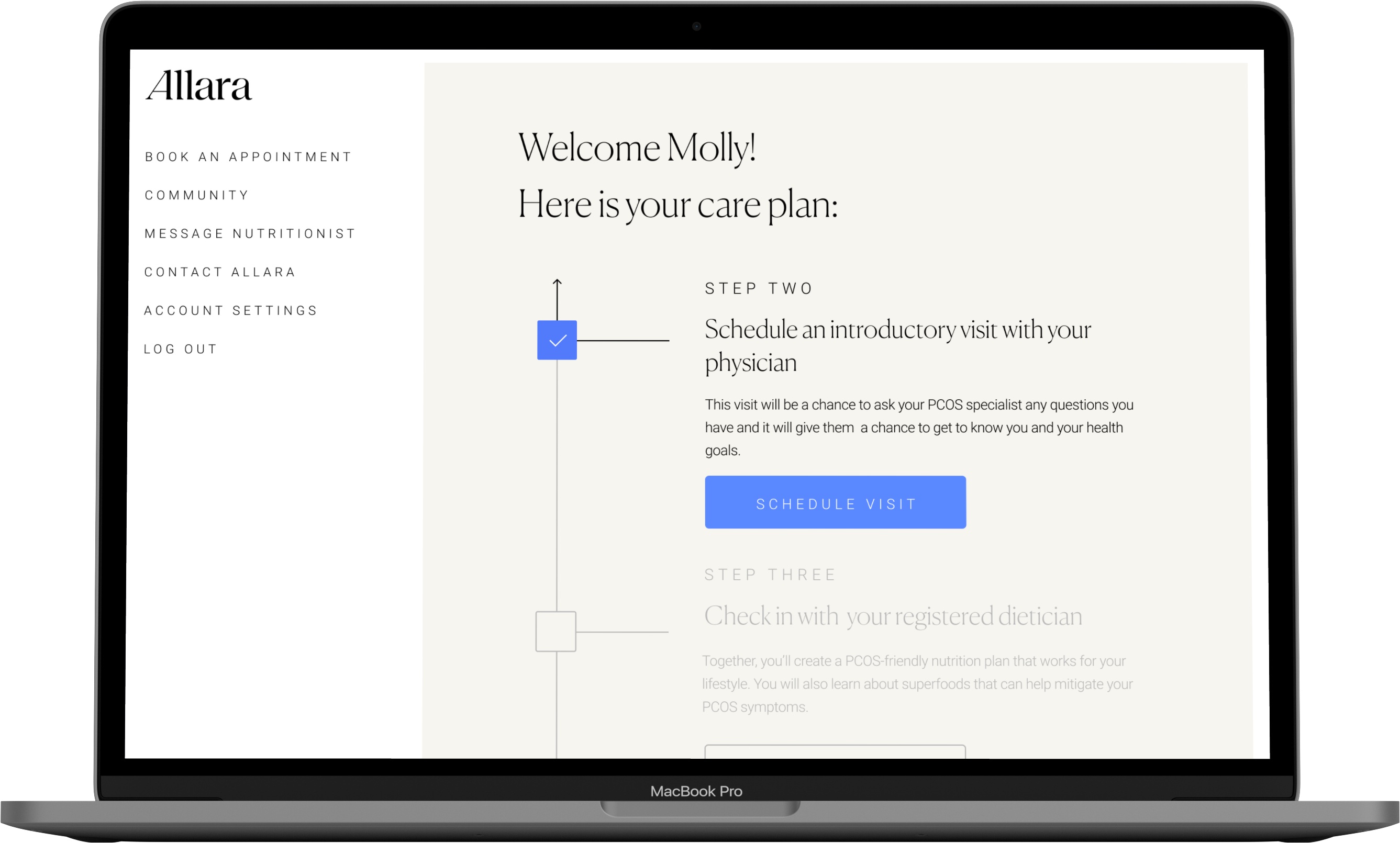
When a consumer first joins the platform, Allara asks them to go through a virtual on-boarding visit with a medical provider. That provider can arrange for labs, then review the lab work and medical history to better understand a patient’s background. Lab work, and any prescriptions, are paid for by the consumer through traditional insurance.

Then, the rest of Allara moves out of pocket. Allara charges $100 a month for access to its care team. Patients get quarterly check-ins with their providers, and have ongoing text-based access to registered dietitians to help with eating and lifestyle goals. Blank explained how Allara wants to make sure all services find ways to talk to each other, creating a patient experience where a nutritionist already knows what your OB-GYN told you and vice-versa so a care plan is centralized.

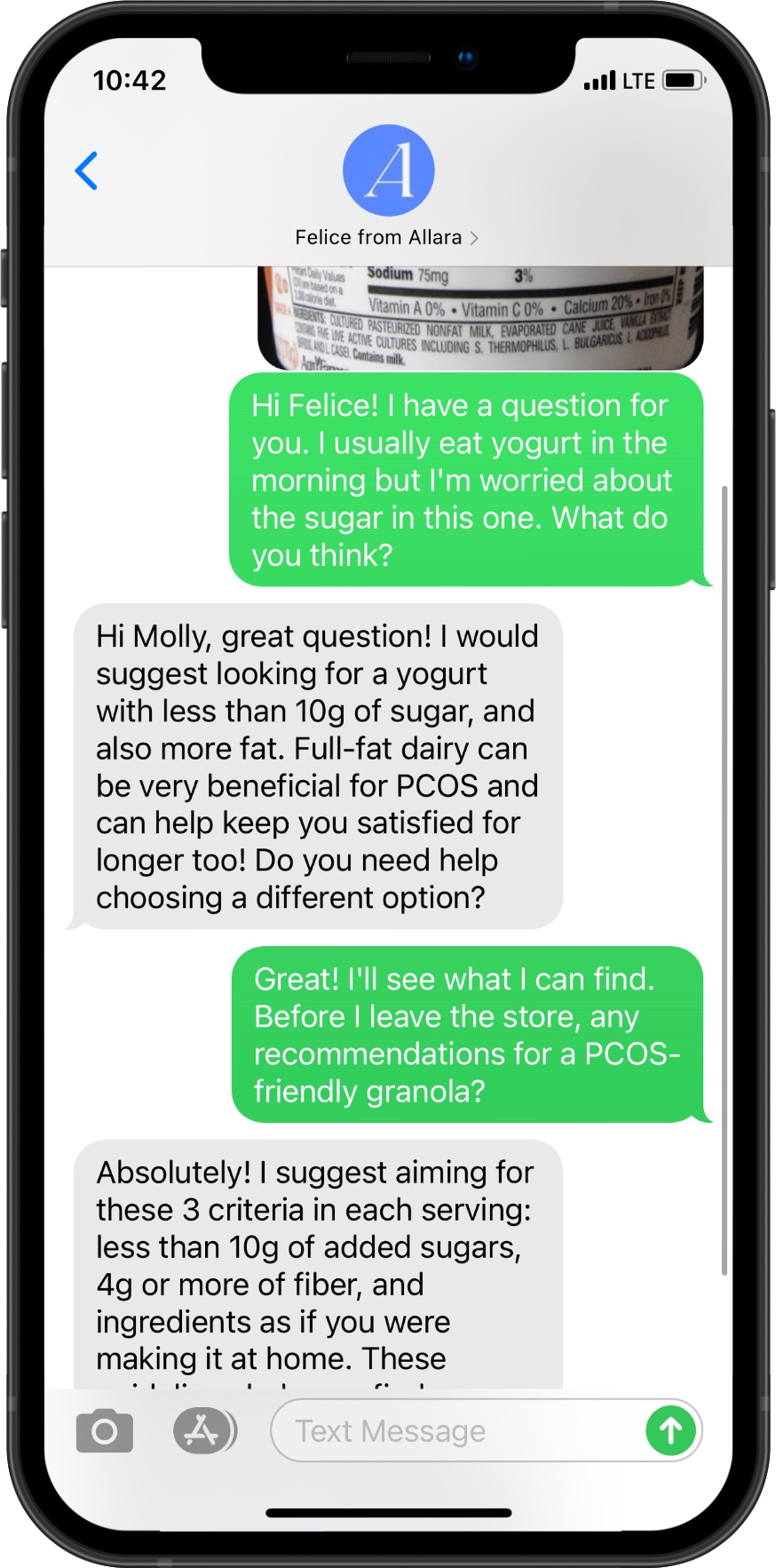
A text message between a patient and a licensed dietician. Image Credits: Allara

If it pulls it off, this is where the heart of Allara’s innovation lies: creative ways to take care of people.

Image Credits: Allara

One hurdle for Allara, and any company working on a solution for this condition, is that PCOS is hard to diagnose, and impossible to fully cure. Like many hormonal conditions, the condition looks different in everyone, which is part of the reason it’s so hard for doctors to identify. There is no blood test, and there is no pill to pop.

PCOS is currently diagnosed with the Rotterdam criteria, which means a patient must have two of the following three conditions: irregular period, excess androgen or polycystic ovaries. Some research argues that the criteria is controversial and not fully inclusive of the spectrum of how PCOS presents. For now, the Rotterdam criteria is the best method toward diagnosing.

Blank says that Allara’s goal is all about “managing risk.”

“It’s not that women with these conditions weren’t looking for a solution,” Blank said. “It’s that they’re all desperately looking for solutions, but the solutions haven’t existed yet.”

Over the past few months, Allara has been operating under a different name — Astrid — to build up interest and get feedback needed to iterate its product. Blank claims that more than 35,000 women are part of its community, either directly or on a waitlist, underscoring the demand for explicit attention on this condition. The startup recently began seeing patients.

Hormonal health grows bigger

Allara is the latest startup to bet that hormonal health is a key wedge into the digital health boom. Companies like Adyn, Modern Fertility, Tia, Veera Health and Perla Health are all working on different ways to better serve hormonal disorders.

Still, the sector remains relatively nascent compared to other health conditions. Blank chalks up part of this truth to stigma.

“There’s been a lack of understanding what women’s health means,” Blank said, explaining how society often views it as a fertility or reproductive health condition. Blank thinks that PCOS is a common thread between a multitude of conditions, from fertility, diabetes, increased risk of uterus and endometrial cancer, heartsease, anxiety and depression.

When she explains this, she said, people are able to get the market opportunity.

“How do we treat women’s healthcare in a way that their entire healthcare outcomes become better but we’re taking on the nuances of them being women?” Blank said.

Blank herself was diagnosed with PCOS at the age of 21, which came as a surprise to her.


Rachel Blank, the CEO and founder of Allara. Image Credits: Allara

“I think what made it more surprising is that my dad is actually an OB-GYN,” she said. “So even though I had grown up around women’s healthcare, and had access to the best of women’s health specialists, I even struggled with getting a process and understanding what was going on in my body.”

Blank initially joined Ro because of her passion for polycystic ovary syndrome, or PCOS. Allara is a return to, and doubling down on, her belief in the condition needing a better standard of care.

As for going solo, and not building it within Ro’s blanket of brands and massive footprint, Blank explained how her vision of specialty care and services is different from what Ro focuses on, which is largely primary care and prescription focus. Notably, Ro did acquire Modern Fertility, a hormonal health company, for north of $225 million, last month.

“PCOS was just part of my personal story — not the vision for Rory,” she said. “Allara is not a primary care platform — it’s a specialty care platform, developing new clinical care models for complex women’s health conditions like PCOS. Imagine it as a place a primary care platform might refer a patient to if they discover she has more complex needs than they can currently serve.”

09 Jun 2021

Here’s what’s on tap today at TC Sessions: Mobility 2021

It’s game day for mobility tech mavens around the world. Well, at least for the ones who made the savvy decision to attend TC Sessions: Mobility 2021. Are you ready for a day packed with potential, overflowing with opportunity and focused on the future of transportation? Yeah, you are, and so are we!

No FOMO zone: Did you wait until the last minute? We don’t judge — simply purchase a pass at the virtual door.

Let’s take a look at just some of the speakers, presentations and breakout sessions on tap today. We’re talking about leading visionaries, founders and makers of mobility tech. They just might have info you need to know, amirite? The times listed below are EDT, but the event agenda will automatically reflect your time zone,

Throughout the course of the day: Be sure to make time to meet, greet and network with the 28 early-stage startups exhibiting in our virtual expo area (seriously, they’re an impressive bunch). The platform lets exhibitors present live demos, host Q&As about their products or hold private 1:1 meetings. Go mining for opportunities!

2:05 pm – 2:15 pm

EV Founders in Focus: We sit down with Ben Schippers, co-founder and CEO of TezLab, an app that operates like a Fitbit for Tesla vehicles (and soon other EVs) and allows drivers to go deep into their driving data. The app also breaks down the exact types and percentages of fossil fuels and renewable energy coming from charging locations.

2:40 pm – 3:10 pm

Equity, Accessibility and Cities: Can mobility be accessible, equitable and remain profitable? We have brought together community organizer, transportation consultant and lawyer Tamika L. Butler; Remix by Via co-founder and CEO Tiffany Chu and Revel co-founder and CEO Frank Reig to discuss how (and if) shared mobility can provide equity in cities, while still remaining a viable and even profitable business. The trio will also dig into the challenges facing cities and how policy may affect startups.

3:10 pm – 3:40 pm

The Rise of Robotaxis in China: Silicon Valley has long been viewed as a hub for autonomous vehicle development. But another country is also leading the charge. Executives from three leading Chinese robotaxi companies (WeRide, AutoX and Momenta) — that also have operations in Europe or the U.S. — will join us to provide insight into the unique challenges of developing and deploying the technology in China and how it compares to other countries.

That’s just a tiny taste of what today has in store for you. Choosing which of the 20 presentations and breakout sessions to attend could be tough. The good news is that you can catch anything you missed — or want to review again — with video-on-demand.

TC Sessions: Mobility 2021 kicks off today — go drive this opportunity-packed day like you stole it.

09 Jun 2021

Terra raises $2.8M to build the Plaid for fitness data

This morning Terra, a recent Y Combinator graduate building an API for fitness and health data, announced that it has closed a $2.8 million round. The investment includes capital from General Catalyst, Samsung Next, and NEXT VENTURES.

The company intends to hire with its new capital, from a team of four today — the co-founders and two other engineers — to seven this month. Terra expects to staff up to 10 people inside the quarter.

More folks makes sense given the scope of what Terra is building. The company’s APIs allow developers to hook into fitness and health data generated by software and hardware. In order-of-operations terms, Terra CEO and co-founder Kyriakos Eleftheriou told TechCrunch that his company is targeting integration points first with companies that offer APIs, then SDKs and, later, Bluetooth-enabled health wearables. That’s a lot of possible connections, so having more hands on-deck will help the company code up its integration points makes sense.

Sure, providing connective tissue between fitness and health data is neat, but only as cool as the technology that is built using the now-unlocked data. With Terra having attracted around early 100 developers or so to its product according to Eleftheriou, the startup should be starting to form an idea of what’s possible. During an interview with TechCrunch Eleftheriou brought up a neat idea of linking music selection to heart rate. So, as your heart rate goes up — say, from exercise — your music player could read that data from your wearable and shake up its shuffle.

Or the opposite, I’d add. Say you are like myself, a Nervous Person. I might want Spotify to move deeper into the Chopin the higher my heart rate during work hours.

How hard is it to link to fitness and health data sources? Per Eleftheriou, the fitness-tech world is more connection-ready than we might have expected. Polar, which makes wearables like fitness trackers, already has an API that Terra can plug into for example, the CEO said.

TechCrunch was curious about third-party hesitancy regarding allowing Terra to plug into various health, and fitness tech hardware and software. But Eleftheriou said that that hasn’t been a large problem for his startup, and that some companies — like those who sell wearables — have a natural incentive to make their hardware as useful as possible.

Calling Terra the Plaid for fitness data is not merely a useful comparison to help ourselves understand what it’s building; the company is pursuing a consumption-pricing model, meaning that its economics will scale akin to Plaid’s, or perhaps Twilio’s own.

But what matters more than where Terra sees health and fitness data fitting into the world is watching what developers actually build with its service. Now flush with a few million dollars, the company has to now prove that it has material market demand for its APIs. If so, we might see a more connected, integrated health and fitness data environment in the future. I’m here for that.

09 Jun 2021

Google announces the Firmina subsea cable between the U.S. and Argentina

Google today announced its plans to build a new subsea cable that will connect the East Coast of the U.S. and Las Toninas, Argentina — with additional landings in Brazil and Uruguay. The idea here is to provide users in South America with improved low-latency access to Google’s portfolio of consumer and cloud services.

The closest Google data center in the region (and its only one in South America) can be found near Santiago, Chile, which is connected to the U.S. West Coast through Google’s Curie cable.

The Firmina cable, named after Brazilian abolitionist and author Maria Firmina dos Reis, will augment Google’s existing cable investments in the region. The Tannat cable, a joint venture between Antel Uruguay and Google, for example, already connects the same locations while the Monet cable connects the U.S. and Brazil, where Google’s Junior cable already connects various parts of the country.

Image Credits: Google

The new cable doesn’t just add capacity but also resilience to Google’s existing network. Specifically, one technical feat that makes this new cable, which consists of 12 fiver pairs, stand out is the system’s ability to power the cable from a single-end power source.

“With submarine cables, data travels as pulses of light inside the cable’s optical fibers,” Google explains. “That light signal is amplified every 100 km with a high-voltage electrical current supplied at landing stations in each country. While shorter cable systems can enjoy the higher availability of power feeding from a single end, recent longer cables with large fiber pair count have made this harder and harder.” To achieve this, the Firmina cable is supplied by a cable with a voltage that is 20% higher than previous cables.


09 Jun 2021

ChartHop raises $35M for its internal org chart and people analytics platform

Human resources is generally a salient cornerstone of any organization, but digitization has democratized a lot of the work that goes into HR, and that’s meant more people in businesses interested in, and using, the kind of data that HR people build and typically manage. Today, a startup called ChartHop that’s built a platform to cater to that trend is announcing $35 million in funding on the heels of strong growth.

The Series B is being led by Andreessen Horowitz, a past backer, with Elad Gil and previous investors Cowboy Ventures and SemperVirens also participating. We understand from sources close to the company that the round values ChartHop at between $300 million and $400 million.

ChartHop was founded in New York by Ian White, now the CEO, who first started building the tools to fill what he felt were gaps in his own knowledge when he founded, ran and eventually sold his previous company, Sailthru (which was acquired by CampaignMonitor).

He said he realized the company could build “all the tech we wanted,” but when it came down to thinking about how to run and scale the business, that was at its heart actually a people question, and also understanding how departments, and the entire organization, looked and worked as a whole.

“It was not as important as hiring, structuring a ‘single you’ of the organization,” he said. (Ian’s pictured here to the right.) Similar to the great analytics tools that have been built for developers, sales teams and others, “What I wanted was people analytics,” he said. “I wanted to understand my team.”

That’s actually a very multifaceted question. It’s not just a matter of an org chart — a big enough task in its own right that the very day that ChartHop came out of stealth in early 2020, another org chart startup, The Org, launched, too. It’s also retention strategy, employee satisfaction, turnover statistics, diversity statistics, predictive visualizations on finances one area was compensated differently, or if hiring were frozen, etc. “All of those problems became mine and there was no great software out there to solve for it,” White said.

The ChartHop platform is built like all strong structures these days in the world of tech: tons of integrations to feed data into ChartHop to make it richer; tons of integrations also to export and use that data in more dedicated applications when needed; and an easy way for everyone to update data but also put in place easy and strong protections to keep confidential data as it should be.

And while HR still “owns” the platform, White said, it can be accessed and used by anyone in the organization, and it is.

It seems that others have found the talent management software market lacking for it, too. Since 2019 it went from a team of one — White himself — to 75, with 130 corporates now using its services. The list has a strong list of household company names with a heavy emphasis in tech, from what White showed me. Revenues in the last 12 months — a time when the spread-out nature of many of our workplaces has meant an even greater need for a platform to manage all the information has possibly reached a high water mark — have grown at a rate of 17% month-by-month.

“With HR and people functions so crucial to the growth and success of businesses, it’s unfortunate that most HR teams lack the critical people data to drive organizational decision making,” said David Ulevitch, general partner at Andreessen Horowitz, in a statement. “ChartHop is the solution to this all-too-common problem, and is built by company leaders who have felt this pain personally. ChartHop’s visual approach to people analytics allows leaders to make organizational planning and strategy decisions with confidence. We’re thrilled to lead ChartHop’s Series B because of their impressive growth, the company’s vision, and the terrific, mission-oriented team they’ve assembled.” He also led the company’s seed round in February 2020.

“Since implementing ChartHop earlier this year, we’ve seen significant improvement in our engagement with talent routines as they’re managed via ChartHop,” said Sara Howe, vice president human resources at ZoomInfo, a customer of ChartHop, in a statement. “Our employees have found the simple user interface and the centralized view of their data as the most helpful features. Leaders across ZoomInfo have also leveraged ChartHop to ensure that their organizations are well structured to support our continued rapid growth.”