Year: 2021

09 Jun 2021

Refyne raises $20.1 million to help workers in India get faster access to wages

A young Indian startup that is betting that earned wage access solutions will take off in the South Asian nation said on Wednesday it has closed a new round from high-profile investors.

Bangalore-based Refyne said on Wednesday that it has raised $16 million in Series A from partners of DST Global and RTP Global. The startup also disclosed that it raised a $4.1 million seed round in December from Jigsaw VC and QED Investors and XYZ Capital, all of whom also participated in the new round.

TechCrunch reported last month that Refyne was in talks with RTP Global to raise money.

Refyne works with employers to let their workers access their earned salaries in real-time. For instance, an employee could see how much they have earned in a week and withdraw a fraction of it anytime they wish.

The idea, explained Chitresh Sharma, co-founder and chief executive of Refyne, is that many individuals in India run out of cash before their next payday and then some end up taking loans on not so favorable terms to make ends meet. “An employee should have the option to access their own earnings at any time,” he told TechCrunch in an interview.

It’s a concept that has taken off in several markets — with many major employers such as Uber and McDonald’s offering this flexibility to their workforce — but is yet to be tested in India. Earlier on Monday, Indonesian startup Wagely announced a $5.5 million fundraise to test this idea in the Southeast Asian market.

Sharma, a third-time founder, said Refyne’s plug-and-play software is aimed at all sizes of employers, and the platform can benefit blue-collar as well as white-collar workers.

“The need for financial inclusion is more important today than ever before. As the first company in India to provide earned wage access, Refyne can revolutionise the way millions of workers manage their money. By providing a real, affordable alternative to payday loans, Refyne will not only improve a person’s financial health, but it will add control for the consumer and dramatically reduce the stress on those who worry about meeting their financial obligations,” said QED Investors Managing Partner and Co-Founder Nigel Morris, in a statement. This is QED’s first investment in India.

Over 100 companies in India are already using Refyne’s platform, serving over 300,000 employees. Some of the clients include Rebel Foods, Cafe Coffee Day, Hira Group, and Chai Point.

This is a developing story. More to follow…

09 Jun 2021

Refyne raises $20.1 million to help workers in India get faster access to wages

A young Indian startup that is betting that earned wage access solutions will take off in the South Asian nation said on Wednesday it has closed a new round from high-profile investors.

Bangalore-based Refyne said on Wednesday that it has raised $16 million in Series A from partners of DST Global and RTP Global. The startup also disclosed that it raised a $4.1 million seed round in December from Jigsaw VC and QED Investors and XYZ Capital, all of whom also participated in the new round.

TechCrunch reported last month that Refyne was in talks with RTP Global to raise money.

Refyne works with employers to let their workers access their earned salaries in real-time. For instance, an employee could see how much they have earned in a week and withdraw a fraction of it anytime they wish.

The idea, explained Chitresh Sharma, co-founder and chief executive of Refyne, is that many individuals in India run out of cash before their next payday and then some end up taking loans on not so favorable terms to make ends meet. “An employee should have the option to access their own earnings at any time,” he told TechCrunch in an interview.

It’s a concept that has taken off in several markets — with many major employers such as Uber and McDonald’s offering this flexibility to their workforce — but is yet to be tested in India. Earlier on Monday, Indonesian startup Wagely announced a $5.5 million fundraise to test this idea in the Southeast Asian market.

Sharma, a third-time founder, said Refyne’s plug-and-play software is aimed at all sizes of employers, and the platform can benefit blue-collar as well as white-collar workers.

“The need for financial inclusion is more important today than ever before. As the first company in India to provide earned wage access, Refyne can revolutionise the way millions of workers manage their money. By providing a real, affordable alternative to payday loans, Refyne will not only improve a person’s financial health, but it will add control for the consumer and dramatically reduce the stress on those who worry about meeting their financial obligations,” said QED Investors Managing Partner and Co-Founder Nigel Morris, in a statement. This is QED’s first investment in India.

Over 100 companies in India are already using Refyne’s platform, serving over 300,000 employees. Some of the clients include Rebel Foods, Cafe Coffee Day, Hira Group, and Chai Point.

This is a developing story. More to follow…

09 Jun 2021

A men’s brand, Faculty, launches with nail polish — and seed funding from Estee Lauder

“It’s not a nail polish company,” says Fenton Jagdeo of Faculty, the startup he cofounded in 2019 with Umar ElBably. Though their Toronto-based company currently sells just three shades of nail polish along with a sleeve of nail stickers at its site — that’s it —  the products are a wedge to something much larger, says Jagdeo.

There will be merchandise, according to the former business management consultant. There will be men’s foundation, and eye shadow, and very possibly hair dye, all of which is focused around a “new wave of masculinity,” he explains.

Not that anything is available for purchase right now — by design. Why? First, this isn’t your everyday brand, found in the aisles of Sephora or CVS, suggests Jagdeo. Faculty is instead “going to be very selective about who we have conversations with. We’re imagining the the Essences of the world, the StockXs, the Kiths. That’s where our clientele is.”

He also says that in the same way that the prominent culture publication Hypebeast created a “desire for new product and newness,” Faculty has “mastered the drop model, which we’ve taken from street culture,” meaning that Faculty has and will continue to advertise a limited supply of a product before invariably selling out of that item.

If you find yourself wondering if Faculty aims to become a streetwear company or a cosmetics company, Jagdeo’s job is done. As he explains it, “essentially, our goal is to blur” that dividing line.

It’s utterly implausible and yet strangely alluring, which likely explains why the cosmetics giant Estee Lauder just led a $3 million seed round in the five-person outfit, joined by RareBreed Ventures, Maple VC, Debut Capital, Creative Connectors, AUFI, 10K Ventures, actress Maisie Williams and recording artist Iann Dior.

After all, there is little to separate one cosmetics brand from another, aside from storytelling and the ability to build up a loyal following. (See, for example, Glossier and its mega-valuation.)

Even Jagdeo readily admits that Faculty’s nail polish is “not, from a purely chemical perspective, different” from what’s widely available in the market already. Yet he sells the vision easily while insisting that ElBably, who attended the same business school as Jagdeo, is the better storyteller of the two.

Certainly, their pitch — that men need more ways through unconventional men’s products to express themselves — is a smart one. Consider that the men’s personal care market alone is expected to balloon to $75 billion over the next six years, according to Grand View Research, and there are few established grooming brands for millennials, even while plenty of outfits are trying. (SNL even came up with a skit recently about a new men’s cosmetics brand called “Man Stain,” which pokes fun at men who want to wear make-up but feel insecure about it.)

Meanwhile, streetwear market is even bigger — it was in the range of $185 billion in sales in 2019, according to PwC analysis — and new brands are breaking through all the time, including brands that, like Faculty, are the express opposite of hyper masculine.

Naturally, Estee Lauder’s imprimatur could make a difference here, too, particularly given that the cosmetics giant isn’t known to actively invest in startups or lead seed rounds. Indeed, while Jagdeo says the funding will help Faculty with its marketing, R&D, and operational expenses, he notes the real advantage to working with Estee Lauder is the mentorship it can provide, as well as its ability to open doors for Faculty.

Says Jagdeo, “It’s a lot easier for us to say, ‘Hey, you know, we’re working with Estee Lauder and Estee Lauder is one of our investors,’ versus, ‘We’re two guys with a dream.’


09 Jun 2021

Wagely, an Indonesian earned wage access and financial services platform, raises $5.6M

A group photo of Wagely's founding team: Tobias Fischer, Sasanadi Ruka and Kevin Hausburg

Wagely founders (from l to r): Tobias Fischer, Sasanadi Ruka and Kevin Hausburg

Earned wage access (EWA) platforms that allow workers to withdraw their earnings on demand instead of waiting until payday are proliferating around the world. Today, Indonesian EWA startup wagely announced it has raised $5.6 million in strategic funding, led by Integra Partners (formerly known as Dymon Asia Ventures). Other investors included the Asian Development Bank (ADB) Ventures, PT Triputra Investindo Arya, Global Founders Capital, Trihill Capital, 1982 Ventures and Willy Swandi Dharma, former president director of insurance company PT Asuransi Adira Dinamika.

Founded in 2020 by alumni of two of Southeast Asia’s largest tech companies, wagely expects to reach more than 250,000 users this year. Chief executive officer Tobias Fischer was former regional lending program manager at Grab Financial Services Asia, while chief technology officer Sasanadi Rukua served as vice president of engineering at Tokopedia.

Fischer told TechCrunch that after working at financial services companies in Southeast Asia, he and Ruka saw that “managing cashflow is the most pressing everyday issue for lower- and middle-income Indonesians.”

While the pandemic exacerbated financial hardships, Fischer said more than 75% of Indonesians already struggled to cover unexpected expenses between paychecks. Many borrow from family or friends, but if that option is unavailable, they may turn to payday lenders who can charge more than 360% annualized percentage rates, or pay overdraft and late fees to their banks until their next paycheck.

“This is the start of a vicious and costly debt cycle that has a long-lasting negative impact on individual financial well-being, which in turn impacts businesses with higher turnover, lower productivity and more employee loans,” Fischer said.

On average, more than 50% of employees at wagely’s enterprise clients use it multiple times throughout the month to track their daily earnings and access their earned wages. The company’s ultimate goal is “to build a holistic financial wellness platform for lower- and middle-income workers” that includes other financial services, including savings, insurance and smart spending products, Fischer said.

More companies around the world are allowing workers to pick when they get paid. Some notable EWA platforms include Gusto’s Flexible Pay; DailyPay, which recently hit unicorn status; Wagestream; Minu and Even. In Indonesia, wagely’s competitors include GajiGesa and Gajiku.

Fischer said wagely “created the earned wage access category in Indonesia,” and is the market leader with more than 50 large companies, including state-owned enterprises and multi-national conglomerates. Its new funding will be used to increase wagely’s sales team in order to close more enterprise deals. Wagely’s current customers include PT Bentoel Internasional Investama Tbk (British American Tobacco); PT Supra Boga Lestari Tbk (Ranch Market); beauty and wellness company PT Mustika Ratu Tbk; and renewable energy group PT Kencana Energi Lestari Tbk.

In a press statement, Wilson Maknawi, president director at PT Kencana Energi Lestari TBK, said, “wagely offers our employees financial stability in times of uncertainty. It is incredibly important and a crucial step for the long-term resilience of our business. With no changes to our payroll process, wagely’s solution has proven to increase our business savings and helped our employees to avoid predatory loans while providing savings and budget tools that increase their financial literacy.”

09 Jun 2021

Trump congratulates Nigeria for Twitter ban, says more countries should do the same

Former President Donald Trump today issued a statement supporting the Nigerian government’s decision to suspend Twitter activities in the West African country.

“Congratulations to the country of Nigeria, who just banned Twitter because they banned their President,” he said in the statement.

The ex-President also encouraged other countries to follow in Nigeria’s footsteps and ban not only Twitter but Facebook too.

“More COUNTRIES should ban Twitter and Facebook for not allowing free and open speech — all voices should be heard. In the meantime, competitors will emerge and take hold. Who are they to dictate good and evil if they themselves are evil? Perhaps I should have done it while I was President. But Zuckerberg kept calling me and coming to the White House for dinner telling me how great I was. 2024?,” he added.

Trump’s praise is coming days after Nigeria suspended Twitter indefinitely last Friday after the platform deleted Nigeria President Muhammadu Buhari’s tweet for violating its abusive behaviour policy and several calls by Nigerians to take it down. His tweet threatened punishment on secessionists in the southeastern part of the country.

Although the Nigerian President, via his spokesperson, later declared that the state-wide ban on Twitter was only a temporary measure to curb misinformation and fake news, new directives suggest otherwise. In a bid to stifle free speech and endorse censorship, the government ordered broadcasting media in the country to delete their Twitter accounts and stop using the platform as a news source on Monday.

“In compliance to the above directive, broadcasting stations are hereby advised to de-install Twitter handles and desist from using Twitter as a source (UGC) of information gathering for news and programmes presentation especially phone-in,” an excerpt of the statement read.

Trump, on the other hand, has been on the receiving end of a ban. In early January, he was permanently banned from Twitter after instigating the Capitol revolt. “These are the things and events that happen when a sacred landslide election victory is so unceremoniously & viciously stripped away from great patriots who have been badly & unfairly treated for so long. Go home with love & in peace. Remember this day forever!” he said at the time. 

He was subsequently suspended indefinitely on Facebook and last Friday, the social media juggernaut announced that it would reconsider the suspension of Trump in two years’ time.

08 Jun 2021

Extra Crunch roundup: Security data lakes, China vs. Starlink, ExtraHop’s $900M exit

News broke this morning that Bain Capital Private Equity and Crosspoint Capital Partners are purchasing Seattle-based network security startup ExtraHop.

Part of the Network Detection and Response (NDR) market, ExtraHop’s security solutions are for companies that manage assets in the cloud and on-site, “something that could be useful as more companies find themselves in that in-between state,” report Ron Miller and Alex Wilhelm.

Just one year ago, ExtraHop was closing in on $100 million in ARR and was considering an IPO, so Ron and Alex spoke to ExtraHop CTO and co-founder Jesse Rothstein to learn more about how (and why) the deal came together.

Have a great week, and thanks for reading!

Walter Thompson
Senior Editor, TechCrunch
@yourprotagonist


Full Extra Crunch articles are only available to members.
Use discount code ECFriday to save 20% off a one- or two-year subscription.


Xometry is taking its excess manufacturing capacity business public

Image Credits: Prasit photo (opens in a new window)/ Getty Images

Xometry, a Maryland-based service that connects companies with manufacturers with excess production capacity around the world, filed an S-1 form with the U.S. Securities and Exchange Commission last week announcing its intent to become a public company.

As the global supply chain tightened during the pandemic in 2020, a company that helped find excess manufacturing capacity was likely in high demand.

But growth aside, it’s clear that Xometry is no modern software business, at least from a revenue-quality profile.

It’s time for security teams to embrace security data lakes

Image of a man jumping from a floating dock into a lake.

Image Credits: Malorny (opens in a new window) / Getty Images

The average corporate security organization spends $18 million annually but is largely ineffective at preventing breaches, IP theft and data loss. Why?

The fragmented approach we’re currently using in the security operations center (SOC) does not work. It’s time to replace the security information and event management (SIEM) approach with security data lakes.

The reduced reliance on the SIEM is well underway, along with many other changes. The SIEM is not going away overnight, but its role is changing rapidly, and it has a new partner in the SOC — the security data lake.


China’s drive to compete against Starlink for the future of orbital internet

There has been a wave of businesses over the past several years hoping to offer broadband internet delivered from thousands of satellites in low-Earth orbit (LEO), providing coverage of most of the earth’s surface.

In tandem with the accelerated deployment of SpaceX’s Starlink constellation in 2020, China has rapidly responded in terms of policy, financing and technology. While still in early development, a “Chinese answer to Starlink,” SatNet, and the associated GuoWang are likely to compete in certain markets with Starlink and others while also fulfilling a strategic purpose from a government perspective.

With considerable backing from very high-level actors, we are likely to see the rollout of a Red Star(link) over China (and the rest of the world) over the coming years.

This SPAC is betting that a British healthcare company can shake up the US market

Babylon Health, a British health tech company, is pursuing a U.S. listing via a blank-check company, or SPAC.

While we wait for Robinhood’s IPO, The Exchange dove into its fundraising history, its product, its numbers and, bracing ourselves for impact, its projections.

The hidden benefits of adding a CTO to your board

A CTO brings a strategic advantage

Image Credits: Westend61 / Getty Images

Conventional wisdom says your board should include a few CEOs who can offer informed advice from an entrepreneur’s perspective, but adding a technical leader to the mix creates real upside, according to Abby Kearns, chief technology officer at Puppet.

Beyond their engineering experience, CTOs can help founders set realistic timelines, help identify pain points and bring what Kearns calls “pragmatic empathy” to high-pressure situations.

They can also be an effective advocate for founder teams who need help explaining why a launch is delayed or new engineering hires are badly needed.

“A CTO understands the nuts and bolts,” says Kearns.

6 career options for ex-founders seeking their next adventure

6 options for ex-founders looking for their next venture

Image Credits: Marie LaFauci / Getty Images

As someone with “founder” on your resume, you face a greater challenge when trying to get a traditional salaried job.

You’ve already shown that you really want to lead a company, not just rise up the ladder, which means some employers are less likely to hire you.

So what should you do? Especially if your life partner and/or bank account are burnt out on the income volatility of startups?

Here are six options for ex-founders planning their next move.

How bottom-up sales helped Expensify blaze the path for SaaS

Image Credits: Nigel Sussman

In the fifth and final part of Expensify’s EC-1, Anna Heim explores how the company built its business, true to form, in an unexpected way.

“You’d expect an expense management company to have a large sales department and advertise through all kinds of channels to maximize customer acquisition, Anna writes. But “Expensify just doesn’t do what you think it should.

“Keeping in mind this company’s propensity to just stick to its guts, it’s not much of a surprise that it got to more than $100 million in annual recurring revenue and millions of users with a staff of 130, some contractors, and an almost non-existent sales team.”

How is that much growth possible without a sales team? Word of mouth.

08 Jun 2021

Pledge 1% is asking VCs to help unlock billions in corporate philanthropy

The corporate philanthropy organization Pledge 1% has, since its launch in 2014, asked founders to donate 1% of their companies’ equity, product, or employees’ time starting on their first day of business.

While the Bay Area-based outfit has found meaningful support from companies like DocuSign, Box, Twilio Okta and PagerDuty that pledged their resources ahead of becoming publicly traded companies, Pledge 1% is now sharpening its ask slightly, and asking a growing list of VCs to also help unlock what it hopes will become billions of dollars in donations by nudging their companies to donate 1% of their outstanding equity ahead of a public offering. 

It’s a soft sell, as the organization’s CEO, Amy Lesnick, describes it. Her five-person team isn’t asking VCs to fork over any of their ownership in pre-IPO companies. Instead, Pledge 1% — originally cofounded by Salesforce founder Marc Benioff and Atlassian co-founder Scott Farquhar, among others — has enlisted VCs who are also “allies” of the organization to talk more systematically with founders whose companies are poised to go public within 12 to 18 months.

The idea is to help persuade these founding teams to set up corporate donor-advised funds so that when their companies’ shares begin to trade, they already have a scheduled sale of those shares in place, or else plans to exercise (and donate) them after the company’s post-IPO lock-up period.

It is already happening somewhat organically, she adds. In the last year, Coinbase, UiPath, and Unity worked with Pledge 1% to set aside equity worth $1 billion.

Much of what Pledge 1% aims to do is simply to institutionalize the process, explains Lesnick. In her view, more companies want to weave philanthropy into their corporate culture, but it’s oftentimes challenging for a fast-moving startup to know how best to do that. Meanwhile, because VCs sits on so many boards, around 50 of them have come together to help Pledge 1% create a living playbook for founders and a step-by-step guide for companies to formalize equity pledges — along with a companion guide for CFOs and in-house attorneys.

Indeed, while right now, participating VCs will focus on nudging their maturing portfolio companies into thinking more about gifting, Lesnick says Pledge 1%’s aspiration is that all venture-backed companies will eventually set aside some equity for social impact during during every round of capital that they raise.

“Hopefully,” says Lesnick, “we’ll have a conversation in five years and have a good chuckle of how we even had to talk about [startups donating equity] because it will just be the norm.”

To get involved with the program as a VC or as a founder, as well as to see who has already signed up (including from Accel, Bessemer, Benchmark and Andreessen Horowitz), you can learn more here.

08 Jun 2021

Daily Crunch: Fastly CDN outage briefly takes Twitch, Reddit and Pinterest offline

To get a roundup of TechCrunch’s biggest and most important stories delivered to your inbox every day at 3 p.m. PDT, subscribe here.

If you want to catch up on why the internet broke today, we have the story that you need. I suppose it’s nice to read that story without it being Amazon’s fault for once. Or Cloudflare. Now that we think about it, there are a lot of failure points for the internet. Today’s culprit, Fastly, went down, taking lots of the internet with it. But Fastly’s stock? Up more than 9% as I write to you. Figure that one out — Alex

The TechCrunch Top 3

  • How bottom-up sales helped Expensify blaze the path for SaaS: The final entry of TechCrunch’s deep dive into Expensify’s business ahead of its IPO is live today. Anna focused her final installment of the five-part series on how the well-known expense software company managed the growth that is helping take it public.
  • Personal computers are not dead: Remember when the iPad came out and PCs were supposedly kaput? Well, they are not dead yet, not by a long shot. In fact, here in the U.S., PC sales shot up 73% in the first quarter compared to Q1 2020 numbers. And Apple lost its top slot to HP, in America at least.
  • Investors still love software more than life: The market for high-growth technology companies is super hot at the moment, recent evidence for which was provided by Monday.com’s IPO pricing and expected investments from both Zoom and Salesforce. The Israeli company should debut on the U.S. markets later this week.

Startups and VC

We have three main blocks of startup news this morning. The first deals with consumer social applications, a category that goes through booms and busts in investor interest. The second is fintech-focused. And the third is a mix of funding rounds large and small to keep you up to date on the latest.

2 Turntables and a camera phone:

  • Dispo’s camera app confirms its Series A round: After a hyped launch and the fallout regarding a member of co-founder David Dobrik’s “Vlog Squad,” the social camera application confirmed what we had heard earlier this year: that it raised a $20 million round. It will be interesting to see when the company accesses the private markets again, if it is able to.
  • Turntable spins up beta apps for Android and iOS: Turntable, similar to Turntable.fm but not the same application, is launching early-release applications for iOS and Android. Don’t forget that Turntable raised half a million dollars earlier this year. Or that Turntable.fm, a competitor, is back from the dead. It’s very 2021 to have two startups in the market with effectively the same name.

From the world of fintech:

  • Nubank raises $750M: Brazilian neobank Nubank is now worth $30 billion and has an extra three-quarters of a billion dollars in the bank. Its new capital is a sort of extension to its known Series G, though at a higher valuation. Which means it’s a new round. But, hey, it’s 2021 and rules are over.
  • Corporate spend startup Airbase raises $60M: On the heels of competing startups Ramp and Brex raising huge new rounds, Airbase followed suit. The company is betting that its focus on midmarket companies and software will set it apart from competitors.

Our regular funding round digest:

  • What happens when you cross easy consumer credit and subprime lending scores? Kafene is going to find out. The company raised $14 million to build what one of its founders called “Affirm for the subprime.” So, buy-now-pay-later tooling, but for folks with poor, traditional credit scores. Expect the “Affirm but for rich people” to come out next.
  • Compose.ai raises $2.1M to help you write super, really, very, amazingly fast: The rise of GPT-3 has helped TechCrunch get hip to all sorts of neat language-focused startups. Compose.ai is similar, even if it uses its own AI. It wants to help everyone write faster, and, in time, offer companies the ability to have their own in-house language model to help keep everyone to the same tone [ed note:?].
  • If you cross 3D-printing and rockets, you get to raise $650M: That’s the lesson that Relatively Space taught us this week. It’s now worth $4.2 billion after its latest fundraise, and the company thinks that it can print its new heavy rocket in 60 days. That would shake things up.
  • And the world of warehouse robotics is far from complete: So says Gideon Brothers, a Croatian robotics startup that just raised a $31 million round. Per Mike, the “investment will be used to accelerate the development and commercialization of GB’s AI and 3D vision-based ‘autonomous mobile robots’ or ‘AMRs.’”

Network security startup ExtraHop skips and jumps to $900M exit

News broke this morning that Bain Capital Private Equity and Crosspoint Capital Partners are purchasing Seattle-based network security startup ExtraHop.

Part of the Network Detection and Response (NDR) market, ExtraHop’s security solutions are for companies that manage assets in the cloud and on-site, “something that could be useful as more companies find themselves in that in-between state.”

A year ago, ExtraHop was closing in on $100 million in ARR and considering an IPO, so we spoke to ExtraHop CTO and co-founder Jesse Rothstein to learn more about how (and why) the deal came together.

(Extra Crunch is our membership program, which helps founders and startup teams get ahead. You can sign up here.)

Big Tech Inc.

Our Apple coverage is not yet complete: The company’s Realty Kit 2 is going to help developers build 3D models from iPhone photos. That’s neat-sounding tech, but I have to admit that I’m curious how it will be used in the market.

read more about Apple's WWDC 2021 on TechCrunch

To close, Google is shaking up its Android search tools after running into a regulatory buzzsaw, and Ford is making a small hybrid truck. It’s very cute.

Image Credits: Ford Motor Company

08 Jun 2021

Trucks VC launches two new funds for early and late-stage transportation startups

Trucks Venture Capital, a fund that focuses on early-stage entrepreneurs in transportation, is launching two new funds that it says will help build the future of transportation.

Its new core fund, Trucks Venture Fund 2 (TVF2), was raised over the last year and recently closed on $52,525,252. The fund is backed by three auto OEMs and three auto suppliers that make everything from bicycles to Class 8 big rig trucks, as well as one communications company, according to Trucks VC. The VC’s new follow-on fund, Trucks Growth Fund, will provide later-stage capital to some of the most promising companies already in Trucks’ portfolio.

“Our mission is to fund companies making transportation safer, cleaner and more accessible,” Reilly Brennan, general partner at Trucks VC, told TechCrunch.

“Safer” companies that Trucks VC looks to invest in might focus on automated vehicles, driver monitoring or vehicle maintenance and improvements. Because we are at the beginning of a decade for zero-emission transportation, “cleaner” looks like batteries and charging, electric and hydrogen vehicle platforms and last-mile logistics. And “more accessible” means companies that focus on micromobility and mass transit, according to Brennan.

“We also believe heavily in automated vehicles in structured environments (agriculture, mining, logistics),” said Brennan. “Given the focus on delivery and changing consumer behavior, it’s not hard to see how logistics AV becomes more valuable than robotaxi. I would go so far as to say the forthcoming exits from those sectors in AV will make the previous five years of robotaxi exits (Cruise, nuTonomy, Zoox) look relatively low in comparison.”

Trucks VC is also looking beyond the micromobility horizon. Brennan says a lot of the VCs with “good hair” have been calling the end of micromobility, so now’s the perfect time to spot emerging companies building a new wave of ideas in B2B, hardware and operating systems. The investment firm will follow these criteria when searching for both newer startups for TVF2 and for the Growth Fund.

The Growth Fund is the first formal entity Trucks VC has established for later-stage companies, although it’s selected a few follow-on investments in the past, says Brennan.

“The origin of this is somewhat unusual: we have this amazing community of people who read our newsletter (FoT) and they have been asking us for investing opportunities for years,” said Brennan. “Once Naval Ravikant showed us the platform they built at AngelList for rolling funds, we decided to use it. I think we’re the first venture fund that is using the new rolling fund structure as a growth fund.”

The growth fund might kick off its portfolio by investing in Universal Hydrogen, Gatik and Bear Flag Robotics, according to Brennan. TVF2 has already made seed investments to Universal Hydrogen — an LA-based startup that’s developing hydrogen storage solutions and conversion kits for commercial aircraft. Universal Hydrogen recently closed a $20.5 million Series A round led by investor syndicate Playground Global.

TVF2 also made a seed investment and participated in a $17.5 million Series A to Swyft, a company trying to rival Amazon on same-day retail delivery, and it provided seed funding to Token Transit, a mobile ticket booking app.

Trucks VC makes up to eight investments from its core seed funds every year, and the Growth Fund will similarly invest in one or two companies each quarter. The San Francisco-based fund, founded in 2015, has invested in well-known exits such as Joby Aviation and DeepScale, which was acquired by Tesla.

08 Jun 2021

Don’t trust that SPAC deck

The continuing saga of Lordstown Motor’s struggles as a public company took a new turn today as the electric truck manufacturer made yet more news. Bad news.

Shares of Lordstown are down sharply today after the company reported in an SEC filing that it does not have enough capital to build and launch its electric truck. Here’s the official verbiage (formatting, bolding: TechCrunch):

Since inception, the Company has been developing its flagship vehicle, the Endurance, an electric full-size pickup truck. The Company’s ability to continue as a going concern is dependent on its ability to complete the development of its electric vehicles, obtain regulatory approval, begin commercial scale production and launch the sale of such vehicles.

The Company believes that its current level of cash and cash equivalents are not sufficient to fund commercial scale production and the launch of sale of such vehicles. These conditions raise substantial doubt regarding our ability to continue as a going concern for a period of at least one year from the date of issuance of these unaudited condensed consolidated financial statements.

Now, companies that are trying to invent the future are more risky than, say, established banking concerns that are generating stable GAAP net income. I’m sure that SpaceX looked dicey at times when it was busy crashing rockets on its way to learning how to land them on drone ships.

But in the case of Lordstown’s admission that it cannot “fund commercial scale production and the launch of sale” of its Endurance pickup are fucking galling.

Why? Because when the company pitched its SPAC-led combination and public debut, it was pretty freaking confident that it would have enough cash to do so.

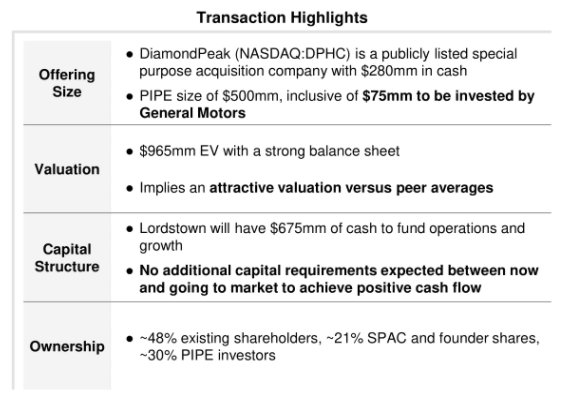
Don’t take my word for it. Here’s an excerpt from Lordstown’s investor deck:

You will note in the “Capital Structure” section that the company claimed that it would not need more funding to go to market.

Now Lordstown is pretty sure it’s going to need more money. If it’s putting the possible need in a filing, it means it.

Here’s what the company may do to solve its problems (formatting, bolding: TechCrunch):

To alleviate these conditions, management is currently evaluating various funding alternatives and may seek to raise additional funds through the issuance of equity, mezzanine or debt securities, through arrangements with strategic partners or through obtaining credit from government or financial institutions.

As we seek additional sources of financing, there can be no assurance that such financing would be available to us on favorable terms or at all. Our ability to obtain additional financing in the debt and equity capital markets is subject to several factors, including market and economic conditions, our performance and investor sentiment with respect to us and our industry.

In other words, the company is going to have to lever itself using debt, or dilute existing shareholders through the sale of equity, and Lordstown can’t promise that it will be able to do either “on favorable terms or at all.”

What we’re seeing here is the difference between SEC filings, which are no-bullshit zones, and SPAC decks, which are business propaganda. Shares of Lordstown fell more than 16% during regular trading, and another 6.9% in after-hours trading, as of the time of writing.

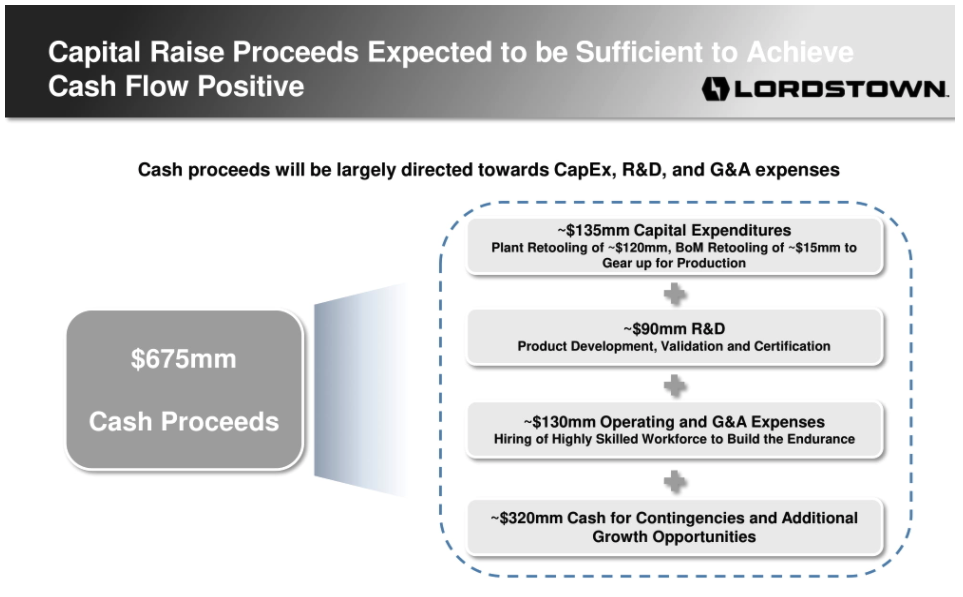
This mess from the company that put out this diagram in its investor deck:

In separate news, TechCrunch received an invite to a media availability to visit Lordstown’s operations in May, which included a note that the company “look[s] forward to opening [its] doors and showing you the latest progress from Lordstown Motors as [it] prepare[s] for the beginning of production in late September.” In a new missive sent today concerning the same event, the production timeline was not present.

So, yeah, maybe don’t trust SPAC decks much, if at all.