Year: 2021

29 Apr 2021

Google to offer 40,000 developer scholarships in Africa; continues accelerator program

Google today announced the launch of 40,000 new developer scholarships in Africa. Google will offer the scholarships — created in partnership with tech talent companies Pluralsight and Andela to developers spread across mobile and cloud development tracks.

According to the statement released by the company, Google will give full scholarships (with certifications in Android and cloud development) to the top 1,000 students (beginner and intermediate developers) at the end of the training.

The announcement, which took place from a virtual event, was also detailed in the company’s blog post. The company hosted key stakeholders in Africa’s tech ecosystem and “reviewed opportunities unfolding throughout the internet economy, paying special attention to the support of developers and startups in the region.”

In addition to the opportunities presented to developers, Google announced the continuation of its accelerator program for African startups. Going into this year, the Google for Startups Accelerator program will be hosting its sixth cohort. The three-month program is expected to start on June 21; applications are open until May 14. A virtual affair, this cohort will be a continuation of how the previous cohort panned out. 

“Last year, due to the COVID-19 pandemic, the first virtual class of Google for Startups Accelerator Africa was launched. It was the first all-online iteration of Google’s accelerator program for Africa and saw 20 startups from seven countries undergo a 12-week virtual journey to redefine their offering while receiving mentoring and attending workshops,” said Onajite Emerhor, head of Google for Startups Accelerator Africa in a statement.

“This year, with the 6th cohort, we want to continue to play our part by supporting developers and startups within the Africa tech ecosystem, ensuring they get all the access and support necessary to see them continue to grow.”

Formerly known as Google Launchpad Accelerator, Google for Startups Accelerator Africa has worked with up to 50 startups across 17 African countries. In 2020, it selected 20 startups into the program (eight from Nigeria, six from Kenya, two from South Africa and one each from Ghana, Tunisia, Ethiopia and Zimbabwe). It expects to also select startups from additional countries, including Egypt, Senegal, Tanzania and Uganda, for this sixth cohort.

“The growth of entrepreneurship is crucial, especially in the African context. African developers and startups play a critical role in the transformation of the African economy, creating new opportunities and paving the way for the economic and social development on the continent that we want to see. We recognize Africa’s exceptional digital potential, and that is why Google is committed to providing this critical support for African startups,” says Nitin Gajria, managing director of Google Sub-Saharan Africa.

Developer communities remain one of the most vital aspects of Google’s operations in the continent. It currently has more than 120 communities across 25 African countries in Sub-Saharan Africa. Besides the just-announced scholarship program and other communities like Google Developer Groups and Developer Student Clubs, Google has provided an intersection between developers and other tech players by building a Google Developers Space in Nigeria.

29 Apr 2021

Sequoia’s Shaun Maguire and Vise’s Samir Vasavada will talk success in fintech on Extra Crunch Live

In the past few weeks, we’ve heard Fifth Wall’s Brendan Wallace and Hippo’s Assaf Wand discuss the biggest opportunities in prop tech, heard why Scale AI’s Alex Wang and Accel’s Dan Levine think that unconventional VC deals can be the best option and taken a stroll through the Poshmark Series A deck with CEO Manish Chandra and Mayfield’s Navin Chaddha.

This is the particular flavor of content, rich in key insights and tactical advice for founders, that goes down on Extra Crunch Live.

In an upcoming episode on Wednesday, May 19, we’ll sit down with Sequoia’s Shaun Maguire and Vise CEO and co-founder Samir Vasavada. You can register here.

Maguire focuses on enterprise, fintech and frontier technology for Sequoia. His portfolio companies include AMP Robotics, Knowde, Physna and Vise. He joined Sequoia in 2019, before which he was a partner at GV, where he led investments in Stripe, Opendoor, IonQ, SpinLaunch, Lambda School, Dandelion Energy, Clutter and Mode and sourced the firm’s investment in Segment.

Maguire has also been an entrepreneur in his own right, co-founding Expanse (a cybersecurity company), which was ultimately acquired by Palo Alto Networks for more than $800 million.

If that weren’t enough, Maguire also spent two years working at DARPA, and was deployed to Afghanistan, participating on a team that earned a Joint Meritorious Unit Award from the U.S. Secretary of Defense.

Samir Vasavada co-founded Vise in 2016. Vise is an AI-powered investment management platform that aims to give independent financial advisors access to technology and tools to build and manage personalized portfolios for their clients, ultimately giving those advisors more time and energy to spend on the relationships.

Vise has raised upwards of $60 million.

We’ll talk to Maguire and Vasavada about what brought them together, key tips for fundraising and how to be successful in the fintech space, and ask about the next great opportunity in fintech.

On the second half of the episode, Maguire and Vasavada will put on their feedback hats and listen to live elevator pitches from the audience as part of the ECL Pitch-off. Folks attending the event will be able to raise their hand and pitch their startup to the VC/founder duo, and then answer their questions and get their feedback.

But the only way you can pitch is to show up. This episode of Extra Crunch Live goes down on Wednesday, May 19 at 3pm ET/12pm PT. Anyone can attend as long as they register here, but on-demand access to the content is reserved strictly for Extra Crunch members, who also have access to the complete library of Extra Crunch Live content, among many, many other awesome articles and perks.


29 Apr 2021

Instagram Live takes on Clubhouse with options to mute and turn off the video

In addition to Facebook’s Clubhouse competitor built within Messenger Rooms and its experiments with a Clubhouse-like Q&A platform on the web, the company is now leveraging yet another of its largest products to take on the Clubhouse threat: Instagram Live. Today, Instagram announced it’s adding new features that will allow users to mute their microphones and even turn their video off while using Instagram Live.

Instagram explains these new features will give hosts more flexibility during their livestream experiences, as they can decrease the pressure to look or sound a certain way while broadcasting live. While that may be true, the reality is that Facebook is simply taking another page from Clubhouse’s playbook by enabling a “video off” experience that encourages more serendipitous conversations.

When people don’t have to worry about how they look, they’ll often be more amenable to jumping into a voice chat. In addition, being audio-only allows creators to engage with their community while multitasking — perhaps they’re doing chores or moving around, and can’t sit and stare right at the camera. To date, this has been one of the advantages about using Clubhouse versus live video chat. You could participate in Clubhouse’s voice chat rooms without always having to give the conversation your full attention or worrying about background noise.

For the time being, hosts will not be able to turn on or off the video or mute others in the livestream, but Instagram tells us it’s working on offering more of these types of capabilities to the broadcaster, and expects to roll them out soon.

Instagram notes it tested the new features publicly earlier this week during an Instagram Live between Facebook CEO Mark Zuckerberg and Head of Instagram Adam Mosseri.

This isn’t the first feature Instagram has added in recent weeks to lure the creator community to its platform instead of Clubhouse or other competitors. In March, Instagram rolled out the option for creators to host Live Rooms that allow up to four people to broadcast at the same time. The Rooms were meant to appeal to creators who wanted to host live talk shows, expanded Q&As, and more — all experiences that are often found on Clubhouse. It also added the ability for fans to buy badges to support the hosts, to cater to the needs of professional creators looking to monetize their reach.

Although Instagram parent company Facebook already has a more direct Clubhouse clone in development with Live Audio Rooms on Facebook and Messenger, the company said it doesn’t expect it to launch into testing until this summer. And it will first be available to Groups and public figures, not the broader public.

Instagram Live’s new features, meanwhile, are rolling out to Instagram’s global audience on both iOS and Android starting today.

29 Apr 2021

Jim Belushi is chasing the magic in cannabis

I don’t think Jim Belushi was high while we talked on Zoom this week. Instead of a joint, he was puffing on a cigar, but he was still happy and smiling.

“I have my brother’s face on it. I have the Blues Brothers brand. It’s got to be good shit, man.”

Jim Belushi was telling me about his weed, specifically about the small 0.7 gram pre-rolls he sells — the perfect size for the post-Covid era, when passing a joint to a friend is likely discouraged. Belushi started his farm with 48 cannabis plants in 2015. Now, six years and one pandemic later, there are 200 plants in each of his four high-tech greenhouses along the Rogue River in southern Oregon.

“I’m always chasing magic,” Belushi said.

We were talking about his new greenhouses supplied in part by GrowGeneration, but Belushi cannot stop gushing about the benefits of cannabis. More than just a celebrity with a weed brand, Belushi is a fully-committed cannabis advocate.

“It’s magic when I do the Blues Brothers,” he said. “And I chase magic on a film set when I’m acting, and chase magic when I’m singing. I mean, I’m always chasing magic, and I’m going to do this cannabis business because there’s magic here.”

Belushi is among a recent group of celebrities diving deep into the world of cannabis. And he’s not shy about it. Look at his social media footprint. Belushi’s Twitter name is ‘Cannabis Farmer: Jim Belushi‘. His TikTok and Instagram feeds are full of clips from his farm. He even has a TV series on Discovery about his farm: “Growing Belushi.”

Cannabis is Belushi’s life right now. He even recently turned down a movie role because filming would take place in the fall, during harvest time. His agent didn’t approve of passing on the opportunity, and told Belushi he represents actors, not farmers. But according to Jim, cannabis farming is more important than acting.

“I’m a cross between Elmer Fudd and Bill Murray,” Belushi confesses. Like Murray in Caddyshack, Belushi is just good enough to be dangerous. According to Belushi, he’s been on the farm more than 200 days during the last year. In his eyes, this is what sets his apart from other celebrity cannabis operations.

Growing cannabis is more than a branding play for Belushi. It’s clear he’s not just trading his credibility and body of work for a hefty check; he’s on the farm, working the land, and tending to the bud he’s dealing.

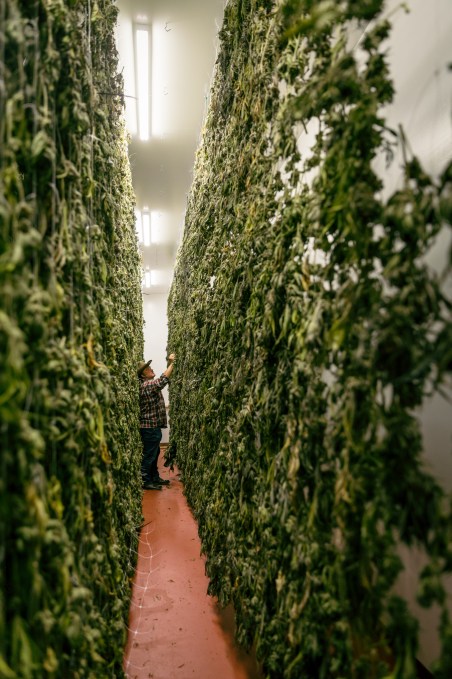
“My hand is in the soil,” he said, explaining he works the land, ensuring the pH is correct, and that the soil is at the right temperature. He’s curing, smelling, testing, and tasting his crop.

“You know, my name is on it, my brother’s name is on it, and I’m not just throwing it out there,” Belushi said. “I’m really farming, and I’m loving this profession.”
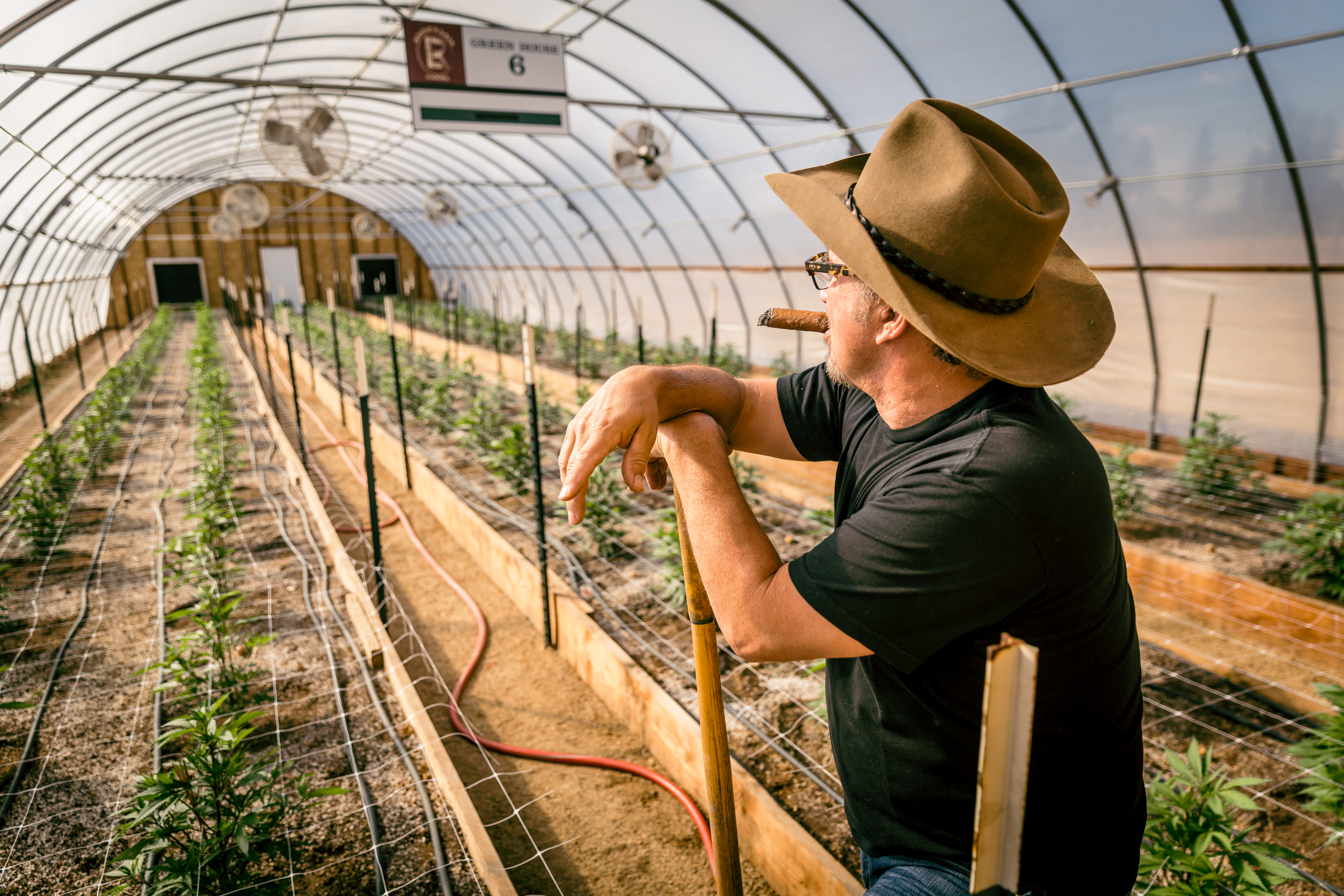
Image Credits: Belushi Farms

Helping Mother Nature

Like many cultivators, Belushi turned to technology to combat pests and increase yields. A team from GrowGeneration outfitted his farm with the goods to mitigate pests and improve the quality. He says what they were selling for $1,000 a pound a year ago is now going for $2,200 a pound, and points to the improved growing facility as a significant factor.

Jeremy Corrao, VP of Commercial Operations at GrowGeneration, says the cannabis industry benefits from a range of new technologies that enable operators to see a faster return on their investments. He points to new lighting technology as an example.

“We’re seeing the most movement in people moving from energy-inefficient solutions into energy-efficient solutions,” Corrao said, explaining that the industry still has doubters who are hesitant of new technology. Yet, he says it’s lowering the cost of goods and improving ROI.

Corrao explains that functions and practices found throughout the agriculture industry are finally making their way to cannabis cultivators such as Belushi.

Yet even with new greenhouses complete with automated systems, some growers like Jim Belushi still rely on nature for help.

“[Belushi Farm] is in Southern Oregon with 192 days of sun,” Belushi said, stressing his love for the area. Moreover, his new greenhouses rely on the Oregon sun and still offer localized climate control, and pest management, which means he can have four growth cycles per year. This hybrid approach forgoes a closed climate system in favor of something that works within Belushi’s world.
More than branding

As legalization draws closer, cultivators are constantly look for an edge amid more competition — better soil, quicker harvest cycles, new strains — and Belushi has his name.

“Has the Belushi name always been associated with pot?” I ask Jim. I’m thinking back to the days of his departed brother, John Belushi, the always-on, always-authentic star of the 1970’s and ’80s. After all, substances were imbibed, smoked, and regularly snorted in those days, and John Belushi was a manic presence in much of 1980s comedy.

“Not pot, but fun”, he says after some thought. Jim gives credit to his brother John for starting the Belushi brand in 1975. To him, the Belushi brand represents “trying to make people feel good with a sense of humor or entertainment.”

Look at the brands from Belushi Farm: Blues Brothers, Belushi’s Secret Stash, and Captain Jack, named after the O.G. weed dealer of the early days of Saturday Night Live. Each of these brands offers strains true to Jim Belushi’s perspective on his name, too. There’s hardly anything offered with THC levels that would be considered gas (aka, stuff that gets you really high), but each offers respectable characteristics. That’s by design.

“My stuff has more to do with great blends of terpenes and THC,” Belushi said. “[This is] to create more of a medicinal effect that sends someone on a pathway to healing.” He added, laughingly, he has a couple of strains hasn’t smoked. He’s scared of them. Likewise, he looks at some of the strains offered by other celebrities as ready to rip and roar thanks to sky-high levels of THC. He hasn’t tried those either.

I ask why he thinks it’s exciting and newsworthy when celebrities launch a cannabis brand. Belushi is hardly the only one doing it. Seth Rogen and Evan Goldberg just launched Houseplant in the U.S., a cannabis brand offering dried flower and house goods. There’s Jay-Z with his upscale cannabis brand, Monogram. Even Martha Stewart is hawking cannabis, albeit in CBD gummy form.

Belushi is hesitant to compare his product to his celebrity competitors (probably related to his self-identification as a cultivator), but points to Snoop and Willy’s original celebrity pot brands as paving the way for him and others.

The failed war on drugs

New regulations are quickly changing the cannabis industry. As more states decriminalize and regulate cannabis, different industry segments are looking to the federal government to loosen its hold on the cannabis business.

For Belushi, access to traditional banking services would immediately impact him and the industry as a whole. And it could be coming soon: Two weeks ago, the U.S. House of Representatives passed a banking bill with broad bipartisan support.

“This is a very exciting time in the cannabis world,” Belushi said. “People have seen changes in others [who partake in cannabis]. Tumors are shrinking, seizures are stopping, people are sleeping, and people are getting better. It’s interesting because, no matter if you’re conservative or liberal or old or young, everybody knows someone that has suffered deeply.”

“Cannabis is not a gateway to drugs,” Belushi said. “It’s a pathway to healing.”

And yet, there are countless individuals in prison because of this so-called pathway to healing. Jim Belushi is working on that, too.

“Get them out,” Jim shouted when I talked about the Last Prisoner Project’s current goals. He’s referring to those incarcerated for crimes involving cannabis. To Belushi, who helps the cannabis activist group, this is a serious effort.

“It’s time to shift some energy to real justice,” Belushi said with deep passion. “Look at the Last Prisoner Project. It’s really a symbol that the war on drugs is over. It’s done. It’s ruined. The war on drugs ruined us. It ruined black and brown communities, which were especially hard hit.”

“Don’t get me started,” Belushi warned, as he laughed and calmed down.

The Last Prisoner Project was founded in 2019 by Steve DeAngelo and seeks cannabis criminal justice reform. The organization is made up of activists, attorneys, advocates, and others, including Belushi, who is an advisor. It’s clear he has a deep respect for the Last Prisoner Project’s founder and leader, Steve DeAngelo. “There’s no better hustler in the world than Steve DeAngelo,” he said. “Man, he’s just relentless, and it’s beautiful to watch.”

Belushi says the project is riding a wave right now, and they’re finding more states’ Attorneys General are answering their calls. But there are still needs, he says. The project can always use capital, as a lot of the work is done pro bono. And there’s a constant need for people to write letters and sign petitions — all of which are readily available on the project’s website here.

“And it would be great if people in the [cannabis] industry hire those that get out,” Belushi said, calling on the industry to lean in and help “these men and women who have been incarcerated for so long.”

He’s not just suggesting it as a course of action for others; he’s actively helping raise capital, too. The Blues Brothers is hosting a fundraiser at M.J. Unpacked this coming October in Las Vegas. Belushi, actor, comedian, weed farmer, and now a member of the Blues Brothers beamed as he spoke about performing for the Last Prisoner Project.

“We’re gonna have a big party there,” he said, “and we’re going to raise lots of funds, too.”

Because everybody needs someone to love.

29 Apr 2021

Click Studios asks customers to stop tweeting about its Passwordstate data breach

Australian security software house Click Studios has told customers not to post emails sent by the company about its data breach, which allowed malicious hackers to push a malicious update to its flagship enterprise password manager Passwordstate to steal customer passwords.

Last week, the company told customers to “commence resetting all passwords” stored in its flagship password manager after the hackers pushed the malicious update to customers over a 28-hour window between April 20-22. The malicious update was designed to contact the attacker’s servers to retrieve malware designed to steal and send the password manager’s contents back to the attackers.

In an email to customers, Click Studios did not say how the attackers compromised the password manager’s update feature, but included a link to a security fix.

But news of the breach only became public after after Danish cybersecurity firm CSIS Group published a blog post with details of the attack hours after Click Studios emailed its customers.

Click Studios claims Passwordstate is used by “more than 29,000 customers,” including in the Fortune 500, government, banking, defense and aerospace, and most major industries.

In an update on its website, Click Studios said in a Wednesday advisory that customers are “requested not to post Click Studios correspondence on Social Media.” The email adds: “It is expected that the bad actor is actively monitoring Social Media, looking for information they can use to their advantage, for related attacks.”

“It is expected the bad actor is actively monitoring social media for information on the compromise and exploit. It is important customers do not post information on Social Media that can be used by the bad actor. This has happened with phishing emails being sent that replicate Click Studios email content,” the company said.

Besides a handful of advisories published by the company since the breach was discovered, the company has refused to comment or respond to questions.

It’s also not clear if the company has disclosed the breach to U.S. and EU authorities where the company has customers, but where data breach notification rules obligate companies to disclose incidents timely. Companies can be fined up to 4% of their annual global revenue for falling foul of Europe’s GDPR rules.

Click Studios chief executive Mark Sandford has not responded to repeated requests for comment by TechCrunch. Instead, TechCrunch received the same canned autoresponse from the company’s support email saying that the company’s staff are “focused only on assisting customers technically.”

TechCrunch emailed Sandford again on Thursday for comment on the latest advisory, but did not hear back.

29 Apr 2021

IBM is acquiring cloud app management firm Turbonomic for up to $2B

IBM today made another acquisition to deepen its reach into providing enterprises with AI-based services to manage their networks and workloads. It announced that it is acquiring Turbonomic, a company that provides tools to manage application performance (specifically resource management), along with Kubernetes and network performance, part of its bigger strategy to bring more AI into IT ops, or as it calls it, AIOps.

Financial terms of the deal were not disclosed but according to data in PitchBook, Turbonomic was valued at nearly $1 billion — $963 million, to be exact — in its last funding round in September 2019. A report in Reuters rumoring the deal a little earlier today valued it at between $1.5 billion and $2 billion, and a source tells us the figure is accurate.

The Boston-based company’s investors included General Atlantic, Cisco, Bain, Highland Capital Partners, and Red Hat. The last of these, of course, is now a part of IBM (so it was theoretically also an investor), and together Red Hat and IBM have been developing a range of cloud-based tools addressing telco, edge and enterprise use cases.

This latest deal will help extend that further, and it has more generally been an area that IBM has been aggressive in recently. Last November IBM acquired another company called Instana to bring application performance management into its stable, and it pointed out today that the Turbonomic deal will complement that and the two technologies’ tools will be integrated together, IBM said.

Turbonomic’s tools are particularly useful in hybrid cloud architectures, which involve not just on-premise and cloud workloads, but workloads that typically are extended across multiple cloud environments. While this may be the architecture people apply for more resilience, reasons of cost, location or other practicalities, the fact of the matter is that it can be a challenge to manage. Turbonomic’s tools automate management, analyse performance, and suggest changes for network operations engineers to make to meet usage demands.

“Businesses are looking for AI-driven software to help them manage the scale and complexity challenges of running applications cross-cloud,” said Ben Nye, CEO, Turbonomic, in a statement. “Turbonomic not only prescribes actions, but allows customers to take them. The combination of IBM and Turbonomic will continuously assure target application response times even during peak demand.”

The bigger picture for IBM is that it’s another sign of how the company is continuing to move away from its legacy business based around servers and deeper into services, and specifically services on the infrastructure of the future, cloud-based networks.

“IBM continues to reshape its future as a hybrid cloud and AI company,” said Rob Thomas, SVP, IBM Cloud and Data Platform, in a statement. “The Turbonomic acquisition is yet another example of our commitment to making the most impactful investments to advance this strategy and ensure customers find the most innovative ways to fuel their digital transformations.”

A large part of the AI promise in the world of network operations and IT ops is how it will afford companies to rely more on automation, another area where IBM has been very active. (In a very different application of this technology — in business services — this month, it acquired MyInvenio in Italy to bring process mining technology in house.)

The promise of automation, meanwhile, is lower operation costs, a critical issue for managing network performance and availability in hybrid cloud deployments.

“We believe that AI-powered automation has become inevitable, helping to make all information-centric jobs more productive,” said Dinesh Nirmal, General Manager, IBM Automation, in a statement. “That’s why IBM continues to invest in providing our customers with a one-stop shop of AI-powered automation capabilities that spans business processes and IT. The addition of Turbonomic now takes our portfolio another major step forward by ensuring customers will have full visibility into what is going on throughout their hybrid cloud infrastructure, and across their entire enterprise.”

29 Apr 2021

U.S. video game spending increased 30% in Q1

Even as signs of hope for life after the pandemic have begun to emerge here in the U.S., increases in video game spending continue. There’s no doubt that much of last year’s big numbers were driven by stay-at-home requirements in much of the country and the world. All said, U.S. spending on the industry increased 27% for 2020.

There remains a broader question, however, around whether this momentum can maintain, as people start to, you know, leave the house more. For now, at least, things are continuing to look rosy for the industry. NPD noted this morning that U.S. spending on the category jumped 30% y-o-y for Q1 2021 to $14.92 billion.

When we break the number down a bit, however, it becomes clear that the driver goes beyond mere pandemic entertainment. Content was up 25% for the quarter, accessories jumped 42% and hardware went up 82%.

The motivator behind that last figure should be immediately obvious to anyone who follows the industry with any among of interest. Where Nintendo’s Switch dominated the conversation for most of 2020, Sony and Microsoft both launched their next gen consoles late-last year.

“While we are still seeing elevated rates of both engagement and spending resulting from changes in consumer behavior driven by the pandemic, we are also seeing cyclical gains from the November launches of both the PlayStation 5 and Xbox Series consoles,” analyst Mat Piscatella said in a release The growth driven by these new platforms, combined with gains experienced in mobile, PC and VR content spending, as well as the continued strength of Nintendo Switch, have pushed the market to new highs.”

29 Apr 2021

Fintech startups set VC records as the 2021 fundraising market continues to impress

While waiting for full first-quarter venture capital results for fintech startups to drop, we knew that they were going to be outsized. The Exchange previously explored the pace at which huge venture rounds were invested into the startup niche, noting that by mid-March the fintech market had already recorded a record number of $100 million rounds.

But the largest venture capital rounds are only part of the fintech investing picture, so we were looking forward to getting a deeper look into what happened in the critical startup sector more generally. We’ve now got the data, so today we’re digging in with both hands.


The Exchange explores startups, markets and money. Read it every morning on Extra Crunch or get The Exchange newsletter every Saturday.


Per a CB Insights compilation of Q1 2021 fintech venture capital data from around the world, the first three months of the year were the most valuable period for fintech investing, ever. Somewhat shockingly, the first quarter beat the infamous second quarter of 2018, when Ant Group raised a $14 billion round, so skewing the category’s longitudinal data that some analyst groups simply discount it for analytical purposes.

It wasn’t necessary this time: The 614 tracked fintech deals in Q1 were worth a total of $22.8 billion, per the report, enough to set an all-time high, Ant Group be damned. Per CB Insights, the quarter’s fintech VC deal volume rose a modest 15% compared to the year-ago quarter, while VC dollar volume in the sector shot 98% higher over the same interval.

The boom in funding was a global affair, as we’ll get into shortly. We’re also going to chat sub-sectors in the fintech world, parsing where there’s the most venture activity to track, and, critically, where VCs are pushing — or pulling back — their attention and capital.

So, where did the fintech venture capital market push the most money in the first quarter, and why? We’ll be chatting data as we go, but The Exchange also enlisted VCs from three continents who have made fintech investments to help provide context: We’ll hear from Jesse Wedler, a partner at CapitalG based in North America; Kola Aina, a general partner at Ventures Platform based in Africa; and Shiyan Koh, a general partner at Hustle Fund based in Asia.

Let’s talk a few key fintech numbers, and then rip into venture results by geography and focus.

Huge checks, myriad exits

While we’re looking beyond the largest checks today to get a more holistic perspective on the state of the fintech venture capital world, we cannot discount them. So, briefly, what matters from the mega-round space, or the funding category of rounds worth nine figures and more? Some 57 were raised by fintech startups around the world in the first quarter, or about 4.5 per week. That number was 30 in Q4 2020, and just 21 in Q1 2020.

The first quarter’s 57 mega-deals were worth a huge 69% of total venture capital in the fintech space during the quarter. Don’t be shocked by that figure; a single mega-round can add up to the value of 50 seed deals pretty easily.

The huge results should also not be a complete surprise, CapitalG’s Wedler told TechCrunch in an email, as “the reality is that fintech has been a hot category for years.” What could be driving the recent acceleration in capital disbursement into financial technology startups? Wedler mused it’s a combination of “the ubiquity of smartphones and the modern internet, the development of modern cloud technology, and advancements in APIs and modular services.”

29 Apr 2021

Google Pay update adds grocery offers, transit expansions, and spending insights

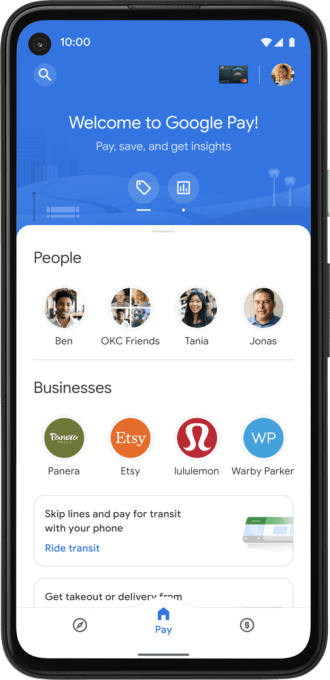
Following November’s overhaul of Google Pay, which saw the service expanding into personal finance, the company today is rolling out a new set of features aimed at making Google Pay more a part of its users’ everyday lives. With an update, Google Pay will now include new options for grocery savings, paying for public transit, and categorizing their spending.

Through partnerships with Safeway and Target, Google Pay users will now be able to browse their store’s weekly circulars that showcase the latest deals. Safeway is bringing over 500 stores to the Google Pay platform, and Target stores nationwide will offer a similar feature. Google Pay users will be able to favorite the recommended deals for later access. And soon, Google Pay will notify you of the weekly deals when you’re near a participating store, if location is enabled.

Image Credits: Google

Another update expands Google Pay’s transit features, which already today support buying and using transit tickets across over 80 cities in the U.S. New additions arriving soon now include major markets, Chicago and the San Francisco Bay Area. This follows Apple Pay’s recently added and much welcomed support for the Bay Area’s Clipper card. The company is also integrating with Token Transit to expand transit support to smaller towns across the U.S.

Soon, the Google Pay app will also allow Android users to access transit tickets from the app’s homescreen through a “Ride Transit” shortcut. They can then purchase, add, or top up the balance on transit cards. Once purchased, you’ll be able to hold up your transit card to a reader — or show a visual ticket in the case there’s no reader.

The final feature is designed for those using Google Pay for managing their finances. With last year’s revamp, Google partnered with 11 banks to launch a new kind of bank account it called Plex. A competitor to the growing number of mobile-only digital banks, Google’s app serves as the front-end to the accounts which are actually hosted by the partner banks, like Citi and Stanford Federal Credit Union.

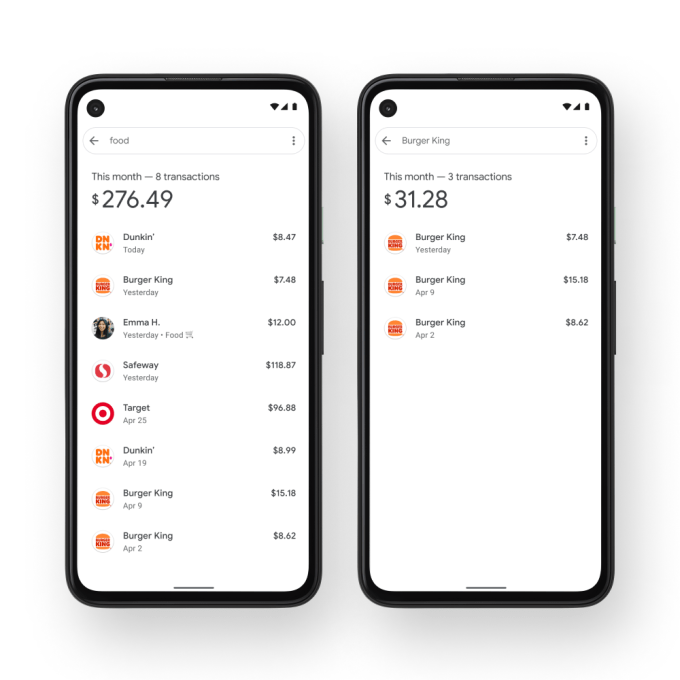
As a part of that experience, Google Pay users will now gain better access into their spending behavior, balances, bills, and more via an “Insights” tab. Here, you’ll be able to see what your balance is, what bills are coming due, get alerts about larger transactions, and tracking spending by either category or business. As Google is now automatically categorizing transactions, that means you’ll be able to search for general terms (like “food”) as well as by specific business names (like “Burger King”), Google explains.

Image Credits: Google

These features are a part of Google’s plan to use the payments app to gain access more data on users, who can then be targeted with offers from Google Pay partners.

When the redesigned app launched, users were asked to opt in to personalization features which could help the app show users better, more relevant deals. While Google says it’s not providing your data directly to these third-party brands and retailers, the app provides a conduit for those businesses to reach potential customers at a time when the tracking industry is in upheaval over Apple’s privacy changes. Google ability to help brands reach consumers through Google Pay could prove to be a valuable service, if the is able to grow its user base, and encourage more to opt in to the personalization features.

To make that happen, you can expect Google Pay to roll out more useful or “must have” features in the weeks to come.

29 Apr 2021

Firstbase raises $13M to make remote work suck less

The chance that I am ever willing to commute on a regular basis again in the future is zero. It’s too inefficient. And while workers and employers are somewhat split on where they stand on the question of remote toil, the COVID-19 pandemic has permanently shaken up the working world; we’re not going back to the pre-COVID normal.

To support what could be droves of workers sticking to distance-labor instead of returning to offices, Firstbase is building a software-and-hardware solution to quickly get remote workers the tools and support they need. And today the company announced that it closed a $13 million Series A led by Andreessen Horowitz. B Capital Group and Alpaca VC also put capital into the round; TechCrunch first caught wind of Firstbase when it took part in an Acceleprise accelerator cohort in mid-2020.

Notably Firstbase didn’t start with its current product focus. As is common amongst startups, it was born as something else entirely. With an original fintech bent, the company went remote back in 2018. But the experience wasn’t stellar, Firstbase co-founder and CEO Chris Herd told TechCrunch. It was hard to get workers the technology they needed, and hard to get it back if they left the company, he explained.

Later, with the fintech effort low on capital and time, the company realized that some internal tech it had built to help support remote staff’s hardware and software needs might have broader application. Firstbase pivoted in late 2019, and by March of 2020 Herd told TechCrunch that his company had 600 companies on its waitlist. That number has since multiplied.

The company’s product is two-fold. It’s a software service that help companies track, and manage their hardware assets that remote workers use. And it’s a hardware service that can pre-install software on hardware and ship it to employees, and provide remote IT support. Notably customers can either use Firstbase’s software alone, which they pay for on a SaaS basis, or both its software and hardware offerings.

Firstbase has two sources of gross margin. Its software business will generate obvious software incomes, and the company can extract gross profit from its hardware business, Herd explained. The hardware part of the startup’s model appears more nascent than the software component. Firstbase only began onboarding customers last November, making it a yet-nascent startup that is allowed to still be figuring things out.

TechCrunch asked Herd what it costs to kit out a remote worker today. He said that it varied, but could land between $2,000 and $5,000, though he added that Firstbase will allow customers to pay those costs over time as a series of flat payments.

What’s ahead for the company? Per its CEO, the merely ten-person company, three of whom are part time, would like to grow its staff by four or five-fold this year. And unsurprisingly, Firstbase intends to hew to its remote roots, meaning that it won’t be looking for workers in a single geographic region. Some of the staff it intends on hiring will be in its sales org, a focus that Herd mentioned during our interview. The company will also build out more enterprise-friendly software features with its new capital, allowing it to target larger customers.

Let’s see how far Firstbase can scale with its Series A. And if it gets pre-empted before the year ends.