Year: 2021

27 Apr 2021

SaaS subscriptions may be short-serving your customers

Like all business operators and investors, I value recurring revenue. From my time as president & CFO of Shutterstock and in many other positions over the last 15 years, I have seen just how powerful a pitch-perfect subscription model can be for scaling quickly and responsibly.

However, Software-as-a-Service (SaaS) has perhaps become a bit too interchangeable with subscription models. Every software company now looks to sell by subscription ASAP, but the model itself might not fit all industries or, more importantly, align with customer needs, especially early on.

New categories make for skeptical customers

In established categories, customers have preconceived ideas as to what a software product should look like and how it should work and be sold. In most cases, this aligns with subscriptions. Customers are just used to it.

However, newer categories of software that address fresh problems-to-solve bring more skeptical, or at least, less experienced customers. They usually want to try a variety of solutions before they settle on the one that works for them. This means they will naturally value flexible terms more than the companies in established categories might.

Requiring commitment via subscriptions or larger agreements up front, in this environment, might actually hurt you rather than help you solidify your value proposition. Moreover, it certainly does not align with the customer’s need to identify the best solution for them by trying several.

A great example of this is the virtual events category. The COVID-19 pandemic instantly created a massive need for better virtual event software. Initially, people tried to use standard video call software for this purpose, but quickly came to the conclusion that they needed more customized solutions, since, as we all now know (and event planners knew all along), events are not meetings!

What happened? Lots of new virtual event companies and products sprang up, and with no established favorite and no clear understanding of the category, customers wanted to try out a variety of solutions. A similar series of events unfolds regularly in many other categories.

27 Apr 2021

Ushopal looks to charm China’s beauty lovers with niche Western brands

What will China’s answer to Estée Lauder look like in the digital age?

According to Ushopal, it will provide a seamless online and offline shopping experience, where China’s savvy beauty shoppers get to discover niche, tasteful brands and learn their stories.

Ushopal was founded in 2017 by J&J veteran Lu Guo as an “omni-channel” partner for luxury beauty brands at a time when online and offline consumption were increasingly merging in China. Unlike traditional import distributors, which simply puts goods on the shelves, Ushopal offers a holistic solution that helps brands develop their digital and brick-and-mortar retail channels as well as marketing content through its network of 2,500 influencers.

Ushopal felt that patnerships weren’t enough, so in 2019, it took a step further by adding a strategic investment arm to seek deeper operational influence on brands. Check sizes range from $10 million to $100 million, and for the larger rounds, Ushopal says it can leverage its own investors such as Cathay Capital, a private equity firm focused on global companies.

For instance, Cathay Capital bought a minority stake in the Paris-based, high-end fragrance brand Juliette Has A Gun. As its investor and partner, Ushopal helped the brand, which was founded by the grandson of the legendary couturier Nina Ricci, grow its gross merchandise value in China from zero to over 70 million yuan within a year.

To boost its capital pool, Ushopal raised $100 million in March that lifted its total fundings to $200 million. Aside from Cathay Capital, its past investors also include FountainVest Partners, a Chinese private equity firm that recently acquired the Canadian premium outdoor clothing label Arc’teryx, and Chinaccelerator, SOSV’s China-based accelerator focused on cross-border businesses.

Chinese consumers are hooked to e-commerce today, but there is still much of the shopping experience that Alibaba’s marketplace and WeChat mini-stores can’t offer. As such, Ushopal opened its first multi-brand store in an upscale mall in Shanghai last year, carrying brands that are normally found in Neiman Marcus in the U.S. and Le Bon Marché in Paris. The goal is to showcase treasures from around the world, an idea that is captured by the chain’s name — Bonnie&Clyde — the names of a Depression-era crime couple who is often depicted as chic and rebellious in popular culture.

Customers don’t pay at B&C’s brick-and-mortar store; instead, they order through its app and can have the order delivered to their doorsteps within four hours if they live in Shanghai. The delivery time is much shorter than China’s standard e-commerce import practice, which normally takes three to seven days for goods to arrive from their overseas distribution centers.

B&C, on the other hand, stockpiles in its own warehouse in a free trade zone in Shanghai, which allows for much quicker delivery. And since it holds exclusive and selective distribution rights to the brands it works with, it has a good grasp over how much inventory to keep.

A promotional short video made by Ushopal for Juliette Has A Gun in China

At China’s beauty stores targeting the mass market, shoppers are often seen moving from one busily stocked shelf to another while their eyes are fixated on their phones, browsing product reviews on content commerce apps like Xiaohongshu. B&C wants full attention from its customers by limiting its in-store product number and statinoing a team of beauty advisors. The demographics it targets are also quite different.

“When they are traveling in the U.S., they are going to Barneys, Saxs Fifth Avenue and whey they are in the U.K., they are going to Harrods,” Lau, vice president of brands at Ushopal, told TechCrunch in an interview. “They are familiar with the experience, and they are not here to line up.”

Last year, B&C generated over $200 million in gross merchandise value through the products it bought from a dozen of brands and subsequently sold in China. The average ticket size of its sales was over 5,000 yuan ($770), with shoppers often spending over 10,000 yuan per order, according to Lau. Many of the customers were what he called “second-generation rich,” roughly China’s equivalent to trust fund kids, as well as “trophy wives.”

Ushopal doesn’t limit its portfolio to overseas products. It doesn’t distinguish the origin of a brand, said Lau, whether it’s Chinese, Japanese or European. Though the company mainly works with Western brands at the moment, Lau said Chinese brands are becoming more sophisticated and often understand the local market better.

“For us, it’s just about creating great brands. It’s like Estée Lauder, which has brands from all over the world. We are a China-based company but a global luxury business.”

27 Apr 2021

Kids-focused fintech Greenlight raises $260M in a16z-led Series D, nearly doubles valuation to $2.3B

Greenlight, the fintech company that pitches parents on kid-friendly bank accounts, has raised $260 million in a Series D funding round that nearly doubles its valuation to $2.3 billion.

The funding comes just months after the Atlanta-based startup landed $215 million in funding at a $1.2 billion valuation. With the latest round, Greenlight has now raised over $550 million.

Andreessen Horowitz (a16z) led its Series D, which also included participation from return backers TTV Capital, Canapi Ventures, Wells Fargo Strategic Capital, BOND, Fin VC, Goodwater Capital, as well as new investors Wellington Management, Owl Ventures and LionTree Partners.

Since it launched its debit cards for kids in 2017, the company has managed to set up accounts for more than 3 million parents and children, who have saved more than $120 million through the app. That’s up from 2 million parents and kids having saved $50 million at the time of its September 2020 raise.

Overall, Greenlight says it has “more than tripled” YoY revenue, more than doubled the number of parents and kids on its platform and doubled the size of its team within the past year. 

“Greenlight has quickly emerged as a leader in the family finance category,” said Andreessen Horowitz general partner David George, who will join Greenlight’s board of directors, in a written statement. “Greenlight was built to help parents raise financially-smart kids, and with its breakthrough combination of easy-to-use money management tools and educational resources, the company is well-positioned to become one of the most loved and trusted brands for families around the world.”

The company pitches itself as more than just a debit card, with apps that give parents the ability to deposit money in accounts and pay for allowance, manage chores and set flexible controls on how much kids can spend. In January, Greenlight introduced its educational investing platform for kids — Greenlight Max. Through that platform, kids can research stocks with analysis from Morningstar and actually make real investments in companies like Apple, Tesla, Microsoft and Amazon as long as their parents approve.

As TechCrunch previously reported, it’s a potentially massive business that can lock in a whole generation to a financial services platform, which is likely one reason why a whole slew of companies have launched with a similar thesis. There’s Kard, Step, Till Financial and Current pitching similar businesses in the U.S. and Mozper recently launched from Y Combinator to bring the model to Latin America. (Step and Current also announced big rounds today, while Till Financial announced its seed round last week).

“Our vision at Greenlight is to create a world where every child grows up to be financially healthy and happy,” said Tim Sheehan, co-founder and CEO of Greenlight. “Today’s financing will enable us to bring even more value to families as we continue to introduce new innovative products that shine a light on the world of money.”

 Greenlight says it will use the new capital to accelerate product development to add more financial services to its platform as well as to invest further in strategic distribution partnerships and geographic expansion. It also plans to hire another 300 employees over the next two years, with an emphasis on engineers.


27 Apr 2021

Vista Equity takes minority stake in Canada’s Vena with $242M investment

Vena, a Canadian company focused on the Corporate Performance Management (CPM) software space, has raised $242 million in Series C funding from Vista Equity Partners.

As part of the financing, Vista Equity is taking a minority stake in the company. The round follows $25 million in financing from CIBC Innovation Banking last September, and brings Vena’s total raised since its 2011 inception to over $363 million.

Vena declined to provide any financial metrics or the valuation at which the new capital was raised, saying only that its “consistent growth and…strong customer retention and satisfaction metrics created real demand” as it considered raising its C round.

The company was originally founded as a B2B provider of planning, budgeting and forecasting software. Over time, it’s evolved into what it describes as a “fully cloud-native, corporate performance management platform” that aims to empower finance, operations and business leaders to “Plan to Growtheir businesses. Its customers hail from a variety of industries, including banking, SaaS, manufacturing, healthcare, insurance and higher education. Among its over 900 customers are the Kansas City Chiefs, Coca-Cola Consolidated, World Vision International and ELF Cosmetics.

Vena CEO Hunter Madeley told TechCrunch the latest raise is “mostly an acceleration story for Vena, rather than charting new paths.”

The company plans to use its new funds to build out and enable its go-to-market efforts as well as invest in its product development roadmap. It’s not really looking to enter new markets, considering it’s seeing what it describes as “tremendous demand” in the markets it currently serves directly and through its partner network.

“While we support customers across the globe, we’ll stay focused on growing our North American, U.K. and European business in the near term,” Madeley said.

Vena says it leverages the “flexibility and familiarity” of an Excel interface within its “secure” Complete Planning platform. That platform, it adds, brings people, processes and systems into a single source solution to help organizations automate and streamline finance-led processes, accelerate complex business processes and “connect the dots between departments and plan with the power of unified data.”            

Early backers JMI Equity and Centana Growth Partners will remain active, partnering with Vista “to help support Vena’s continued momentum,” the company said. As part of the raise, Vista Equity Managing Director Kim Eaton and Marc Teillon, senior managing director and co-head of Vista’s Foundation Fund, will join the company’s board.

“The pandemic has emphasized the need for agile financial planning processes as companies respond to quickly-changing market conditions, and Vena is uniquely positioned to help businesses address the challenges required to scale their processes through this pandemic and beyond,” said Eaton in a written statement. 

Vena currently has more than 450 employees across the U.S., Canada and the U.K., up from 393 last year at this time.

27 Apr 2021

Instreamatic, which inserts interactive voice ads into audio streams, raises $6.1M Series A round

Interactive voice advertising startup Instreamatic, which can insert interactive voice ads into an audio stream, has raised $6.1 million in a Series A funding led by Progress Ventures led the round, joined by Accomplice, and Google Assistant Investments.

SF-HQ’d Instreamatic lets brands that advertise through streaming music apps and podcasts (for instance) have interactive voice-based dialogues with consumers. So instead of an audio ad playing in a one-way experience (as all adverts currently do), the listener can talk to, and interact, with the ad.

For example, when an Instreamatic advert says “Hello! Need help sleeping?” the microphone on the device it’s playing on opens, and the listener can respond however they like. If they say “Yes” then the brand’s voice (perhaps it’s a mattress brand) will respond with “Then we will sing you a lullaby”. If the user doesn’t respond then the ad experience is over and the content resumes playing. There are also more complex versions of this scenario. The key is that Instreamatic knows what happened and can tailor future ads to match the listener’s past engagement. Here’s an example.

The company says its technology can understand the ‘intent and tone’ of consumers’ natural responses to take the next action.

The upshot is that this AI-fueled voice ad could be coming to an audio stream near you soon. And with audio exploding following the pandemic, the platform is likely to benefit.

CEO Stas Tushinskiy, CEO, Instreamatic said in a statement: “Consumers don’t like being fed annoyingly repetitive ads. Brands are under ever-increasing pressure to make those moments meaningful while supporting strong ROI demands. On the publisher side, audio and video platforms need a better way to prove their audiences and ad inventory deliver their promise to brands. Our voice AI infrastructure, deployed by brands such as IKEA, Infiniti, and HP and across platforms like Pandora and Gaana, is empirically demonstrating that conversational marketing benefits brands, consumers, and publishers alike.”

Instreamatic says its voice ads can reach an average of 12% engagement, with some campaigns reaching 19%. These figures are quite unusual for the online advertising industry – the average CTR of mobile advertising is 0.6%.

The company says that a recent campaign by Infiniti saw 5.5% of listeners who declined the offer in the first conversation ask to receive more information about the vehicle after the second (and more personalized) chat.

Instreamatic also says it can achieve what it calls ‘continuous dialogues’ with consumers, not dissimilar to an Alexa or Siri device.

Because of the platforms complexity, Instreamatic also says it can build up a profile of the user based on an individual consumer’s previous interactions with a brand, allowing it to customize future campaigns.

So far brands that have used the platform include Pandora, Salem Media, Gaana (the Indian streaming music service), as well as a recent deal with Universal Electronics to expand voice ads into the smart-TV industry. It is also working with Triton Digital, one of the larger audio ad networks.

 
“Consumer demand for audio and video content, and the ubiquity of smart devices delivering that content on-demand, continues to accelerate,” said Nick MacShane, the founding partner at Progress Ventures, the venture capital arm of Progress Partners, a full-service merchant bank. “What hasn’t caught up is how brands and publishers can effectively engage those audiences in the same medium and analytically prove the ROI of their audio and video platform ad spend.”
 
A competitor to Instreamatic is AdsWizz, which, instead of voice, allows users to shake their phones when they are interested in an ad. But its interactions are obviously, therefore, more limited.

According to Juniper Research, the voice-based ad market will grow to $19 billion in the U.S. by 2022, growing the market share from the $17 billion audio ad market and the $57 billion programmatic ad market. Voice assistant usage is booming. Some estimates put it at over at 3 billion right, and half of all searches are expected to be done via voice. Some 55% of teens use voice search daily.

As well as Tushinskiy, the Instreamatic team also includes cofounder Simon Dunlop (former CEO/Founder of Bookmate, a subscription-based reading and audiobook platform, and Zvuk; Victor Frumkin (co-founder at Zvuk, a mobile music streaming app in Eastern Europe and Bookmate); Ilya Lityuga, CTO, one of the original team members at RuTube; and Andy Whatley, U.S. radio industry veteran.

27 Apr 2021

The UK’s plan to tackle big tech won’t be one-size fits all

The director of a new unit set up this month inside the UK’s competition watchdog — with a dedicated focus on tech giants’ impacts on digital markets — has been giving a hint of how it could operate, once it’s on a statutory footing and imbued with powers to sanction problem platforms and potentially even order some forms of structural separation.

The government announced its intention to regulate big tech in November last year — saying it would establish a “pro-competition” regime to tackle concerns associated with digital markets, such as ‘winner takes all’ network-effect dynamics.

It’s not clear when exactly that will happen — the government has only said it will do so as soon as parliamentary time allows.

The UK is devising its own approach to digital regulation now that the country is outside the European Union — where lawmakers recently proposed a major new set of pan-EU rules to apply to digital services (the Digital Services Act) and ex ante requirements for the largest tech giants (the Digital Markets Act).

EU lawmakers have also proposed draft rules for high risk applications of AI, while the UK has an Online Safety bill in the pipeline (a legislative proposal is due this year) — so there are a lot of new digital rules being written right now, and the potential for confusing and counterproductive regulatory overlap if lawmakers don’t end up on the same page.

Continued divergence of approach between the UK and the EU is, nonetheless, to be expected, even as UK lawmakers say they want to engage with the international community as they work on drafting rules to ensure a British digital rulebook aligns in spirit (if not letter) with requirements being shaped for Internet platforms elsewhere.

The UK’s Digital Markets Unit (DMU) launched earlier this month, to help support the government as it drafts legislation to put it on a statutory footing and ahead of the unit being able to function as big tech’s British overseer.

Speaking at a conference on Friday the head of the DMU, Catherine Batchelor, detailed the approach she wants the unit to take, and some of the powers it has advised the government it needs to deliver on ministers’ goal of fostering competition in tipping-prone digital markets.

Giving an overview of the issues, she said a new approach is needed to regulating digital markets owing to changed dynamics — noting that companies “who were once garage startups or started from campuses in universities [and] are now the most powerful firms across the world” — and saying tech giants have been able to accrue so much market power as a result of digital market characteristics like access to data; network effects and economies of scale associated with platform business; and the ecosystems firms have been able to build around their core businesses — leveraging those interlocking benefits of data, scale and network effects to also acquire rivals to (further) grow and consolidate a powerful position.

“You might say well what’s the danger of that? But I think we see the danger of that on a day to day basis. Firms can use this position to exploit the consumers and businesses that rely on them,” she explained. “From a business perspective that might be the price you’re paying to sell your goods and services on the marketplace or the price you’re paying to list your app in an app store or the price you’re paying to advertise your products and services.

For consumers she pointed out they may be ‘paying’ for free digital goods and services with their attention or data, highlighting concerns over whether the amount of data being provided by users is a “fair exchange” for what they’re getting in return.

On the business side, Batchelor pointed to ‘self preferencing’ as one of the problematic “exclusionary” tactics tech giants indulge in that the unit will be seeking to tackle. “The overarching impact of that is a less vibrant digital economy,” she said. “You don’t have these new tech firms coming through, able to grow in the way the ones of old were.”

The problem with trying to tackle unfair (digital) market behaviors with existing competition law is that it can’t be “proactive and preventative”, she said — hence DMU has recommended setting rules that prevent firms from engaging in such conduct in the first place.

But she also said the unit is keen to avoid the risk of over-regulating. So unlike the EU’s DMA proposal it hasn’t supported having a set list of ‘dos and don’ts’ to apply universally to all platforms which fall under scope of the regulation.

Instead she said it wants more flexibility to target requirements at specific platforms — to take account of unique characteristics and any variations in market or operation.

On the question of who would fall under scope of the incoming pro-competition regime, the unit has recommended an “evidence-based assessment” to define whether or not a firm has ‘strategic market status’ (SMS) — meaning they are “in a position which is unlikely to be transitory”, as she put it.

“Our recommendations were that to come within scope of this regime the DMU should have to assess whether a firm has substantial, entrenched market power and that that market power provides the firm with a strategic position,” she went on. “We’ll be looking at the factors which might lead to that entrenched position — so things like barriers to entry and expansion.”

“The addition of strategic position is probably the more novel or more new element,” she added. “What we are getting at with that is whether the effects of the firm’s market power are particularly widespread or significant.”

Batchelor also gave a few examples of what strategic position might boil down to. Such as the sheer size of the business (which makes its impact particularly significant or widespread); or that the firm acts as an important access point to businesses trying to reach customers (along the lines of the ‘gatekeeper’ designation EU lawmakers have used in the DMA); or its ability to leverage or extend its market power from a core operational market into neighbouring markets.

The recommendation is for the SMS test to be carried out by the regulator, which would consult and take views during the process of arriving at a designation — a period which she suggested could take as long as a year.

It has also recommended that the SMS designation — once arrived at — is fixed for a set period. (Batchelor said they’d recommended five years.)

Firms that meet the SMS test will be subject to the full sweep of the pro-competition regime. The DMU wants this to include a preventative code of conduct — specific to the firm but with general objectives set out in legislation (such as “fair trading, open choices and trust and transparency”). And the government appears to have accepted that approach.

Also speaking at the conference was Harry Lund, who works on digital policy at the Department of Digital, Media, Culture and Sport, as deputy director for digital regulation and markets, as it draws up the new competition approach.

“At the centre of this regime will be an enforceable code of conduct to provide firms with substantial and endearing market power — so ‘SMS’ status — with clear expectations over what’s acceptable and what’s not acceptable behavior,” he said, adding: “The government has also accepted the case in principle for pro-competition interventions — which would address the underlying sources of market power, noting that these are potentially very major market interventions.”

Lund added that the overarching aim for the regime will be for regulators “to proactively shape platforms’ behaviour to avoid harmful behavior before it happens”, while when harmful behavior does happen the goal is to be able to address it more quickly then currently happens under existing competition law.

“The DMU would be able to set the code itself, very much targeted at the evidence of harms and problematic conduct that was identified through the SMS designation,” Batchelor went on.

“One of the key factors that we highlighted in our advice is the ability for these codes to differ between the activities of different SMS firms. So we are not necessarily recommending there is one code that is uniform across different SMS firms and activities but that there should be the discretion to be able to target those codes depending on the particular activity that is of concern, or the particular business model of the firm for example,” she went on, flagging that as a distinguishing feature from the European Commission’s approach — and part of the DMU’s philosophy of trying to avoid “over or under regulation”.

The idea is therefore “the ability to go further when you feel that it warrants it, but equally the ability to row back and take away regulation where you feel it’s not needed for a particular firm”, she also said, adding that the unit feels that’s “very important”.

Batchelor said the DMU has suggested each code be developed alongside an SMS designation — so that a consultation on a firm’s SMS status would happen in parallel to a consultation on a draft code of conduct for the same firm.

On top of the code, the DMU has proposed pro-competition interventions — which she said are intended to address the reason why a firm has a powerful position in the first place. The aim will be for interventions to try and promote “greater contestability, greater competition” in the markets where a given firm operates, she added.

“These are vital interventions if what you want to do is not just deal with the consequences of the firm having this powerful position — but actually try and change it for the future,” she emphasized.

The unit has suggested a range of pro-competitive interventions to be able to do the job — including data-related interventions, such as personal data mobility (so consumers can seamlessly move their data from platform to platform); interoperability; access to data (by competitors or third parties); common standards; and separation remedies — “not necessarily going so far as full ownership separation”, but perhaps separation of different business divisions within a firm, for example.

“We recognize that these are very significant interventions and would not be undertaken lightly. The idea around the pro-competitive interventions is that the DMU would have to go through… and evidence-based process to firstly identify what is the particular problem that is causing a lack of competition in the market but also then to satisfy itself that the remedy it’s proposing… is a rational, proportionate and effective way of dealing with that problem,” she added.

“We would expect significant consultation to go into the development of these remedies, and, for example, to undergo testing to ensure that they were effective and they were going to have the intended outcome. So we recognize the significance of these remedies but we also recognize how powerful they could be and we think they’re a very important part of the regulator’s toolkit.”

The DMU has also proposed a bespoke merger regime for firms with SMS — including an obligation to make the Competition and Markets Authority (CMA) aware of all intended transactions and mandatory notifications for some transactions that meet particular thresholds.

“This is in contrast to the CMA’s existing regime which is a voluntary regime,” Batchelor noted, saying the intent is to make sure the watchdog is in a position to consider the market impacts of proposed transactions.

Significantly, she said the DMU has proposed using “a more caution standard of proof” in relation to mergers — which could mean it will become much, much harder for tech giants to gain regulatory approval for acquisitions in the UK (assuming the government decides to take this particular piece of the DMU’s advice).

“What we’re saying is that with this mergers, quite often there is a small likelihood of a very, very significant impact on competition, with the likelihood for significant harm, and with these tech mergers where you have these firms in such significant positions perhaps having to say that on the balance of probabilities this merger is likely to lead to a significant lessening of competition is too high a bar,” said Batchelor, adding: “We think that [having a more cautious standard of proof is] really important so we can effectively scrutinize the mergers and acquisitions that these firms are undertaking.”

On the enforcement front, she notes that it’s important the DMU is able to take action if firms breach codes of conduct or pro-competition interventions.

Though she said it has suggested a “participatory” approach to tackling compliance issues in the first instance — “working with the firm in a relatively informal way”, i.e. to try and address the problem without regulatory sanction.

If that fails she said it’s recommended the DMU has the power to order firms to change behaviors to comply with requirements. And for those tech giants that act negligently or intentionally breach requirements the DMU wants to have the power to issue “very significant” penalties — of up to 10% of a firm’s global annual turnover.

Lund said the government has a number of priorities as it works on developing and implementing the new regime — which includes instructing the DMU to look at how the code of conduct could work in practice for specific sectors of the economy — such as content creators and news publishers (“where we know from the CMA’s market study and other work that there’s a particular competition issue”).

It is also seeking to shape international debate on digital competition — such as at the G7. “The international dimension of this is really important. The UK is not operating in a vacuum so we’re looking to build consensus, foster dialogue and increase co-operation with international partners as they seek to develop their own approaches.”

He confirmed that a consultation will be launched later this year to set out the government’s vision on digital competition and its specific proposals for the regime — fed by the expert advice from the DMU (which Lund said DCMS is now working through, as well as taking advice from other sources).

The final details of the regime — including key elements such as penalties for breaches — will be set out in a legislative proposal from DCMS once it’s concluded the consultation process.

The latter is slated to take place in the first half of this year, but there’s no timeframe from government on when it will introduce legislation. But the soonest would logically be the second half of this year — so there’s no realistic prospect of legislation being introduced before 2022.

During a Q&A discussion at the conference, Lund gave an example of a potential pro-competition remedy the DMU may be able to apply — albeit at what he couched as “the more radical end of the spectrum” — as ordering changes to default settings which affect how people’s data is collected, such as requiring an active opt in from consumers to gather their data, rather than consumers having to actively opt out.

It won’t be “one-size fits all”, he emphasized, saying “the tailored nature of the pro-competition interventions is that if that’s the issue then that’s where the remedy can be targeted”.

He added that the work reconfiguring competition policy for an era of digital giants is “complex and far-reaching”, adding: “A new competition regime will be a major change to the regulatory landscape so it’s really important we get it right.”


27 Apr 2021

Brazil’s Positive Ventures closes on $10M fund for impact investing

Positive Ventures, a Sao Paulo-based venture firm, has secured $10 million for its latest fund.

Positive Ventures has raised the capital from an impressive list of LPs including investor Luis Stuhlberger, founding partner of Verde Asset Management and Cândido Bracher, former chairman and CEO of Itaú-Unibanco, Brazil’s largest bank.

The Brazilian venture firm’s self-described mission is to “invest in startups where every dollar of revenue is also delivering environmental or social impact.”

I spoke with co-founder and co-CEO Fabio Kestenbaum who emphasized the importance of such an investment strategy in a country like Brazil that has had its share of corruption over the years. (Kestenbaum co-founded the firm with Andrea Oliveira and Bruna Constantino.

Positive Ventures prides itself on being guided by the United Nations as part of its Global Compact initiative. It also has a top tier B Impact Score, meaning as a B Corp. that makes impact part of its core strategy, it’s doing pretty darn good.

The firm’s sweet spot is early-stage — Seed and Series A — ventures “that can deliver outsized impact and financial return,” according to Kestenbaum. Its average investment size is $500,000, but the firm can go up to $1.5 million in follow-on rounds. 

Positive Ventures seeks to back impact-oriented early-stage companies “building breakthrough solutions to tackle massive challenges related to inequality and climate change.”

Partner and CIO Murilo Johas Menezes is based out of the Bay Area and leads the firm’s offshore strategy and investments in companies.

Investments

Positive Ventures is sector agnostic but keeps three impact megatrends in mind when sourcing deals: 

  • Planetary Boundaries, such as recycling, carbon, sustainable systems
  • Social Resilience, such as financial services, credit, workforce upskilling and 
  • Institutional Voids, focused on emerging economies’ most pressing challenges such as education, health and rising technologies.

“If you want to bring private capital to the game to help address social and environmental challenges, we have to reward this capital,” Kestenbaum told me in a previous interview. “As such, we recognize that we have to invest in good businesses that can provide financial returns as well.”So far, Positive Ventures has backed five companies from its new fund.

One of its first investments, Labi Exames, went on to become a “yardstick for fighting Covid in Brazil,” Kestenbaum said, by delivering a fair-priced and quality alternative to test millions of uninsured low-income families in vulnerable communities.

Another portfolio company, Labi, helped support companies in reopening safely by continually testing their workforce. 

“This hybrid value proposition made Labi the most admired health tech in Brazil and resulted in MRR growth beyond 600%, accelerating their Series B, which will happen in the upcoming months,” Kestenbuam noted.

Another cornerstone investment for Positive Ventures was Slang, an AI-driven app to challenge the English illiteracy in Latin America backed by Chamath Palihapitiya of Social Capital and Mexico’s AllVP. 

“Less than 3% of Brazilians speak English with proficiency, and such a void hammers their chances to get a decent job and improve income,” Kestenbau said. “The same happens in all LATAM’s countries.”

Positive Ventures recently went on to close its largest investment thus far — in Provi, a B-Certified fintech providing education-driven loans to enable upskilling and employability for LATAM’s workforce, starting in Brazil. The company’s mission is to revolutionize education by delivering hassle-free and impact-oriented credit.      

Provi has pioneered income-share agreements (ISAs) in the region and already generated over $30 million in credit, most of which will go toward technology and healthcare courses.

Next up for Positive Ventures is a $30 million growth fund.

27 Apr 2021

With Workfront, Adobe combines automated workflow with customer experience

Five months ago, Adobe purchased Workfront for $1.5 billion, a company that helps build marketing department workflows. Today the company is officially announcing how it intends to use it. As marketing executives try to balance mapping strategy to the creative process while building customized experiences, a marketing workflow tool would fit neatly into Adobe Experience Manager (AEM), and that’s where it has landed.

Alex Shootman, who was CEO at Workfront and is now VP and GM of Adobe Workfront, told me they see the tool as the system of record for the marketing department inside of AEM. While there is more than a hint of marketing in that explanation, the data from Workfront’s workflows acts as a record of the creative process.

As part of Adobe, the company has built hooks into Experience Manager and Creative Cloud to enable marketing’s creative work to move through an organized and auditable process, leaving a data trail that lets management know exactly what happened, a marketing system of record.

Shootman says having this system of record in place allows marketing teams to do several things. For starters, it lets them connect strategy to execution. “If you think about a CMO, he or she and their team is developing the key priorities for decisions for the year or for the quarter [and this helps them] take those key priorities and make sure that they are driving the activities within the marketing organization,” he said.

He says that involves connecting the people, processes and data within marketing into a single system where teams can iteratively plan on the work as changes arise. That’s where Workfront comes into play.

Brent Leary, lead analyst at CRM Essentials, says the approach makes a great deal of sense. “Creating enough personalized content at scale to stay connected with customers as their needs evolve over time is a team sport. That calls for tighter collaboration throughout the creation process, and Workfront within the AEM brings a sophisticated project management capability to the creative process,” Leary said.

During the pandemic, that became imperative as the majority of sales moved on online. That increased the need for speed and agility. Having this workflow tool in place inside the Adobe Experience Manager means it’s not only allowing marketing to build customized experiences for its customers, it also enables them to automate the workflows behind those customizations.

The way this could work in practice is a marketing team creates a campaign and maps it out in Workfront. From there, creatives get assigned tasks and these tasks show up in Creative Cloud. When they complete the assignment, it automatically goes back into Workfront where it will be reviewed, eventually get approved and get published to the Digital Asset Management (DAM) tool where it will be available for use by the entire marketing team.

When it comes to acquisitions, it’s hard to know how well they’ll turn out, but Workfront seems particularly well suited to the Adobe ecosystem, a tool that can help bring a missing workflow automation component to the entire creative process, while allowing marketing execs to see exactly how their strategy played out.

27 Apr 2021

Family tracking app Life360 to acquire wearable location device Jiobit for $37M

Popular family tracking app Life360 is investing in hardware. The company this morning announced the $37 million acquisition of Chicago-based Jiobit, the maker of a wearable location device designed for use by families with younger children, pets, or seniors. The $37 million is primarily in stock and debt, Life360 notes, but if certain performance metrics are met within two calendar years following the deal’s close, the deal price could increase to $54.5 million.

The Jiobit was first introduced on the market in 2018, mainly as a kid and pet tracker. The small, lightweight device can be attached to items kids wear or carry, like belt loops, shoelaces, and school backpacks, and appealed in particular to families who wanted a way to track younger children who didn’t yet have their own mobile device. Earlier this year, the company launched an updated version of the Jiobit ($129.99) that included a combination of radios (Bluetooth, Wi-Fi, cellular and GPS), as well as sensors, including an accelerometer/pedometer, temperature sensor and barometer.

The new antenna system was specifically designed to increase performance inside schools, stores, high rises and other challenging signal environments. It also leveraged the reach of low-power, wide-area (LPWA) wireless networks in order to better serve rural regions where cellular coverage is limited and spotty. And the new device was waterproof (IPX8) up to 30 minutes in up to 5 feet of water and had a longer battery life.

Image Credits: Jiobit

Life360 envisions adding the Jiobit to its existing family safety membership, allowing family members and pets with the device attached to show in the Life360 mobile app’s map interface, alongside other family members. Life360’s paid users (Premium members) would get a discounted Jiobit along with their subscription.

“We’ve long wanted to expand beyond the smartphone into wearable devices, and Jiobit offers the market leading device for pets, younger children, and seniors,” said Chris Hulls, CEO and co-founder of Life360, in a statement about the deal. “With Jiobit, Life360 would be the market leader in both hardware and software products for families once the deal closes. We will continue to seek out additional opportunities that could further cement our position as the leading digital safety brand for families,” he added.

Image Credits: Life360

San Francisco-based Life360 made a name for itself over the years as an app that parents love, but teens hate. In more recent months, however, the company has been responsive to teens’ criticism of being helicopter-parented with no freedom of privacy, by announcing new features like “bubbles” that instead allow the teen to share a generalized location instead of their specific whereabouts. Hulls has also regularly engaged with teens via TikTok, in a clever marketing move.

As of the end of 2020, Life360 claimed more than 26 million monthly active users across 195 countries.

The acquisition is still pending the approval of the boards of the two companies.

27 Apr 2021

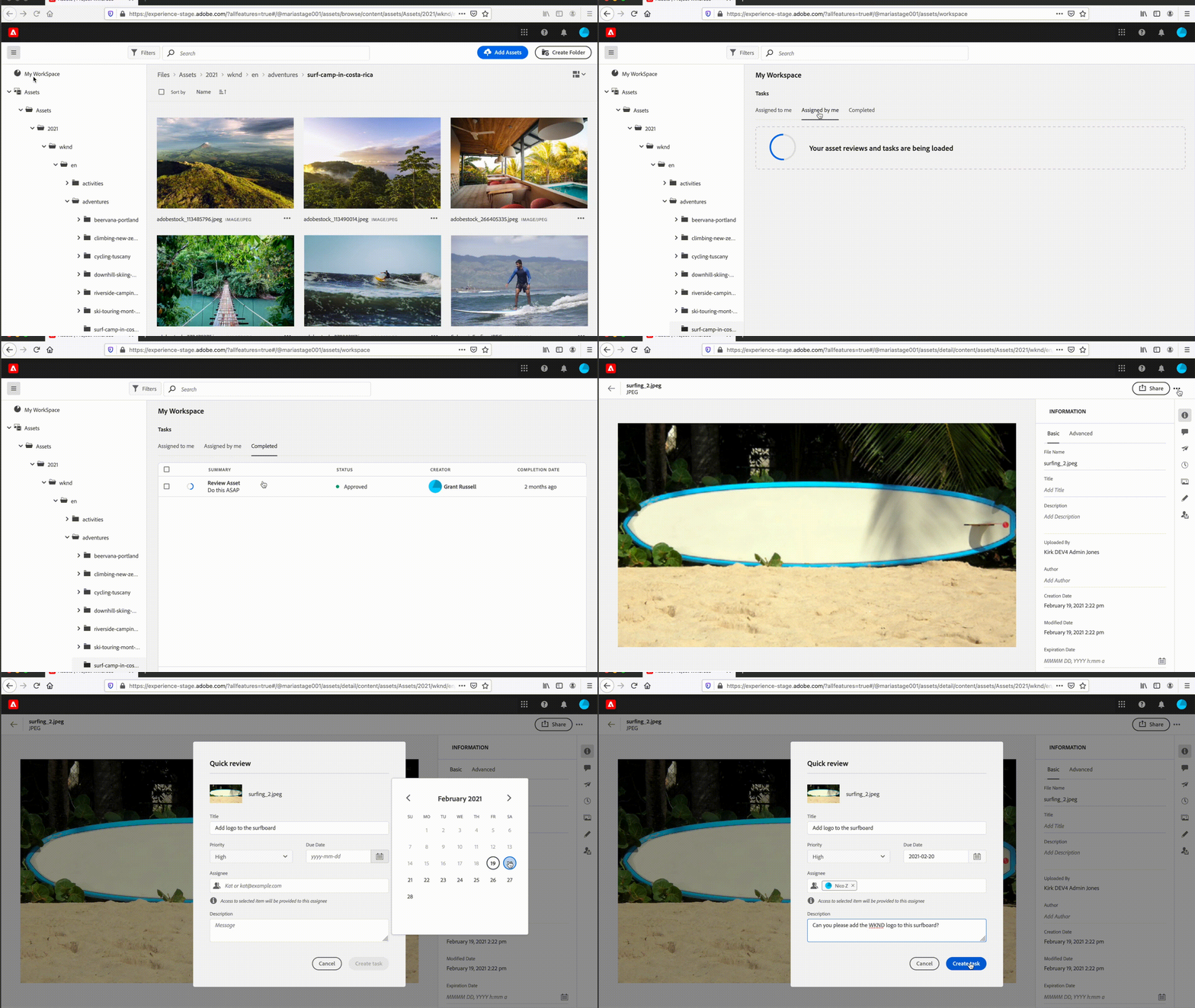
Adobe launches a new, simplified digital asset manager

Adobe today announced the launch of a new asset management tool, Adobe Experience Manager Assets Essentials. That’s a mouthful, but while the company didn’t necessarily simplify the name, the idea here is to give teams that work with lots of digital assets an easier-to-use management experience in the Adobe Experience Cloud than Adobe’s current enterprise-centric asset management tool can offer.

In addition, Adobe is also launching the first tool to integrate this new experience: the Adobe Journey Optimizer. This new tool is meant to help users leverage their customer data to build out customer journeys and figure out the best ways to deliver messages and content along that journey.

“The push towards digital content and building these richer, engaging experiences — customers expect it,” Elliot Sedegah, director of Strategy and Product Marketing, Adobe, told me. “Almost every interaction that you go along, you expect a rich experience. And not only at that point of just having richer material, like images or video, etc., but you expect it at every point of interaction with that customer. So that customer, if you think of it, isn’t just interacting with a brand, but our customers, they think of it as a customer journey. So using the same content, from awareness to conversion to post-sale and loyalty — they expect that same story to maintain. And it’s getting increasingly hard to get to all the different touchpoints.”

Image Credits: Adobe

Like with similar products, the idea here is to create a centralized, collaborative space for content creators and the teams that use their work. In that respect, this new tool isn’t necessarily all that different from other shared online file management services. But Adobe is also leveraging some of its unique capabilities. It’s using its AI smarts and Adobe Sensei platform to help users organize and tag their assets, for example, to make them more easily searchable. And the new tool is integrated with Adobe Asset Link, so creative professionals can search, browse and edit these assets directly from Photoshop, Illustrator, InDesign and XD without having to switch context.

As Sedegah noted, not too long ago, it was mostly the creative teams and marketing that were involved in the content creation and management process. But today, this group also includes sales teams and customer support, for example, and the pandemic only accelerated this process.

Image Credits: Adobe

“[Our customers] have been forced to rethink their business models, rethink the way that they engage with customers — and it essentially accelerated this digital-everywhere process of the experiences customers get, the agility that customers expect from businesses, and then the number of people — and how they work — leveraging that content.”

So while Adobe’s enterprise asset management tools worked just fine before, the company’s users were telling it that it needed to do a better job at creating tools that made its asset management technology easier to use by more teams.

The first tool to integrate this new asset management experience directly is the Journey Optimizer. “That was a great opportunity for us to rethink that user experience that our customers wanted to deliver — and then make it easier for that person to do,” Sedegah said. “So as you’re building out a content journey — or maybe you’re designing a piece of content that’s going to get sent to maybe a customer as they engage with a brand — the digital assets appear right there for that author to use.”

Next up for integration is Workfront, the work management platform Adobe acquired last year. There’s an obvious synergy here between Workfront’s abilities to manage the planning, review and approval stages of a project and an asset management system like this.

The long-term strategy, though, is to integrate this experience across all Experience Cloud applications.