Author: azeeadmin

26 Feb 2019

Meet GV investors at the TechCrunch Include March Office Hours

GV (formerly Google Ventures) is partnering with TechCrunch Include to host Office Hours for underserved and underrepresented founders on March 5th. From 10:30am-12:30pm, GV investors Dave Munichiello, Graham Spencer, Laura Melahn, Brian Bendett and Barkha Gvalani will meet for one-on-one sessions with founders. Apply here.

In 2014, TechCrunch launched the Include program which facilitates opportunities for underserved and underrepresented founders in tech, through our vast network and resources. Include Office Hours is one of TechCrunch’s initiatives. TechCrunch partners with VC firms to give founders access to investors for guidance as well as product and business model feedback. Investors host private 20 minute one-on-one meetings with founders, roundtables, or lunches.

Founders from diverse backgrounds are encouraged to apply. Underrepresented and underserved founders include, but are not limited to veteran, female, Latino/a, Black, LGBTQ and founders with handicaps.

The March Include Office Hours will be hosted by GV (formerly Google Ventures) on March 5th from 10:30am – 12:30pm PT. Founded in 2009, GV is a venture fund based in California with over 300 investments. Apply here.

Meet the participating investors:

Dave Munichiello – General Partner

“Dave is a general partner at GV and leads the team’s investments in data, platforms, and infrastructure. Prior to GV, Dave built and led enterprise software sales and operations teams for highly-technical products, under pressure in rapidly-changing markets.

As a senior executive at Kiva Systems, he helped grow the enterprise-enabling robotics and software platform to $120 million in annual revenue before it was purchased by Amazon. Dave’s career prior to Kiva included management consulting for The Boston Consulting Group and leading teams as a Captain in the U.S. military’s most elite units. His military leadership roles ranged from running a high-tech organization in Europe; to serving as an Aide de Camp to the Four Star General responsible for U.S. forces in Europe, Africa, and Afghanistan; to deploying with elite special operations teams worldwide, ensuring they were enabled by the world’s most advanced technologies.

Dave is a combat veteran and former paratrooper.

Graham Spencer – Managing Partner

Graham Spencer is a managing partner at GV. He was an engineering director at Google following the 2006 acquisition of JotSpot, which he co-founded with Joe Kraus. Graham was one of the original six founders of Excite.com and was the chief technology officer of the company until its sale to @Home.

In 1999, Graham left Excite@Home to co-found DigitalConsumer.org, a 50,000-member non-profit consumer organization dedicated to protecting fair-use rights for digital media. Graham is also on the board of the Santa Fe Institute.

Laura Melahn – Investing Partner

Laura joined GV in 2011 and is a partner on the investing team. Previously, she established GV’s marketing function, working with our portfolio on branding and growth.

Laura named Calico, Alphabet’s company aiming to slow aging and counteract age-related diseases. Prior to joining GV, Laura was a product marketing manager at Google, where she worked on Search, Maps, Analytics, and the brand. She developed the Street View snowmobile for the 2010 Winter Olympics and helped bring Search Stories to TV. Previously, Laura conducted research at the Cancer Research Center of Hawaii and in the University of Oxford biochemistry department.

Brian Bendett – Investing Partner

Brian is a partner on the GV investing team focusing on investments in platforms, machine learning, and infrastructure.

Prior to joining GV, Brian managed projects at Google across people operations, finance, marketing, and corporate development. In a former life, Brian worked in private equity and spent time in Washington D.C. supporting the White House Council of Economic Advisers and the Office of the Vice President.

Barkha Gvalani – Engineering Partner

Barkha works on investing operations, product management, and analytics at GV. She also helps portfolio companies scale their operations through analytics, data-warehousing, and business intelligence.

Prior to joining GV, Barkha worked extensively with Google’s Ads and Hardware finance teams solving their hard data problems. She was also chief of staff on the team overseeing Google’s financial systems strategy. Before Google, Barkha worked at Tata Consultancy Services, where she specialized in the leasing business and consulted for GE Commercial Finance.”

If you are a partner/managing director of a firm and are interested in supporting underserved and underrepresented founders, email neesha@techcrunch.com.
26 Feb 2019

Polis, the door-to-door marketer, raises another $2.5 million

Polis founder Kendall Tucker began her professional life as a campaign organizer in local Democratic politics, but — seeing an opportunity in her one-on-one conversations with everyday folks — has built a business taking that shoe leather approach to political campaigns to the business world.

Now the company she founded to test her thesis that Americans would welcome back the return of the door-to-door salesperson three years ago, is $2.5 million richer thanks to a new round of financing from Initialized Capital (the fund founded by Garry Tan and Reddit co-founder Alexis Ohanian) and Semil Shah’s Haystack.vc.

The Boston-based company currently straddles the line between political organizing tool and new marketing platform — a situation that even its founder admits is tenuous at the moment.

That tension is only exacerbated by the fact that the company is coming off one of its biggest political campaign seasons. Helping to power the get-out-the-vote initiative for Senatorial candidate Beto O’Rourke in Texas, Polis’ software managed the campaign’s outreach effort to 3 million voters across the state.

However, politically-focused software and services businesses are risky. Earlier this year the Sean Parker-backed Brigade shut down and there are rumblings that other startups targeting political action may follow suit.

“Essentially, we got really excited about going into the corporate space because online has gotten so nasty,” says Tucker. “And, at the end of the day, digital advertising isn’t as effective as it once was.”

Customer acquisition costs in the digital ad space are rising. For companies like NRG Energy and Inspire Energy (both Polis clients), the cost of acquisitions online can be as much as $300.

Polis helps identify which doors for salespeople to target and works with companies to identify the scripts that are most persuasive for consumers, according to Tucker. The company also monitors for sales success and helps manage the process so customers aren’t getting too many housecalls from persistent sales people.

“We do everything through the conversation at the door,” says Tucker. “We do targeting and we do script curation (everything from what scrpt do you use and when do you branch out of scripts) and we ahve an open api so they can push that out and they run with it through the rest of their marketing.”


26 Feb 2019

Spotify reportedly launches in India

Spotify has reportedly launched for some users in India today, with plans to officially launch on Wednesday to everyone, Variety, citing sources with knowledge of Spotify’s plans, reports.

For the first 30 days, Spotify’s premium service will be free and then cost 119 rupees (about $1.67) per month. There are also single-day, weekly, monthly, three-month, six-month and annual plans. Similar to other streaming services available in India, Spotify will also offer a free, ad-supported product.

Spotify first announced its intent to launch in India last March. In November, Spotify CEO Daniel Ek cited licensing situations as a roadblock to its launch.

Last month, Spotify inked a global content deal with T-Series, a leading Indian film and music company with a catalog of more than 160,000 songs. As TechCrunch’s Sarah Perez has noted, the Indian market won’t be an easy one for Spotify to win. That’s because Spotify is up against local player Gaana, which already has more than 80 million users, Saavn, Wynk as well as the North American likes of Google, Apple and Amazon.

This is launch is happening in light of Spotify’s legal battle with Warner Music Group. Earlier this week, WMG asked an Indian court to block Spotify from being able to play music from its catalog.

TechCrunch has reached out to Spotify and will update this story if we hear back.

26 Feb 2019

An insider’s peek at TC Sessions: Robotics & AI

We are not quite ready to announce the agenda for TechCunch’s April 18 robotics and AI show at UC Berkeley, but anyone who has been watching the speaker announcements is bound to be just a bit excited. Here’s a quick sneak peek at the soon-to-be-announced agenda.

Robotics & AI investor panel

For founders eager to know what’s on investors’ minds, there is an all-star robotics and AI investor panel that includes Peter Barrett from Playground Global, Helen Liang from FoundersX Ventures, Andy Wheeler from GV and Hidetaka Aoki from Global Brain. Not only will a TechCrunch editor grill these investors onstage, but there will be a separate and longer Q&A session where attendees can ask questions to figure out where VCs are focusing their funds.

AI – Understanding the unfathomable world

For anyone trying to fathom the nearly unfathomable world of AI, there is a remarkable session featuring, respectively, Dartmouth and UC Berkeley professors Hany Farid and Alexei Efros, who are two of the world’s leading authorities on the use of AI and computer vision to create live video of things that, well, never happened. Their work was featured in a remarkable New Yorker piece (“In the Age of A.I., Is Seeing Still Believing?”)

The future of human & robot interaction

In the robotics field, one of the toughest frontiers is human-robot interaction, which brings together just about every aspect of AI and robotics. UC Berkeley’s Interact Lab leader Anca Dragan, Affectiva co-founder Rana el Kaliouby and SoftBank Robotics HRI lead Matt Willis will convene for a panel discussion focused on the state of HRI today and where breakthroughs will come tomorrow.

Building a robotics startup

Building a startup is always a big theme at every TechCrunch event, and no less so when the subject is robotics, a notoriously unforgiving category for founders. Melonee Wise is CEO of five-year-old Fetch Robotics, which has raised $48 million. Manish Kothari is president of SRI Ventures and former director of SRI’s robotics program. Nima Keivan is the CTO and co-founder of four-year-old Canvas Technology, which has raised $15 million. Wise and Keivan will discuss how they got this far, and Kothari will share lessons he learned guiding many robotics founders forward. They will be available for audience questions in a separate Q&A after their session on the main stage.

These sessions should get us about halfway through… the morning! There is so much more we have yet to announce, including speakers, demos, workshops and more. And for the first time, we’ll also unfold CrunchMatch at this show, our highly successful app-based system to help attendees network and set up meetings. No one will have trouble finding interesting, like-minded folks to meet.

Early-bird tickets will stay on sale for only two more weeks. Book your $249 ticket today and save $100 before prices go up. Students, get a major discount with student tickets going for only $45 — book here.

26 Feb 2019

For a monthly subscription fee, this startup will send out customized gifts to current and prospective clients at scale

In today’s noisy, fast-paced world, finding a way to let clients and potential customers know that they are top of mind can be a major challenge for companies.

Enter Sendoso, a 2.5-year-old, San Francisco-based online-to-offline startup that promises to source, store, ship anything a business ever needs to send — and track its return on investment to boot.

How does it work? According to CEO and cofounder Kris Rudeegraap, Sendoso, founded in 2016, already has 110 full time employees, hundreds of vendor relationships, and six warehouses, including its biggest, an 80,000-square-foot space in Las Vegas.

It also has relationships with dozens of workers who it can call on to help it as it needs them and, as crucially, it integrates with Salesforce, Marketo, Engagio among other platforms where companies largely live.

Collectively, these various pieces enable an employee to log into Sendoso and — according to a budget that has been preset — click on a contact, type out a customer message, and choose a gift if desired, and that directive will show up as a campaign on the company’s end and as an order over at Sendoso, which then gets to work.

Want to send cupcakes to a client in New York? Done.  A handwritten note to a prospect in Washington? No problem. See something on Amazon? Sendoso will have it sent to one of its warehouses, then repackage it so that it looks like you did it yourself. Then out the door it goes with a major carrier like FedEx or UPS.

Sendoso — which charges a monthly subscription fee for its services based on a company’s number of users and its sending volume — caters to both tech startups, as well as Fortune 1,000 companies, with a client list that includes the marketing data company LiveRamp, the construction management software company ProCore, and the call center platform TalkDesk, where Rudeegraap was most recently a senior account executive — and where he says the idea for Sendoso was born.

“Having worked in sales for 10 years, it was clear that customer success was shifting away from this dependence on email because of the digital noise being created.” He sensed that a channel with offline gifts like wine and handcrafted notes (penned by Sendoso warehouse workers) might be the solution.

The idea of business-to-business gifting is far from new of course, and even though Sendoso is customizing the experience, it also isn’t alone, with other upstarts like Knack in Seattle and Alyce in Boston among many others focused on power gifting.

Still, investors like Sendoso’s packaging, so to speak. Indeed, Rudeegraap tells us the company just closed on $10.7 million in Series A funding to bolster its ranks and accelerate its reach beyond the 15 countries where the service is already available. The round was led by David Sack’s Craft Ventures, with participation from Signia Partners, Storm Ventures, Struck Capital and Hack VC.

Sendoso has now raised $13.2 million to date.

26 Feb 2019

Facebook wants up to 30% of fan subscriptions vs Patreon’s 5%

Facebook will drive a hard bargain with influencers and artists judging by the terms of service for the social network’s Patreon-like Fan Subscriptions feature that lets people pay a monthly fee for access to a creator’s exclusive content. The policy document attained by TechCrunch shows Facebook plans to take up to a 30 percent cut of subscription revenue minus fees, compared to 5 percent by Patreon, 30 percent by YouTube which covers fees, and 50 percent by Twitch.

Facebook also reserves the right to offer free trials to subscriptions that won’t compensate creators. And Facebook demands a “non-exclusive, transferable, sub-licensable, royalty-free, worldwide license to use” creators’ content and “This license survives even if you stop using Fan Subscriptions.”

Distrust of Facebook could scare creators away from the platform when combined with its significant revenue share and ability to give away or repurpose creators’ content. Facebook has consistently shown that it puts what it thinks users want and its own interests above those of partners. It cut off game developers from viral channels, inadequately warned Page owners their reach with drop over time, decimated referral traffic to news publishers, and most recently banished video makers from the feed. If Facebook wants to win creators’ trust and the engagement of their biggest fans, it may need a more competitive offering with larger limits on its power.

“Facebook reached out to offer Hard Drive early access to a “fan subscription” product” tweeted Matt Saincome, who also runs satirical news site Hard Times. “I asked my editors about it and the complete distrust amongst our team was kinda funny. We read through the terms and found a couple things that were hilarious when compared to Patreon’s 5% . . . Up to 30% and the rights to all our stuff? From the people who let us build an audience on their platform before pulling it out from under our feet? Hilarious. Here’s a crazy alternative: let people who signed up to see our content see it and then we can monetize that hahah.”

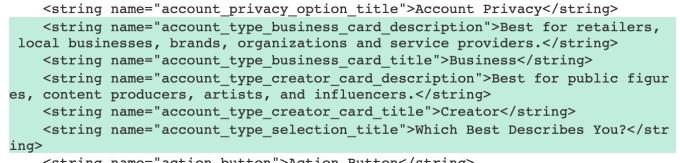
Instagram is refocusing on creators too. Instagram’s Android app reveals the prototype of a feature that lets users switch their profile into a Creator Account, similar to the Business Profiles it launched in 2016. Instagram first told The Hollywood Reporter about Creator Accounts in December but now it’s showing up in the code. Reverse engineering specialist Jane Manchun Wong generated this screenshot showing the option for Creator Accounts to hide their contact info or profile category. Fellow code digger Ishan Agrawal gave TechCrunch an exclusive look at the Instagram code that shows the Creator Accounts are “Best for public figures, content producers, artists, and influencers”. Creator Accounts give users “more advanced insights and reach more people with promotions”, “more growth tools” and “a new inbox that makes it easier to manage message requests and connect with fans.”.

Trading Control For Subscribers

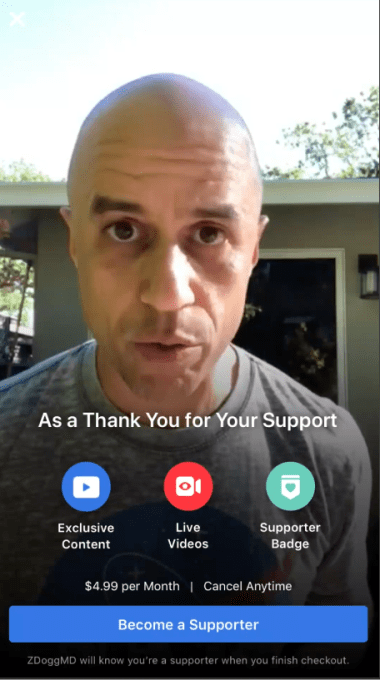
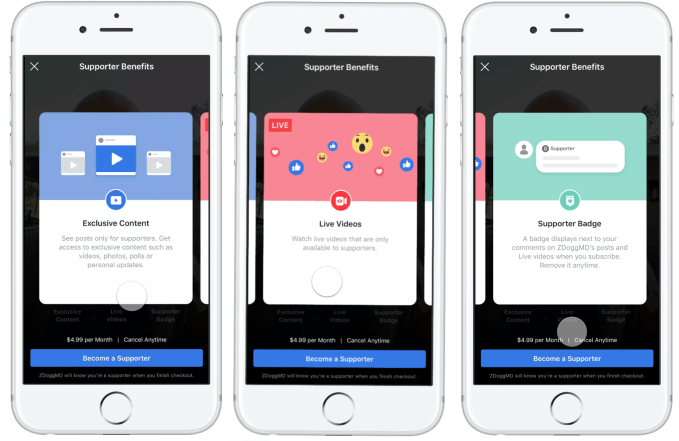
Facebook began testing Fan Subscriptions a year to give creators a financial alternative to maximizing ad views after watching the rise of Patreon which now has 3 million patrons who’ll pay 100,000 artists, comedians, models, and makers over $500 million this year. This month Facebook expanded the test to the UK, Spain, Germany, and Portugal to allow users to pay $4.99 per month to a creator for exclusive content, live videos, and a profile badge that highlights them as a subscriber. While Twitch owns gamers, YouTube rules amongst videographers, and Patreon is a favorite with odd-ball creators, Facebook may see an opportunity to popularize Fan Subscriptions internationally and turn mainstream consumers into paid supporters.

The terms for Fan Subscriptions are not publicly available, and only visible on Facebook’s site to Pages it’s invited to test the feature. But TechCrunch has published the full policy document below.

Thankfully, Facebook isn’t taking a cut of Fan Subscription revenue during the test phase, and creators get to keep 100 percent of the money paid by any patrons it signs up before the official launch. Facebook tells me that it hasn’t finalized its percentage cut, though the terms permit it to take as much as 30 percent. That would qualify given Facebook tells me its rake will be in line with industry standards and creators will retain the majority of their earnings.

But whatever cut it takes will be after processing fees and the 15 to 30 percent tax Apple and Google levy on iOS and Android in-app purchases. We’ll see if Facebook tries a workaround that pushes users to their mobile browser where it can take their subscription money tax-free. And if Facebook decides it want to give users a free one-month trial or discount to any creator, they can’t stop it even if that lets people download all their exclusive content and then cancel without ever paying.

But what’s sure to raise the most hairs is the clause about “Supplemental Data” that gives Facebook a license to display a creator’s content as they might expect, but also a royalty-free license to use it however they want, even after a creator abandons Facebook Fan Subscriptions. A Facebook spokesperson confirmed that Supplemental Data does in fact cover all content provided by the creator. They claim it’s so if a creator made a custom fan sticker, a subscriber could use it in their own Facebook post, but the rule gives Facebook vast power beyond that. Patreon has a similar clause, but gets the benefit of the doubt in a way Facebook doesn’t after so many scandals.

Facebook’s spokesperson claimed that the Supplemental Data terms were similar to Facebook’s standard terms, but the normal Facebook terms say “You can end this license any time by deleting your content or account.” Not so with Fan Subscriptions. I don’t expect Facebook is going to try to outright steal and resell creators’ content, but it will have jurisdiction to use their art however it wants to fuel its war with Patreon, Twitch, and YouTube.

Creators will have to decide whether access to Facebook’s 2.3 billion users is worth the platform risk of building a following somewhere they don’t control and that has other business priorities. If Facebook’s strategy suddenly veers away from Fan Subscriptions, it could be hard for creators to score new signups or retain their old ones. At least with a dedicated site like Patreon, creators know the platform can’t abuse them without the threaten of ruin.

Here’s the full Terms Of Service for Facebook’s Patreon competitor Fan Subscriptions:

Fan Subscriptions Creator Terms

The fan funding feature (“Fan Subscriptions”) allows Facebook users to support their favorite pages, creators, group administrators, gamers, or others (“Pages”) through a monthly subscription with Facebook (“Subscription”) that gives those people (“fans”) access to digital content offered by Pages, such as exclusive digital content, fan recognition, and merchandise discounts. These Terms (“Terms”) govern how Pages use Fan Subscriptions.

With regard to your use of Fan Subscriptions, you agree to the following:

  1. Your use of the Platform with respect to Fan Subscriptions is subject to, and you agree to comply with, the Platform Policy currently available at https://developers.facebook.com/policy/.
  2. Your use of Fan Subscriptions to offer digital content and/or services to Facebook fans is subject to, and you agree to comply with the (a) Monetization Eligibility Standards currently available at https://www.facebook.com/help/publisher/169845596919485, and (b) Content Guidelines for Monetization currently available at https://www.facebook.com/facebookmedia/get-started/monetization_contentguidelines. You agree to follow any additional instructions and/or technical documentation we provide to you for Fan Subscriptions.
  3. You will provide accurate information to fans in connection with your use of Fan Subscriptions, including but not limited as part of any digital content or services you choose to offer to them. You must clearly and conspicuously disclose all material terms regarding your offer and the nature of content or services you will provide to fans once they choose to subscribe. You agree to comply with all laws applicable to your use of Fan Subscriptions.
  4. You confirm that the content you offer via Subscription does not infringe upon the intellectual property rights of any third party and that you have secured all rights necessary to distribute, copy, display, publicly perform, or otherwise use the content.
  5. You will not use, incorporate, or provide any music or physical goods in connection with your use of Fan Subscriptions without FB’s prior written approval (email is sufficient).
  6. You will not offer discounts on physical goods that exceed 80 percent of the offered goods’ retail value.
  7. Your fans’ Subscriptions may be processed as payments to Facebook via Apple’s In-App Purchase or Google’s In-App Billing services, which are subject to Apple’s and Google’s separate payment terms and conditions. Apple and Google may charge Facebook a revenue share and/or other fees for such payment services according to their respective terms and conditions. FB will pay you a revenue share calculated as a percentage (“Your Share”) of what’s left after deduction of those fees/charges and of any other fees or taxes incurred by Facebook. As a the date of these Terms, Your Share of that net revenue is 100%. However, Facebook may in the future change these Terms such that Facebook keeps a revenue share of up to 30%. We will give 30 days’ notice of any such change.
  8. Facebook reserves the right to offer discounted and free trials for fans from time to time in our discretion, whether to incentivize Subscription sign-ups or otherwise. Where we do so in relation to your Fan Subscriptions, your revenue share will be reduced accordingly: we only pay you a revenue share based on the amounts fans actually pay (less fees and taxes we incur).
  9. If you have accurately completed and timely provided to FB any forms or documentation that FB reasonably determines are required to set up payment to you, and subject to and only in the event that you are in compliance in all respects with these Terms, payment of any net amounts FB receives from Apple and Google for Subscriptions made by your fans during your use of Fan Subscriptions will be on a monthly basis, within approximately 60 days after the end of the applicable month. Facebook will not be responsible for any subsequent fees applied by your financial institution to complete payment of the Monthly Fee to you. Furthermore, in the event the payment due to you would be less than One Hundred U.S. Dollars ($100.00), Facebook reserves the right to roll such payment over month to month until such payment threshold is met, at which time Facebook will make the applicable payment to you. Facebook also reserves the right to set off and/or withhold any amounts that Facebook reasonably considers are or are likely to be payable by you to Facebook under these Terms (including under any indemnities).
  10. If you are providing (or allowing us to access) any data, content, or other information in connection with your use of Fan Subscriptions (collectively, “Supplemental Data”), then you grant us (and our affiliates) a non-exclusive, transferable, sub-licensable, royalty-free, worldwide license to use such Supplemental Data. This license survives even if you stop using Fan Subscriptions. You are responsible for obtaining the necessary rights from all applicable rights holders to grant this license.
  11. You are responsible for paying any applicable taxes owed with respect to any amounts you receive through your use of Fan Subscriptions. Facebook will charge you taxes with respect to such amounts if it is required to do so under applicable law.
  12. Facebook can terminate or suspend your use of Fan Subscriptions at any time in our sole discretion, and we may change or stop offering Fan Subscriptions at any time in our sole discretion. In no event will we be liable in any way for terminating or suspending your use of Fan Subscriptions, for the discontinuation of Fan Subscriptions, for the removal of or disabling of access to content, or for the withdrawal of the content or Fan Subscriptions.
  13. If you change what’s included in a Subscription in a way that could be considered material, you must give fans reasonable prior notice such that they have a reasonable opportunity to cancel their Subscriptions if they so choose, with the change only taking effect after their next Subscription fee payment.
  14. If you are using Fan Subscription on behalf of a third party (including, but not limited to, as an agent or representative of a Creator), you represent and warrant that you have the authority as agent of such party to use such features on their behalf, agree to these Terms, and hereby bind such party to these Terms. You agree to indemnify and hold Facebook harmless from any claims, suits, losses, liabilities, damages, costs, and expenses resulting from your breach of the Terms. If you are accepting these Terms as admin of Facebook Business Manager for your business, these Terms shall apply to Content on all Facebook Pages and profiles owned or operated by your business at the time of acceptance and thereafter.
  15. By using the Fan Subscriptions feature, you agree that we may communicate with you electronically any important information regarding your use of Fan Subscriptions, including without limitation as to Your Share and any payments. We may also provide notices to you by posting them on our website, or by sending them to an email address or street address that you previously provided to us. Website and email notices shall be considered received by you within 24 hours of the time posted or sent; notices by postal mail shall be considered received within three (3) business days of the time sent.
  16. Facebook reserves the right to update these Terms from time to time. If any change to these Terms will materially disadvantage you, or materially affect the availability of the Subscription, we will provide you with notice before the changes become effective and you can choose to cancel your Subscription. Your continued use of this feature constitutes acceptance of those changes.
  17. Fan Subscriptions is part of the “Facebook Products” under Facebook’s Terms of Service(“Facebook Terms”), and your use of Fan Subscriptions is deemed part of your use of Facebook Products. In the event of any express conflict between these Terms and the Facebook Terms, these Terms will govern solely with respect to your use of Fan Subscriptions and solely to the extent of the conflict. These Terms do not alter in any way the terms or conditions of any other agreement you may have with Facebook. Facebook reserves the right to monitor or audit your compliance with these Terms and to update these terms from time to time, and your continued use of Fan Subscriptions constitutes acceptance of those changes.
26 Feb 2019

Energizer’s P18K Pop is basically a giant battery with a smartphone built into it

This is the future you asked for.

When people read smartphone reviews, one of the first things they want to know is whether the battery life is going to be sufficient for their use cases. Well, what if the battery life was the only stat that mattered?

At MWC in Barcelona, phone maker Avenir Telecom is turning heads with an Energizer-branded behemoth that packs a punch.

The P18K Pop has a truly massive 18,000 MAh battery built-in, the manufacturer says that you could play videos for two straight days without depleting the battery. By comparison, the phone in your pocket probably has a battery in the 2,500-3,500 MAh so this things would likely be able to keep you going for several days with regular usage.

Consumers haven’t always been psyched about about manufacturer’s never-ending desire to trim thickness from their phones, that’s not an issue with the P18K Pop which is 18mm thick at its thinnest point. Hilariously the thing is thick as hell but manages to not have a headphone jack.

It is abundantly unclear how big the market is for this chunkster but Paris-based Avenir Telecom says they will start shipping them to customers sometime this summer.

26 Feb 2019

Energizer’s P18K Pop is basically a giant battery with a smartphone built into it

This is the future you asked for.

When people read smartphone reviews, one of the first things they want to know is whether the battery life is going to be sufficient for their use cases. Well, what if the battery life was the only stat that mattered?

At MWC in Barcelona, phone maker Avenir Telecom is turning heads with an Energizer-branded behemoth that packs a punch.

The P18K Pop has a truly massive 18,000 MAh battery built-in, the manufacturer says that you could play videos for two straight days without depleting the battery. By comparison, the phone in your pocket probably has a battery in the 2,500-3,500 MAh so this things would likely be able to keep you going for several days with regular usage.

Consumers haven’t always been psyched about about manufacturer’s never-ending desire to trim thickness from their phones, that’s not an issue with the P18K Pop which is 18mm thick at its thinnest point. Hilariously the thing is thick as hell but manages to not have a headphone jack.

It is abundantly unclear how big the market is for this chunkster but Paris-based Avenir Telecom says they will start shipping them to customers sometime this summer.

26 Feb 2019

BMW continues to bet on the (Azure) cloud

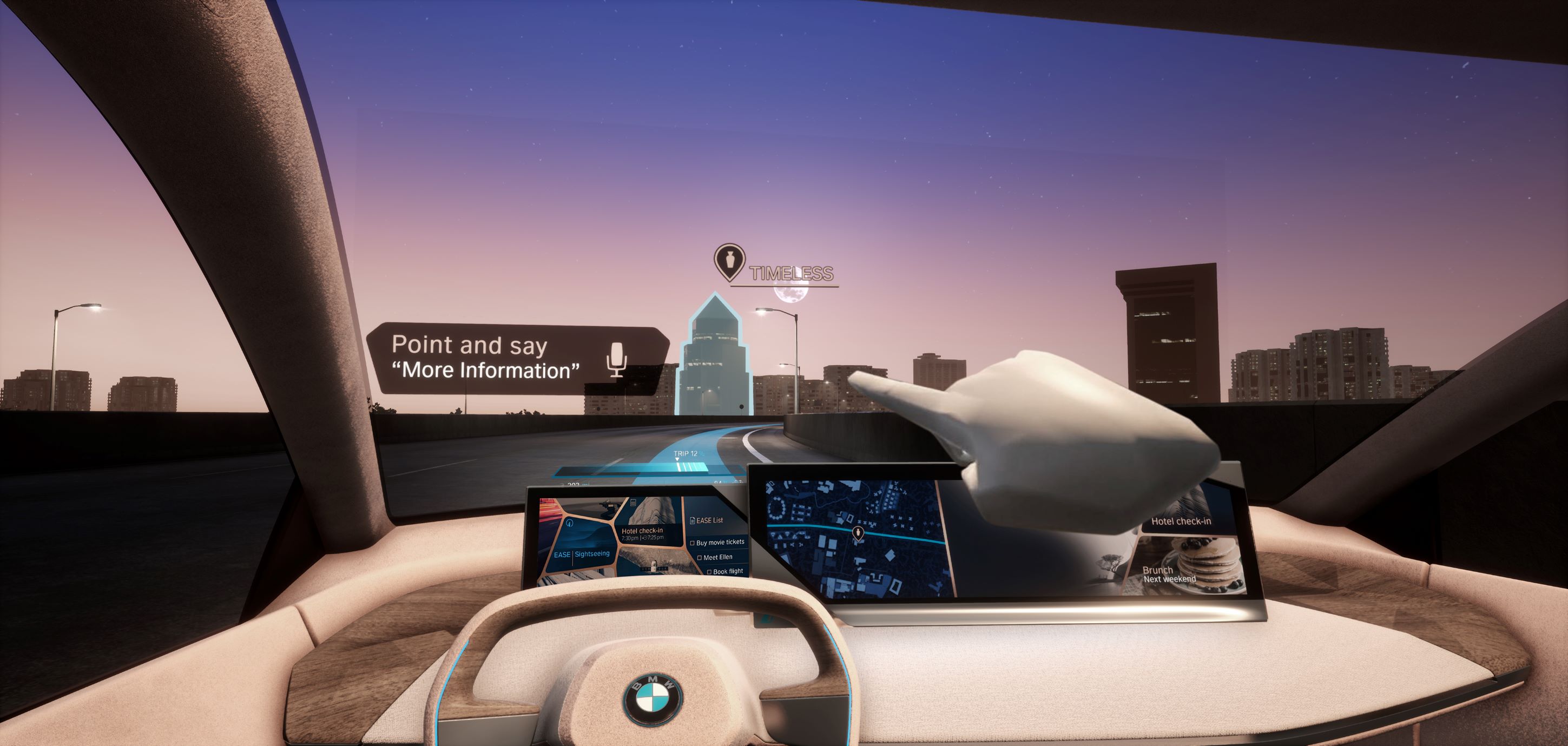
Earlier this week, at MWC Barcelona, BMW announced its newest in-car AI initiative: BMW Natural Interaction. The idea here is to use cameras, microphones and other sensors in the car to allow you to have more natural interactions with the car, either through voice or gestures. The marquee feature here is the ability to point at something outside the car and get more information about it or, if it’s a restaurant, have the BMW Intelligent Personal Assistant (IPA) make a reservation for you. These systems will work by combining in-car AI with cloud technologies — and for those, BMW continues to bet on Microsoft’s Azure cloud.

After the announcement, I sat down with Christoph Grote, BMW Group’s senior VP for electronics. I admit that a lot of what I saw in the demo felt a bit futuristic, but Grote noted that everything he showed off during his presentation is more or less production-ready. “I don’t think I would’ve dared to stand up there if any of the things I showed today were a utopia,” he told me. “All of this is in series production and some of it is already available as part of the BMW OS 7 release. But the major work we are doing, looking ahead to the iNext [electric SUV], is about gaze, head pose and gesture tracking and combing those with the other modalities. But everything we showed today is going to go into production.”

In practice, this means that BMW will use two cameras: a wide-angle camera behind the rear-view mirror that can track the gestures of both the driver and front-seat passenger and one behind the dashboard that only looks at the driver through the steering wheel and recognizes when their eyes blink, where their eyes look and their head pose.

As Grote noted, figuring out where you are looking is not exactly easy. The camera sees your hands in relation to the car. That’s pretty straightforward. But the car, too, is situated somewhere in space, and for this to work, that localization has to be very precise, and the digital map has to be very detailed, too. “GPS isn’t enough for this,” Grote said, and noted that the company plans to use the car’s forward-facing camera to gather additional information that helps localize the car in space based on comparing the image to the digital map. The AI smarts that power these mapping features run right in the car — and in many ways, these features also lay the groundwork for self-driving cars, which obviously need highly detailed maps, too.

In many ways, this work is a continuation of BMW’s work on its IPA in-car assistant. “There, we use Azure Cognitive Service and we plan to integrate these new modalities (like gaze and gesture tracking) with the same technology. And that’s important for these multi-modal systems. […] We have a great partnership with Microsoft and we expect that’ll continue.”

Grote also noted that BMW has a long history of working in the cloud, thanks to many years of experience in offering its connected car services. “We don’t think of the car as an isolated client that connects to some service in the cloud, but that we also see these connected cars as a swarm that has collective intelligence.”

Vehicle-to-everything (V2X) connectivity is one of the hot topics in the car industry right now — especially given the advent of 5G with its low-latency connectivity — and BMW does have its own point of view here. For Grote, V2X systems that use the cellular network and connect to the cloud have major advantages over those that try to connect cars directly. These cloud-connected systems, he argues, are easier to maintain and they are able to translate between different standards or — in the long run — integrate different generations of this system to ensure that cars from different manufacturers can talk to each other.

“A cellular-based system is forward-looking, maintainable, secure and the better foundation that guarantees future development efforts versus a standard that’s 20 years old, from a time when the carriers were not interested in machine-to-machine traffic at all.”

BMW continues to bet on the cloud for many of its newest tech developments. Among car manufacturers, it’s obviously not alone here. Daimler recently announced that it has moved its big data platform to the cloud, for example. And in many ways, that move makes sense. Running online services isn’t a core competency for many of these companies, and even if they are experienced at running their own data centers by now, this isn’t what allows them to differentiate their cars in a highly competitive market. That energy is better spent on building applications, not managing them. The large cloud providers also offer global coverage, and redundancies are hard and expensive to build.

26 Feb 2019

BMW continues to bet on the (Azure) cloud

Earlier this week, at MWC Barcelona, BMW announced its newest in-car AI initiative: BMW Natural Interaction. The idea here is to use cameras, microphones and other sensors in the car to allow you to have more natural interactions with the car, either through voice or gestures. The marquee feature here is the ability to point at something outside the car and get more information about it or, if it’s a restaurant, have the BMW Intelligent Personal Assistant (IPA) make a reservation for you. These systems will work by combining in-car AI with cloud technologies — and for those, BMW continues to bet on Microsoft’s Azure cloud.

After the announcement, I sat down with Christoph Grote, BMW Group’s senior VP for electronics. I admit that a lot of what I saw in the demo felt a bit futuristic, but Grote noted that everything he showed off during his presentation is more or less production-ready. “I don’t think I would’ve dared to stand up there if any of the things I showed today were a utopia,” he told me. “All of this is in series production and some of it is already available as part of the BMW OS 7 release. But the major work we are doing, looking ahead to the iNext [electric SUV], is about gaze, head pose and gesture tracking and combing those with the other modalities. But everything we showed today is going to go into production.”

In practice, this means that BMW will use two cameras: a wide-angle camera behind the rear-view mirror that can track the gestures of both the driver and front-seat passenger and one behind the dashboard that only looks at the driver through the steering wheel and recognizes when their eyes blink, where their eyes look and their head pose.

As Grote noted, figuring out where you are looking is not exactly easy. The camera sees your hands in relation to the car. That’s pretty straightforward. But the car, too, is situated somewhere in space, and for this to work, that localization has to be very precise, and the digital map has to be very detailed, too. “GPS isn’t enough for this,” Grote said, and noted that the company plans to use the car’s forward-facing camera to gather additional information that helps localize the car in space based on comparing the image to the digital map. The AI smarts that power these mapping features run right in the car — and in many ways, these features also lay the groundwork for self-driving cars, which obviously need highly detailed maps, too.

In many ways, this work is a continuation of BMW’s work on its IPA in-car assistant. “There, we use Azure Cognitive Service and we plan to integrate these new modalities (like gaze and gesture tracking) with the same technology. And that’s important for these multi-modal systems. […] We have a great partnership with Microsoft and we expect that’ll continue.”

Grote also noted that BMW has a long history of working in the cloud, thanks to many years of experience in offering its connected car services. “We don’t think of the car as an isolated client that connects to some service in the cloud, but that we also see these connected cars as a swarm that has collective intelligence.”

Vehicle-to-everything (V2X) connectivity is one of the hot topics in the car industry right now — especially given the advent of 5G with its low-latency connectivity — and BMW does have its own point of view here. For Grote, V2X systems that use the cellular network and connect to the cloud have major advantages over those that try to connect cars directly. These cloud-connected systems, he argues, are easier to maintain and they are able to translate between different standards or — in the long run — integrate different generations of this system to ensure that cars from different manufacturers can talk to each other.

“A cellular-based system is forward-looking, maintainable, secure and the better foundation that guarantees future development efforts versus a standard that’s 20 years old, from a time when the carriers were not interested in machine-to-machine traffic at all.”

BMW continues to bet on the cloud for many of its newest tech developments. Among car manufacturers, it’s obviously not alone here. Daimler recently announced that it has moved its big data platform to the cloud, for example. And in many ways, that move makes sense. Running online services isn’t a core competency for many of these companies, and even if they are experienced at running their own data centers by now, this isn’t what allows them to differentiate their cars in a highly competitive market. That energy is better spent on building applications, not managing them. The large cloud providers also offer global coverage, and redundancies are hard and expensive to build.