
Author: azeeadmin

12 Feb 2019

Google and IBM still trying desperately to move cloud market share needle

When it comes to the cloud market, there are few known knows. For instance, we know that AWS is the market leader with around 32 percent of market share. We know Microsoft is far back in second place with around 14 percent, the only other company in double digits. We also know that IBM and Google are wallowing in third or fourth place, depending on whose numbers you look at, stuck in single digits. The market keeps expanding, but these two major companies never seem to get a much bigger piece of the pie.

Neither company is satisfied with that of course. Google so much so that it moved on from Diane Greene at the end of last year, bringing in Oracle veteran Thomas Kurian to lead the division out of the doldrums. Meanwhile, IBM made an even bigger splash, plucking Red Hat from the market for $34 billion in October.

This week, the two companies made some more noise, letting the cloud market know that they are not ceding the market to anyone. For IBM, which is holding its big IBM Think conference this week in Las Vegas, it involved opening up Watson to competitor clouds. For a company like IBM, this was a huge move, akin to when Microsoft started building apps for iOS. It was an acknowledgement that working across platforms matters, and that if you want to gain market share, you had better start thinking outside the box.

While becoming cross-platform compatible isn’t exactly a radical notion in general, it most certainly is for a company like IBM, which if it had its druthers and a bit more market share, would probably have been content to maintain the status quo. But if the majority of your customers are pursuing a multi-cloud strategy, it might be a good idea for you to jump on the bandwagon and that’s precisely what IBM has done by opening up access to Watson across clouds in this fashion.

Clearly buying Red Hat was about a hybrid cloud play, and if IBM is serious about that approach, and for $34 billion, it had better be, it would have to walk the walk, not just talk the talk. As IBM Watson CTO and chief architect Ruchir Puri told my colleague Frederic Lardinois about the move, “It’s in these hybrid environments, they’ve got multiple cloud implementations, they have data in their private cloud as well. They have been struggling because the providers of AI have been trying to lock them into a particular implementation that is not suitable to this hybrid cloud environment.” This plays right into the Red Hat strategy and I’m betting you’ll see more of this approach in other parts of the product line from IBM this year. (Google als acknowledged this when it announced a hybrid strategy of its own last year.)

Meanwhile Thomas Kurian had his coming out party at the Goldman Sachs Technology and Internet Conference in San Francisco earlier today. Bloomberg reports that he announced a plan to increase the number of salespeople and train them to understand specific verticals, ripping a page straight from the playbook of his former employer, Oracle.

He suggested that his company would be more aggressive in pursuing traditional enterprise customers, although I’m sure his predecessor, Diane Greene, wasn’t exactly sitting around counting on inbound marketing interest to grow sales. In fact, rumor had it that she wanted to pursue government contracts much more aggressively than the company was willing to do. Now it’s up to Kurian to grow sales. Of course, given that Google doesn’t report cloud revenue it’s hard to know what growth would look like, but perhaps if it has more success it will be more forthcoming.

As Bloomberg’s Shira Ovide tweeted today, it’s one thing to turn to the tried and true enterprise playbook, but that doesn’t mean that executing on that approach is going to be simple, or that Google will be successful in the end.

These two companies obviously desperately want to alter their cloud fortunes, which have been fairly dismal to this point. The moves announced today are clearly part of a broader strategy to move the market share needle, but whether they can or the market positions have long ago hardened remains to be seen.

12 Feb 2019

In healthcare, better data demands better privacy protections

In August 2016, the Australian government released to the public a data set containing the medical billing history of nearly three million persons: every procedure they had undergone or prescription they had received. Needless to say, their names and all other identifying features had been redacted.

Nevertheless, within a few weeks a group of researchers at the University of Melbourne discovered how easy it was to re-identify the individuals in this ostensibly anonymous data set and extract their medical history. The researchers did this by using information readily available on the internet.

The media coverage of their paper bordered on hysteria; the Australian government was forced to remove the data set from its website — but not before it had been downloaded nearly 1,500 times.

In Israel in March 2018, the government decided to adopt a National Digital Health plan in order to exploit a rare Israeli asset — an extraordinary volume of computerized healthcare information, on a scale available in very few countries. Over the next five years, the Israeli government intends to invest more than 250 million dollars on collaboration between the Israeli healthcare system and corporations, startups and international investors.

The use of big data and its analysis by machine learning and artificial intelligence offer unparalleled prospects for improving medical care: first of all, in the area of predictive medicine, including early diagnosis and disease prevention; second, with regard to decision-support systems that produce more accurate diagnoses than human physicians can; and third — precision medicine. There is good reason why this market has become a goldmine, with annual revenues of billions of dollars.

What is surprising is that the government’s decision, despite its broad economic implications and the significant questions it raises, passed without almost any public discussion of the issue.

It is true that the resolution includes the explicit stipulation that all uses of health-related information must comply with statutory provisions and maintain medical privacy and confidentiality. It seems, however, that this decision and the report on the  National Digital Health plan appended to it, which refers to the conclusions of a Health Ministry committee that considered the secondary uses of health-related information, view privacy mainly as a legal impediment to be bypassed.

The working assumption of the policy documents is that as long as we are dealing with an anonymized data set, there is no need to require the active consent of individuals whose data is contained in it, but only to allow deletion from the data set upon explicit request. Let’s face it: Most of us are not experts in this domain, will not be aware of the dangers involved and will not be interested in something that seems to be complicated. How convenient…

The ability to take an anonymized data set of cellphone locations, for example, and use it to identify individuals was already demonstrated in 2013 in an article published in Nature. In Germany, researchers discovered that an anonymous internet search history could be linked to an actual identity. An extensive investigation by The New York Times recently showed how it is possible to reconstruct identifying information from anonymous smartphone app data. As the trail of digital crumbs we leave behind grows longer, the ability to re-identify “anonymous” data sets increases.

What validity can there be to a promise of anonymity in a world of ready re-identification?

In the best-case scenario, those who extract information about us will be our bosses, who want to know if we were really home with the flu the day we called in sick; or law-enforcement agencies searching for a criminal. In the worst, politicians seeking to embarrass an opponent, insurance agents or advertising executives who want to convince us to buy a specific product or change our views of a candidate for office.

To put it bluntly, anyone who releases a medical database today without obtaining individuals’ consent for the use of their health records, with the excuse that the information is anonymous, is conning us. What validity can there be to a promise of anonymity in a world of ready re-identification? Decision-makers need to re-evaluate the risks involved, weighing the costs against the benefits, while considering privacy to be an immutable value, a basic human right and a precondition for the ability to realize one’s autonomy, independent thought and the democratic process — not a constraint.

How can we explain what is going on here? One possibility is that startup nation advocates pushed hard to ratify the plan as soon as possible, because of its contribution to innovation; these advocates view considerations of privacy as obstacles. Or maybe decision-makers simply lack an adequate understanding of the implications of this assault on privacy.

Also, the fact that those who draft new legislation are dragging their feet has made them seem incapable of providing a relevant response in real time, so it is simply better to circumvent them.

We can assume that no one in the government intends to grant anyone the right to traffic in our most sensitive personal data. The question is whether there is an adequate supervision mechanism to ensure that this will not happen. Has there been a public discussion of the serious ramifications of re-identification of medical data sets? Has a decision been made about the need for legislation on this matter? Has there been a national campaign to educate the public about it? The answer is no.

The re-identification of personal medical data sets is not some wild dystopian nightmare, but a real and rational fear. Such re-identification will not only generate social problems at the macro level, but will also introduce a significant element of distrust into the healthcare system, mainly at the level of the doctor-patient relationship.

The day we can no longer consult our family physician and tell him or her that we are suffering from delirium and hallucinations will be a sad day indeed. At that point, no slogan about a startup nation will help Israel.

12 Feb 2019

Donde Search picks up $6 million to help fashion retailers with visual search

Donde Search has just closed a $6 million Series A investment led by Matrix Partners, with participation from previous investors such as senior leaders from AliExpress, Google, and Waze.

Donde first launched in 2014 as a consumer-facing app that helped users search and discover apparel items based on visual characteristics rather than text-based searches. In early 2018, the company pivoted to the enterprise space, helping retailers power suggestions and related items on their websites.

Here’s how it works:

Retailers partnered with Donde hand over their product catalog and run it through the Donde algorithm, which identifies all the visual features associated with each product. Retailers can then add a widget to their site to let users search based on those features (like sleeve length or type, color, or material).

As users interact with the products, the website adapts to that behavior to offer personalized product recommendations and related items.

Moreover, Donde offers an analytics dashboard that not only provides insights on the customer’s own website, but a look into trends being featured on competing ecommerce websites to understand the industry in general.

Donde was founded by Liat Zakay, who previously served as a software engineer and R&D team manager in the Israeli intelligence unit 8200. Using her technical expertise, she built Donde to solve her own problem of not having the time or energy to go through the tedious process of online shopping.

Zakay told TechCrunch that Donde is focused on apparel for now, but that the technology can be applied to almost any vertical.

“One of the interesting pieces about Donde is that it’s language agnostic,” said Zakay. “You don’t need to know what it’s called and it doesn’t matter what language you speak, you can still find what you want based on visual features. Which makes us extremely relevant to global retailers.”

The new funding, which will be used to expand the product and the team, came shortly after the announcement of Donde’s partnership with Forever 21. The fast-fashion retailer tested out the Donde platform on its mobile app and, after a month, saw a 20 percent increase in average purchase value and higher conversions. Forever21 has now expanded the program, putting Donde on the web as well.

Donde said it is working on pilot programs with several other retailers across the U.S. and Europe.

Fast fashion, in particular, represents a big opportunity for Donde. Because product turnover is so fast, retailers rarely have reliable data around a certain SKU, with the website being run on outdated data from last ‘season.’

This latest round brings Donde’s total funding to $9.5 million, with backing from UpWest, Afterdox and Golden Seeds.

12 Feb 2019

Sixteen percent of US adults own a smartwatch

The latest figures out of NPD show a continued uptick in smartwatch sales here in the States. The category has been a rare bright spot in an overall flagging wearable space, and the new numbers show gains pretty much across the board. In fact, the study puts smartwatch ownership at 16 percent among U.S. adults as of December — that figure is up from 12 percent a year prior.

Unsurprisingly, it’s a younger demo driving that growth — specifically 18-34-year-olds, where smartwatch ownership is around 23 percent. Of course, Apple and the like have been looking to increase purchases with the older crowd, courtesy of more serious health features like last year’s addition of an ECG meter.

Apple, Samsung and Fitbit continue to dominate the market, making up 88 percent of the nearly $5 billion in sales tallied for the year ending in November. But companies like Fossil and Garmin made some market-share gains. Google, naturally, will be looking to make a larger dent in the market, with its recent purchase of Fossil IP. Wear OS’s growth has been pretty flat, but that could change in 2019 with the rumored arrival of the Pixel Watch.

12 Feb 2019

Instagram is now testing a web version of Direct messages

Insta-chat addicts, rejoice. You could soon be trading memes and emojis from your computer. Instagram is internally testing a web version of Instagram Direct messaging that lets people chat without the app. If, or more likely, when this rolls out publicly, users on a desktop or laptop PC or Mac, a non-Android or iPhone, or that access Instagram via a mobile web browser will be able to privately message other Instagrammers.

Instagram web DMs was one of the features I called for in a product wishlist I published in December alongside a See More Like This button for the feed and an upload quality indicator so your Stories don’t look crappy if you’re on a slow connection.

A web version could make Instagram Direct a more full-fledged SMS alternative rather than just a tacked-on feature for discussing the photo and video app’s content. Messages are a massive driver of engagement that frequently draws people back to an app, and knowing friends can receive them anywhere could get users sending more. While Facebook doesn’t monetize Instagram Direct itself, it could get users browsing through more ads while they wait for replies.

Given Facebook’s own chat feature started on the web before going mobile and getting its own Messenger app, and WhatsApp launched a web portal in 2015 followed by desktop clients in 2016, it’s sensible for Instagram Direct to embrace the web too. It could also pave the way for Facebook’s upcoming unification of the backend infrastructure for Messenger, WhatsApp, and Instagram Direct that should expand encryption and allow cross-app chat, as reported by the New York Times’ Mike Isaac.

Mobile reverse-engineering specialist and frequent TechCrunch tipster Jane Manchun Wong alerted us to Instagram’s test. It’s not available to users yet, as it’s still being internally “dogfooded” — used heavily by employees to identify bugs or necessary product changes. But she was able to dig past security and access the feature from both a desktop computer and mobile web browser.

In the current design, Direct on the web is available from a Direct arrow icon in the top right of the screen. The feature looks like it will use an Instagram.com/direct/…. URL structure. If the feature becomes popular, perhaps Facebook will break it out with its own Direct destination website similar to https://www.messenger.com which launched in 2015. Instagram began testing a standalone Direct app last year, but it’s yet to be officially launched and doesn’t seem exceedingly popular.
Instagram’s web experience has long lagged behind its native apps. You still can’t post Stories from the desktop like you can with Facebook Stories. It only added notifications on the web in 2016 and Explore plus some other features in 2017. only added notifications and Explore.

Instagram did not respond to requests for comment before press time. The company rarely provides a statement on internal features in development until they’re being externally tested on the public, at which point it typically tells us “We’re always testing ways to improve the Instagram experience.” [Update: Instagram confirms to TechCrunch it’s not publicly testing this, whch is its go-to line when a product surface that’s still in internal development.]

After cloning Snapchat Stories to create Instagram Stories, the Facebook-owned app decimated Snap’s growth rate. That left Snapchat to focus on premium video and messaging. Last year Instagram built IGTV to compete with Snapchat Discover. And now with it testing a web version of Direct, it seems poised to challenge Snap for chat too.

12 Feb 2019

Instagram is now testing a web version of Direct messages

Insta-chat addicts, rejoice. You could soon be trading memes and emojis from your computer. Instagram is internally testing a web version of Instagram Direct messaging that lets people chat without the app. If, or more likely, when this rolls out publicly, users on a desktop or laptop PC or Mac, a non-Android or iPhone, or that access Instagram via a mobile web browser will be able to privately message other Instagrammers.

Instagram web DMs was one of the features I called for in a product wishlist I published in December alongside a See More Like This button for the feed and an upload quality indicator so your Stories don’t look crappy if you’re on a slow connection.

A web version could make Instagram Direct a more full-fledged SMS alternative rather than just a tacked-on feature for discussing the photo and video app’s content. Messages are a massive driver of engagement that frequently draws people back to an app, and knowing friends can receive them anywhere could get users sending more. While Facebook doesn’t monetize Instagram Direct itself, it could get users browsing through more ads while they wait for replies.

Given Facebook’s own chat feature started on the web before going mobile and getting its own Messenger app, and WhatsApp launched a web portal in 2015 followed by desktop clients in 2016, it’s sensible for Instagram Direct to embrace the web too. It could also pave the way for Facebook’s upcoming unification of the backend infrastructure for Messenger, WhatsApp, and Instagram Direct that should expand encryption and allow cross-app chat, as reported by the New York Times’ Mike Isaac.

Mobile reverse-engineering specialist and frequent TechCrunch tipster Jane Manchun Wong alerted us to Instagram’s test. It’s not available to users yet, as it’s still being internally “dogfooded” — used heavily by employees to identify bugs or necessary product changes. But she was able to dig past security and access the feature from both a desktop computer and mobile web browser.

In the current design, Direct on the web is available from a Direct arrow icon in the top right of the screen. The feature looks like it will use an Instagram.com/direct/…. URL structure. If the feature becomes popular, perhaps Facebook will break it out with its own Direct destination website similar to https://www.messenger.com which launched in 2015. Instagram began testing a standalone Direct app last year, but it’s yet to be officially launched and doesn’t seem exceedingly popular.

Instagram’s web experience has long lagged behind its native apps. You still can’t post Stories from the desktop like you can with Facebook Stories. It only added notifications on the web in 2016 and Explore plus some other features in 2017. only added notifications and Explore.

Instagram did not respond to requests for comment before press time. The company rarely provides a statement on internal features in development until they’re being externally tested on the public, at which point it typically tells us “We’re always testing ways to improve the Instagram experience.” [Update: Instagram confirms to TechCrunch it’s not publicly testing this, whch is its go-to line when a product surface that’s still in internal development.]

After cloning Snapchat Stories to create Instagram Stories, the Facebook-owned app decimated Snap’s growth rate. That left Snapchat to focus on premium video and messaging. Last year Instagram built IGTV to compete with Snapchat Discover. And now with it testing a web version of Direct, it seems poised to challenge Snap for chat too.

12 Feb 2019

Facebook and Google still offer the best value for mobile advertisers (Singular report)

Among mobile ad networks, Facebook and Google remain the best bet for advertisers, according to the latest ROI Index from marketing startup Singular.

To pull together this year’s index, Singular says it sampled $1.5 billion in ad spending (from the $10 billion in spending that the company optimizes annually) and measured which networks are delivering the best return on investment. It also kept an eye out for ad fraud, apparently deleting a record 15 companies from the rankings because of “excessive” fraud.

So yes, Facebook followed by Google topped the list. As the report puts it, “Savvy marketers know they need more than just two media partners, but Google and Facebook are in virtually every mobile marketer’s game plan for good reason: they deliver.”

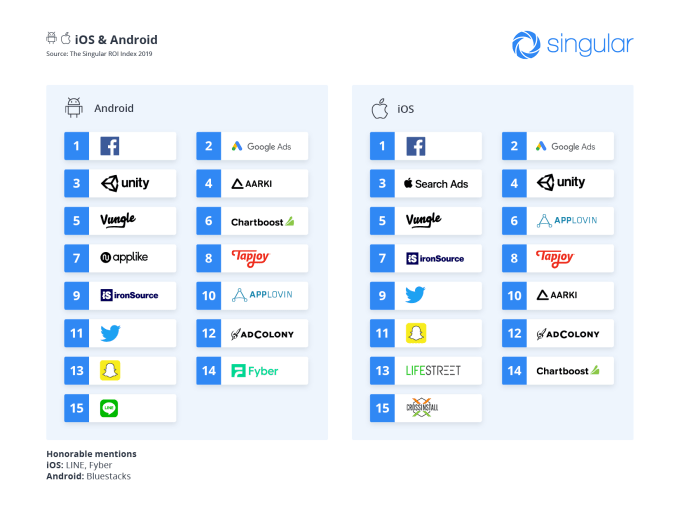
Singular ROI Index 2019 — iOS-AndroidAt the same time, Singular noted that Snap improved its rankings on virtually all the lists, and is now the No. 3 network for non-gaming ads on both iOS and Android. And Twitter did respectably as well, ranking second on iOS for retention.

Comparing the two big mobile platforms, it seems that Android is more volatile — one-third of the networks on the Android ROI list are appearing for the first time, and 80 percent of the remaining 10 networks changed position on the list. On iOS, on the other hand, 73 percent of the networks changed positions, but there were only two new ones on the list.

You can download the full index here.

12 Feb 2019

Facebook and Google still offer the best value for mobile advertisers (Singular report)

Among mobile ad networks, Facebook and Google remain the best bet for advertisers, according to the latest ROI Index from marketing startup Singular.

To pull together this year’s index, Singular says it sampled $1.5 billion in ad spending (from the $10 billion in spending that the company optimizes annually) and measured which networks are delivering the best return on investment. It also kept an eye out for ad fraud, apparently deleting a record 15 companies from the rankings because of “excessive” fraud.

So yes, Facebook followed by Google topped the list. As the report puts it, “Savvy marketers know they need more than just two media partners, but Google and Facebook are in virtually every mobile marketer’s game plan for good reason: they deliver.”

Singular ROI Index 2019 — iOS-AndroidAt the same time, Singular noted that Snap improved its rankings on virtually all the lists, and is now the No. 3 network for non-gaming ads on both iOS and Android. And Twitter did respectably as well, ranking second on iOS for retention.

Comparing the two big mobile platforms, it seems that Android is more volatile — one-third of the networks on the Android ROI list are appearing for the first time, and 80 percent of the remaining 10 networks changed position on the list. On iOS, on the other hand, 73 percent of the networks changed positions, but there were only two new ones on the list.

You can download the full index here.

12 Feb 2019

DARPA wants smart bandages for wounded warriors

Nowhere is prompt and effective medical treatment more important than on the battlefield, where injuries are severe and conditions dangerous. DARPA thinks that outcomes can be improved by the use of intelligent bandages and other systems that predict and automatically react to the patient’s needs.

Ordinary cuts and scrapes just need a bit of shelter and time and your amazing immune system takes care of things. But soldiers not only receive far graver wounds, but under complex conditions that are not just a barrier to healing but unpredictably so.

DARPA’s Bioelectronics for Tissue Regeneration program, or BETR, will help fund new treatments and devices that “closely track the progress of the wound and then stimulate healing processes in real time to optimize tissue repair and regeneration.”

“Wounds are living environments and the conditions change quickly as cells and tissues communicate and attempt to repair,” said Paul Sheehan, BETR program manager, in a DARPA news release. “An ideal treatment would sense, process, and respond to these changes in the wound state and intervene to correct and speed recovery. For example, we anticipate interventions that modulate immune response, recruit necessary cell types to the wound, or direct how stem cells differentiate to expedite healing.”

It’s not hard to imagine what these interventions might comprise. Smart watches are capable of monitoring several vital signs already, and in fact have alerted users to such things as heart-rate irregularities. A smart bandage would use any signal it can collect — “optical, biochemical, bioelectronic, or mechanical” — to monitor the patient and either recommend or automatically adjust treatment.

A simple example might be a wound that the bandage detects from certain chemical signals is becoming infected with a given kind of bacteria. It can then administer the correct antibiotic in the correct dose and stop when necessary rather than wait for a prescription. Or if the bandage detects shearing force and then an increase in heart rate, it’s likely the patient has been moved and is in pain — out come the painkillers. Of course, all this information would be relayed to the caregiver.

This system may require some degree of artificial intelligence, although of course it would have to be pretty limited. But biological signals can be noisy and machine learning is a powerful tool for sorting through that kind of data.

BETR is a four-year program, during which DARPA hopes that it can spur innovation in the space and create a “closed-loop, adaptive system” that improves outcomes significantly. There’s a further ask to have a system that addresses osseointegration surgery for prosthetics fitting — a sad necessity for many serious injuries incurred during combat.

One hopes that the technology will trickle down, of course, but let’s not get ahead of ourselves. It’s all largely theoretical for now, though it seems more than possible that the pieces could come together well ahead of the deadline.

12 Feb 2019

Ubisoft and Mozilla team up to develop Clever-Commit, an AI coding assistant

Game developer Ubisoft today announced that it has partnered with Mozilla to develop Clever-Commit, an AI-based coding assistant that learns from your code base’s bug and regression data to analyze and flag potential new bugs as new code is committed. Ubisoft already uses this tool internally and Mozilla says that it will deploy it to spot bugs in its Firefox code.

Typically, when you think of Mozilla, chances are you are thinking open source, too. Clever-Commit, however, isn’t open source. “It’s being discussed. There are no plans for Clever-Commit to be open sourced right now,” a Ubisoft spokesperson told me. While Mozilla surely uses other proprietary tools to build its open-source software, it’s odd to see the organization say that it is helping to develop a tool that isn’t open source (or currently available to all developers, even for a price).

Ubisoft first demoed the tool — then called Commit-Assistant — last year. Now, Mozilla says it will work with Ubisoft by “providing programming language expertise in Rust, C++ and JavaScript, as well as expertise in C++ code analysis and analysis of bug tracking systems.” Mozilla will first use it during the code review phase and then later, if it turns out to be useful, at other stages during the development process. The organization hopes that Clever-Commit will catch three to four out of five bugs before they are ever introduced into the code.

“With a new release every 6 to 8 weeks, making sure the code we ship is as clean as possible is crucial to the performance people experience with Firefox,” writes Mozilla’s Firefox release manager Sylvestre Ledru today. “The Firefox engineering team will start using Clever-Commit in its code-writing, testing and release process. We will initially use the tool during the code review phase, and if conclusive, at other stages of the code-writing process, in particular during automation.”