Author: azeeadmin

12 Feb 2019

Ubisoft and Mozilla team up to develop Clever-Commit, an AI coding assistant

Game developer Ubisoft today announced that it has partnered with Mozilla to develop Clever-Commit, an AI-based coding assistant that learns from your code base’s bug and regression data to analyze and flag potential new bugs as new code is committed. Ubisoft already uses this tool internally and Mozilla says that it will deploy it to spot bugs in its Firefox code.

Typically, when you think of Mozilla, chances are you are thinking open source, too. Clever-Commit, however, isn’t open source. “It’s being discussed. There are no plans for Clever-Commit to be open sourced right now,” a Ubisoft spokesperson told me. While Mozilla surely uses other proprietary tools to build its open-source software, it’s odd to see the organization say that it is helping to develop a tool that isn’t open source (or currently available to all developers, even for a price).

Ubisoft first demoed the tool — then called Commit-Assistant — last year. Now, Mozilla says it will work with Ubisoft by “providing programming language expertise in Rust, C++ and JavaScript, as well as expertise in C++ code analysis and analysis of bug tracking systems.” Mozilla will first use it during the code review phase and then later, if it turns out to be useful, at other stages during the development process. The organization hopes that Clever-Commit will catch three to four out of five bugs before they are ever introduced into the code.

“With a new release every 6 to 8 weeks, making sure the code we ship is as clean as possible is crucial to the performance people experience with Firefox,” writes Mozilla’s Firefox release manager Sylvestre Ledru today. “The Firefox engineering team will start using Clever-Commit in its code-writing, testing and release process. We will initially use the tool during the code review phase, and if conclusive, at other stages of the code-writing process, in particular during automation.”

12 Feb 2019

Massless raises $2M to build an Apple Pencil for virtual reality

Despite all of the VR over-hyping, for those observing from the inside, the capabilities are still uncharted. VR as a creative medium has probably been one of the more entrancing use cases since the first high-end headsets launched. Products like Google’s Tilt Brush isolated impossible use cases, where VR was the only way to experience that act of creating something mesmerizing from nothing.

Massless has been intrigued by the potential of VR as a way to achieve new precision and more seamlessly shove designers and engineers into their digital workshops. The product they’re working on, the Massless Pen, is a professional stylus that functions with much of the pizzazz you’d expect from a product like the Apple Pencil, featuring things like deep pressure sensing and capacitive touch, in addition to upgrades like haptic feedback.

Indeed, you can use the Massless Pen much like you would any other designer’s stylus, but things get a bit bizarre when you pick it up off the surface and manipulate the space in front of you. That’s because the startup’s product is also a tracked 6DoF VR controller, which users can utilize as a tool to manipulate, edit and further create. It utilizes its own tracking system, which can be mounted below hardware trackers used for VR headsets.

“I think the most important thing about this product is that it works in three-dimensions, but you don’t have to use VR,” CEO Jack Cohen tells TechCrunch. “You can just use it as a standard graphics tablet and you can use it to control 3D software on a monitor… This is a transitional period for everyone, so it’s good to have that bridge that goes between them.”

While a lot of digital ink has been spilled on bringing VR to consumer markets, Massless plans to aim this device firmly at business customers, hoping to attract further attention from customers working in design and visualization-heavy enterprises like commercial architecture and automotive design.

The plights of a hardware startup are well-documented; that’s further true of a VR team. Massless has closed a seed raise of $2 million led by Founders Fund Pathfinder to get things started. Entrepreneur First, Vivi Nevo, Shrug Capital and Wendy Tan-White also participated in the round.

The company is using the new funding to grow its team and finish the Massless Pen and bring it to its first set of production enterprise partners.

12 Feb 2019

Massless raises $2M to build an Apple Pencil for virtual reality

Despite all of the VR over-hyping, for those observing from the inside, the capabilities are still uncharted. VR as a creative medium has probably been one of the more entrancing use cases since the first high-end headsets launched. Products like Google’s Tilt Brush isolated impossible use cases, where VR was the only way to experience that act of creating something mesmerizing from nothing.

Massless has been intrigued by the potential of VR as a way to achieve new precision and more seamlessly shove designers and engineers into their digital workshops. The product they’re working on, the Massless Pen, is a professional stylus that functions with much of the pizzazz you’d expect from a product like the Apple Pencil, featuring things like deep pressure sensing and capacitive touch, in addition to upgrades like haptic feedback.

Indeed, you can use the Massless Pen much like you would any other designer’s stylus, but things get a bit bizarre when you pick it up off the surface and manipulate the space in front of you. That’s because the startup’s product is also a tracked 6DoF VR controller, which users can utilize as a tool to manipulate, edit and further create. It utilizes its own tracking system, which can be mounted below hardware trackers used for VR headsets.

“I think the most important thing about this product is that it works in three-dimensions, but you don’t have to use VR,” CEO Jack Cohen tells TechCrunch. “You can just use it as a standard graphics tablet and you can use it to control 3D software on a monitor… This is a transitional period for everyone, so it’s good to have that bridge that goes between them.”

While a lot of digital ink has been spilled on bringing VR to consumer markets, Massless plans to aim this device firmly at business customers, hoping to attract further attention from customers working in design and visualization-heavy enterprises like commercial architecture and automotive design.

The plights of a hardware startup are well-documented; that’s further true of a VR team. Massless has closed a seed raise of $2 million led by Founders Fund Pathfinder to get things started. Entrepreneur First, Vivi Nevo, Shrug Capital and Wendy Tan-White also participated in the round.

The company is using the new funding to grow its team and finish the Massless Pen and bring it to its first set of production enterprise partners.

12 Feb 2019

Report: Voice assistants in use to triple to 8 billion by 2023

The use of voice assistants is set to triple over the next few years, according to a new forecast from the U.K.-based analysts at Juniper Research. The firm estimates there will be 8 billion digital voice assistants in use by 2023, up from the 2.5 billion assistants in use at the end of 2018.

The majority of those assistants will live on smartphones, where Google Assistant and Siri offer voice assistants to Android and iOS users, respectively.

In fact, Google already announced its voice assistant would be enabled on a billion devices as of last month, thanks to its integration with Android. Meanwhile, Amazon’s Alexa — which still primarily lives on smart speakers like Echo — has reached more than 100 million devices.

Juniper, however, predicts that the fastest-growing category for voice over the next several years will not be smart speakers. It will be smart TVs.

The firm expects the smart TV voice assistant category to grow by 121.3 percent (CAGR) over the next five years, while smart speakers will grow by 41.3 percent. Wearables will also play a significant role, with 40.2 percent growth, the study found.

Alexa is already the market leader on smart speakers, but in the years ahead it will be challenged by Chinese companies rolling out their own smart devices, the report says.

Also of note, the report challenges the belief that smart speakers aren’t being used for commerce. Instead, it says that voice commerce will grow substantially to reach more than $80 billion per year by 2023. However, there’s a twist to its findings.

Its “voice commerce” figure includes money transfer and purchases of digital goods alongside voice commerce’s use for more traditional purchases. And it doesn’t expect physical purchases to account for the bigger chunk of that $80 billion.

“We expect the majority of voice commerce to be digital purchases, until digital assistants offer truly seamless cross-platform experiences” said research author James Moar, in a statement about the new study. “Connected TVs and smart displays are vital here, as they can provide a visual context that is lacking in smart speakers.”

It’s worth noting, too, that Juniper believes the rise of digital assistants will negatively affect the global mobile app market. Specifically, it says that as consumer demand for multi-platform assistants increases, standalone apps for smartphones and tablets made by independent developers will decline. This will come about because many of the simpler interactions we use apps for today will become outsourced to voice assistants. And this, in turn, will also reduce our screen time.

In addition, there are early indications that smart speakers are becoming a part of users’ daily routines in ways that voice assistants on other platforms are not. This will lead to increased demand for voice-only interactions in the future, the firm says.

12 Feb 2019

Report: Voice assistants in use to triple to 8 billion by 2023

The use of voice assistants is set to triple over the next few years, according to a new forecast from the U.K.-based analysts at Juniper Research. The firm estimates there will be 8 billion digital voice assistants in use by 2023, up from the 2.5 billion assistants in use at the end of 2018.

The majority of those assistants will live on smartphones, where Google Assistant and Siri offer voice assistants to Android and iOS users, respectively.

In fact, Google already announced its voice assistant would be enabled on a billion devices as of last month, thanks to its integration with Android. Meanwhile, Amazon’s Alexa — which still primarily lives on smart speakers like Echo — has reached more than 100 million devices.

Juniper, however, predicts that the fastest-growing category for voice over the next several years will not be smart speakers. It will be smart TVs.

The firm expects the smart TV voice assistant category to grow by 121.3 percent (CAGR) over the next five years, while smart speakers will grow by 41.3 percent. Wearables will also play a significant role, with 40.2 percent growth, the study found.

Alexa is already the market leader on smart speakers, but in the years ahead it will be challenged by Chinese companies rolling out their own smart devices, the report says.

Also of note, the report challenges the belief that smart speakers aren’t being used for commerce. Instead, it says that voice commerce will grow substantially to reach more than $80 billion per year by 2023. However, there’s a twist to its findings.

Its “voice commerce” figure includes money transfer and purchases of digital goods alongside voice commerce’s use for more traditional purchases. And it doesn’t expect physical purchases to account for the bigger chunk of that $80 billion.

“We expect the majority of voice commerce to be digital purchases, until digital assistants offer truly seamless cross-platform experiences” said research author James Moar, in a statement about the new study. “Connected TVs and smart displays are vital here, as they can provide a visual context that is lacking in smart speakers.”

It’s worth noting, too, that Juniper believes the rise of digital assistants will negatively affect the global mobile app market. Specifically, it says that as consumer demand for multi-platform assistants increases, standalone apps for smartphones and tablets made by independent developers will decline. This will come about because many of the simpler interactions we use apps for today will become outsourced to voice assistants. And this, in turn, will also reduce our screen time.

In addition, there are early indications that smart speakers are becoming a part of users’ daily routines in ways that voice assistants on other platforms are not. This will lead to increased demand for voice-only interactions in the future, the firm says.

12 Feb 2019

Mental health startup Lantern will continue to live through IP licensing deals

After winding down its consumer-oriented operations last July, mental health startup Lantern has partnered with larger mental health providers to license its IP. In addition to licensing its IP to Omada Health, Lantern has licensed its tech to Spring Health, Ginger.io and two others.

Spring Health, which offers mental health benefits for large employers, provides personalized, clinically proven approaches to mental health care for employees. But Spring Health has always wanted to integrate digital cognitive behavioral therapy into its approach, Spring Health CEO April Koh told TechCrunch.

Spring Health has already offered psychiatry, therapy and self-help tools, but it was wanting to refer people to digital CBT, Koh said.

“There was really only one player that was committed to evidence as deeply as we were and that was Lantern,” she said. “So when the opportunity presented itself, we were thrilled.”

CBT is a clinically validated approach that examines the relationship between thoughts, feelings and behaviors. Lantern, which proved the clinical validity of its digital CBT tools, offered programs designed to empower people to learn how to manage their anxiety, stress and/or body images on a daily basis.

“We’re in the market of saying one size doesn’t fit all,” Koh said. “One size fits one person. There are so many different options and treatments for people. We shouldn’t try to come up with blanket solutions and expect those solutions to help everybody.”

Omada, which develops tools for people struggling with chronic illnesses like diabetes and obesity-related diseases, was also attracted to Lantern’s IP because of the startup’s demonstration of clinical validity and effectiveness.

“We have known that anxiety and depression are likely co-morbidities for the population we serve, and that they are obstacles to success for those dealing with chronic conditions,” Omada Health president Adrian James said in a statement to TechCrunch.

Thanks to Lantern’s IP, Omada plans to launch a behavioral health program for its customers, as well as integrate more CBT content into its chronic disease prevention and management programs. The money made from selling the IP, Lantern founder Alejandro Foung told TechCrunch, will go back to LPs and investors. Lantern had previously raised more than $20 million in funding.

Meanwhile, Foung has also started a nonprofit organization, All Mental Health, to offer free tools to a group of people sometimes referred to as the “sandwich generation” — those who are caring for kids as well as their aging parents.

“So they’re basically sandwiched in between those two things and that’s a very difficult place to be,” Foung said.

Similar to Lantern, All Mental Health’s tools are CBT-oriented. But rather than focus on selling to employers to offer as an employee benefit or people who can already afford to pay for therapy, Foung told me, “the goal of the not-for-profit is to actually be content and techniques for everyone. And by being a not-for-profit, we’re more able to serve a more macro audience that’s currently not getting anything.”

When Foung and I chatted in July, he said he would be focused on “addressing gaps that exist for underserved populations.” This is where All Mental Health comes in. Its first app, Caring for You, is designed to help support caregivers in caring for themselves. The next app Foung has planned is geared toward breakups, followed by one that’s focused on life after sports.

12 Feb 2019

Mental health startup Lantern will continue to live through IP licensing deals

After winding down its consumer-oriented operations last July, mental health startup Lantern has partnered with larger mental health providers to license its IP. In addition to licensing its IP to Omada Health, Lantern has licensed its tech to Spring Health, Ginger.io and two others.

Spring Health, which offers mental health benefits for large employers, provides personalized, clinically proven approaches to mental health care for employees. But Spring Health has always wanted to integrate digital cognitive behavioral therapy into its approach, Spring Health CEO April Koh told TechCrunch.

Spring Health has already offered psychiatry, therapy and self-help tools, but it was wanting to refer people to digital CBT, Koh said.

“There was really only one player that was committed to evidence as deeply as we were and that was Lantern,” she said. “So when the opportunity presented itself, we were thrilled.”

CBT is a clinically validated approach that examines the relationship between thoughts, feelings and behaviors. Lantern, which proved the clinical validity of its digital CBT tools, offered programs designed to empower people to learn how to manage their anxiety, stress and/or body images on a daily basis.

“We’re in the market of saying one size doesn’t fit all,” Koh said. “One size fits one person. There are so many different options and treatments for people. We shouldn’t try to come up with blanket solutions and expect those solutions to help everybody.”

Omada, which develops tools for people struggling with chronic illnesses like diabetes and obesity-related diseases, was also attracted to Lantern’s IP because of the startup’s demonstration of clinical validity and effectiveness.

“We have known that anxiety and depression are likely co-morbidities for the population we serve, and that they are obstacles to success for those dealing with chronic conditions,” Omada Health president Adrian James said in a statement to TechCrunch.

Thanks to Lantern’s IP, Omada plans to launch a behavioral health program for its customers, as well as integrate more CBT content into its chronic disease prevention and management programs. The money made from selling the IP, Lantern founder Alejandro Foung told TechCrunch, will go back to LPs and investors. Lantern had previously raised more than $20 million in funding.

Meanwhile, Foung has also started a nonprofit organization, All Mental Health, to offer free tools to a group of people sometimes referred to as the “sandwich generation” — those who are caring for kids as well as their aging parents.

“So they’re basically sandwiched in between those two things and that’s a very difficult place to be,” Foung said.

Similar to Lantern, All Mental Health’s tools are CBT-oriented. But rather than focus on selling to employers to offer as an employee benefit or people who can already afford to pay for therapy, Foung told me, “the goal of the not-for-profit is to actually be content and techniques for everyone. And by being a not-for-profit, we’re more able to serve a more macro audience that’s currently not getting anything.”

When Foung and I chatted in July, he said he would be focused on “addressing gaps that exist for underserved populations.” This is where All Mental Health comes in. Its first app, Caring for You, is designed to help support caregivers in caring for themselves. The next app Foung has planned is geared toward breakups, followed by one that’s focused on life after sports.

12 Feb 2019

Daily Crunch: Amazon acquires Eero

The Daily Crunch is TechCrunch’s roundup of our biggest and most important stories. If you’d like to get this delivered to your inbox every day at around 9am Pacific, you can subscribe here:

1. Amazon is buying home mesh router startup, Eero

It’s a pretty clear fit for Amazon as it pushes to make Alexa a feature in the connected home. The move also makes sense for five-year-old Eero — which, in spite of being early to the home mesh router game and pulling in some high-profile investors, has struggled.

If you’re an Eero owner wondering how this affects your privacy, read this.

2. LinkedIn debuts LinkedIn Live, a new live video broadcast service

Launching in beta first in the United States, LinkedIn Live will be invite-only. The plan is to start by covering conferences, product announcements, Q&As and other events led by influencers and mentors, office hours from a big tech company, earnings calls and graduation/awards ceremonies.

3. Announcing Extra Crunch

Okay, if you’r reading this on the TechCrunch website (as opposed to your inbox), you probably know about Extra Crunch already, but just in case: It’s an additional layer of content, coverage, product and events-based offerings for our most regular and engaged readers. And you can get 20 percent off an annual subscription if you use the code TCDAILY.

4. Car rental startup Virtuo picks up €20M Series B

Originally founded in France and available in 19 French and two Belgium locations, Virtuo launched in London last summer, and says it plans to bring the service to U.K. cities Manchester, Bristol and Edinburgh later this year.

5. Hands-on with an Alpha build of Google Maps’ Augmented Reality mode

Most of us have probably had this big city experience: You step off public transit, take a peek at Google Maps to figure out which way you’re supposed to go … and then somehow proceed to walk two blocks in the wrong direction. Google Maps’ Augmented Reality mode is designed to end that scenario.

6. Amazon is bringing its delivery Lockers to Coachella

The retailer says it will make its storage lockers available to festival-goers, allowing them to order — in advance or on the same day — to have items like sunscreen, hats and phone chargers delivered to an on-site locker.

7. Mode, a collaborative analytics platform focused on empowering data scientists, just landed $23M in fresh funding

Mode’s CEO says organizations need to better empower data scientists to quickly and effectively answer key questions, like how clients are using their product in unexpected ways, and how companies can take advantage of trends they are seeing in the data.

12 Feb 2019

Devialet’s Phantom Reactor turns music into an emotional experience

French startup Devialet has done it again. The new Phantom Reactor is a smaller, more effective speaker that packs everything that made Devialet speakers good in the first place.

Devialet’s first speaker, the Phantom, attracted rave reviews a few years ago. The egg-shaped speaker promised no background noise, no saturation and no distortion in a relatively small package.

To be clear, it wasn’t that small when you compared it with an average bookshelf speaker. But when you turned it on, it would feel like a much larger speaker — something that you’d find in a concert hall.

But that speaker wasn’t for everyone. If you live in a tiny apartment, spending $1,700 to $3,500 for a speaker capable of generating up to 4,500 Watts of power was overkill.

Hence the Phantom Reactor, a smaller version of the Phantom with the same promises — no background noise, no saturation and no distortion. It still features the iconic egg-shaped design.

The company let me borrow a Phantom Reactor for a few weeks to play with it at home. And I’ve been impressed by the speaker. It’s a tiny beast that makes any all-in-one Bluetooth speaker sound like a joke.

In many ways, this speaker reminds me of the iPod lineup. When Apple first introduced the iPod, it was the perfect device for music enthusiasts. For the first time, you could take all of your music with you, even if you had a large music library.

But that device was heavy, expensive and thick — stack three iPhone XS and you get the thickness of the original iPod. Everything was great on paper, but it was impractical if you’re not that much into music.

With the iPod mini, Apple created a device that was not only cheaper than the original iPod but also more effective. Music devices, from portable players to connected speakers, are supposed to disappear and integrate perfectly in your daily routine.

The Phantom Reactor is a damn good speaker. Music fills up my living room in a way that none of my many other speakers do. When I compare it with another speaker, I can hear that it’s the same song. But, with Devialet’s speaker, it feels like I’m experiencing the song instead of just listening to the song.
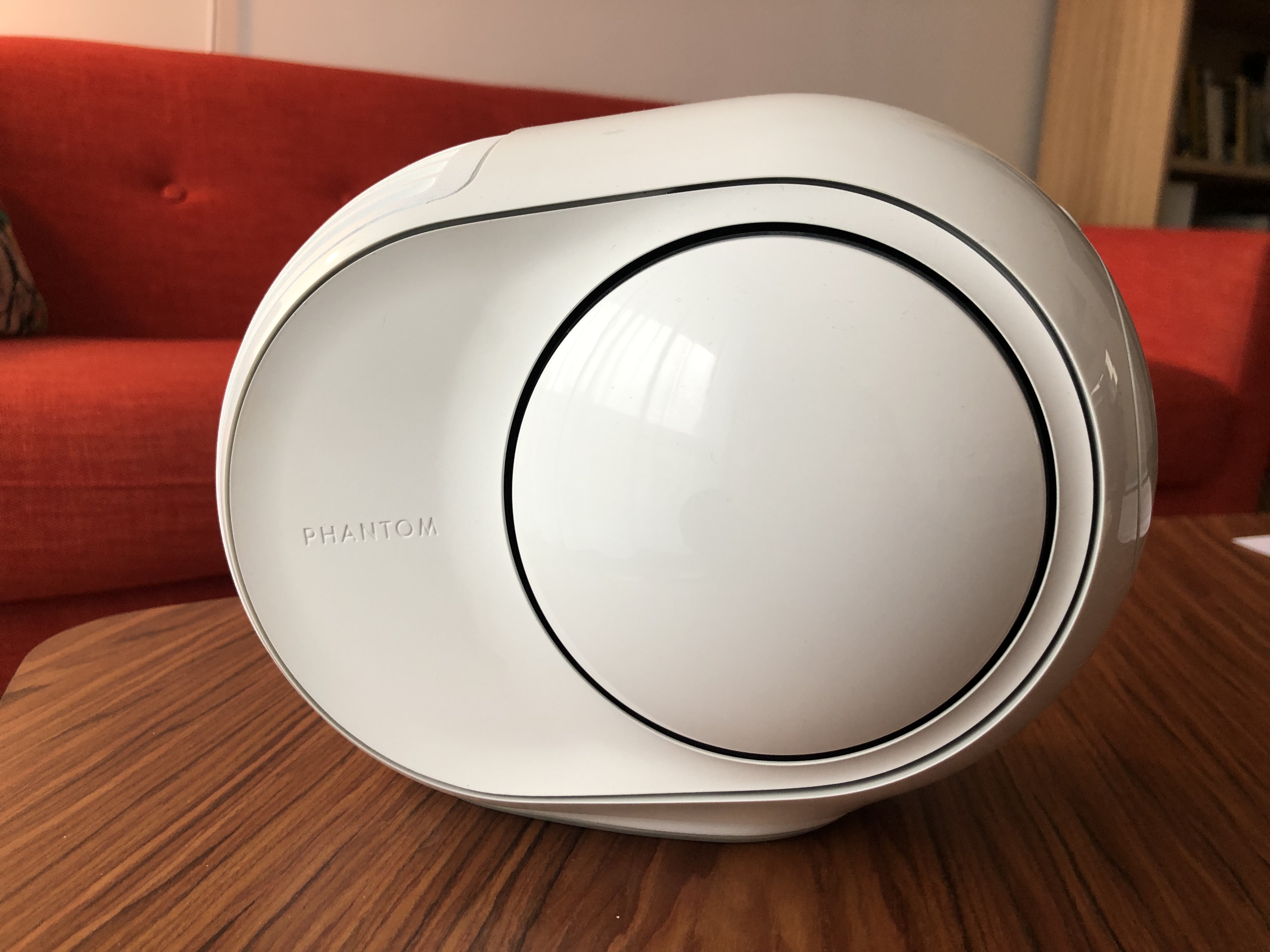
The 900W model that I’m using is still too powerful for my apartment — I can’t play music at 60 percent of the volume for too long without thinking about my neighbors. If you live in a crowded city with small living rooms, the cheaper 600W model is probably enough. If you have a house in the suburbs, that’s probably a different story.

The Phantom Reactor isn’t portable per se. It doesn’t have a battery and it still weighs 9.5lbs/4.3kg. You’ll be able to unplug it and carry it to another room every now and then, but you won’t take it with you to your friend’s house.

You can currently play music using AirPlay, Bluetooth, Spotify Connect, UPnP as well as analog and optical input. You can connect it to your network using Wi-Fi or Ethernet.

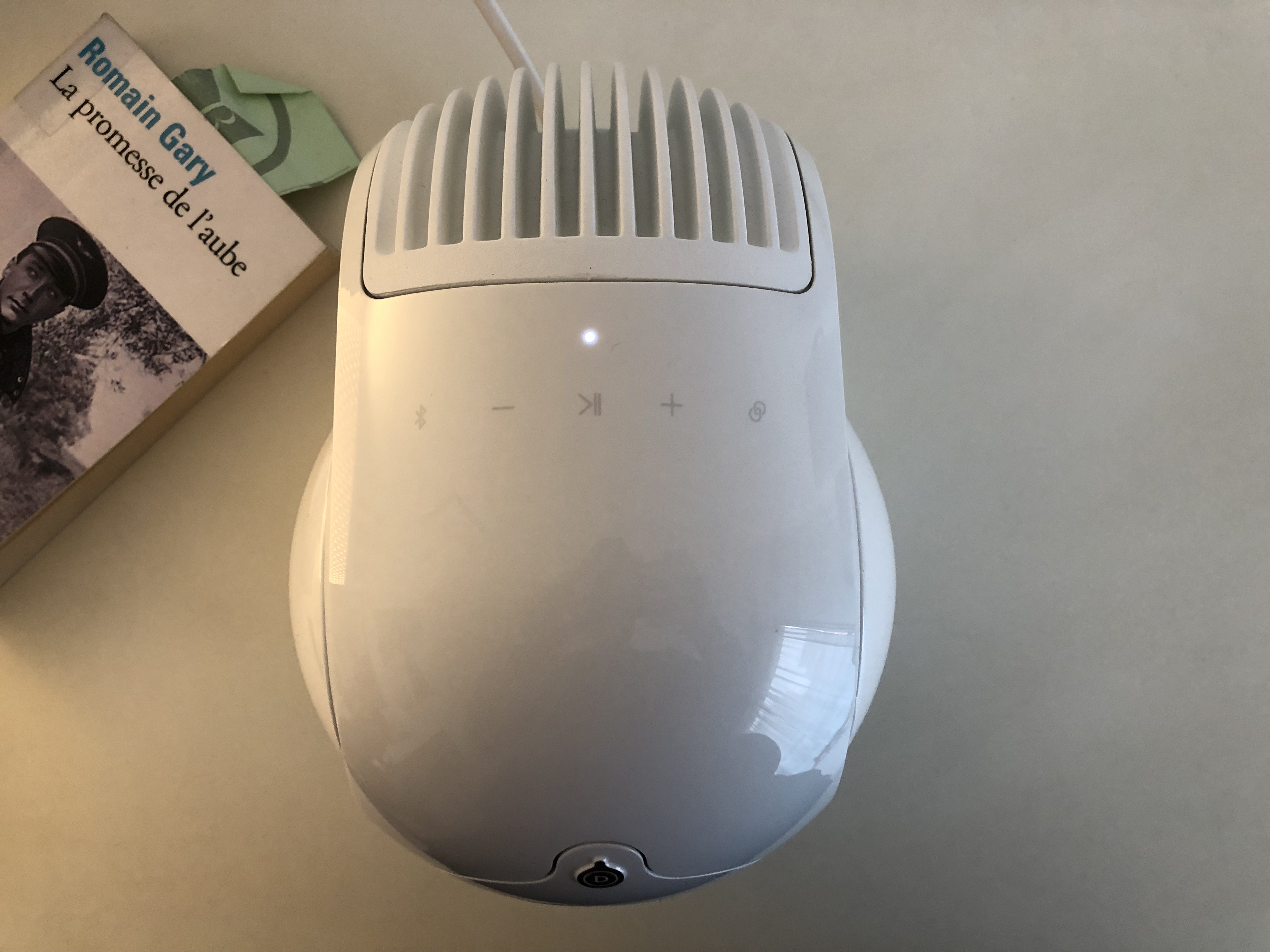
The mobile app is quite minimal. It guides you through the setup process and lets you select the source input at any time. You’re supposed to control music from your usual music players. There are also touch buttons on the top of the speaker for basic playback and pairing controls.

I’ve been mostly using Spotify Connect, which lets you stream music on the speaker directly. If you’re not familiar with the protocol, you play a song or playlist in the Spotify app just like you would normally do — you just have to select the Phantom Reactor as the output speaker. Nothing actually happens on your phone or computer, the Spotify app acts as a remote.

As you may have noticed, AirPlay 2 isn’t supported just yet and you can’t pair multiple speakers. The company says that those features will come later with a software update. Devialet also says that it isn’t in the business of voice assistants — there’s no microphone on board.

But if you’re looking for a business that sounds good and you have enough money for the Phantom Reactor, the speaker is available now for for $999/€990/£990 for the 600W model and $1,299/€1,290/£1,290 for the 900W model.
12 Feb 2019

Lyft brings on Uber’s former global head of internal audit

The battle between Uber and Lyft, which are both expected to go public this year, continues. Today, Lyft announced the hire of Michelle DeBella, formerly Uber’s global head of internal audit, as its own VP of finance strategy.

DeBella will be responsible for ensuring Lyft meets its objectives around scaling. She’ll systematically review Lyft’s operations, examine its risks and ensure the company is set up for success. Previously, DeBella spent eight years at Hewlett-Packard, where she served as VP of internal audit.

“I had the pleasure of working with Michelle for several years at HPE and am excited to partner with her once again at Lyft,” Lyft Audit Committee Chairperson Maggie Wilderotter said in a statement. “Michelle’s pragmatic and collaborative approach to financial leadership is exactly what we need to position Lyft for future success and grow the business responsibly.”