Author: azeeadmin

12 Feb 2019

Save the date and save a bundle on Disrupt San Francisco 2019

Mark your calendars startup fans, because Disrupt is returning to the beautiful City by the Bay to host TechCrunch’s flagship event, Disrupt San Francisco 2019, October 2-4 at the Moscone North Convention Center. It may only be February, but it’s never too early to save the date — or save a bundle. Planning pays off and, in this case, it pays in the form of cold, hard cash.

Simply register your interest by signing up for our mailing list and you’ll save an extra $500 on your Disrupt SF 2019 passes when the official registration opens next month. How sweet is that?

Last year’s Disrupt San Francisco — TechCrunch’s largest ever — was epic by any measure, and we’re hard at work to make this year even better. Be on the lookout for more details in the coming weeks and months, but here’s a taste of what you can expect.

Startup Battlefield, the world-renowned startup competition, returns — and so does $100,000 in prize money for one extraordinary early-stage startup. Last year, Forethought took home $100K. Will your startup be the next? Keep your eyes on the site for your chance to apply and compete for the cash, the coveted Disrupt Cup and a ton of media and investor attention.

The Startup Alley exhibit hall — the heart and soul of Disrupt — will feature hundreds of early-stage startups demonstrating innovative tech and talent. Exhibiting startups cross a wide range of technologies, with a special focus on these tracks: Artificial Intelligence, Augmented/Virtual Reality, Blockchain, Biotech/Healthtech, Fintech, Gaming, Investor Topics, Justice/Diversity, Mobility, Privacy/Security, E-commerce/Retail and Robotics.

You’ll also find the hand-selected TC Top Picks camped out in the Alley. Do you have what it takes to be a TC Top Pick? Watch the site for your chance to apply. Here’s another reason to stay tuned; we’re planning to give away free Startup Alley exhibitor packages through our Top Picks program.

The Hack is back. That’s right, the TechCrunch on-site Hackathon returns to run simultaneously alongside Disrupt SF 2019. Hundreds of developers, engineers, students, marketers and makers form teams and spend the first two days of Disrupt coding and hacking their way to a new software product. Cash prizes will be awarded for the best overall hack, and there will be plenty of other sponsored hack contests, cash prizes, swag — and coffee. Lots and lots of coffee.

There’s your taste of Disrupt San Francisco 2019. Be sure to save the date — October 2-4 at Moscone North — and sign up for our mailing list. That one simple act will trim $500 off the price of your exhibit pass when registration opens. It’s the easiest bundle you’ll ever save.

12 Feb 2019

Medium buys Bay Area mag The Bold Italic to add to its paywall

Medium is seeking to juice up its premium subscription content in its home market with the acquisition of The Bold Italic. The 10-year-old online culture magazine will go behind the $5 per month Medium Membership paywall. The deal will keep The Bold Italic afloat when other San Francisco-local publications have struggled, following the shutdown of the The Oakland Tribune an SFist plus the layoff of most the Easy Bay Express.

The Bold Italic could make Medium Membership more appealing to Bay Area techies, newshounds, and community-philes. It needs all the subscribers it can get after pivoting away from ads and laying off 50 employees as well as shuttering two offices in 2017. That’s despite having raised $132 million. Last year it gave some publications whiplash by suddenly terminating its program that let them operate their own paywalls on the Medium platform. With so many publications competing for subscription revenue (TechCrunch launched its own subscription product called Extra Crunch today), and having raised so much money, many are uncertain of Medium’s fate.

The Bold Italic almost died too. Back in 2015, its owner Gannett decided it wasn’t worth operating. But Scripted co-founder Sunil Rajaraman and tech author Sonia Arrison managed to buy The Bold Italic assets off of Gannett and relaunch the publication. It’s continued to chronicle the weird mashup of local startup and hipster cultures, the art scene’s resistance against rent hikes, and San Francisco’s persistent civic troubles.

“Medium is a natural partner for us” writes Bold Italic editor-in-chief Clara Hogan. “Not only have we already been operating on the platform for several years, but we’re also both intrinsically committed to innovation and risk taking when it comes to journalism. We’re excited to now have greater resources to produce even better content and, most importantly, pay our contributors — old and new — significantly more.”

Bringing in premier, well-branded content could make people see Medium Membership as more than just paying for what you could get elsewhere for free.

12 Feb 2019

No, Tencent isn’t about to burn Reddit down

Ahoy, it’s doom and gloom for Reddit after the company welcomed investment from Chinese censorship overlord Tencent.

Well, not quite.

The reality is, in fact, it’s quite the opposite. In recruiting the company behind one of the internet’s largest and vibrant social networks — chat app WeChat — and countless blockbuster games, Reddit has pulled off a major coup and banked a huge amount of cash, both of which can help it grow to the next level.

But, right now, reports in the U.S. are suggesting otherwise. You might have seen a range of negative stories surface in the past week following Reddit’s latest round of investment — first reported by TechCrunch — which is led by Tencent and values the company at $3 billion.

Triggered by a Gizmodo story last week, fear is being stoked that a deal with the “Chinese censorship powerhouse” could lead Reddit awry and bankrupt its morality, well, whatever of that it has left. Reddit users, not ones to be slow on humor, have already plastered the site with content that would be forbidden in China, including Winnie the Pooh, the cartoon character often used to represent Chinese President Xi Jinping.

Gizmodo referred to Tencent as “one of the most important architects of the Great Firewall,” and that’s a refrain that has been repeated in countless other reports.

I get it, it‘s a delicious irony; one of the lawless parts of the internet combining forces with a company that aggressively monitors and censors its users. Plus, Reddit is already blocked in China.

But, unfortunately for Gizmodo, the fears are overblown and its descriptions of Tencent are at best naive and at worst deliberately misguided.

China’s censorship system

Tencent is no “architect” of China’s Great Firewall internet censorship program. It’s one of a number of companies which, from its success, finds itself a prominent target for the government with little room to wiggle out.

Tencent sits in an awkward position, for sure. It is the largest internet company in China — it became the first $500 billion firm in Asia last year — and that makes it a core part of the government’s ongoing campaign to control Chinese internet space.

After an unprecedented crackdown on the Twitter-like service Weibo in 2012, when the government closed down comments for three days, China’s censorship became more proactive rather than reactive. That approach leaves fewer traces, for one thing, and it allows Beijing to shift responsibility to the platforms themselves, which fear the repercussions of angering authorities.

That’s to say that today’s dynamic sees China’s top internet companies, including Tencent, instructed to monitor the content produced by their users and, where necessary, remove it.

Reddit CEO Steve Huffman delivers remarks on “Redesigning Reddit” during the third day of Web Summit in Altice Arena on November 08, 2017 in Lisbon, Portugal. Web Summit.

Censoring social networks is one thing, but censoring WeChat — Tencent’s prized asset and China’s top messaging app with more than a billion monthly users — is another thing altogether. Tencent has been roundly (and rightly) criticized for implementing a range of “silent” blocks that, for some terms, prevent messages from being sent or picked up by the receiver.

Likewise, it has also purged millions of accounts from WeChat following numerous rounds of government-led initiatives that crack down on media, pornography and unsubstantiated rumors.

Those crackdowns and censorship moves are not false, but Gizmodo is painting a picture that suggests Tencent is complicit in cleaning its slate.

The truth is that the company, even a company of its size, has no choice in the matter when the Chinese government comes knocking with demands. To ignore the summons, or fail to act, would cause Tencent — a publicly listed company — serious problems that would not reflect well for shareholders. Adhering to these demands is expensive and resource-intensive, as it requires a new “content checking” division with specialist employees hired and trained. In short, it is certainly not something companies willingly opt-in to.

A rite of passage

Tencent is definitely not in control of the agenda, as anyone with an eye on tech in China can tell you. The company suffered a poor end to 2018, in part because the Chinese government decided to freeze new game licenses.

That left Tencent unable to monetize its new roster of games, a situation that saw it lose countless hundreds of millions in revenue and saw its share price drop by nearly 50 percent between March and October. The freeze has only just thawed, with a handful of licenses tentatively distributed this year.

So much for the Chinese government looking after their own.

These issues affect every tech company in China with a meaningful presence. Getting hit by government demands and censorship requests is a rite of passage for tech startups in China, like a dreaded badge of honor that shows your service has grown suitably influential to be considered a threat.

That happened to ByteDance, the company behind TikTok, the current social darling for many U.S. media. Last year, its CEO was forced to issue a groveling apology after it had “overemphasized growth and scale over quality and responsibility.”

The company resolved to increase its content checkers (read, censorship police) from 6,000 to 10,000 people, a move likely made to appease the government. Still, it was made an example of, with a number of TikTok apps removed from app stores and shuttered on the word of authorities.

Welcome to the club!

But it isn’t just Chinese companies.

Tencent became Asia’s first $500 billion company thanks to a stock rally — today it is worth around $425 billion [Photographer: Qilai Shen/Bloomberg via Getty Images]

Choices

Apple, the self-proclaimed protector of freedom, removed every unlicensed VPN from its China-based App Store at the behest of the government in 2017. While, in a rare move that runs counter to its core privacy focus, it relented to state rules and agreed to store Chinese iCloud user data on Chinese soil, through a government-backed cloud service provider, no less.

The difference between Apple and the likes of Tencent and ByteDance is that the U.S. company has a choice. It entered China voluntarily and it has complied with free speech-quashing demands to keep its revenue flowing.

Tencent and ByteDance, as the biggest internet players, would have a tough time moving outside of their native China and remaining in business. Maybe, in today’s censorship-heavy era, some Chinese companies wish they had started out in Hong Kong or another domain, but few markets have the opportunity that comes with 800 million internet users.

The point is that they have no control over censorship demands and no leverage to push back. To blame them — and paint them as co-conspirators, even “architects” — is misleading.

Tencent, in fact, has a reputation as a skillful investor that can be an asset for non-Chinese companies.

Its capital and guidance helped Fortnite creator Epic Games completely revamp its business into the smash hit success that it is today. Elsewhere, Tencent is the largest single investor in Snap — CEO Evan Spiegel has said he often seeks its guidance — and its other deals include Tesla, Discord, Kik and more, none of which have resulted in the introduction of censorship.

Yes, Reddit and Tencent are strange bedfellows, but that’s exactly the point of venture capital. The best founders surround themselves with different opinions, perspectives and experiences to ensure that they are evaluating all possible strategies. Tencent can give Reddit unique insight which, for those who use it, can only be a net positive for the future health of Reddit’s business and continued service.

12 Feb 2019

Investors are pouring money into Latin America’s logistics and shipping businesses

New technology companies are poised to transform the shipping and freight industry across Latin America.

Startups like Liftit, a Colombian provider of trucking services, and Nowports, a Brazilian freight shipping startup, are angling to be the next Convoy and Flexport — at a time when shipping and logistics business in Latin America is booming thanks to increasing trade coming from China.

In the first half of 2018, Chinese foreign direct investment in Latin America increased to a whopping $15.3 billion at the same time it plummeted in the U.S. to $1.8 billion. And while much of that investment had historically gone to minerals and natural resource extraction or agriculture, China is also making infrastructure investments — just as it has in Africa.

“The most exciting sectors for innovation in shipping are in trucking, consumer/third-party shipping options, and in last-mile delivery,” writes the venture investor Nathan Lustig, a partner with the Chilean investment firm Magma Partners. “Startups in the logistics industry have their work cut out for them in Latin America, and these sectors are the most prominent battlegrounds for innovation so far.”

Some Latin American logistics companies — like the Brazilian trucking company CargoX — have gained the attention of investors like Goldman Sachs, The Blackstone Group, and Samsung Ventures thanks, in part, to being initially backed by Oscar Salazary, one of the minds that originally launched Uber. The company raised $60 million in its most recent round of funding, but has been on investors’ radar for years, thanks to its famous pedigree.

Now companies like Nowports are entering the fray. The company, which is graduating as part of the most recent crop of Y Combinator accelerated startups has set itself up to be the Flexport of Latin America.

Flexport became a billion-dollar business by applying technology to the outdated shipping industry, and NowPorts is angling to do much the same.

Alfonso de los Rios and Maximiliano Casal met at a program at Stanford University, but both come from Mexico originally. And Mexico is where the company is operating. De los Rios comes from a shipping family and is very familiar with the time-consuming, manual practices that now dominate the Latin American shipping industry.

“One out of every two containers is lost or delayed because of miscommunication,” says de los Rios. “One container can get 300 emails between the freight provider and the shipper. We reduce the mistakes to zero and processing documentation three times faster than a normal freight provider in Latin America.”

To familiarize himself with the market that he’d be developing a technology for, Casal worked in a freight forwarder in Kansas City that had been operating for more than 30 years.

NowPorts is operating from Monterrey and Mexico City and will soon be opening offices in Santiago, and Montevideo, Uruguay.

“Right now we have four customers and we are moving 60 containers per month and we have a pipeline that will be growing to a very big number in March,” says Casal.

In all, freight providers are getting paid nearly $40 billion per year to move freight into Latin America.

If Nowports is building a new kind of shipping business, then Liftit, which just raised the largest Series A of any company hailing from Colombia is looking to do the same with trucking.

The $14.3 million round was led by the International Finance Corp. and the Brazilian-based pan-Latin American investment firm Monashees.

Founded by serial entrepreneur Brian Kent, Liftit is looking to be the logistics provider for trucking in Latin America.

Kent, who was born in Bogota, but was raised by his adoptive parents in Boston, returned to Latin America after several years as a successful serial entrepreneur in the United States.

After several years of searching for his biological family and exploring his roots in between running startups, Kent decided to return to Colombia more permanently. He found his biological brother (who is working for Liftit as a truck driver) and launched the company with a $2 million seed round.

The opportunity for logistics startups is vast. As Lustig notes:

The challenge of automating and streamlining shipping logistics in Latin America is becoming more pressing as e-commerce and other B2C delivery businesses take hold. Not only are large corporations dealing with sending and receiving bulk cargo across the region, but individual consumers want more on-demand services that require better organization and logistics.

Latin America still lags behind in the development of its shipping industry. The World Bank reported that in 2014, no Latin American country was in the top 25% of the Logistic Performance Index global rankings. In 2016, this figure hardly changed; Panama is the top-ranked Latin American country for logistics and shipping, yet it comes in 40th on the LPI global rankings. Chile is next at 46th, with Mexico and Brazil ranking 54th and 55th, respectively.

It’s with this in mind that investors are willing to open their wallets for startups in these emerging markets. And aligning the infrastructure in the region with 21st century standards will create even more opportunities as startups can take advantage of the more modern delivery and distribution tools at their disposal.


12 Feb 2019

The Patreon EC-1

TechCrunch is launching a new format for Extra Crunch members, called the EC-1. Modeled after the Form S-1 filing that late-stage startups submit to the SEC as part of the IPO process, EC-1s are authoritative, deep analyses into growth-stage startups.

Through extensive interviews and research, an EC-1 acts as a case study for entrepreneurs and startup executives to learn from a company’s journey as well as a thorough analysis for industry observers and public market investors eager to understand the next big companies.

Patreon is the subject of our first EC-1, which is fitting given the startup’s focus on membership. The company has an interesting backstory for sure, and it has the necessary success accoutrements: it’s raised more than $100 million in venture capital and crossed the $500 million payments milestone.

What really attracted us to Patreon, though, was the profound depth of its strategy. From every angle we looked at, the startup provided a rich and nuanced case study of how to navigate fast-moving consumer and content producer waters, all the while dodging competition from some of the wealthiest companies in the world. It’s had its moments of brilliance and certainly its share of detractors, but the company is engrossing all the same.

TechCrunch media columnist Eric Peckham wrote this EC-1. He conducted dozens of hours of interviews with Patreon’s founders, executive leadership team, and investors as well as with creators, media market experts, and consultants. Plus, he investigated datasets provided by Patreon itself, Graphtreon, and Second Measure. Together, those behind-the-scenes sources provided a profound level of access and nuance about Patreon, and Peckham offers this discerning synthesis.

Patreon had no say in the content of this analysis and did not get advanced access to it. Peckham has no financial ties to Patreon or other conflicts of interest to disclose.

The Patreon EC-1 is comprised of six main articles and a bonus reading guide, representing roughly 20,000 words and a reading time of 1 hour and 21 minutes. Read a bit now, and enjoy the rest when you can take it all in. Let’s get started:

  • The Story (2,100 words / 8 minutes) — A look at the hopes and dreams of two founders, the challenges of starting a company, as well as thoughts on fundraising and recruiting.
  • The Product (4,400 words / 18 minutes) — A comprehensive analysis of Patreon’s product strategy and how it has recently refocused on serving creators rather than being a content destination for patrons.
  • The Business (4,900 words / 20 minutes) — A deep dive into the business model, financials, revenues, churn, customer retention, segmentation and other key metrics of Patreon using a wide array of public and private datasets.
  • The Thesis (2,750 words / 11 minutes) — An argument for how Patreon becomes a massive company, exploring the necessary market conditions and steps it will need to take to reach its zenith.
  • The Competition (3,950 words / 16 minutes) — A backgrounder on the myriad of threats and competitors targeting Patreon, including social networks like Facebook, vertical subscription platforms, talent agencies, and political controversy.
  • Reading Guide (2,050 words / 8 minutes) — A bonus annotated guide to the news articles, analyses, videos, and data about Patreon that have been posted in the past and are worth referencing if you would like to research the company further.

Stay tuned, because tomorrow, Peckham will follow up this report with his opinions on the future of Patreon as well as possible roads for Patreon’s exit in the coming years.

Patreon is a startup, and so are we here at Extra Crunch. Let us know your feedback! We intend to iterate this EC-1 format more in the coming weeks as we publish the next companies in the series. Let us know what you liked, what you didn’t, and what companies you think we should look at next. You can reach the author Eric Peckham at eric.peckham@techcrunch.com and Extra Crunch Executive Editor Danny Crichton at danny@techcrunch.com.

12 Feb 2019

Announcing Extra Crunch

I won’t bury the lede. TechCrunch is launching a subscription product called, appropriately and deliciously, Extra Crunch.

Extra Crunch, as it says on the tin, is an additional layer of content, coverage, product and events-based offerings for our most regular and engaged readers. This will consist of articles that go more in-depth on topics in the entrepreneurship and startup universe, of course.

In addition to cutting closer to the bone on the topics we already cover on a daily basis, we’ll be tackling a lot of the practical nuts and bolts issues that confront founders, entrepreneurs, analysts and tech workers — from issues like inclusion and diversity to navigating hiring, legal and product decisions to mental health and wellness in high-performance environments. We want to gather the expertise and knowledge of the founders that have come before and those that are in the thick of it now.

Leading this project is Executive Editor Danny Crichton, a writer and editor with a fantastic understanding of both media and the “other side” of the equation as a venture investor and VC consultant.

He’s joined by Managing Editor Eric Eldon, who you may know as the guy I Costolo’d to get this job. He spent the last five years on his third startup — a technology and media company — and brings an invaluable understanding of the entrepreneurial journey.

Travis Bernard, who guided us through a transformational period in TechCrunch growth has been leading ops on this project — one that is simple in premise but becomes exponentially more complicated to do the right way. They’re joined by a team of people new and old that will be making an attempt to create something uniquely TC and uniquely valuable in the industry.

Our COO Ned Desmond began and championed this project for two years, and has been beyond instrumental in figuring out how to launch a subscription product at a publication that runs at breakneck speed inside a corporation with a lot on its mind. It’s been a pleasure to know that no matter what obstacles we ran into that he would not only be there to figure out how to get us over the line and to this point.

In the near term, we’re going to be pulling apart the journeys of some companies you recognize, and some that are on the cusp, to produce a guide-book of sorts that makes for a compelling read as well as sound analysis. In the long term, we hope to make Extra Crunch a repository of all the things that no one tells you, no one wants to discuss in-depth or you just have to figure out ad-hoc as you build a company.

The plans for Extra Crunch reflect our belief that honest and informative content around building startups doesn’t start and stop at Success Porn or Failure Fascination. There is so much territory to explore in between about how to build and scale sustainably and responsibly.

Quietly, and with the gratifying support of management, we’ve been reconfiguring TechCrunch over the past few years to focus on making sure that we’re providing useful, engaging content to readers, not just advertisers. While our audience — you folks — is still one many advertisers would love to reach, that’s their job, not ours. Instead, we wanted to re-align all of our goals around what we saw as the future of sustainable journalism.

This isn’t easy to do for any organization at scale, but we’re uniquely privileged to have a long, loyal readership that may not always agree with our take but appreciates that we’re coming at it from a place of honesty and belief.

There are four main components to our offering:

Price:

  • $15 per month or $150 per year
  • 30-day free trial
  • U.S., Canada, U.K., France, Germany and Spain, but we’re planning to expand to more EU countries later this year

Editorial:

  • Deep profiles of startups that have achieved late-stage success, including how they got there and where they’re headed next  — everyone will get a free taste of that this week
  • Profiles and databases of experts who any startup should think about working with, including how-to guides, based on recommendations from founders
  • Regular articles about key components of company-building, from TechCrunch staff, outside experts and more

Community:

  • Regular live conference calls with TechCrunch staff and guests
  • 20% discount on tickets to all of our events including Disrupt for annual subscribers
  • More features coming soon

Product:

  • List Builder to help you quickly track the types of companies TechCrunch covers that you care about most
  • Rapid Read Mode to help you quickly skim through the dozens of stories we publish per day
  • And one more thing: no banner ads on the site or in video pre-rolls

We hope that you’ll take the journey with us as we continue to cover the daily news of emerging and established technology companies, startups and entrepreneurs, as well as find new ways like Extra Crunch to build a direct relationship with you where we can provide something of lasting value in exchange for your local currency.

Over the past few years, TechCrunch as an organization has been able to resist a lot of the market forces and fads of the media world. We have pivoted away from the shiny objects of the moment and toward a deeper and more meaningful relationship with our core readers, and it has paid off. Not only have we nearly doubled in readership over the past few years, we’ve done it without going inorganically broad, attempting to squeeze out more value per eyeball or making our events pay-to play.

This has only been a success because every writer on our staff new and old, every videographer, product engineer, events staffer and salesperson has been on the same page. And, of course, because you, our readers, have allowed us to grow and figure out what we need to be for you. Thank you for that; it’s been a wild ride and I can’t wait to show you what we have for you next.

You can sign up for Extra Crunch here.

Matthew Panzarino

Editor-in-Chief

TechCrunch


12 Feb 2019

WeWork launches skills-based profiles as a value add for tenants

WeWork has made a big name for itself in a short period of time as a global co-working space. In fact, WeWork is now the largest private office tenant in all of Manhattan.

But whether the real estate play alone can support its reported $47 billion valuation still remains to be seen. That might explain the company’s 2018 acquisition spree, as well as today’s newly announced changes to the WeWork app.

The new feature set is aimed at fostering collaboration and real-life communities among WeWork’s 400,000+ members, but if executed properly and adopted, could also provide a way for WeWork to potentially harness the data of its users to find new revenue streams.

Up until now, WeWork has always offered its members the opportunity to connect via the WeWork app in a relatively unstructured way. With the new updates, WeWork is looking to give users the chance to offer their skills up to other WeWork members who may be looking for a freelancer or service provider.

[gallery ids="1781885,1781886,1781887,1781888"]

It starts with the profile. WeWork has added new fields for members to include their skills and interests. The interests portion will allow WeWork to customize programming based on location, so that a building with a high number of people interested in mindfulness (for example) can have access to specific programming in that field.

Where skills are concerned, WeWork has given users the tools to be hyper-specific. For example, alongside noting that John Doe is a graphic designer, he can also specify that he is particularly interested in/skilled at designing brand logos or web pages.

We Company CPO Shiva Rajaraman told TechCrunch that adding structure and matching algorithms to the website allows for members to get the most out of both their local WeWork community and the global community as a whole.

“We think that, in many of these interactions, it’s better to have someone close by,” said Rajaraman. “Being face to face can often help solve problems more efficiently, but there are instances when members might need the expertise of someone within our global community, and the app offers the ability to do both.”

Members who make a request for help from someone in the community are matched with a person who has the skills they seek by the algorithm, which is overseen by community managers who’ve gotten to know the members in their building. The app facilitates setting up a time and place to meet, and interactions are ranked after the fact to ensure that the meetings are productive.

It’s not hard to imagine entrepreneurial minded individuals building up a customer base among WeWork members in fields like design, engineering, and accounting.

In fact, language skill consultant Jen Carmody of the Miami Brickell City Centre location says she’s reached 100 percent of her clients through the WeWork app.

For now, Rajaraman says that there are no current plans to add the ability to complete a freelance contract or transaction within the app.

“For us, it’s about removing as much friction as possible when facilitating these connections between people,” said Rajaraman. “We want to learn from these connections and see what might help. This is largely about making the value proposition of what we do richer than just providing space.”

We Company CEO Adam Neumann has said before that WeWork has made space, which has traditionally been a fixed entity, much more flexible. But it seems that WeWork itself is becoming more flexible as well.

12 Feb 2019

The founding story of Patreon

It’s May 7, 2013 and Jack Conte is, in his own words, “totally exhausted, slash, totally wired, in that really weird in-between zone.” He has spent 18 hours per day for the last 50 days building a replica of the Millennium Falcon set from “Star Wars” and shooting a music video in it. When Conte has a vision for something he wants to create, he becomes obsessive. In fact, he maxed out his credit cards to see his vision through on this one.

But this is the moment. He uploads his video to YouTube where he has 100,000 subscribers. It’s not just a music video though: Conte inserted a segment at the end where he encourages fans to support him by going to a website he and his friend Sam have created called patreon.com. There, they will be able to download his new music (for free) and pledge money to help fund each video he creates going forward.

His fans respond with encouragement — and their wallets. While Conte normally makes just $100 in ad revenue per video, his fans commit to funding him with more than $5,000 per video within the first few weeks of the announcement. His creative economics had changed practically overnight.

When he was getting ready to announce patreon.com to his fans, Conte had reached out to 40 other creators asking them to create accounts, but none of them were interested. He, his girlfriend, and his roommate were the only creators on the platform when it launched. But buzz about Conte’s thousands of dollars in patronage triggered hundreds of creators to sign up. And so the story of Patreon begins.

Reading time for this article is about 8 minutes. Feature illustration by Bryce Durbin / TechCrunch.

The founding


Conte came up with the idea for Patreon in February 2013 due to his own financial situation: the small amount of ad revenue he expected from YouTube wouldn’t come close to repaying the thousands of dollars he was expecting to spend on the “Pedals” music video (it ultimately cost $10,000). He believed there was a small subset of his audience who would be happy to help though, and to do so for each future video. He mocked-up his vision on 14 pieces of printer paper and, unable to build a software platform himself, reached out to his old Stanford roommate, Sam Yam.

Conte, who studied music as an undergraduate in the Stanford class of 2006, gained notability as a musician through the duo Pomplamoose he formed with his girlfriend and now wife Nataly Dawn in 2008. While Pomplamoose considered offers from several respected record labels, they decided they could gain distribution without giving up economics or creative control given the rise of YouTube and other direct-to-fan platforms online. After an initial surge of independent success, they fell into a three-year hiatus, a period in which the ad revenue creators earned on YouTube dried up considerably.

Meanwhile, Yam was building a name for himself in the startup world. After graduation, he continued studying at Stanford for a master’s in computer science (Marc Andreessen wrote his letter of recommendation) but took a leave of absence to become one of the first engineers at the social-mapping startup Loopt.

After Loopt was acquired for $43 million in 2006, Yam founded AdWhirl, which allowed iPhone developers to dynamically select their ad networks. It was acquired in 2009 by AdMob, which Google then bought a few months later. After a short stint at Google, he spent three years trying out new startup ideas. For part of that time, he worked out of the Dogpatch Labs incubator space, sitting next to Kevin Systrom and Mike Krieger as they tinkered with early versions of Instagram, as well as media entrepreneur-turned-VC Josh Felser.

After Conte reached out to Yam about his idea for what would become Patreon, they arranged to meet at Coffee Bar on Bryant Street in San Francisco on March 6, 2013. On that day though, Yam’s focus was elsewhere. He had discovered a startup concept he believed could be a winner: a freelance photographer marketplace called OurSpot. March 6th was the day Yam was unveiling OurSpot to the world, and he had arranged for coverage in TechCrunch.

Conte’s pitch struck Yam immediately. He agreed it was an enormous opportunity and that Conte was the natural entrepreneur to drive it forward as a creator solving his own need. Yam had started their discussion by telling Conte there was no need for an NDA because ideas are a dime a dozen and execution is everything, but by the end, he was urging Conte not to tell anyone else about the idea.

That very evening, even as inbound interest from the TechCrunch coverage of OurSpot rolled in, Yam went with his gut: he began coding the Patreon platform. It quickly became his main focus, although he kept running OurSpot in parallel until Patreon’s seed round closed.

Raising the seed round


The month after Conte launched his Patreon page, he and Yam — who agreed to be equal co-founders — set out to raise their first round of funding, setting a target of $700,000. Yam reached out to Josh Felser, who had passed on investing in OurSpot but liked Yam and was intrigued to hear he had suddenly switched to work on Patreon. Felser met Conte for the first time on June 7th and says he knew he wanted to invest right away. His firm Freestyle Ventures formally committed on June 12th, offering to invest the full $700,000 on a $5.5 million pre-money valuation.

Saar Gur, a partner in the Palo Alto office of CRV, heard about Patreon through Evan Tana, who had worked with Yam at Loopt. Gur saw the sudden rise of Kickstarter as a sign of a broader wave of transformation — the rise of a new online creative class with the ability to crowdsource their financing. He had been evaluating a number of crowdfunding startups that all launched around the same time, and he said Patreon was not the obvious standout among them in terms of metrics. But Yam had solid experience, and based on the behind-the-scenes video about the making of “Pedals,” he believed Conte had the qualities of a high-potential entrepreneur.

As Gur and others met Conte and Yam, Patreon quickly became a hot deal among VCs in the Valley. Some investors who had previously ignored them returned bearing term sheets. The founders decided to raise more than they anticipated: a $2.1 million seed round led by CRV and Freestyle and joined by several other investors, including Reddit co-founder Alexis Ohanian.

When I asked Conte how he decides which VC firms to work with, he explained that it has always come down to which individuals most genuinely understood and cared about Patreon’s mission. CRV and Thrive Capital (which led the Series B and C) won the jockeying to invest and gain board seats, he noted, because Gur and Thrive’s Chris Paik as individuals felt like the most authentic partners.

12 Feb 2019

The product of Patreon

Patreon is aggressively pursuing a new three-year product vision that is, in the words of SVP of Product Wyatt Jenkins, to build “the world’s best membership SaaS product for creators.” With about 90 engineers and product managers, the company sees an opportunity to own a particular niche that’s not well served by other B2B software and is also a growing market.

In this section of the Patreon EC-1, I dive into Patreon’s product strategy, analyzing its history and current approach.

Reading time for this article is about 18 minutes. Feature illustration by Bryce Durbin / TechCrunch.

Business software for artists

The six-year-old startup enables independent content creators to finance their pursuits by converting their most dedicated fans to monthly memberships. Those memberships provide special perks to the fans — like exclusive content, access to private discussion groups, first dibs on tickets, etc. — and stable, recurring revenue to the creator. (Patreon makes its money by taking a cut of that revenue.)

Patreon is building business software distinct to the fan-artist relationship. Creators have a base of superfans who want to support them and get special access. Creators are their business — their fans specifically want them and the content they create. This is why creators often get a manager or agent to handle their business when they find success, whereas a small business owner would normally do the opposite (become a manager and delegate product creation and customer interaction).

Creators need business tools for non-business people. As a result, Patreon’s core product includes a CRM, CMS, analytics, and payments platform with a lot of proactive guidance on what to do (like telling creators in a step-by-step manner when to, say, message certain patrons in order to reduce their risk of churning). 

This is what SVP of Product Wyatt Jenkins calls “a lean-forward CRM.” It is simplified for non-technical users to navigate (lacking a lot of the flexibility other businesses want), which results in an ongoing challenge to make it more advanced without making it more complicated.

Patreon acts a bit like a business partner, not just a tech platform. In terms of human interaction, it goes beyond technical support to provide advice on business strategy, both on a creator-by-creator basis and in a scalable way through educational webinars, articles, and events. The business model of earning a commission rather than charging a monthly subscription, like normal SaaS companies do, also fits the particular dynamics of media and entertainment, where it is standard for a creator’s business partners (talent manager, agent, business manager, lawyer) to get paid on commission. 

“We’re not here to help them do art. They don’t need help doing art,” explained Jenkins, “We’re here to be their hard-core business manager friend who is like ‘no no no, you need to do this.’” He added that there’s an emotional element that is distinct in working with artists as well: “We deal with a constituency for whom price creates anxiety…it’s all wrapped up in their self-worth. So it’s part of our job in that onboarding funnel to give them the confidence to say ‘the thing you do is real and valuable…you should be okay charging for that.’”

The early product development of Patreon

For the majority of Patreon’s life, its platform has been — to varying degrees — a social marketplace with creator profiles requesting funding and featuring content, patron profiles showing the creators they support, and discovery features for patrons to find new creators. 

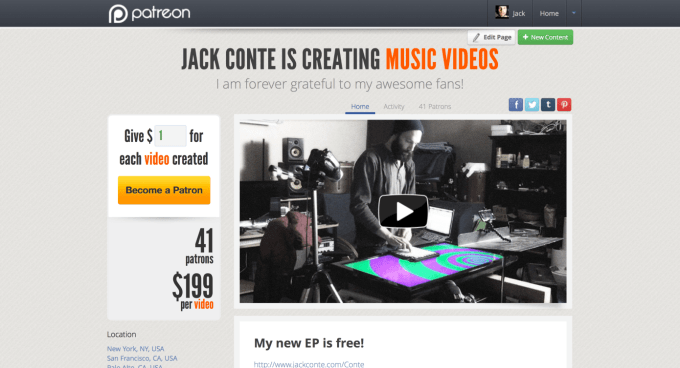
An early screenshot of the Patreon platform, here showing CEO Jack Conte’s profile page.

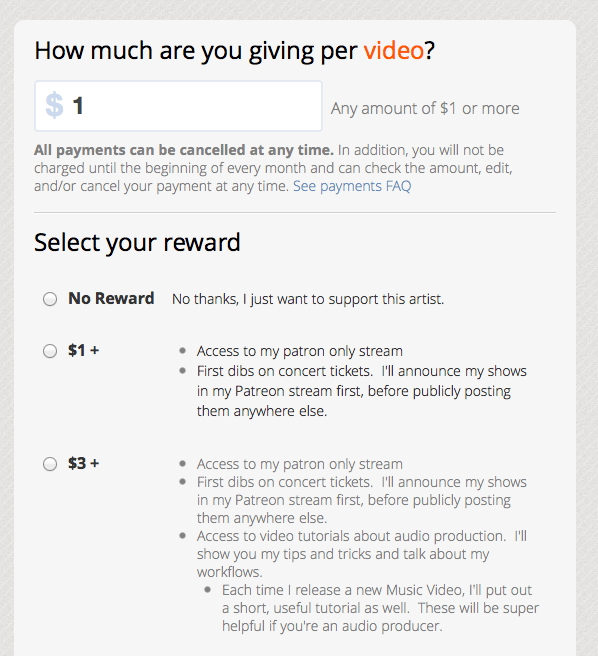
Modeled as a recurring Kickstarter, the “ask” on each creator’s profile when Patreon first launched was to commit to funding them at a set dollar amount for each creation (video, song, cartoon, etc.) they released. The creator would keep posting their content online for free, but incentivized potential patrons with perks for committing to certain donation tiers ($1, $3, $10, etc.). Fans entered a dollar amount to contribute and set a cap for the maximum they could be charged per month.

In the original conception of Patreon, patrons would pay per piece of content that a creator made.

Co-founder and CEO Jack Conte was the first creator on the platform and explained the concept to his fans in the video below.

During the first two months of Patreon, the team noticed many creators were trying to “hack” its model of paying per creation to offer a flat per month payment option, so they added that functionality. By 2015, roughly 80 percent of creators were using the per-month payment model that now defines Patreon’s membership business model, according to CTO Sam Yam. Per-month payment was made the default setting for creator benefit tiers and later the option for new creators on the platform to choose the per-creation model was removed.

In 2014, Patreon redesigned its platform to emphasize content consumption rather than creator profiles. It was a move to become more like a media platform for consumers, with the discovery and crowdfunding of creators happening as a natural byproduct. At the time, Conte told TechCrunch’s John Biggs, “Think about why people love and share something online. It’s because of the content. We wanted to showcase what the artists were doing instead.”

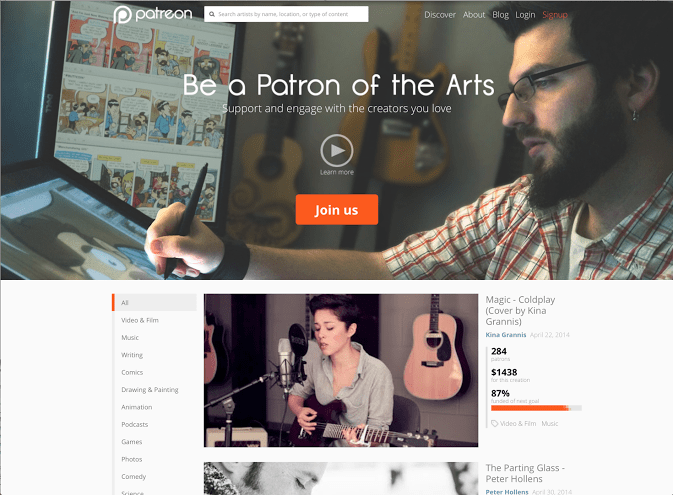
Patreon moved to emphasize content instead of profiles in order to draw in patrons

Patreon soon faced a tension in its burgeoning marketplace. To increase engagement, it wanted to help patrons discover more creators. Yet, many patrons were coming in on the recommendation of a creator, and so Patreon was essentially taking that superfan and awkwardly directing that user to other creators — possibly even competitors. So the product shifted its focus back to the pages of individual creators, which were the primary landing pages for new patrons.

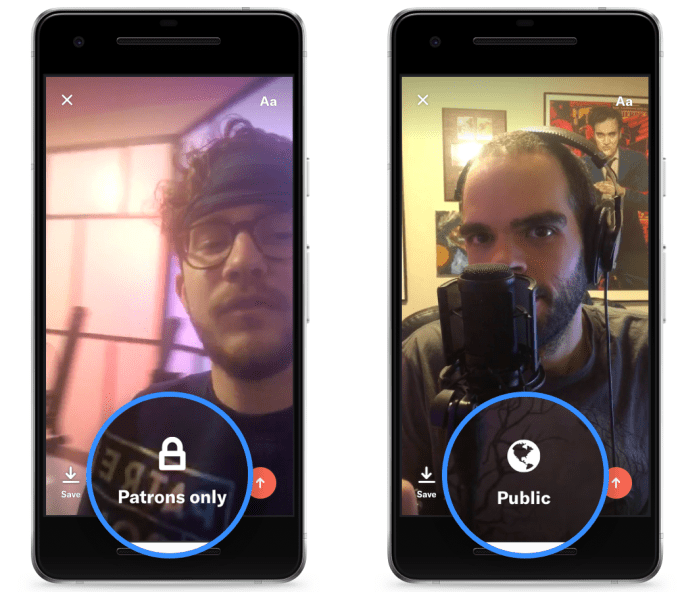
One year ago, the company launched Patreon Lens, a copycat of Snapchat Stories and Instagram Stories enabling creators to share daily behind-the-scenes video exclusively with their patrons. It was the last major product release in pursuit of the vision that Patreon should be a daily destination for content consumption — competing with YouTube, Instagram, Snapchat, and other dominant social platforms — in order to help creators convert and retain patrons. 

A screenshot of Patreon’s app Patreon Lens, which allowed users to view behind-the-scenes content from creators

12 Feb 2019

The business of Patreon

Patreon provides business infrastructure to independent content creators: people making videos, music, podcasts, paintings, comics, games, magazines and other forms of media for fans online. It helps them turn the small subset of superfans within their broader fan base into paying monthly patrons and manage relationships with those patrons across the web. Patreon is angling to become the dominant platform for creators to build these membership businesses, a position from which it could expand into other products and services for creators.

In this section of the EC-1, I am digging into the structure, performance and health of Patreon as a business. The sections are organized as follows:

  1. Business model
  2. Revenue
  3. User metrics
  4. New revenue streams
  5. Costs and efficiencies
  6. Mergers and acquisitions
  7. Investors and fundraising

My analysis of Patreon’s product, competitors, and overarching thesis have been spun out as their own articles.

Reading time for this article is about 20 minutes. Feature illustration by Bryce Durbin / TechCrunch.

Business model

Patreon’s business model is straightforward, though it is becoming more complex. It charges creators 10 percent of their revenues through the platform, which is divided into a 5 percent platform fee and a 5 percent payment processing fee. Patreon has always had a flat 5 percent platform fee, but its payment processing fees have varied in the past.

Patreon has shifted strategy, no longer acting as a marketplace connecting fans and creators but as a SaaS platform with a suite of tools for creators. Rather than viewing its fees as a marketplace rake, a better analogy is to the commission model akin to that of a talent manager, agent or record label. Patreon’s incentives are directly aligned with its customers’ goal of generating more income from their fans.

That simple model will get more complicated, as Patreon is poised to introduce additional commission fees in exchange for access to some new functionality and services. Plus, the company acquired two startups last year (Memberful and Kit), which each come with their own business models.

Revenue

On January 23rd, Patreon announced it expects to process more than $500 million in payments in 2019. That would put the company’s 2019 revenue from its core Patreon platform at north of $50 million, given its 10 percent cut.

Back in May 2018, CEO Jack Conte said in a video that they would process $300 million in payments that year, implying roughly $30 million in revenue for 2018. That was twice the $150 million they processed in 2017 (the payment fee was variable until 2018, so the 10 percent assumption doesn’t hold for 2017, but I assume revenue was in the $12-15 million range).
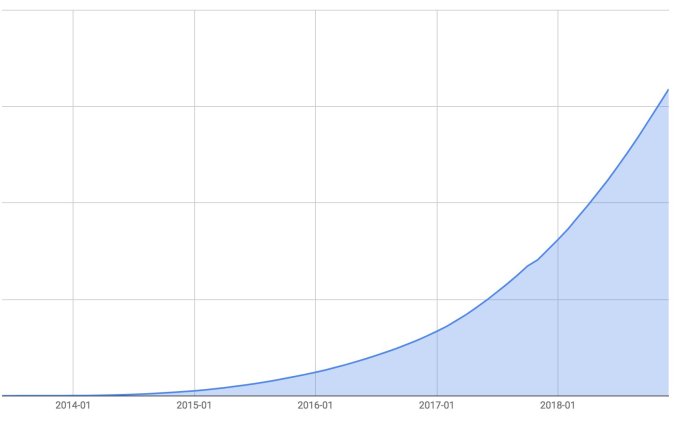
Graph of payments processing volume by Patreon since founding, shared on Twitter on February 6, 2018 by Patreon CEO Jack Conte

None of these figures include revenue from Memberful or Kit. Kit’s revenue is likely a rounding error by comparison, and there is no longer any team working on it or resources allocated to developing it further. 

In contrast, Conte told me calling Memberful a rounding error would be “way off” and that it’s a product with “incredible product-market fit and incredible traction” whose revenue doesn’t look tiny next to Patreon’s. TechCrunch’s Josh Constine reported it had 500 paying customers and seven employees at the time of the acquisition. I haven’t found helpful data to use in estimating Memberful’s revenue, so whether this is $3 million or $5 million or another amount, I don’t know.

Is Patreon profitable? “Yeah, we’ve a ways to go there,” said Conte. After multiple years of trying to figure out its long-term business model and role within the online creator ecosystem, Patreon has clarified that creators are its customers and it will generate new revenue streams by offering new products and services to them.

User metrics

Creators

Patreon reports the total number of creators earning at least $1 on its platform as “over 100,000,” but they have been using that statistic since mid-2018. The independent website Graphtreon, which estimates Patreon data using the company’s API, says the total number of creators with at least one patron is 132,500. 

Based on this same Graphtreon data set, the number of creators increased 105 percent year-over-year in 2017 (to 92,500), but then only 39 percent in 2018 (to 129,000). Patreon’s Head of Communications said the correct 2018 growth rate for creators is “slightly over 50 percent growth.”

Revenue almost doubled over the last year, and revenue is tied to creator earnings. If revenue growth is holding steady while creator growth is slowing, it implies Patreon is adding fewer small creators who don’t generate much income, but is still gaining strong traction among more established creators who do.

Creator churn tightly correlates to creator income on the platform. People don’t walk away from a meaningful source of income, but they will walk away if they have been trying to gain patrons for weeks and only have $10 to show for it. A large number of creators join Patreon before they have a fan base — they see successful creators on Patreon and mistakenly attribute that success to joining Patreon rather than bringing a pre-existing fan base to it. They churn after a few months of gaining little to no financial backing. 

From the data Patreon agreed to show me during my research, I can tell you that the annual churn rate of Patreon creators drops under 1 percent for those generating $500 per month in revenue through the platform. The greater the income, the lower the churn, and after $1,000 per month in particular, it is very rare for creators to leave the platform at all.

$1K Creators

Given those churn metrics, Patreon’s team now measures the company’s progress by two KPIs: 1) the number of creators earning $1,000+ per month and 2) the total amount of money those creators are earning through Patreon.

This focus on $1,000+ per month creators (which I’ll refer to as “$1K Creators”) likely derives from their stickiness as customers, the disproportionate contribution they make to Patreon’s revenue and the strategic decision to narrow the platform’s scope to building tools for creators with existing fan bases (not trying to help creators without fan bases get discovered).

These $1K Creators receive 70 percent of the patronage and so generate 70 percent of Patreon’s revenue (or ~$35 million in 2019). Given the extent to which content is a hits business, in which the superstars in each field capture a massively disproportionate percentage of the economics, Patreon is less top-heavy than one might otherwise expect. While it has many $50,000+ per month creators, and indeed its single highest-earning creator — earning roughly $400-500,000 per month by my estimate — accounts for nearly 1 percent of all money flowing through the platform, Patreon’s dominant revenue source is creators earning between $1,000 and $50,000 per month. This is the mid-tail of content creators that the company’s business thesis hinges on.

Patreon doesn’t disclose how many $1K Creators there are, but CEO Jack Conte said “It’s a tiny portion. Because it’s an open platform, we at one point had hundreds and hundreds of thousands of creators who were making $0.” By the estimates of Graphtreon creator Tom Boruta, there are currently more than 4,300 creators making at least $1,000 per month (and more than 9,200 creators making $500+ per month). That small subset — 4,300 out of 132,500 active creators or about 3.2 percent of its customers — is Patreon’s core focus nowadays.

Patrons

In 2018, creators used Patreon to generate income from more than 3 million active patrons. That is a 50 percent year-over-year increase from the 2 million patrons Patreon had processed payments from in 2017. Using data from Second Measure — a firm that tracks billions of anonymized debit and credit transactions from millions of U.S. consumers — Patreon appears to be retaining patrons at a healthy rate. Averaging across several cohorts, 62 percent of first-time patrons on Patreon are still sending payments six months later and 51 percent are still doing so after a year. For comparison, those retention rates are about 10 percent behind Netflix’s best-in-class 73 percent and 66 percent metrics, respectively, but on par with those of Hulu (61 percent at six months and 53 percent at 12 months).

Far from a uniquely San Francisco phenomenon, patrons are geographically distributed too. According to the same Second Measure data set, while New York City leads in (U.S.-based) patrons, San Antonio is the second most common city with 2.2 percent of U.S. transactions, with Austin, Chicago, Houston, Las Vegas, Dallas, Tucson, Colorado Springs and Atlanta all making appearances in the top 20 (a “city” here is a legal jurisdiction, not a metro area). Moreover, Patreon confirmed that 40 percent of all money flowing through Patreon since founding has come from patrons outside the U.S.