Category: UNCATEGORIZED

07 May 2019

Google launches Jetpack Compose, an open-source, Kotlin-based UI development toolkit

Google today announced the first preview of Jetpack Compose, a new open-source UI toolkit for Kotlin developers who want to use a reactive programming model similar to what React Native and Vue.js.

Jetpack Compose is an unbundled toolkit that is part of Google’s overall Android Jetpack set of software components for Android developers, but there is no requirement to use any other Jetpack components. With Jetpack Compose, Google is essentially bringing the UI-as-code philosophy to Android development. Compose’s UI components are fully declarative and allow developers to create layouts by simply describing what the UI should look like in their code. The Compose framework will handle all the gory details of UI optimization for the developer.

Developers can mix and match the Jetpack Compose APIs and view with those based on Android’s native APIs. Out of the box, Jetpack Compose also natively supports Google’s Material Design.

As part of today’s overall Jetpack update, Google is also launching a number of new Jetpack components and features. These range from support for building apps for Android for Cars and Android Auto to an Enterprise library for making it easier to integrate apps with Enterprise Mobility Management solutions and built-in benchmarking tools

The standout feature, though, is probably CameraX, a new library that allows developers to build camera-centric features and applications that gives developers access to essentially the same features as the native Android camera app.

07 May 2019

Bubble-driven boom in M&As hides steep costs long-term

Driven by ultra-easy central bank policy, global merger and acquisition activity is exploding. The value of transactions in the first eight months of 2018 reached $3.3 trillion worldwide, a 39% increase from 2017, and the market can expect another record-setting year in 2019. What does this mean? The data suggests that optimism about the efficacy of M&As has never been higher. Businesses are increasingly looking to M&As as the way to grow.

Growth is good, but growth can also be cancerous. Financial and strategic calculus may suggest a perfect fit between two companies, but that calculus is mostly irrelevant to the long-term success of an M&A transaction. What looks on paper to be a perfect fit ends up in protracted conflict arising from a mismatch of cultures, values and ideologies. Those intangible factors are often only obvious in hindsight, and it is tempting for decision makers to ignore them because of their very intangibility; after all, if it is not part of the model, it cannot possibly exist, right?

Most acquisitions fail. That is the sobering reality. 

Issues of high executive turnover, labored transition periods and lowered production standards arise when businesses either jump into a deal too quickly or leave internal disagreements unchecked for too long. It is not a secret that M&As have drawbacks, and a lot of ink has been spilled outlining the potential pitfalls of mergers and acquisitions. For a lot of companies, staying private and addressing issues internally is the best path to steady growth. It may not make for a bold headline or improve a company’s financial valuation, but there are real benefits to avoiding M&As altogether.

Facebook’s WhatsApp and Instagram acquisitions will rank among the most successful in all of tech. Yet, even with that success, issues of culture and values have come to the fore longer term.

Late-stage executive churn

In 2003, the Harvard Business Review looked at executive churn within targeted companies. It reported, “On average, about a quarter of the executives in acquired top management teams leave within the first year, a departure rate about three times higher than in comparable companies that haven’t been acquired. An additional 15% depart in the second year, roughly double the normal turnover rate.”

Upon further research, the Harvard Business Review survey found that “executives continued to depart at twice the normal rate for a minimum of nine years after the acquisition.” If we look at a company like Facebook, the Harvard study’s churn timeline doesn’t seem so far-fetched.

Back in 2012, Mark Zuckerberg was unjustly mocked for what was then an unthinkable $1 billion bid to buy Instagram. Five years later, Instagram was seen as perhaps Facebook’s most successful acquisition. Then, from disagreements with Facebook and the urge to start something new, Kevin Systrom and Mike Krieger, the co-founders of Instagram, exited the company at the end of last year. Nicole Jackson Colaco, Instagram’s director of Public Policy, left the company in early 2018. Around the same time, Keith Peiris, Instagram’s AR/Camera product lead, moved on as well. According to TechCrunch, “Instagram’s COO Marne Levine who was known as a strong unifying force, went back to lead partnerships at Facebook. Without an immediate replacement named, Instagram started to look more like just a product division within Facebook.”

Growth is good, but growth can also be cancerous.

Loss of autonomy — and even the perceived loss of autonomy — can be a prime driver of executive churn at targeted companies. In 2018, Facebook also lost Jan Koum, a board member and the co-founder of WhatsApp, the company Zuckerberg acquired in 2014 for $19 billion. Many speculated that Koum’s departure came after concerns about data privacy and Facebook’s advertising model. In either case, Koum’s departure was born out of concern for his company’s ability to function autonomously within Facebook — a concern, we’re learning, that was justified.

What we see here is the exodus of key decision-makers at two targeted companies. With Instagram and WhatsApp, Facebook is now left to move these properties forward without the help of critical executives who know the products they created more intimately than their acquirer ever could. It’s yet to be seen how much and in what ways these personnel changes will hurt Facebook’s bottom line. Facebook is still reporting substantial revenue growth year-over-year, but these recent departures make for a cloudier outlook. Keep in mind that WhatsApp and Instagram would count as major successes.

Righting the ship

Fortune ran an article in 2014 outlining some of the problems with acquisitions. One of the companies they reported on was Aptean, a roughly 1,500-person business software company formed in 2012 from a merger of CDC Software and Consona. Both CDC Software and Consona were the product of several previous acquisitions. The company had become a daisy chain of acquired businesses strung together under one name.

According to Aptean’s own chief architect, “The result was 30 companies that were really never integrated with each other. We had 30 vertically organized separate companies doing their own things, with their own tools. Everything from HR to software delivery and launch was in the hands of the product teams. There were attempts to try and solve that but there was really no interest.”

Aptean, like so many other companies, was not prepared for the herculean task of retraining and acclimating hundreds of workers. It can take years to onboard new teams, requiring long adjustment periods for employees who need to learn new systems and management styles. According to Forbes,”Worker experiences can vary dramatically even if values are aligned. You can speed up assimilation with focus, resources, support, communication and transparency, but it still takes time.”

Early M&A struggles can be managed, but it takes recognition at the point of conflict.

Acquisitions are often initiated to solve a problem then and there, so long acclimation periods require time most businesses don’t have or are unwilling to give. Aptean was willing to put in the work to shore up foreseeable issues that come from a business model built on mergers and acquisitions. If there’s one thing to learn from Aptean it’s that early M&A struggles can be managed, but it takes recognition at the point of conflict to enact a plan to remedy the situation.

One fairly recent M&A that has received a lot of attention is Amazon’s purchase of Whole Foods. If we look at Whole Foods one year after the acquisition, a familiar narrative to Facebook and Aptean arises, only now Amazon and Whole Foods have the added challenge of competing in the retail space while maintaining customer satisfaction.

Growing pains

Similar to Instagram and Whatsapp, Whole Foods was a big fish in a big pond that has been swallowed by a blue whale. To what end? As The Wall Street Journal points out, “More than a dozen executives and senior managers have left since Amazon acquired Whole Foods last year, according to former employees and recruiters steering them to new jobs.”

There appears to be little harmony between Amazon and Whole Foods right now, and the bruises are already showing. Whole Foods may be reporting a 19% rise in sales year-over-year, but customers are complaining about the quality of their produce. Businesses are weary of steep price hikes for prime shelving space, and perhaps most concerning of all, Amazon — the blue whale — isn’t getting the return on its investment.

Late last year, Forbes ran an article about the Amazon-Whole Foods deal, writing, “Amazon, even after acquiring Whole Foods for $13.7 billion in 2017 and offering two-hour grocery delivery service, is finding little success in the grocery business.” It may be that Amazon’s plans for Whole Foods are far-reaching and require several years to fall into place, but just like Facebook, the company is encountering problems now that if gone unaddressed could jeopardize the viability of the acquisition. Bloomberg reported that, “The number of Amazon Prime members who shop for groceries at least once a month declined in 2018 compared with 2017… The drop was surprising given the company’s Whole Foods investment and expansion of two-hour delivery service Prime Now.”

In the short-term, we see that shoppers at Whole Foods are unhappy, vendors are feeling pinched and Amazon is losing money to Walmart and Kroger and Target (businesses with more physical stores to service online orders). Looking ahead, Amazon’s plans for Whole Foods are ambitious, and with proper management of these early issues, this acquisition could prove beneficial to both companies, but only time will tell.

The perks of going it alone

An overwhelming majority of companies that engage in M&As are public. The reason for this is because public companies are accountable to their shareholders, who demand revenue growth year-over-year. The fastest way for a business to demonstrate growth and reinvest capital is to acquire another company. When financial valuations, shareholders and exit strategies are top of mind for a business, little attention is paid to company culture.

Good company culture is becoming harder to find as businesses increasingly turn to M&As to solve their problems.

Now consider a private company that avoids M&As. Over time, that company can benefit immensely from its autonomy. Money that would have otherwise been used to buy a competing business can be reinvested into R&D and far-reaching growth projects that may not suit the revenue timeline of a shareholder. Executive turnover is lower, which leads to lower churn, company-wide. These benefits contribute to company culture. Demonstrating good company culture means that employees stay longer and are given the opportunity to work on projects that excite them. Good company culture is becoming harder to find as businesses increasingly turn to M&As to solve their problems.

Look before you leap

Ultimately, expectations and creative control have always loomed large over the fate of any merger or acquisition. It is natural for a business to want to absorb the brain trust of a competing company. Buying out a business to integrate its products into your suite can be a sound financial practice as well. But when things go south — whether that be through executive churn at the targeted company or problems with integration — people rarely point to the baked-in complications associated with M&As as a responsible party.

With each acquisition, a business may be forfeiting a part of its core DNA. There are issues of long-term employee retention and ideological compatibility that weigh heavy on any M&A. What’s more, acquisitions can require 10-year implementation plans (or longer), but with such a high turnover rate, it becomes incredibly difficult to make the transition work.

In the abstract, warning against these issues can come off as patronizing. But with this year expected to bring more M&A activity than 2018, the best way for businesses to assess the merits of a merger or acquisition tomorrow is to study the troubles befallen many high-profile companies today.


07 May 2019

What Chrome’s browser changes mean for your privacy and security

At the risk of sounding too optimistic, 2019 might be the year of the private web browser.

In the beginning, browsers were a cobbled together mess that put a premium on making the contents within look good. Security was an afterthought — Internet Explorer is no better example — and user privacy was seldom considered as newer browsers like Google Chrome and Mozilla Firefox focused on speed and reliability.

Ads kept the internet free for so long but with invasive ad-tracking at its peak and concerns about online privacy — or lack of — privacy is finally getting its day in the sun.

Chrome, which claims close to two-thirds of all global browser market share, is the latest to double down on new security and privacy features after Firefox announced new anti-tracking blockers last month, Microsoft’s Chromium-based Edge promised better granular controls to control your data, and Apple’s Safari browser began preventing advertisers from tracking you from site to site.

At Google’s annual developer conference Tuesday, Google revealed two new privacy-focused addition: better cookie controls that limit advertisers from tracking your activities across websites, and a new anti-fingerprint feature.

In case you didn’t know: cookies are tiny bits of information left on your computer or device to help websites or apps remember who you are. Cookies can keep you logged into a website, but can also be used to track what a user does on a site. Some work across different websites to track you from one website to another, allowing them to build up a profile on where you go and what you visit. Cookie management has long been an on or off option. Switching cookies off mean advertisers will find it more difficult to track you across sites but it also means websites won’t remember your login information, which can be an inconveniences.

Soon, Chrome will prevent cross-site cookies from working across domains without obtaining explicit consent from the user. In other words, that means advertisers won’t be able to see what you do on the various sites you visit without asking to track you.

Cookies that work only on a single domain aren’t affected, so you won’t suddenly get logged out.

There’s an added benefit: by blocking cross-site cookies, it makes it more difficult for hackers to exploiting cross-site vulnerabilities. Through a cross-site request forgery attack, it’s possible in some cases for malicious websites to run commands on a legitimate site that you’re logged into without you knowing. That can be used to steal your data or takeover your accounts.

Going forward, Google said it will only let cross-site cookies travel over HTTPS connections, meaning they cannot be intercepted, modified or stolen by hackers when they’re on their way to your computer.

Cookies are only a small part of how users are tracked across the web. These days it’s just as easy to take the unique fingerprints of your browser to see which sites you’re visiting.

Fingerprinting is a way for websites and advertisers of collecting as much information about your browser as possible, including its plugins and extensions, and your device, such as its make, model, and screen resolution, which creates a unique “fingerprint that’s unique to your device. Because they don’t use cookies, websites can look at your browser fingerprint even when you’re in incognito mode or private browsing.

Google said — without giving much away as to how — it “plans” to aggressively work against fingerprinting, but didn’t give a timeline of when the feature will roll out.

Make no mistake, Google stepping up to the privacy plate, following in the footsteps of Apple, Mozilla and Microsoft. Now that Google’s on board, that’s two-thirds of the internet set to soon benefit.

07 May 2019

Android developers can now force app updates

Half a year ago, at the Android Dev Summit, Google announced a new way for developers to force their users to update their apps when they launch new features or important bug fixes. It’s only now, at Google I/O, though, that the company is actually making this feature available to developers. Previously, it was only available to a few select Google partners.

In addition, Google is also launching its dynamics updates feature out of beta. This allows developers to deliver some of their apps’ modules on demand, reducing the file size for the initial install.

“Right now, if you have an update, either you have auto-update or you need to go to the Play Store to even know that there is an update, or maybe the Play Store will give you a notification,” Chet Haase, Chief Advocate for Android, said. “But what if you have a really critical feature that you want people to get or, let’s say, a security issue you want to address, or a payment issue and you really want all of your users to get that as quickly as they can.”

This new feature, called Inline Updates, gives developers access to a new API that they can then use to force users to update. Developers can force users to update, say with a full-screen blocking message, force-install the update in the background and restart the app when the download has completed, or create their own custom update flows.

07 May 2019

Google’s newest Cloud TPU Pods feature over 1,000 TPUs

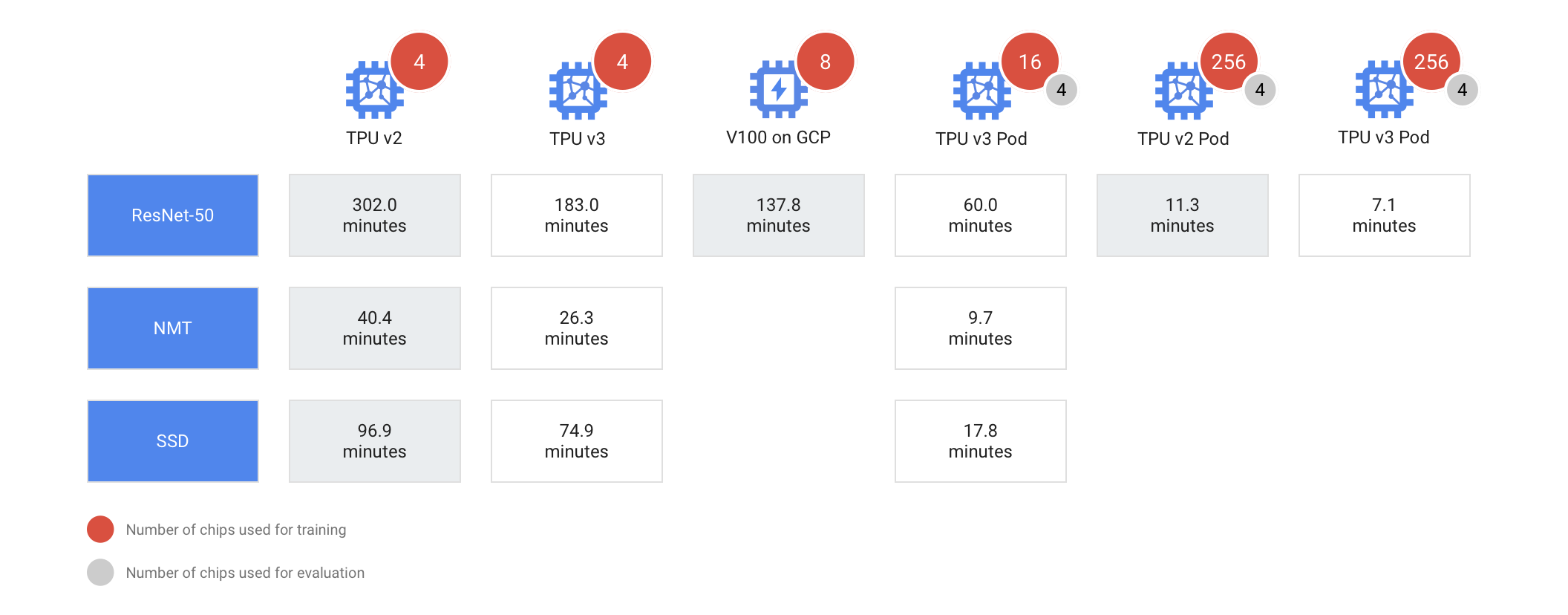
Google today announced that its second- and third-generation Cloud TPU Pods — its scalable cloud-based supercomputers with up to 1,000 of its custom Tensor Processing Units — are now publicly available in beta.

The latest-generation v3 models are especially powerful and are liquid-cooled. Each pod can deliver up to 100 petaFLOPS. As Google notes, that raw computing power puts it within the top 5 supercomputers worldwide, but you need to take that number with a grain of salt given that the TPU pods operate at a far lower numerical precision.

You don’t need to use a full TPU Pod, though. Google also lets developers rent ‘slices’ of these machines. Either way, though, we’re talking about a very powerful machine that can train a standard ResNet-50 image classification model using the ImageNet dataset in two minutes.

The TPU v2 Pods feature up to 512 cores and are a bit slower than the v3 ones, of course. When using 265 TPUs, for example, a v2 Pod will train the ResNet-50 model in 11.3 minutes while a v3 Pod will only take 7.1 minutes. Using a single TPU, that’ll take 302 minutes.

Unsurprisingly, Google argues that Pods are best used when you need to quickly train a model (and theprice isn’t that much of an issue), need higher accuracy using larger datasets with millions of labeled examples, or when you want rapidly prototype new models.

07 May 2019

Google latest Android Studio release focuses on speed and stability

At last year’s I/O developer conference, Google announced Project Marble, an effort to bring more speed and stability to the company’s Android Studio IDE. That was in marked contrast to previous updates, where the focus was very much on adding new features. Over time, though, as Google extended Android Studio, it started to slow down. Android Studio 3.5, which the company is launching today, is the result of these efforts.

“We are certainly not done improving quality with Android Studio, but with the work and new infrastructure put into Project Marble we hope that you are even more productive in developing Android apps,” the company notes in today’s announcement.

The most important updates probably focus on speed. One of the things that slowed Android Studio down were memory leaks, for example. Over the last year, the team fixed 33 major memory leaks and a new feature allows the IDE to collect more information about how it uses memory and suggest memory settings for you. It’s now also easier for developers to share their memory problems with Google.

The team also addressed user interface freezes and improved both build and overall IDE speed. The Android Emulator now also uses fewer CPU resources, often by up to 3x.

One interesting update will bring a welcome change to Android Studio users on Windows. Developers on Microsoft’s platform often complained about how their build times were getting slower. The reason for this, it turned out, was that many anti-virus programs would scan Android Studio’s build targets — and these have a lot of small files. Scanning those takes up a lot of I/O and CPU bandwidth. With this update, the IDE now check the directories that could be impacted by this and recommends how to fix this issue.

In addition to these updates that focus on speed and stability, the team also polished numerous existing features, ranging from improved Intellij support to Layout Editor improvement. Android Studio 3.5 is now also officially supported on Chrome OS 72 and high-end x86-based Chromebooks.

07 May 2019

Google strengthens Chrome’s privacy controls

Google today announced a major new initiative around its Chrome browser that will, in the long run, introduce significant changes to how Chrome handles cookies and enhance its users’ privacy across the web.

With this move, Google is making cookies more private and also adding new anti-fingerprinting technology to its browser. While some of the changes here are happening in the Chrome browser, developers, too, will have to prepare for this change and adapt their cookies to this new reality.

“We’ve been thinking a lot about this topic for a while and think it’s really important that users have transparent choice and control over how they are tracked over the web,” Google’s web platform lead Ben Galbraith said in an interview ahead of the announcement.

There will be a number of UI changes in Chrome to enable this, but the company isn’t disclosing any information about this yet. Instead, it is talking about the necessary changes in the web platform to enable this.

The overall idea here is to provide users with more control over how their data is shared. While cookies are very useful to allow you to keep a persistent login to a site or store your preferences, for example, they are also being used to track you across the web. Few users, however, would want to block all of their cookies and lose these conveniences. The compromise here is to only allow the site that originally set the cookie to access it and block third-party cookies, making it harder for others to track you using these cookies.

To do this, Chrome will move to require developers to explicitly allow their cookies to be used across websites. Using the SameSite cookie attribute, developers have to explicitly opt in to make their cookies available to others. SameSite simply stops the browser from sending it when it receives a cross-site request. There are some security enhancements that come with this, but the main goal here is to prevent tracking.

Right now, all cookies pretty much look the same to the browser, so it’s hard to selectively delete third-party cookies. Since this change also makes it easier to identify tracking cookies in the browser, though, users can then also more easily delete them.

“This change will enable users to clear all such cookies while leaving single domain cookies unaffected, preserving user logins and settings,” Google explains in today’s announcement. “It will also enable browsers to provide clear information about which sites are setting these cookies, so users can make informed choices about how their data is used.”

SameSite isn’t new, but it’s not all that widely used, especially given that browser don’t have to respect it. In the coming months, however, it will become the default in Chrome.

That’s an important fact to stress: this isn’t just about adding a new feature to Chrome that makes it easier to block or delete tracking cookies — it’s about changing how developers use them at a very fundamental level.

Galbraith also tells me that Google will start experimenting with only allowing cross-site cookies if they are served over an encrypted SSL connection. This is currently hidden behind a flag in the Canary version of Chrome, but it’ll likely become more widely available soon, too.

None of these are immediate changes, though. “I compare this to the deliberate way we moved https to the default in Chrome,” Galbraith said. For this, Google signaled its intent for a few years before finally changing the default.

With its anti-fingerprinting technology, Google is doing something similar to what is happening with cookies. “Because fingerprinting is neither transparent nor under the user’s control, it results in tracking that doesn’t respect user choice,” Google explains. “This is why Chrome plans to more aggressively restrict fingerprinting across the web. One way in which we’ll be doing this is reducing the ways in which browsers can be passively fingerprinted, so that we can detect and intervene against active fingerprinting efforts as they happen.”

For a company that makes most of its revenue from advertising, that’s a pretty bold move. It’s also a bit late, given that users have been asking for these privacy controls for a while. Galbraith acknowledged that “this is increasingly an area of concern for users.”

In a related announcement, the Google Ads team today said that it is “committing to a new level of ads transparency.” The first step in actually providing users with better insights into how ads are personalized for them, Google will launch a browser extension that will disclose the names of the companies that were involved into getting these ads in front of you (including ad tech companies, advertisers, ad trackers and publishers) and the factors that were used to tailor the ad to the user.

This extension is going live today and will work for all of Google’s own properties and those of its publishing partners. The company is also making an API available to other advertising companies that want to feed the same information into the browser extension.

Even though in the age of mobile apps, tracking users through browser cookies isn’t quite as important as it used to be, it’s still an important mechanism for many online advertising firms, including Google. Google’s move has wide-ranging implications for online advertising and it’ll be interesting to see how Google’s competitors in this space will react to the announcement.

07 May 2019

Here’s everything Google announced today at the I/O 2019 Keynote


In a two hour keynote at the annual Google I/O Conference this afternoon, the company announced a ton of stuff it’s been working on over the last year, from new phones to a next-gen version of its voice-powered Assistant.

Don’t have time to watch it all? That’s okay — we’ll summed up the biggest stuff for you.

Google Pixel 3a and 3a XL

As rumored, Google is launching more affordable versions of its Pixel 3 phones.

To bring the price down, they’ve bumped the processor down a bit (from a Snapdragon 845 to a Snapdragon 670), capped storage at 64GB, and dropped wireless charging capabilities. On the upside, they found room for a 3.5mm headphone jack!

The Pixel 3a will start at $399, and come with a 5.6″ display, 12.2mp rear camera, and run Android P out of the box. The Pixel 3a XL will start at $479, and bumps the screen up to 6.0″.

TechCrunch’s Brian Heater checked out the devices earlier this week. You can find his impressions here.

Nest Hub and Nest Hub Max

The Google Home Hub is being rebranded as the “Nest Hub,” with the price dropping from $149 to $129.

Meanwhile, it’s getting a bigger brother: take the Nest Hub, bump the display up from 7″ to 10″, and add a camera — that’s the Nest Hub Max. The Nest Hub Max will tie into the Nest app, allowing it to function like any other Nest cam. Google says a hardware switch on the back disables the camera/microphone (alas, it doesn’t seem like you can disable one without disabling the other.) It’ll cost $229 and ship this summer.

A new “Face Match” feature on the Nest Hub Max will recognize your face to customize its responses. In a blog post on the feature, Google says “Face Match’s facial recognition is processed locally with on-device machine learning, so the camera data never leaves the device.”

Augmented Reality in search

Certain search results — like, say, a search for a specific shoe model, or “great white shark” — will now include 3D models. Tap the model and you’ll be able to place it in a view of the real world via augmented reality.

Google Lens Upgrades

Google Lens is learning a few new tricks. Point Google Lens at a restaurant’s menu, and it’ll highlight the most popular items. Point it at your receipt, and it’ll automatically calculate things like tips and totals.

Duplex on the Web

At I/O last year, Google launched Duplex, an AI-powered customer service tool meant to help small businesses (like restaurants and hair salons) field more phone calls, answering common questions and scheduling reservations or appointments.

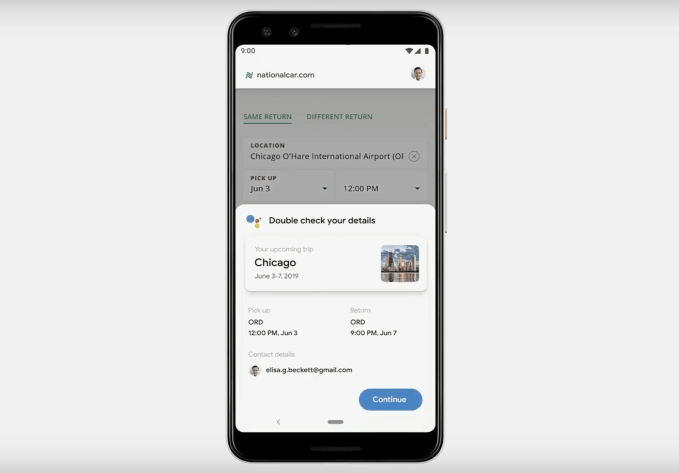
This year it’ll expand on this by opening up Duplex to the web. Online car rental reservations were given as an example; you say “get me a rental car through [rental company]”, and it pulls up that company’s website and automatically starts booking your car. It can pre-fill things like trip dates from your calendar, and car preferences based on previous rental confirmations found in your Gmail.

Google’s “Next-Gen” Assistant

Google has managed to shrink its voice recognition models down from hundreds of gigabytes to half a gigabyte, making them small enough to fit right on a phone.

By storing it locally. they’re able to eliminate the latency involved with the back-and-forth pings to the cloud, making conversations with Assistant almost instantaneous. As it’s running on the device, it’ll work even in airplane mode. The company showed off the new speed by firing off voice requests rapid fire, with very little delay between commands (like “Call me a Lyft” or “Turn on my flashlight”) and their resulting actions.

Google says its next-gen Assistant will hit new Pixel phones later this year.

Google Assistant in Waze

Google Assistant will be built into the Waze up “in just a few weeks”, allowing you to do things like report accidents or potholes by voice.

Google Assistant Driving Mode

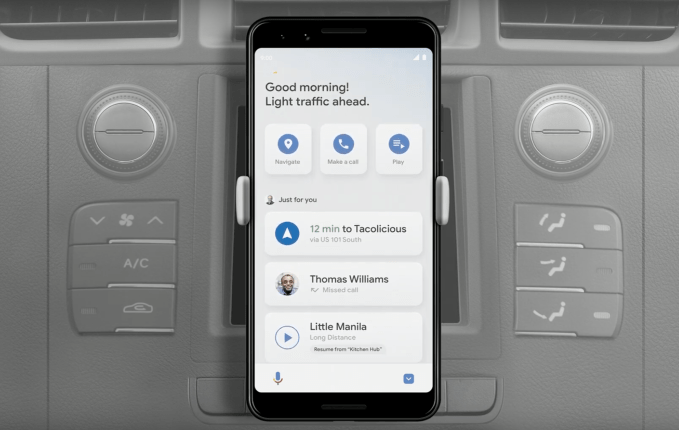
Saying “Hey Google, lets drive” will now shift Assistant into driving mode, a minimalist/at-a-glance dashboard view that focuses on what you might need while behind the wheel, like directions to your daily spots and music control.

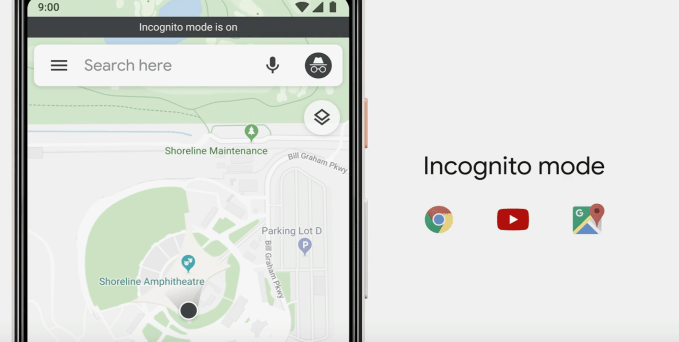
Incognito Mode in Google Maps

Like incognito mode in a browser, the new incognito mode in Google Maps will prevent your destination searches/routes from being saved to your Google account history.

Live Caption and Live Transcribe

Android will soon be able to automatically generate captions for media on your phone, including podcasts and videos.  Through a feature the company calls “Live relay”, it can also transcribe phone calls in realtime, and allows users to respond via text.

Here’s Google’s video of it in action:


Project Euphonia

Google is researching how it can adapt its AI voice algorithms to better understand users with speech impairments (such as those with ALS or who have had a stroke), custom tailoring its models to an individual user’s speech to better help them communicate.

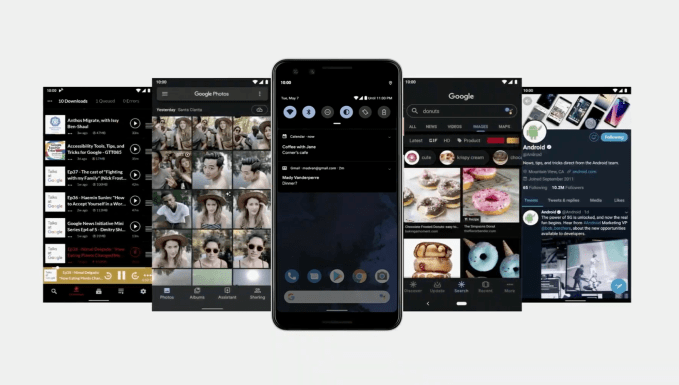
Dark Theme

Android Q will have a dark mode; you can trigger it manually, or it’ll turn on automatically in battery saver mode.

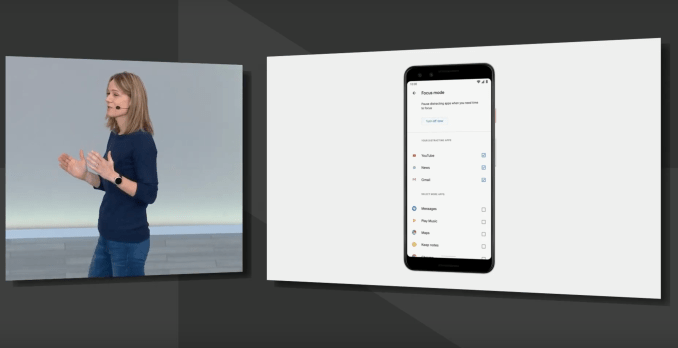
Focus Mode

Need to get some work done? With Focus Mode, you’ll make a list of the apps you find most distracting — flip a switch, and they’ll disappear until you turn Focus Mode off.  It’ll hit Android this fall.

Google Maps AR mode rolls out to Pixel phones

A few months back, Google showed off a new augmented reality mode that it’s been working on for Google Maps. The goal? Help make sure people start off their walks heading in the right direction. Hold your phone up and you’ll see a camera view of the world in front of you. Google Maps will compare this image to its Street View data to determine your exact position/orientation better than GPS alone can, then draw arrows that point you in the right direction.

This mode has been in beta for a while, and should start hitting Pixel phones later today.

07 May 2019

Here’s everything Google announced today at the I/O 2019 Keynote


In a two hour keynote at the annual Google I/O Conference this afternoon, the company announced a ton of stuff it’s been working on over the last year, from new phones to a next-gen version of its voice-powered Assistant.

Don’t have time to watch it all? That’s okay — we’ll summed up the biggest stuff for you.

Google Pixel 3a and 3a XL

As rumored, Google is launching more affordable versions of its Pixel 3 phones.

To bring the price down, they’ve bumped the processor down a bit (from a Snapdragon 845 to a Snapdragon 670), capped storage at 64GB, and dropped wireless charging capabilities. On the upside, they found room for a 3.5mm headphone jack!

The Pixel 3a will start at $399, and come with a 5.6″ display, 12.2mp rear camera, and run Android P out of the box. The Pixel 3a XL will start at $479, and bumps the screen up to 6.0″.

TechCrunch’s Brian Heater checked out the devices earlier this week. You can find his impressions here.

Nest Hub and Nest Hub Max

The Google Home Hub is being rebranded as the “Nest Hub,” with the price dropping from $149 to $129.

Meanwhile, it’s getting a bigger brother: take the Nest Hub, bump the display up from 7″ to 10″, and add a camera — that’s the Nest Hub Max. The Nest Hub Max will tie into the Nest app, allowing it to function like any other Nest cam. Google says a hardware switch on the back disables the camera/microphone (alas, it doesn’t seem like you can disable one without disabling the other.) It’ll cost $229 and ship this summer.

A new “Face Match” feature on the Nest Hub Max will recognize your face to customize its responses. In a blog post on the feature, Google says “Face Match’s facial recognition is processed locally with on-device machine learning, so the camera data never leaves the device.”

Augmented Reality in search

Certain search results — like, say, a search for a specific shoe model, or “great white shark” — will now include 3D models. Tap the model and you’ll be able to place it in a view of the real world via augmented reality.

Google Lens Upgrades

Google Lens is learning a few new tricks. Point Google Lens at a restaurant’s menu, and it’ll highlight the most popular items. Point it at your receipt, and it’ll automatically calculate things like tips and totals.

Duplex on the Web

At I/O last year, Google launched Duplex, an AI-powered customer service tool meant to help small businesses (like restaurants and hair salons) field more phone calls, answering common questions and scheduling reservations or appointments.

This year it’ll expand on this by opening up Duplex to the web. Online car rental reservations were given as an example; you say “get me a rental car through [rental company]”, and it pulls up that company’s website and automatically starts booking your car. It can pre-fill things like trip dates from your calendar, and car preferences based on previous rental confirmations found in your Gmail.

Google’s “Next-Gen” Assistant

Google has managed to shrink its voice recognition models down from hundreds of gigabytes to half a gigabyte, making them small enough to fit right on a phone.

By storing it locally. they’re able to eliminate the latency involved with the back-and-forth pings to the cloud, making conversations with Assistant almost instantaneous. As it’s running on the device, it’ll work even in airplane mode. The company showed off the new speed by firing off voice requests rapid fire, with very little delay between commands (like “Call me a Lyft” or “Turn on my flashlight”) and their resulting actions.

Google says its next-gen Assistant will hit new Pixel phones later this year.

Google Assistant in Waze

Google Assistant will be built into the Waze up “in just a few weeks”, allowing you to do things like report accidents or potholes by voice.

Google Assistant Driving Mode

Saying “Hey Google, lets drive” will now shift Assistant into driving mode, a minimalist/at-a-glance dashboard view that focuses on what you might need while behind the wheel, like directions to your daily spots and music control.

Incognito Mode in Google Maps

Like incognito mode in a browser, the new incognito mode in Google Maps will prevent your destination searches/routes from being saved to your Google account history.

Live Caption and Live Transcribe

Android will soon be able to automatically generate captions for media on your phone, including podcasts and videos.  Through a feature the company calls “Live relay”, it can also transcribe phone calls in realtime, and allows users to respond via text.

Here’s Google’s video of it in action:


Project Euphonia

Google is researching how it can adapt its AI voice algorithms to better understand users with speech impairments (such as those with ALS or who have had a stroke), custom tailoring its models to an individual user’s speech to better help them communicate.

Dark Theme

Android Q will have a dark mode; you can trigger it manually, or it’ll turn on automatically in battery saver mode.

Focus Mode

Need to get some work done? With Focus Mode, you’ll make a list of the apps you find most distracting — flip a switch, and they’ll disappear until you turn Focus Mode off.  It’ll hit Android this fall.

Google Maps AR mode rolls out to Pixel phones

A few months back, Google showed off a new augmented reality mode that it’s been working on for Google Maps. The goal? Help make sure people start off their walks heading in the right direction. Hold your phone up and you’ll see a camera view of the world in front of you. Google Maps will compare this image to its Street View data to determine your exact position/orientation better than GPS alone can, then draw arrows that point you in the right direction.

This mode has been in beta for a while, and should start hitting Pixel phones later today.

07 May 2019

Keyword research in 2019: Modern tactics for growing targeted search traffic

In 2019, it’s estimated that every minute there are 150 new websites coming online. While many of these won’t be long-term ventures, a large percentage will eventually find themselves looking to organic search engine traffic to grow their reach.

This invariably leads people to the task of keyword research; uncovering the search terms most likely to result in prospective customers.

With increased competition it’s imperative you don’t just focus on the traditional sources of keyword inspiration that every other business uses.

In the past year alone I’ve personally helped hundreds of business owners grow search engine traffic to their websites. This responsibility drives me to succeed in one key area: Finding relevant search terms to target that their competitors have likely missed.

In this article, I will highlight some of the most overlooked ideas and sources of data to reveal words and phrases relevant to your business that are high in intent but lacking in competition.

If you can find the keywords your audience are searching for, but your competitors haven’t found, you can leverage a huge advantage to increase traffic and engagement on your content.

Table of Contents

  1. Be Open to Talking About Your ‘Best’ Competition
  2. Use [Brand Alternatives] Search Terms to Gain Visibility
  3. Find Content Opportunities in the ‘People Also Ask’ Box
  4. Use Public Wikipedia Stats to See If a Term Is Worth Targeting
  5. Quora’s Ad Platform Reveals Popular Search Terms Without Spending a Penny
  6. Wikihow’s Public View Counts Are Great for Tutorial-Based Content Inspiration
  7. Bonus Tip: ProductHunt Dominate ‘Alternatives’ Keywords: Make Sure You Have a Listing There
  8. To Recap

1. Be Open to Talking About Your ‘Best’ Competition

Google is constantly improving their ability to understand searcher intent. That is, they know what people are looking for and the results that will satisfy those searches.

When it comes to any industry that offers products or services, one of the most common search queries is often some variation of “best [industry] [services / products]”.