Category: UNCATEGORIZED

02 May 2019

Microsoft brings Azure SQL Database to the edge (and Arm)

Microsoft today announced an interesting update to its database lineup with the preview of Azure SQL Database Edge, a new tool that brings the same database engine that powers Azure SQL Database in the cloud to edge computing devices, including, for the first time, Arm-based machines.

Azure SQL Edge, Azure corporate vice president Julia White writes in today’s announcement, “brings to the edge the same performant, secure and easy to manage SQL engine that our customers love in Azure SQL Database and SQL Server.”

The new service, which will also run on x64-based devices and edge gateways, promises to bring low-latency analytics to edge devices as it allows users to work with streaming data and time-series data, combined with the built-in machine learning capabilities of Azure SQL Database. Like its larger brethren, Azure SQL Database Edge will also support graph data and comes with the same security and encryption features that can, for example, protect the data at rest and in motion, something that’s especially important for an edge device.

As White rightly notes, this also ensures that developers only have to write an application once and then deploy it to platforms that feature Azure SQL Database, good old SQL Server on premises and this new edge version.

SQL Database Edge can run in both connected and fully disconnected fashion, something that’s also important for many use cases where connectivity isn’t always a given, yet where users need the kind of data analytics capabilities to keep their businesses (or drilling platforms, or cruise ships) running.

02 May 2019

Spotify spotted testing ‘Your Daily Drive,’ a personalized playlist that includes podcasts

Spotify was recently spotted testing a new personalized playlist — the first one to mix music and podcasts, customized to user’s musical tastes. According to a report by The Verge, which saw the new playlist titled “Your Daily Drive” first-hand, the playlist features short episodes from podcasts following by a curated selection of music that fits your interests.

In the case of the test The Verge saw, however, the podcasts episodes were in Portuguese — an indication that this was not meant for public consumption at this time.

However, the site wasn’t the only one to come across the test.

Several other users have also had the personalized playlist presented to them in recent days, including those based in the U.S. and abroad.

So far, the responses have been overwhelmingly positive. (See below).

Spotify declined to offer any explanation or details about the playlist.

“We’re always testing new products and experiences, but have no further news to share at this time,” a spokesperson said.

The idea behind a playlist like this is interesting, as it would demonstrate Spotify’s ability to successfully bring its personalization technology to podcasts. This is something Pandora is doing as well, by expanding its “Genome” categorization technology to podcast recommendations. Today, its recommendation system leverages the Podcast Genome Project to learn more about what sorts of audio programs users like, which it then turns into suggestions of what to listen to.

Spotify, meanwhile, is best known for its hugely popular personalized playlist “Discover Weekly” which has become one of its service’s biggest draws. If Spotify were to expand that personalization technology to spoken word and then combine it with personalized music, it could potentially have the next big hit — in terms of personalized playlists — on its hands.

The “Daily Drive” playlist could also give Spotify a better way to compete with Alexa’s Daily Briefing, which has become a popular way that Echo owners start their day. Though mainly listened to in the home for the time being, Amazon has been working to expand Alexa to vehicles, through not only third-party devices, but also its own Echo Auto.

With Echo in the vehicle, Alexa users might begin to access their Daily Briefing during their commute instead of launching Spotify, as before. And once Alexa has captured the user engagement, it could be easier to then hand those users off to Amazon’s own music service, which is tightly integrated with Echo devices.

Amazon even recently launched its own free, ad-supported music service, designed only to be played only on Echo and other Alexa-enabled devices.

Spotify has been talking up its plans to turn on personalization for podcasts for some time, as it delves further into the market through acquisitions — like Gimlet, Parcast and Anchor — and investments in original content.

In the company’s earnings call with investors this week, Spotify CEO Daniel Ek noted how important its personalization technology is to its new efforts around podcasts.

“Personalization is one of our core pillars of our strategy. And there, we are obviously really, really far along in music,” he explained. “Podcasts [are] a much newer space for us. The way we merchandise podcasts, the way we recommend podcasts is completely different,” Ek continued. “Of course, we want to expand on [the product] and become an even better experience. And there, personalization is absolutely key…we’re still in the early innings,” he added.

02 May 2019

Verizon reportedly seeking to sell Tumblr

Last year’s decision to ban porn from its platform has had a marked averse effect on Tumblr’s traffic. No surprise, really, especially given how wide the net was cast for “adult content” when it announced back in December. Now the blogging platform’s media parent is looking to sell, according to a new story from The Wall Street Journal.

The paper cites “people familiar with matter.” We reached out to Verizon Media Group (who, for the record, also own TechCrunch) and unsurprisingly got your bog standard statement about not commenting on rumors.

A sale wouldn’t be much of a surprise, given Tumblr’s history at the company. Yahoo bought the platform for north $1 billion in 2013, with Verizon inheriting it as part of its 2017 acquisition of Yahoo. Tumblr was rolled up into the short-lived Oath business, which has since been rebranded as the much more straightforward Verizon Media Group.

As the piece notes, Tumblr ultimately failed to be the money maker Yahoo and Verizon were hoping for, exacerbated by the fact that other social media properties have since taken some of the wind out of the company’s sails. A few years after the acquisition, Yahoo had written the site’s value down significantly. Verizon’s Q1 financials, meanwhile, had Media revenues 7.2 percent year over year.

The recent adult content ban has managed to both derail traffic and upset much of the site’s core user base. But Tumblr has stood firm, citing concerns over graphic child exploitation, all while arguably casting its net far too wide to include anything falling underneath the adult content banner.

It’s tough to say what media company might be in the market for a Tumblr at this point. The once white hot platform doesn’t hold the same sort cache it did when it was purchased half a decade ago. Notably, Tumblr also lost its CTO to SeatGeek earlier this week.

02 May 2019

Brand new fiber link from Alaska to US will carry 100 terabits over the Yukon

Alaska is disconnected from the rest of the U.S. in a lot of ways — that’s kind of the point of Alaska. But giving residents the choice to participate in the modern online world is important for the state’s prosperity, and to that end one of the state’s largest broadband providers is collaborating with Canada to lay hundreds of miles of high-speed fiber connecting Alaska to the rest of the country.

The Alaska Canada Overland Network from co-op telecom MTA will directly connect the northern state to the lower 48, as the name suggests, over land for the first time, improving connections statewide with a 100-terabit connection that could grow as better tech empowers the fiber.

To be clear, Alaska is hardly an island right now — but connectivity is slower and more complicated than it needs to be for the kind of high-bandwidth tasks many take for granted. Most traffic from Alaska has to travel out through one of four aging submarine cables, traveling down to Seattle, where the nearest peering facility is, before heading out to the broader internet. Not a problem if you’re just downloading an album, but the increased latency and reduced bandwidth may make things like HD video a chore, as well as adding friction to industries like web development.

“Businesses forget about Alaska. They forget it’s part of the states,” said MTA’s CEO, Michael Burke, in an interview with TechCrunch. Although a major project recently concluded connecting outer communities to the state’s backbone, it didn’t add to the pool of bandwidth available — it might have just have put more people on the same lines. “Terabit capacity requires a lot of backhaul. And some of these cables are 20 years old — I don’t know how much more can be squeezed out of them.”

The solution is of course to build better infrastructure, but how do you do that when there are 2,000 miles of another country between origin and destination?

In fact Canada is facing similar problems, as I wrote about years ago, in that it struggles to connect its populous south with the wild, sparsely inhabited north. And it turns out that over the years investments in connectivity have added up.

20 years back or so, when work was being done laying broadband infrastructure, very little fiber had been built north away from Canada’s southern border. If you’d wanted to lay a cable from Alaska to Seattle it would have been 2,000 miles long.

“What’s happened quietly since then is there’s been a lot of fiber builds in Canada,” Burke said. “Canadians are just like the U.S., they want to build out fiber into the rural areas. And they’ve constructed fiber all the way to Haines Junction, which is only 200 miles away from the U.S.-Canada border.”

That means that instead of building a 2,000-mile deployment from scratch, they can run a couple hundred miles and connect with existing infrastructure.

It’s a win-win operation: The fiber will be used to send traffic from Alaska’s interchange at the border down to Seattle, just like the submarine cables except way faster. MTA is providing money to the Canadian providers to build out the fiber that extra distance, which they might not have invested in otherwise (there’s no government money involved, it’s a private endeavor). But having done so, the new infrastructure will add redundancy to the region’s systems and provide a base on which to build more if necessary. Traffic between Alaska and Canada will also be massively accelerated, since it can just jump in at the border rather than go through Seattle.

But isn’t even a few hundred miles of fiber a chore to lay down? Well, yes — but coastal British Columbia isn’t upper Nunavut.

“This project is more like what you’d see in any other state,” said Burke. “We’re running it along the Alaska-Canadian Highway, it’s well maintained. It’s not as technically challenging and difficult as places you have to cross terrain where there’s no roads.”

“The surveying and preliminary work has been done,” he continued. “The materials have been purchased. They’re going to start trenching and laying fiber next week — It’ll be done and lit up in 2020.”

It’s not always worth calling attention to when companies lay down fiber, as crucial as it is to our modern economy. But this is a particularly interesting case and one that stands to make a big difference for a lot of people in a place, as Burke noted, often forgotten by the vanguard of the information age.


02 May 2019

Solving tech’s stubborn diversity gaps

Twenty years after Jesse Jackson first took aim at tech employers, Silicon Valley’s enduring diversity gaps remain a painful reminder of its origins as a mostly white boy’s club.

Sadly, little has changed in the decades since the campaign first made headlines. Today, just 7.4 percent of tech industry employees are African-American, and 8 percent are Latinx. Workers at Google, Microsoft, Facebook and Twitter — according to those companies’ own reports — were just 3 percent Hispanic and 1 percent black in 2016.

In some ways, tech’s equity gaps reflect a simple supply and demand imbalance. But it is an imbalance with artificial constraints. Because while Black and Hispanic students now earn computer science degrees at twice the rate that they are hired by leading tech companies, they are all but invisible to most recruiters.  

The problem stems from the fact that tech employers tend to recruit from a tiny subset of elite U.S. colleges.  Which means they may never come into contact with, for example, the 20 percent of black computer science graduates who come from historically black colleges and universities. Thousands of talented candidates are overlooked each year because they graduate from less-selective public universities, minority-serving institutions or women’s colleges — schools that exist far outside the elite network where tech employers recruit.

As a result, the recruiting practices of Silicon Valley actually compound the structural race and economic inequities that are endemic at every step of the education-to-career ladder. The number of segregated schools in the United States has doubled over the past 20 years. Poor and minority students often lack SAT and ACT test preparation, college advising services and after-school or extracurricular options. Just 3 percent of the students at the most competitive colleges are from the lowest economic quartile. And even those who make their way through the admissions industrial complex face college-to-career barriers like unpaid internships, which are more than many less-affluent students can endure.

Failure to broaden their aperture for talent means that even the best-intentioned diversity initiatives leave companies competing for the tiny pool of engineers of color who graduate from the top programs.

Inequities have plagued the tech world since Ada Lovelace coded the first computer program in 1842.

To move the needle on diversity, employers must move beyond filtering outputs of top computer science programs and focus on changing the inputs. They must invest in building industry-aligned programs at colleges and universities that are attended by more diverse students, but may lack the know-how to build — and keep current — curricula that prepare students to thrive in an increasingly dynamic tech industry. They can partner with institutions falling into the well-worn traps of academia, teaching theory without application, or relying on dated practices that leave graduates unprepared for the labor market.

A growing number of employers have begun to take such an approach, partnering with institutions that harbor underrepresented talent to transform their computer science programs.

Facebook has partnered with institutions, including the City College of New York, to create industry-relevant courses, and committed to funding the training of 3,000 Michigan workers for jobs in digital marketing. Last year, Facebook invested $1 million in an effort to teach computer science to more women and underrepresented minorities.

In 2015, Intel announced a $300 million effort to diversify its workforce by 2020.Since then, the company has launched a $4.5 million program to help STEM students at historically black colleges stay on track. In 2017, Howard University opened a campus at Google’s headquarters, offering students a three-month program in which they can receive instruction from both Howard faculty and engineers at Google. A year later, Howard leaders said the partnership helped lead to a 40 percent increase in computer science enrollment at the university.

Inequities have plagued the tech world since Ada Lovelace coded the first computer program in 1842 — only to lose her place in the textbooks to the men who capitalized on her insights while denying her contributions. Today, fluency in high-tech skills and knowledge is no longer controlled by an elite few. Opportunity, however, can remain stubbornly fixed.

Top tech companies have already taken the first step by activating the search for underrepresented talent. The next step is to broaden their search beyond elite campuses and invest in the education of underrepresented students.

It will take wholesale collaboration between employers and colleges to provide meaningful, relevant computer science education to any student on any campus. But such partnerships hold the promise of addressing the diversity gaps that blight our industry at its roots.

02 May 2019

Hundreds of Orpak gas station systems can be easily hacked, thanks to hardcoded passwords

Homeland Security’s cybersecurity agency says a popular gas station software contains several security vulnerabilities that require “low skill” to exploit.

The advisory, posted by the Cybersecurity and Infrastructure Security Agency (CISA), gave the Orpak SiteOmat software a rare vulnerability severity rating of 9.8 out of 10.

Orpak’s SiteOmat systems monitor the amount of fuel stored in a gas station’s tanks, as well as their temperature and pressure. The software also sets the price of the gas and processes card payments. Its user interface is password protected, preventing unauthorized access to its data or configuration.

According to the advisory, the software contained a hardcoded password set by the manufacturer, which if used would grant unfettered access to the system.

CISA didn’t publish the password.

The advisory said an attacker could gain access to the system’s configuration, including payment information, or shut down the system altogether, preventing customers from buying gas. Worse, the bugs are remotely exploitable, putting any internet-connected SiteOmat device at risk.

A cursory search of Shodan, a search engine for publicly available devices and databases, revealed more than 570 Orpak systems are connected to the internet out of more than 35,000 service stations across 60 countries.

Most of the exposed systems are located in the U.S.

The software also has several other flaws that can be remotely exploited, including code injection and buffer overflow vulnerabilities.

Ido Naor, a security researcher with Kaspersky Lab, was credited with finding the bugs — the second time in as many years. Last year, Naor and his colleague Amihai Neiderman found near-identical flaws in the SiteOmat, including another hardcoded password. The buffer overflow flaw would not only let an attacker gain access to the system but also erase its logs, wiping any evidence of their activity.

CISA said the bugs had been fixed in a new software version — v6.4.414.139 — but customers have to request the update from Orpak directly.

A spokesperson for Orpak parent company Gilbarco Veeder-Root did not immediately return a request for comment.

02 May 2019

Facebook bans a fresh batch of mostly far-right figures

Facebook just announced its latest mini-purge of controversial accounts that violate its rules against “dangerous individuals and organizations.” In this round Facebook newly cracked down on Milo Yiannopoulos, Paul Joseph Watson, Laura Loomer, Paul Nehlen, Louis Farrakhan. The company also doubled down on its position toward Alex Jones and his conspiracy hub Infowars.

While most figures in that cluster of names are far right media figures, Farrakhan is best known for leading the Nation of Islam and has faced ongoing criticism for anti-semitism. Nehlen ran against Paul Ryan in 2018, openly espousing white supremacist views.

“We’ve always banned individuals or organizations that promote or engage in violence and hate, regardless of ideology,” a Facebook spokesperson told TechCrunch via email. “The process for evaluating potential violators is extensive and it is what led us to our decision to remove these accounts today.”

Facebook previously announced a ban for Jones in 2018 and again did a sweep for accounts linked to Jones in February. In spite of the Facebook ban, Jones was allowed to maintain his presence on Instagram due to the fact that less than 30% of his content violated the platform’s rules.

02 May 2019

Awair raises $10M to help customers like WeWork monitor their office environments

Monitoring a space is about a lot more than security cameras, Awair is trying to help businesses and consumers more deeply understand the environments they live and work in.

Awair has raised a $10 million Series B led by The Westly Group with participation from iRobot, Altos Ventures, Emerson Electric and Nuovo Capital as well. The company has raised over $21 million to date.

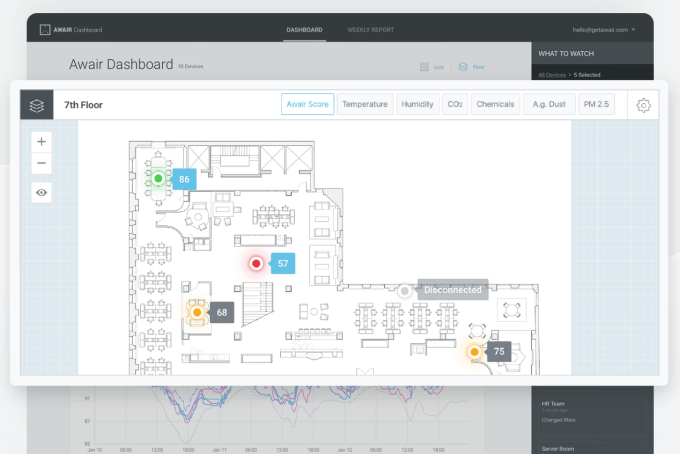
The company has previously just been plugging along with air-quality monitors that looked like they belong in the MoMa. Awair’s $199 monitor senses things like particulate matter, temperature, humidity, and CO² levels. They’ve built out their product line with a couple other devices but they’re largely targeting air-conscious consumers that might have allergies of another ailments and “design moms” who are looking to get some well-designed tech into their home.

The information all plugs into an app that helps consumers understand what’s happening in their home and get tips for how they can improve air quality.

As the company looks to make venture-worthy returns, it’s been scaling beyond the consumer IoT space into the world of enterprise IoT with its Omni product that Await has been selling to large real estate firms, offices and hospitals aiming to give companies more insight into what life is like in every corner of their physical spaces.

The devices measure the same things their consumer products do but also can track ambient light and noise in space, and pipe all of that data into a dashboard that can help businesses automate how they push their existing building infrastructure like their HVAC systems to respond to changes in the environment.

While Awair has been selling consumer IoT devices since 2015, its business product is about 18 months old, and a big part of this fundraise is to bring a sales staff onboard to keep the pace of enterprise expansion, which has been faster growing than the consumer business.

The company says they have more than 300 enterprise customers on the platform, including WeWork, AirBnB, Harvard, and The Crown Estate.

02 May 2019

Takeaways from F8 and Facebook’s next phase

Extra Crunch offers members the opportunity to tune into conference calls led and moderated by the TechCrunch writers you read every day. This week, TechCrunch’s Josh Constine and Frederic Lardinois discuss major announcements that came out of Facebook’s F8 conference and dig into how Facebook is trying to redefine itself for the future.

Though touted as a developer-focused conference, Facebook spent much of F8 discussing privacy upgrades, how the company is improving its social impact, and a series of new initiatives on the consumer and enterprise side. Josh and Frederic discuss which announcements seem to make the most strategic sense, and which may create attractive (or unattractive) opportunities for new startups and investment.

“This F8 was aspirational for Facebook. Instead of being about what Facebook is, and accelerating the growth of it, this F8 was about Facebook, and what Facebook wants to be in the future.

That’s not the newsfeed, that’s not pages, that’s not profiles. That’s marketplace, that’s Watch, that’s Groups. With that change, Facebook is finally going to start to decouple itself from the products that have dragged down its brand over the last few years through a series of nonstop scandals.”

(Photo by Justin Sullivan/Getty Images)

Josh and Frederic dive deeper into Facebook’s plans around its redesign, Messenger, Dating, Marketplace, WhatsApp, VR, smart home hardware and more. The two also dig into the biggest news, or lack thereof, on the developer side, including Facebook’s Ax and BoTorch initiatives.

For access to the full transcription and the call audio, and for the opportunity to participate in future conference calls, become a member of Extra Crunch. Learn more and try it for free. 

02 May 2019

Unshackled Ventures has $20M to invest exclusively in immigrant founders

Unshackled Ventures isn’t like other venture capital funds.

The firm invests in immigrant founders and helps them secure visas so they can ditch their corporate job and launch the startup of their dreams. Today, Unshackled is announcing its sophomore fund of $20 million, topping its debut effort by $15.5 million.

“The point is to take the burden off of founders because they are not immigration experts, they are experts at building satellites or extracting protein from plants,” Unshackled founding partner Nitin Pachisia told TechCrunch. “These are people that if you go to a workspace, you’ll see them show up on nights and weekends because they want to build something but they can’t.”

Immigrants looking to start their own businesses face a huge barrier. Take Jyoti Bansal for example. He famously waited seven years before launching AppDynamics, a business that later sold to Cisco for $3.7 billion days before its initial public offering. Why? Because as an Indian immigrant with H-1B visa status, he could work for startups but wasn’t legally allowed to start his own. It wasn’t until receiving an employment authorization document (EAD), a part of the green card process, that Bansal could finally found AppDynamics. If Bansal had the opportunity to pitch to Unshackled, which provides bespoke immigration solutions to each founder, he could have launched AppDynamics years prior.

Immigrant founders, according to a 2018 study by the National Foundation for American Policy, are responsible for 55 percent of U.S. billion-dollar companies, or “unicorns,” as they are known. Uber, SpaceX, WeWork, Palantir Technologies, Stripe, Slack, Moderna Therapeutics, Robinhood, Instacart, Houzz, Credit Karma, Tanium, Zoox and CrowdStrike all count at least one immigrant co-founder.

“The difference between success and failures is oftentimes who you know and when,” Unshackled founding partner Manan Mehta told TechCrunch. “We can bring those resources at just 1/200th the size of Andreessen Horowitz to immigrants at day zero.”

“We’re creating the best place for immigrants to start their companies,” he added. “And guess what? We’re keeping American innovation in America.”

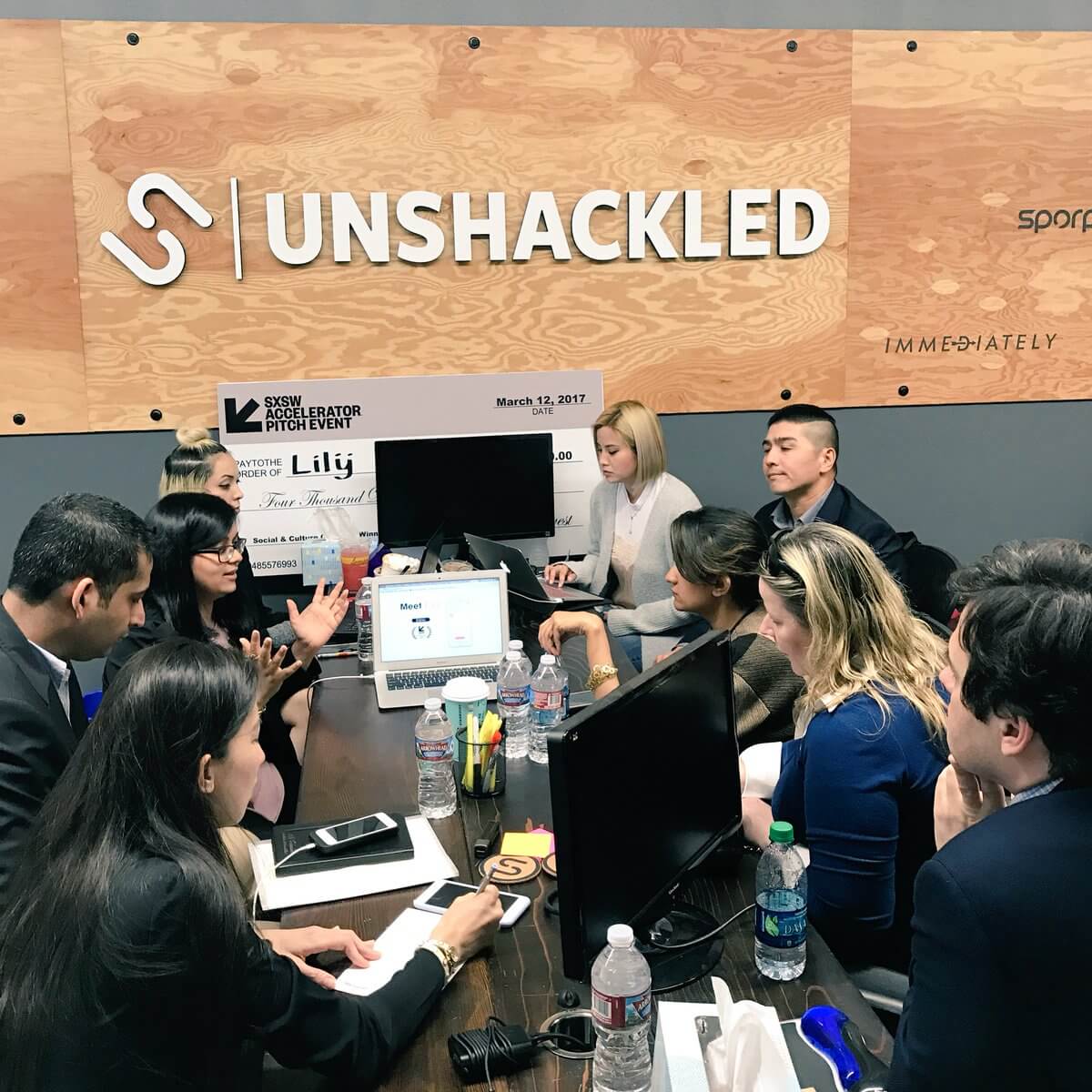
Unshackled Ventures portfolio company Lily AI.

The firm was founded by Pachisia, the son of immigrants, and Mehta, an Indian immigrant, in 2015. Since then, the duo have written pre-seed checks to 31 companies with a 100 percent success rate in procuring visas to keep talent working in the U.S. Startups in its portfolio include the very recent Y Combinator graduate Career Karma, Starsky Robotics, Plutoshift, Togg, Hype, Lily AI and more.

“I didn’t think it was possible to start a company on a visa in the U.S., let alone scale one to hit the next major milestone so quickly,” Plutoshift founder Prateek Joshi said in a statement. “That all changed when we met the Unshackled team.”

Mehta and Pachisia say its startups have gone on to raise $54 million in follow-on investments from top investors like First Round Capital, NEA and Shasta.

In addition to supporting companies based in Silicon Valley, the investors search far and wide for aspiring immigrant founders, as well as respond to every single cold email they receive. Recently, they joined the Rise of the Rest tour, a trip hosted by Steve Case and JD Vance that showcases startups in underrepresented geographies, and they make frequent visits to college campuses across the U.S.

Unshackled’s limited partners include Bloomberg Beta, Jerry Yang’s AME Cloud Ventures and Emerson Collective.

“I think the name represents the feeling that you’re a little bit shackled to a framework or a policy that doesn’t necessarily encourage entrepreneurship,” Mehta said. “When if you take a step back, immigrants are probably more entrepreneurial than native-born people.”